
AUTO-210 · Lesson 1 of 12 · 24 min
What suspension and steering do
It is the second week of March, and Calgary is in the middle of the season every front-end technician knows. A warm chinook melts the snow by day, the water runs into cracks in the pavement, and it freezes again at night. Each freeze pries the asphalt apart a little more, and by the time the plows have scraped over the softened patches, the city's streets are covered in potholes. Ridgeline Auto Service's phone starts ringing with the same complaints: a clunk over bumps, a pull to one side, a steering wheel that is no longer straight, a vibration at highway speed.
Kiran Dhaliwal is nearly a year into her apprenticeship. She has done oil services, tires, inspections, engine work and a winter of brakes. On Monday morning Simone Tremblay puts a familiar repair order on the board: Gord Haney's pickup, with a note that says “clunk and squeak over bumps, front, getting worse.” Kiran remembers the truck. Twice last year Ridgeline recommended new front sway bar bushings, and twice Gord said they could wait. “Well,” says Marty Kowalchuk, reading over her shoulder, “this is the term you learn suspension and steering. Let's start with what all those parts are actually for.”
This lesson explains what a suspension and a steering system have to do, how they carry the vehicle's weight and the forces of driving, what is meant by sprung and unsprung mass, how the tires' contact patches tie everything to the road, and how the parts are grouped into the systems the rest of this course covers. It ends with the safety rules for suspension work and with the first inspection of Gord's truck.
Five jobs at once
A suspension connects the wheels to the body or frame. It has five jobs, and every design is a compromise among them. First, it carries the weight of the vehicle and its load and holds the body at the right height. Second, it keeps the tires in contact with the road, pressing them down with as even a force as possible, because a tire that lifts or bounces cannot brake, steer or accelerate. Third, it isolates the passengers and cargo from the bumps, so that a wheel can move up and down over a pothole without the whole vehicle following it. Fourth, it controls how the body moves: how far it leans in a turn, how much it dives under braking and squats under acceleration, and how quickly bouncing dies away. Fifth, it holds each wheel at the angles the engineers chose, so that the tires roll straight, wear evenly and let the vehicle go where the driver steers.
The steering system lets the driver turn the front wheels, and on some vehicles the rear wheels as well, through a controlled angle, with a sensible effort, while giving the driver a feel for what the tires are doing. It must return to straight ahead on its own when the driver relaxes, and it must not jerk the wheel when one tire hits a bump. Steering and suspension are tightly linked: the steering parts are attached to the same knuckles the suspension moves, so wear or damage in one shows up as a symptom in the other.
Wheel alignment is the setting of the angles at which the wheels sit: whether they lean in or out, whether they point in or out, and how the steering axis is tilted. Alignment is not a separate system; it is the result of how the suspension and steering parts are made, fitted and adjusted. Lessons 10 and 11 cover it in detail.
Sprung and unsprung mass
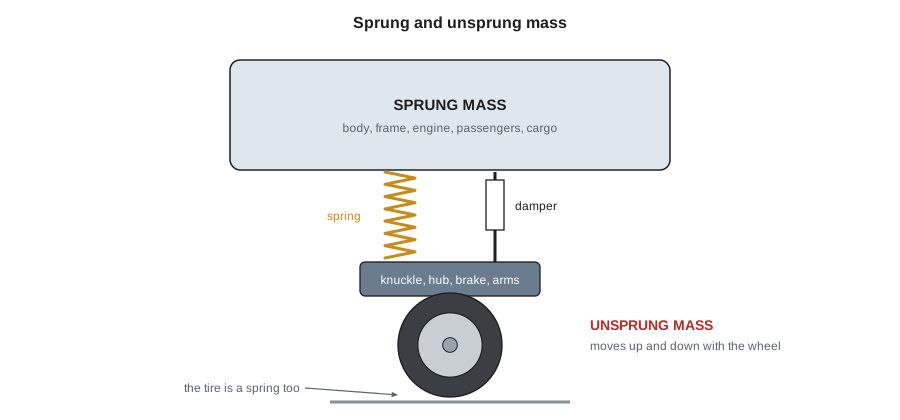
Everything supported by the springs is called sprung mass: the body or frame, the engine and transmission, the passengers and the cargo. Everything that is not carried by the springs, but moves up and down with the wheels, is unsprung mass: the tires and wheels, the brake rotors and calipers, the hub and knuckle, and part of the mass of the springs, the dampers and the control arms that connect to the body. On a solid rear axle, the whole axle housing, differential and axle shafts are unsprung.
Engineers want unsprung mass to be as low as possible. When a wheel hits a bump, the spring has to push the wheel back down onto the road. A light wheel follows the road quickly; a heavy wheel keeps moving upward and takes longer to come back, so the tire's grip falls for an instant. The ratio of sprung to unsprung mass matters: the higher it is, the less the body is disturbed by the wheel's motion and the better the tire follows the road. Aluminum control arms and knuckles, lighter wheels and independent rear suspensions are all ways to reduce unsprung mass.
# Sprung and unsprung mass of four shop vehicles (one corner shown)
UNITS = "metric"                        # "metric" or "US"
cars = [
    # name, total mass kg, unsprung mass of one corner kg (wheel, tire, brake, hub, half of arms and spring)
    ("Gord's pickup, front", 2220, 62),
    ("Ines's hybrid, front", 1380, 36),
    ("Dr. Singh's EV, front", 1690, 41),
    ("courier van, rear axle", 2700, 95),
]
for name, total, corner in cars:
    unsprung = corner * 4
    sprung = total - unsprung
    ratio = sprung / unsprung
    if UNITS == "metric":
        print(f"{name:<24} unsprung about {unsprung:4d} kg, sprung {sprung:5d} kg, ratio {ratio:4.1f} to 1")
    else:
        print(f"{name:<24} unsprung about {unsprung * 2.205:4.0f} lb, sprung {sprung * 2.205:5.0f} lb, ratio {ratio:4.1f} to 1")
print("a higher ratio means the body is disturbed less when a wheel moves")Gord's pickup, front unsprung about 248 kg, sprung 1972 kg, ratio 8.0 to 1 Ines's hybrid, front unsprung about 144 kg, sprung 1236 kg, ratio 8.6 to 1 Dr. Singh's EV, front unsprung about 164 kg, sprung 1526 kg, ratio 9.3 to 1 courier van, rear axle unsprung about 380 kg, sprung 2320 kg, ratio 6.1 to 1 a higher ratio means the body is disturbed less when a wheel moves
The figures are illustrative, but the pattern is real. The van's heavy solid rear axle gives it a low ratio, which is part of why an empty van rides so harshly over broken pavement: the axle bounces and the light body follows it. The compact hybrid, with its light wheels and aluminum parts, has a much higher ratio.
The contact patch
Every force that moves, stops or turns a vehicle passes through four small areas where the tires touch the road. Each one, the contact patch, is roughly the size of a hand. Its area depends mainly on the load the tire carries and the air pressure inside it: to a first approximation, the load divided by the inflation pressure gives the area, because the air inside the tire is what holds the load up. A tire that is underinflated has a larger, longer patch that flexes more, runs hotter and wears on its shoulders; one that is overinflated has a smaller patch, less grip and more wear in the centre.
In this rough relation, A is the area of the contact patch, F is the load on the tire and p is the inflation pressure. The real patch is a little larger, because the tire's carcass carries some of the load, but the relation explains why the placard pressure matters so much and why a heavy electric vehicle needs tires built for higher loads.
# Approximate contact patch area: load divided by inflation pressure
UNITS = "metric"
tires = [
    # name, load on one tire kg, pressure kPa
    ("pickup front, placard", 645, 380),
    ("pickup front, 25 % low", 645, 285),
    ("hybrid front", 400, 250),
    ("EV front", 460, 290),
]
for name, kg, kpa in tires:
    force = kg * 9.81                 # newtons
    area_m2 = force / (kpa * 1000)    # m2
    if UNITS == "metric":
        print(f"{name:<24} about {area_m2 * 10000:5.0f} cm2")
    else:
print(f"{name:<24} about {area_m2 * 1550:5.1f} square inches at {kpa * 0.145:3.0f} psi")pickup front, placard about 167 cm2 pickup front, 25 % low about 222 cm2 hybrid front about 157 cm2 EV front about 156 cm2
A drop of a quarter in pressure makes the patch about a third larger. That is why the shop's tire pressure monitoring systems are set to warn at about that level, and why Kiran checks and sets pressures on every vehicle before she road tests it for a handling complaint. A soft tire can cause a pull all by itself.
Forces on a moving vehicle
A suspension carries more than the vehicle's weight. When the driver brakes, weight moves forward and the front springs compress, a motion called dive. When the driver accelerates, the rear squats. In a turn, the body leans outward, or rolls, and load moves from the inside tires to the outside ones. A bump pushes a wheel up suddenly, and the spring and damper must absorb that motion and then return the wheel. The suspension's links and bushings also carry the forces that push the vehicle forward, stop it and turn it: every braking force, for example, passes from the tire through the knuckle and the control arms into the body.
Engineers describe body motion with a few words that Kiran will hear for the rest of her career. Heave is the whole body moving up and down. Pitch is the body rotating nose up or nose down, as in dive and squat. Roll is rotation about a line running front to back, the lean in a turn. Yaw is rotation about a vertical line, the vehicle turning; stability control, from AUTO-130, measures yaw to tell whether the vehicle is turning as much as the driver is steering.
| Motion | What it looks like | Main parts that control it |
|---|---|---|
| Heave | The whole body bouncing up and down | Springs and dampers |
| Pitch: dive and squat | Nose down under braking, tail down under acceleration | Springs, dampers and the suspension geometry |
| Roll | Body leaning outward in a turn | Springs, dampers and the stabilizer bar |
| Yaw | The vehicle rotating as it turns | Steering, tires and stability control |
| Wheel hop | A wheel bouncing off the road on rough pavement | Dampers and low unsprung mass |
The parts and how they are grouped
The springs carry the load: coil springs, leaf springs, torsion bars or air springs. Lesson 2 covers them, along with the dampers, often called shock absorbers, which control how fast the springs compress and extend. Without dampers a vehicle would bounce for a long time after every bump.
The linkages locate the wheel: control arms, struts, trailing arms, links and the bushings and ball joints that let them pivot. They decide the path the wheel follows as it moves up and down and how its angles change on the way. Lessons 3 and 4 cover front and rear designs, including the stabilizer bar, also called a sway bar or anti-roll bar, which links the left and right wheels to resist body roll. Lesson 5 covers electronically controlled dampers and air suspension, which more and more vehicles use.
The steering system includes the steering wheel and column, a steering gear, usually a rack-and-pinion, and the tie rods that connect it to the knuckles. Lesson 6 covers those parts and their geometry, and Lesson 7 covers the hydraulic and electric power assist that makes steering light. Lessons 8 and 9 cover tires and wheels in more depth than the introduction in AUTO-110: how tires are built and rated, what their wear tells a technician, and how to find and cure a vibration. Lessons 10 and 11 cover alignment, and the capstone in Lesson 12 puts it all together on a pull and a vibration.
Dependent and independent suspensions
In a dependent suspension, the left and right wheels are joined by a solid axle or beam, so when one wheel rises the other is tilted with it. Solid axles are strong, simple and keep the wheels at a fixed track and camber as the vehicle is loaded, which is why pickups like Gord's and the courier vans use one at the rear. Their drawbacks are high unsprung mass and the way a bump on one side disturbs the other.
In an independent suspension, each wheel moves on its own linkage, so a bump on one side does not tilt the other wheel. Independent designs give a better ride, lower unsprung mass and more control of the wheel's angles, at the cost of more parts. Almost every car and light truck now has independent front suspension; most cars and many SUVs have it at the rear as well. In between is the twist beam, a rear design used on many small cars and some minivans, in which two trailing arms are joined by a beam that twists; Lesson 4 explains it.
Safety in suspension and steering work
Suspension work carries hazards that oil changes and brakes do not. A coil spring holding up a corner of a vehicle stores a large amount of energy, and a spring that is released carelessly can throw a strut or a control arm with enough force to kill. Springs are compressed only with a spring compressor designed and rated for that type of spring, inspected before each use, with its hooks or plates fully seated, and never with an impact wrench on the compressor's screw unless the manufacturer allows it. A strut assembly is never taken apart with the spring still under load.
Lifting points change, too. When a control arm or axle is unbolted, the vehicle's weight may shift on the lift, so Kiran learns to support the arm or axle with a jack before removing a bolt that carries load, and to use the lift's safety locks before working under the vehicle, as she learned in AUTO-110. Ball joints and tie rod ends are separated with the correct puller or a fork, never by heating the knuckle, and new self-locking nuts and cotter pins are used where the service information says. Every steering and suspension fastener is torqued to specification, many of them with the vehicle's weight on the wheels, because rubber bushings tightened with the wheels hanging will be twisted when the vehicle is lowered and will tear early.
Air suspensions and electronic dampers add their own steps: the air system must be put into service mode before the vehicle is lifted, so the compressor does not run and the control module does not try to level a vehicle with its wheels in the air. Lesson 5 covers that.
The dry-park check
Marty's first lesson on Gord's truck is a dry-park check, a quick test that finds a surprising amount of wear before the vehicle is even lifted. With the truck on the floor, wheels straight ahead and the engine running so the power steering works, Kiran rocks the steering wheel back and forth through a small arc while Marty lies under the front and watches the steering linkage. Any movement in a joint before the wheel itself moves is looseness that the driver feels as play. She then bounces each corner of the truck hard and lets go: the body should rise once and settle. More than about one and a half oscillations points to tired dampers.
Then the truck goes up on the four-post rack in bay 3 with the front wheels free on slip plates. Kiran grabs each front tire at the top and bottom and rocks it in and out to check for play in the wheel bearing and the ball joints, then at the front and back to check the tie rod ends. Marty shows her how to tell which part is moving: a helper watches each joint while she rocks the tire, and a finger placed across a joint and the part next to it feels movement that the eye cannot see. On a short-and-long-arm suspension like Gord's, the ball joint that carries the weight must be unloaded before it is checked; Lesson 3 explains how.
This time the noise is easy to find. The right front stabilizer bar end link's lower bushing has pushed out of its sleeve, and the link knocks against the control arm every time the right wheel moves. Both bar bushings at the frame are cracked and squeak. “That's what he heard last fall,” Marty says. “The bushings let the bar move, the bar beat on the link, and now the link is done too.” Simone builds an estimate for both end links and both bushings, and Gord, this time, says yes. Lesson 3 follows the repair.
Worked problem
How much does the patch grow?
Gord's front tires are set to 380 kPa (55 psi). During the inspection the right front reads 300 kPa. By what percentage has its contact patch grown, using the simple load over pressure relation?
Show solution
- The patch area is inversely proportional to the pressure.
- New area divided by old area is 380 / 300 (55 / 43.5).
- That is about 1.27, an increase of about 27 percent.
- The larger patch means more flexing, more heat, more rolling resistance and more wear on the shoulders, and a pull toward that side.
Answer: About 27 percent larger, enough to make the truck pull right on its own; the pressure is corrected before the road test.
Common mistakes
MistakeStarting a handling diagnosis without setting tire pressures.
InsteadSet every tire to the placard pressure first; a soft tire can cause a pull or wander on its own.
MistakeThinking of alignment as a part that can be replaced.
InsteadAlignment is the result of the condition and setting of the suspension and steering parts.
MistakeReleasing a coil spring without a rated spring compressor.
InsteadUse the correct compressor, seated fully, and never take a loaded strut apart.
MistakeRemoving a load-carrying bolt with nothing supporting the arm or axle.
InsteadSupport the part with a jack and use the lift locks.
MistakeTightening rubber-bushed bolts with the wheels hanging.
InsteadTorque them at ride height, with the weight on the wheels, when the service information says so.
Summary and key terms
- A suspension carries the load, keeps the tires on the road, isolates bumps, controls body motion and holds the wheel angles.
- Sprung mass rides on the springs; unsprung mass moves with the wheels, and less of it lets the tires follow the road better.
- Each contact patch is about the size of a hand, and its area depends mainly on load and inflation pressure.
- Heave, pitch, roll and yaw describe body motion; the springs, dampers, linkages and stabilizer bar control it.
- Dependent suspensions join the wheels with a solid axle; independent suspensions let each wheel move on its own.
- Springs store dangerous energy and must be handled only with rated tools and procedures.
- A dry-park check and a lifted inspection find most worn steering and suspension parts.
- Sprung mass
- The part of the vehicle carried by the springs.
- Unsprung mass
- The parts that move up and down with the wheels, such as the wheels, tires, brakes and knuckles.
- Contact patch
- The area of a tire in contact with the road.
- Roll
- Rotation of the body about a front-to-rear line, the lean in a turn.
- Stabilizer bar
- A torsion bar linking the left and right wheels to resist body roll; also called a sway bar or anti-roll bar.
- Dependent suspension
- A design in which the left and right wheels are joined by a solid axle or beam.
- Dry-park check
- A steering linkage check made with the vehicle on the ground while the steering wheel is rocked.
Practice problems
Work each problem on paper first, then reveal the answer to check.
Name the five jobs of a suspension.
Show answer
Carry the load and set the ride height, keep the tires on the road, isolate bumps, control body motion, and hold the wheel angles.
Why do engineers try to keep unsprung mass low?
Show answer
A lighter wheel follows the road faster after a bump, so the tire keeps its grip and the body is disturbed less.
A tire carrying 450 kg is inflated to 240 kPa. Roughly how large is its contact patch?
Show answer
450 × 9.81 / 240,000 ≈ 0.0184 m², about 184 cm².
During a bounce test a corner rises and falls three times before it settles. What does that suggest?
Show answer
The damper at that corner is worn and no longer controls the spring.
Lesson quiz · 5 questions
Score 60% or more to complete this lesson.
Create a free account to save your progress, take quizzes and earn a certificate.