
ARCH-430 · Lesson 9 of 12 · 21 min
Site visits and field reports
Wren's first site visit on her own is in late June. The timber frame is up to the roof over the library and the envelope panels are going on along the avenue. She arrives with the drawings on a tablet, a moisture meter borrowed from the envelope consultant, a camera, a hard hat and a checklist, and signs in at Bhatt's trailer. Two hours later she has seventy photographs and nine observations, ranging from an air barrier lapped the wrong way under a window sill to a pallet of CLT panels standing in a puddle after the previous night's rain. Back in the office, Thibodeau asks her the question he asks after every visit: 'Which of those will matter in ten years, and who needs to know about each of them by tomorrow?'
What site visits are for
CCDC 2 requires the consultant to visit the place of the work at intervals appropriate to the progress of construction, to become familiar with the progress and quality of the work and to determine whether it is proceeding in general conformity with the contract documents. The consultant's own agreement sets how often, and the Manitoba Association of Architects' guidance with the Winnipeg Construction Association describes these visits as periodic field reviews, each producing a written report that lists deficiencies and recommends correction early enough to limit remedial work. This is general review, not inspection. The consultant does not watch every bolt being tightened or every membrane lap being sealed, and it does not supervise the work. It samples the work at the stages that matter, reports what it sees, and requires correction of work that does not conform.
The distinction between review and inspection protects everyone, as long as it is understood. The contractor remains responsible for the quality of its own work and for its own quality control. The building official inspects for compliance with the code at the stages its permit requires, and testing agencies hired by the owner or the contractor test concrete, welds, air barriers and other work as the specification requires. The consultant adds a design professional's judgement: does the work, as built, carry out the design and meet the documents? A report that says the work is proceeding in general conformity is a professional opinion based on the samples the reviewer saw, not a guarantee.
Planning the visits
Good site review is planned. The visits are timed to the construction schedule, so that the reviewer sees each critical stage before it is covered: the piles and grade beam reinforcement before concrete, the first timber connections, the first full window installation, the air barrier at the first panel joints, the roof membrane at the first tooth, the firestopping before ceilings close. Many specifications require the contractor to give notice before such stages, and to build the first installation of a repeated assembly as a reference sample, called a first-work review or a benchmark. The design team's engineers and specialist consultants visit for their own disciplines, on their own schedules, and their reports go out with the architect's.
Each visit has a short checklist drawn from the documents and the current stage of work. For Wren's visit in June it includes the wall panel joints and their tape, the window rough openings and sill pans, the CLT moisture content before the roof is closed, the protection of stored timber, the location of the roof penetrations against the timber shop drawings, and three items left open from the last report. A visit without a checklist tends to report what happened to catch the reviewer's eye, which is rarely the most important thing on site.
Observations that matter
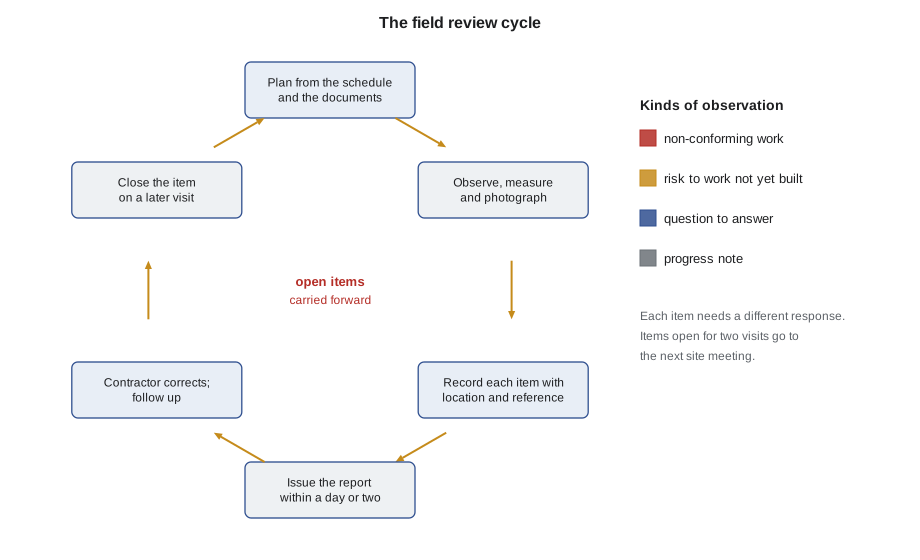
Observations fall into a few kinds. Some are work that does not conform to the documents: the air barrier lapped so that water running down the wall would be directed behind the sill rather than out over it. Some are risks to work not yet built: CLT panels standing in water, which will swell, stain and take weeks to dry. Some are questions the documents did not answer and the contractor has solved in its own way, which may or may not be acceptable. And some are progress notes, useful for the owner's records and for later payment certificates. The report should make clear which is which, because each needs a different response.
Wren's moisture readings are a good example of an observation that matters in ten years. The specification limits the moisture content of the CLT to 16% before it is enclosed, because timber sealed in at higher moisture content dries into the building, shrinks unevenly and can grow mould if it stays wet. Her readings on the panels standing in the puddle are above 20%, and on two installed roof panels over the library 18%. She photographs the meter readings with a reference card showing the panel number, records the location on the roof plan and reports them as non-conforming. The contractor raises the stored panels, adds temporary roof protection and dries the installed panels with fans and heaters until two consecutive readings, taken a week apart, are below the limit.
Wren also notices a worker on the roof edge without fall protection. Safety on site is the contractor's responsibility under the contract and under Manitoba's workplace safety and health law, and the consultant does not direct safety measures. But an architect who sees an immediate danger to a person should not walk past it. Thibodeau's office practice is to tell the superintendent immediately, record that it did so, and leave the response to the contractor. The report records the conversation, not an instruction about how the edge should be protected.
Writing the field report
A field report is a contract document of record, and it is written to be read by people who were not there. It states the date, time, weather and stage of work; who was present; what was reviewed, so that the reader knows what was not; each observation, numbered, with its location on a drawing, a reference to the document it relates to, a photograph and the action required; items carried forward from earlier reports and their status; and a closing statement of the reviewer's general opinion, limited to what was reviewed. It is issued within a day or two of the visit to the owner and the contractor, and to the engineers when their work is involved.
The language of a field report matters. It describes what was seen, not what someone did wrong, and it refers to the documents rather than to the reviewer's preference: 'The sill membrane at window W-14, grid 4 to 5, is lapped under the wall membrane, contrary to A-501 detail 9; correct before the window is installed' rather than 'Window flashing done badly.' It requires correction of non-conforming work without telling the contractor how to correct it, unless the documents prescribe a method. And it never gives an instruction that changes the work; anything that would do so goes out separately through the change procedure.
# Track field observations from visit to visit and report what is still open.
from collections import Counter
obs = [  # (number, visit first seen, category, closed on visit or None)
    ("FR04-01", 4, "non-conforming", 5),
    ("FR04-03", 4, "question", None),
    ("FR05-02", 5, "risk", 6),
    ("FR06-01", 6, "non-conforming", None),   # sill membrane lap at W-14
    ("FR06-02", 6, "risk", None),             # CLT moisture over the limit
    ("FR06-03", 6, "non-conforming", 7),
    ("FR06-04", 6, "progress", 6),
    ("FR06-05", 6, "question", None),
    ("FR07-01", 7, "non-conforming", None),
]
current_visit = 7
open_items = [o for o in obs if o[3] is None]
print(f"open after visit {current_visit}: {len(open_items)}")
for num, seen, cat, _ in open_items:
    age = current_visit - seen
    note = "  ESCALATE at site meeting" if age >= 2 and cat in ("non-conforming", "risk") else ""
    print(f"  {num}  {cat:15s} open for {age} visit(s){note}")
print("open by category:", dict(Counter(o[2] for o in open_items)))
closed = [o for o in obs if o[3] is not None and o[2] != "progress"]
avg = sum(o[3] - o[1] for o in closed) / len(closed)
print(f"average visits to close: {avg:.1f}")open after visit 7: 5
FR04-03 question open for 3 visit(s)
FR06-01 non-conforming open for 1 visit(s)
FR06-02 risk open for 1 visit(s)
FR06-05 question open for 1 visit(s)
FR07-01 non-conforming open for 0 visit(s)
open by category: {'question': 2, 'non-conforming': 2, 'risk': 1}
average visits to close: 1.0The tracker shows something the individual reports do not. One question from the fourth visit has been open for three visits, and three items from the sixth visit, including both the sill lap and the wet timber, are still open a visit later; neither is yet old enough to be escalated, but both will be if they are open after the next visit. Thibodeau's office escalates any non-conforming or risk item open for two visits or more to the next site meeting, where the contractor's project manager and the owner are present. The question from the fourth visit, about the finish of the exposed timber at the stair, is the architect's own; Wren is asked to answer it before the next visit.
Non-conforming work and testing
When work does not conform, the consultant can reject it, and the contractor must correct or remove and replace it at its own cost. If work has been covered before a review the contract required, the contractor must uncover it for review at its own cost; if the work was covered without such a requirement and is found to conform, the owner pays for uncovering and replacing it. The owner can also accept non-conforming work instead of having it corrected, usually with a reduction in the contract price; that decision belongs to the owner, advised by the architect, and must be recorded in a change order.
Testing gives measurements where judgement is not enough. On the Rail Yard Commons the specification requires concrete cylinder tests on every pour, a whole-building airtightness test before the interior finishes close the walls, water tests of the first installed windows and of the roof tooth valleys, and moisture readings of the CLT before enclosure. The reports go to the consultant, who reviews them against the specified results. A failed test is a non-conformance like any other, and a retest after correction is usually at the contractor's cost.
Worked problem
Writing two observations
Write the field report entries for the sill membrane lap at window W-14 and the wet CLT panels over the library.
Show solution
- FR06-01, non-conforming: 'At window W-14, grid 4 to 5, the sill membrane is lapped under the wall membrane, contrary to A-501, detail 9, and Section 07 27 00, 3.4. Correct the lap so that the upper membrane overlaps the lower before the window is installed, and notify the consultant for review. Photo 23.'
- FR06-02, risk to the work: 'Moisture readings of 18% were taken on installed roof panels R-31 and R-32 over the library, and above 20% on stored panels in the north laydown area, against a limit of 16% before enclosure in Section 06 17 19, 3.2. Protect stored panels from standing water and dry installed panels to below the limit, confirmed by two readings a week apart, before the roof assembly is installed over them. Photos 41 to 46.'
- Both entries name the location, the document, what was seen, the required result and how it will be confirmed, without saying how the contractor must do the work.
Answer: Each entry is specific, refers to the documents and requires a result rather than a method.
Exercise 9: a site review
- Prepare a checklist for a visit at the stage of the first window installations, drawn from the drawings and specifications.
- Using the site photographs supplied by the instructor, write six numbered observations, each with location, reference, photo and action.
- Classify each observation and decide which, if any, must be reported to the owner before the report is issued.
- Run the tracker with your observations and plan the follow-up for the next visit.
Self-check
- Is my visit timed to see the work before it is covered?
- Does every observation cite the documents and require a result, not a method?
- Have I stated what I reviewed and what I did not?
- Is every open item tracked until it is closed?
Common mistakes
MistakeCalling a site visit an inspection.
InsteadDescribe it as general review, limited to what was reviewed.
MistakeVisiting without a checklist.
InsteadPlan each visit from the schedule and the documents.
MistakeTelling the contractor how to correct work.
InsteadRequire the result the documents call for, unless they prescribe a method.
MistakeIgnoring an immediate safety danger because safety is the contractor's.
InsteadTell the superintendent at once, record it and leave the response to the contractor.
MistakeReporting observations once and never following up.
InsteadTrack every item until it is closed on a later visit.
Summary and key terms
- Site visits are general review of the work's conformity with the documents, not inspection or supervision.
- Visits are planned to see critical stages before they are covered, with a checklist for each.
- Observations are classified as non-conformance, risk, question or progress, each with a different response.
- Field reports are documents of record: specific, referenced, illustrated and issued promptly.
- Non-conforming work is corrected at the contractor's cost, or accepted by the owner with a price reduction.
- General review
- Periodic review of the work by the design professional to determine general conformity with the documents.
- Field report
- The written record of a site visit, with observations, references and required actions.
- Non-conforming work
- Work that does not meet the contract documents.
- Benchmark
- The first installation of a repeated assembly, reviewed as a reference for the rest.
- Testing agency
- An independent firm that tests materials and assemblies against specified results.
Practice problems
Work each problem on paper first, then reveal the answer to check.
Why is general review not a guarantee?
Show answer
Because it samples the work at chosen stages and gives an opinion on what was reviewed.
Why did the CLT moisture readings matter?
Show answer
Timber enclosed above the limit dries into the building, shrinks unevenly and can grow mould.
What should the architect do on seeing a worker at a roof edge without protection?
Show answer
Tell the superintendent at once, record that it did so, and leave the response to the contractor.
Who pays to uncover work covered before a required review?
Show answer
The contractor.
When does the tracker escalate an item?
Show answer
When a non-conforming or risk item has been open for two visits or more.
Lesson quiz · 5 questions
Score 60% or more to complete this lesson.
Create a free account to save your progress, take quizzes and earn a certificate.