
APT-230 · Lesson 9 of 12 · 21 min
Filters and fluids specifications
▶ Video coming soon A video version of this lesson is on the way.
Ewan Tullis from Orland Courier had a fleet question, and it came with a spreadsheet. His 34 vans were due for oil changes over the next month, and his previous supplier had been selling him a cheaper oil filter that "cross-referenced" to the original. Two of his drivers had reported a ticking noise for a few seconds after cold starts. He wanted to know whether the filter could be the cause, and what oil the vans should be on. Talia did not know, but she knew how to find out, and she told him she would call back. With Imani, she compared the two filters' specifications side by side. The cheaper filter matched the thread and the gasket, but it had no anti-drainback valve. The original did. Oil was draining out of the filter overnight, and the engine ran for a moment without full pressure on each cold start. Talia called Ewan back with the answer and a quote. At Thursday's session, Imani made filters and fluid specifications the subject, "because the cheapest part on the car can kill the most expensive one."
Filters on a modern vehicle
A car or light truck carries several filters, each with its own job and replacement schedule:
- The oil filter removes particles from the engine oil. It is a spin-on canister or a cartridge element in a housing on the engine.
- The engine air filter cleans the air entering the engine. A clogged filter cuts power and fuel economy only slightly on modern engines, but a torn or badly fitting one lets dust wear the engine.
- The cabin air filter cleans air entering the passenger compartment. Basic filters trap particles; activated carbon filters also absorb odours and some gases. Many owners do not know they have one.
- The fuel filter is inside the tank module on most gasoline cars (lesson 4), but separate on many older vehicles and on all diesels.
- Transmission filters sit inside the pan or on the case of many automatics and are changed with the fluid service where the maker calls for it.
- Heavy vehicles and equipment add fuel and water separators, hydraulic filters, coolant filters and DEF filters (lessons 10 and 11).
What makes one oil filter different from another
Two oil filters that screw onto the same engine are not necessarily the same filter. The details that matter:
- Thread and gasket diameter: the filter must seal on the engine's mounting face.
- Size: height and diameter affect capacity and clearance.
- Filter media: cellulose, synthetic or blended, which sets how fine the particles caught are and how long the filter lasts. Extended-interval oil changes need filters rated for them.
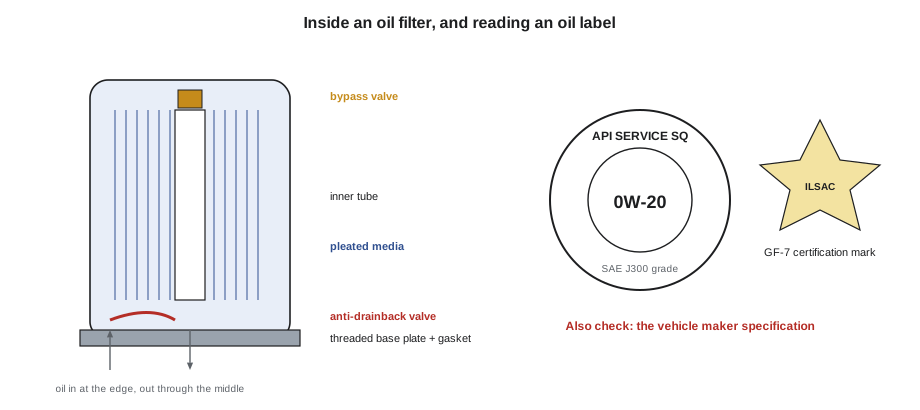
- Bypass valve: a spring-loaded valve that lets oil flow around the media if it clogs or when cold oil is too thick to pass. The opening pressure differs between engines, and the wrong setting can let dirty oil through too often or starve the engine.
- Anti-drainback valve: a rubber flap that keeps oil in the filter when the engine is off, so the engine gets oil pressure quickly at start-up. It matters on engines where the filter is mounted sideways or upside down. Ewan's cheap filter lacked one.
- Cartridge filters come with their own O-rings, and some housings have a drain valve that needs a new seal.
Cross-referencing filters
Filters are cross-referenced constantly: from the original part number to an aftermarket brand, from one aftermarket brand to another, from a customer's old filter to the counter's stock. A cross-reference is a starting point, not proof.
- Use the filter maker's own application lookup or interchange, which lists the vehicles and original numbers the filter is meant to replace. Corvane and Torvale both publish them.
- Compare specifications, not just numbers: thread, gasket diameter, height, bypass valve setting, anti-drainback valve, media rating. Filter makers publish these.
- Watch for one-way interchanges. A larger filter may replace a smaller one on some engines but not the other way round, and a cross-reference list may not say so.
- Check the vehicle, not just the old filter. The old filter on the car may have been wrong.
- Treat a mismatch as a stop sign. If two sources disagree, look deeper before selling.
Cabin and engine air filters cross-reference the same way. Their shape and frame must match exactly, and some vehicles changed filter shape part-way through a model year.
Engine oil: viscosity grades
Engine oil is specified two ways: by viscosity, how thick it is, and by performance, what tests it has passed. Both appear on the label, and the vehicle maker specifies both.
Viscosity grades are defined by SAE J300. A multigrade oil such as 0W-20 has two numbers. The first, with the W for winter, describes how the oil behaves when cold: a lower number means it flows and pumps more easily at low temperatures, which protects the engine at start-up. The second number describes its viscosity at engine operating temperature: a higher number means a thicker oil when hot. J300 includes very low grades such as 0W-8, 0W-12 and 0W-16, because many new engines are designed for thin oils to save fuel.
The rule is to use the grade the maker specifies, which is printed in the owner's manual and often on the oil filler cap. The Vela calls for 0W-20. A thicker oil is not "more protection" in an engine designed for a thin one; it can upset variable valve timing, hydraulic tensioners and the engine's oil pressure control, and it can hurt fuel economy.
Engine oil: performance specifications
Performance specifications come from industry bodies and from vehicle makers.
- The API service category for gasoline engines is shown in the top half of the API service symbol (the donut) on the bottle. The current category is API SQ, introduced in 2025. Each new category is designed to protect engines better against problems seen in modern engines: low-speed pre-ignition in turbocharged direct-injection engines, timing chain wear and deposits. Newer categories are generally backward compatible, so API SQ oil can be used where an earlier category such as SP or SN was specified. Diesel categories start with C, such as CK-4 and FA-4, and are separate.
- The ILSAC standard, set by North American and Japanese vehicle makers, adds fuel economy requirements. The current standard is ILSAC GF-7, first licensed in 2025. GF-7A covers the common grades such as 0W-20 and 5W-30 and can be used where GF-6A or earlier was recommended; GF-7B covers 0W-16 oils and can be used where GF-6B was recommended for 0W-16. Oils meeting GF-7A carry the ILSAC certification mark (the starburst) on the front of the bottle.
- Vehicle maker specifications go further. Many makers require their own approval, and the oil must list it on the label: General Motors' licensed dexos specifications are a well-known example, and many European makers require their own approvals. Tessaro specifies its own standard for the Vela, which oils meeting API SQ and ILSAC GF-7A in 0W-20 satisfy, according to the Tessaro service information. For a vehicle under warranty, the oil must meet the maker's specification, and the shop should keep records showing that it did.
Reading a bottle, then, takes three checks: the SAE grade matches the maker's grade; the API category and ILSAC mark are current enough; and any maker specification the vehicle needs is listed. Synthetic and conventional describe the base oil, not the specification; most low-viscosity grades such as 0W-20 are synthetic or synthetic blends because conventional oil cannot meet them.
Fluid capacities
Every fluid sale needs a quantity, and the service information lists capacities: engine oil with and without the filter, cooling system, transmission (total and drain-and-fill), differentials, transfer case, brake fluid and refrigerant. The counter should sell enough to finish the job without opening a second large container for a few hundred millilitres, and without sending the customer home with a nearly full extra jug.
Capacity notes to watch:
- Oil with filter is the figure for a normal oil change.
- Drain-and-fill for an automatic transmission is often only a third to a half of the total capacity, because the torque converter and cooler hold fluid that does not drain.
- Cooling system capacity is the total; a radiator job may only need part of it, but a full flush needs all of it.
- Fleet orders multiply small errors; Ewan's 34 vans each needing a little more than one jug adds up quickly.
Worked problem
An oil change order
The Vela's oil capacity with filter is 5.4 L. Oil comes in 1 L bottles and 5 L jugs. What should the counter sell for one oil change, and how much is left over?
Show solution
- One 5 L jug leaves:
- \[5.4 - 5.0 = 0.4 \text{ L still needed}\]
- Add one 1 L bottle:
- \[5.0 + 1.0 = 6.0 \text{ L}\]
- Left over:
- \[6.0 - 5.4 = 0.6 \text{ L}\]
Answer: One 5 L jug and one 1 L bottle, leaving 0.6 L for top-ups. In the shop, oil comes from a bulk tank by the litre, so the repair order shows 5.4 L. For Ewan's fleet, bulk drums would serve better: 34 changes at 5.4 L each would be 183.6 L.
Other fluids at a glance
| Fluid | Specified by | Covered in |
|---|---|---|
| Engine oil | SAE grade, API category, ILSAC, maker approval | This lesson |
| Coolant | Maker specification or chemistry; not colour | Lesson 3 |
| Brake fluid | DOT grade; maker specification on some vehicles | Lesson 5 |
| Automatic, CVT and DCT fluid | Maker specification by name | Lesson 7 |
| Gear oil | API GL grade and SAE viscosity; friction modifier for limited-slip | Lesson 7 |
| Power steering fluid | Maker specification; some use ATF | Lesson 6 |
| A/C refrigerant and oil | Refrigerant type on the under-hood label; matching compressor oil | APT-310 |
| Washer fluid | Freeze rating for the season | This lesson |
Air conditioning systems on newer vehicles use the refrigerant R-1234yf rather than the older R-134a, with different fittings, equipment and compressor oils; the type is on a label under the hood. Refrigerant is handled only by trained, certified technicians with recovery equipment. Washer fluid is sold by freeze rating; in winter, customers want fluid rated to about −40 °C (−40 °F), which happens to be the same number on both scales.
Air, cabin and fuel filters in more detail
Engine air filters are mostly pleated paper or synthetic media in a rubber or urethane frame, sized to the airbox. Some performance filters are oiled cotton gauze, washable and reusable; they must be oiled sparingly, because excess oil can coat the MAF sensor. The maker's interval is often given by distance, with a shorter interval for dusty conditions such as gravel roads and construction sites. A heavily clogged filter is also a sign that the airbox seals, the intake hoses and the cabin filter deserve a look.
Cabin air filters sit behind the glovebox or under the cowl at the base of the windshield. A clogged one cuts heater and air conditioning airflow and can cause fogged windows and musty smells. Activated carbon versions cost more and absorb odours and some exhaust gases; some brands add antimicrobial treatments. Many customers will buy a cabin filter once they are shown the old one, which is often grey and full of leaves.
Fuel filters on gasoline vehicles with separate inline filters are replaced at the maker's interval, with new clips or O-rings for the quick connectors. Diesel fuel filters on cars and pickups usually include a water separator with a drain and often a water-in-fuel sensor; they must be primed after replacement, following the maker's procedure, so the engine does not draw air. Diesel filters are rated by how fine a particle they catch, and a cheaper filter with coarser media can let through the particles that damage high-pressure injectors.
Oil change intervals and oil life monitors
Many modern vehicles, including the Vela, use an oil life monitor that calculates when the oil needs changing from engine revolutions, temperatures, trip lengths and other data, rather than a fixed distance. The monitor is reset after each change. Many makers also set a maximum time, often one year, whichever comes first. Fleet vehicles like Ewan's vans, which idle a lot and make many short trips, often fall under the maker's severe service schedule, with shorter intervals. That is useful for the counter: a fleet's schedule tells the counter how many filters and how much oil to stock each month.
Common mistakes
MistakeTreating a cross-reference as proof.
InsteadCheck the filter's specifications: thread, gasket, bypass setting, anti-drainback valve and size.
MistakeSelling a thicker oil as extra protection.
InsteadUse the SAE grade the maker specifies.
MistakeReading only the viscosity on an oil bottle.
InsteadCheck the API category, the ILSAC mark and any maker specification too.
MistakeSelling the total transmission capacity for a drain and fill.
InsteadUse the drain-and-fill figure, which is usually much less.
Summary and key terms
- Vehicles carry oil, air, cabin, fuel and transmission filters; heavy equipment adds more.
- Oil filters differ in thread, gasket, size, media, bypass valve and anti-drainback valve.
- A cross-reference is a starting point; confirm with the filter maker's specifications.
- SAE J300 sets viscosity grades; API SQ and ILSAC GF-7 are the current performance standards, and maker specifications such as dexos may also apply.
- Sell fluids by the maker's capacity figure for the job: with filter, drain-and-fill or total.
- Anti-drainback valve
- A flap in an oil filter that keeps oil in the filter when the engine is off.
- Bypass valve
- A valve in an oil filter that lets oil flow around the media if it is clogged or the oil is very cold.
- SAE J300
- The standard that defines engine oil viscosity grades such as 0W-20.
- API service category
- The performance level an engine oil meets, shown in the API service symbol; SQ is the current gasoline category.
- ILSAC GF-7
- The current ILSAC engine oil standard, with GF-7A for common grades and GF-7B for 0W-16.
- Cross-reference
- A listing that matches one part number to equivalent parts from other brands.
Practice problems
Work each problem on paper first, then reveal the answer to check.
What does the W in 0W-20 refer to?
Show answer
Winter: the oil's cold-temperature performance.
Which current API category would you expect on a new gasoline engine oil?
Show answer
API SQ.
Why might a filter that matches the thread and gasket still be wrong?
Show answer
It may differ in bypass valve setting, anti-drainback valve, size or media.
Capacity with filter is 4.4 L. Oil comes in 1 L bottles. How many bottles?
Show answer
5 bottles; 0.6 L left over.
Can API SQ oil be used where API SP was specified?
Show answer
Yes; newer API categories are generally backward compatible.
Lesson quiz · 5 questions
Score 60% or more to complete this lesson.
Create a free account to save your progress, take quizzes and earn a certificate.