
APT-230 · Lesson 1 of 12 · 22 min
How a vehicle is put together
▶ Video coming soon A video version of this lesson is on the way.
In her second week at Linmore Tessaro, Talia Brankovic sold a set of front brake pads to the service shop for a 2024 Vela, then watched Dario Pellicano carry them straight back to the counter. "These are the right pads for a front-wheel-drive Vela," he said, not unkindly. "This one is all-wheel drive with the JL4 package. Bigger brakes." The lookup had been right; Talia had not read the option codes. Imani Grantham, her mentor, used the moment to start something new. "Every Thursday at lunch," she said, "you and I are going to walk through one system of the car. You don't need to fix it. You need to know what the parts are, what they do, what wears out, and what questions to ask so the part you hand over is the part that fits."
This course is those Thursday sessions. It is written for the parts counter, not the service bay. A technician needs to know how to diagnose and repair a system; a parts technician needs to know enough about the same system to identify the parts, understand the words technicians use, ask the questions that separate one version of a part from another, and spot a request that does not make sense. AUTO-110 covered how the systems work in more depth; here each system is seen from the counter. This first lesson is the map: how a vehicle is built, how its systems divide up, and why the same model can need several different parts in the same place.
Two ways to build a body
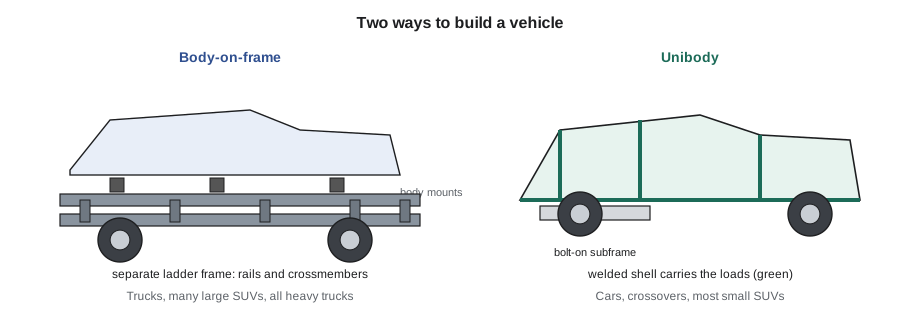
Every vehicle needs a structure that carries the engine, the passengers and the load, and resists the forces of the road. There are two main ways to build it.
In body-on-frame construction, a separate steel frame, usually two long rails joined by crossmembers, carries the engine, transmission, suspension and fuel tank. The body is a separate shell bolted to the frame through rubber body mounts. Full-size pickup trucks, many large SUVs, vans built on truck platforms and all heavy trucks are built this way. The frame is strong and can be repaired or extended, which is why trucks built for towing and heavy loads use it. From the counter, body-on-frame vehicles bring their own parts: body mounts, frame brackets, crossmember bolts and, on trucks, leaf springs and shackles.
In unibody construction, the body and frame are one welded steel structure. The floor pan, rocker panels, pillars and roof all carry load, and short subframes bolt underneath to hold the engine and suspension. Almost every car, crossover and small SUV is built this way, including every Tessaro now sold. A unibody is lighter and stiffer for its weight, which helps handling and fuel economy, and it is designed to crush in a planned way in a crash. From the counter, unibody vehicles bring subframe mounts and bushings, strut towers that carry suspension loads, and a body shop that orders structural parts by the exact build of the vehicle.
Where the power goes: FWD, RWD and AWD
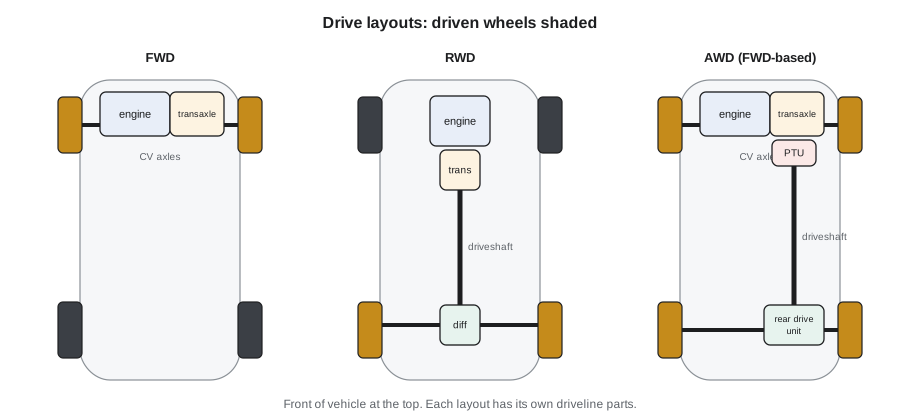
The drive layout tells you which wheels are driven, and it changes almost every driveline and suspension part on the vehicle.
- Front-wheel drive (FWD). The engine usually sits sideways (transverse) and drives a transaxle, a transmission and differential in one case, which turns the front wheels through two CV axles. There is no driveshaft to the rear. Most small and mid-size cars, including the Tessaro Arden, are FWD.
- Rear-wheel drive (RWD). The engine usually sits lengthwise (longitudinal) and drives a transmission, then a driveshaft with universal joints, then a rear differential and two axle shafts. Pickup trucks, many performance cars and almost all heavy trucks are RWD.
- All-wheel drive (AWD). All four wheels can be driven on the road all the time, with the system sharing torque between the front and rear axles automatically. Many AWD crossovers, including the Vela, are built on a FWD layout with a power take-off unit (PTU) at the transaxle, a driveshaft to the rear, and a rear drive unit with an electronically controlled coupling.
- Four-wheel drive (4WD). Usually found on trucks and truck-based SUVs: a transfer case behind the transmission sends power to front and rear driveshafts, often with a low range for off-road use. Many part-time 4WD systems should not be driven in four-wheel drive on dry pavement.
The same model can come in more than one layout. A Vela sold with front-wheel drive has no PTU, no rear driveshaft and no rear drive unit, and its rear suspension knuckles and hubs differ from the AWD version. The JL4 brake package that caught Talia out was only offered with AWD. That is why the drive layout is one of the first things a parts person confirms.
The systems, as the parts catalogue groups them
Parts catalogues, electronic or printed, divide the vehicle into groups. The names vary by maker, but the groups are much the same, and they match the lessons in this course:
| Group | Typical parts | Lesson |
|---|---|---|
| Engine | Gaskets, timing parts, mounts, sensors, belts | 2 |
| Cooling and lubrication | Radiator, water pump, thermostat, hoses, oil pump, oil cooler | 3 |
| Fuel and exhaust | Fuel pump, injectors, filters, oxygen sensors, catalytic converter, mufflers | 4 |
| Brakes | Pads, rotors, drums, shoes, calipers, hoses, ABS sensors | 5 |
| Steering and suspension | Struts, shocks, springs, control arms, ball joints, tie rods | 6 |
| Drivetrain | Clutch, transmission parts, CV axles, driveshafts, differentials | 7 |
| Wheels, tires and hubs | Tires, wheels, lug nuts, hub bearings, sensors | 8 |
| Maintenance | Filters, fluids, wipers, bulbs | 9 |
| Electrical and body | Batteries, starters, lamps, panels, trim (covered in APT-310 and APT-120) | - |
Knowing the group a part belongs to speeds up any lookup. A technician who asks for a "lower arm bushing" is in the suspension group; one who asks for a "lower mount" might mean an engine mount, a transmission mount or a strut mount, and the right question is "which lower mount?".
Why one model needs many versions of a part
A model name is not enough to choose a part. Within one model year a vehicle can differ by:
- Engine. Hugo Wexcombe learned this when he bought a thermostat housing for his 2016 Arden: the 1.8 L and 2.0 L engines use different housings (APT-130).
- Transmission. A manual and an automatic version use different clutch or torque converter parts, mounts, axles and sometimes different brackets.
- Drive layout. FWD and AWD versions differ in driveline, rear suspension and, on the Vela, brakes.
- Trim and option packages. Option codes such as JL4 (larger brakes) and FE9 change parts that look the same in a photo.
- Production date and plant. A running change part-way through the model year can change a part number, which is why a VIN lookup beats a model-year lookup (APT-120).
- Market. Vehicles built for different countries or for different emission rules can use different emission parts.
The VIN and the vehicle's build data answer most of these questions, and the parts catalogue uses them to filter. But a parts person still needs to understand what the differences mean, because the catalogue can only ask about differences it knows about, and a technician's request may not say which version he is looking at.
The words technicians use
Technicians describe parts by position and by function, and they use a few conventions that confuse new parts staff.
- Left and right are always as seen from the driver's seat, facing forward. The left side is the driver's side in Canada and the United States. A "left front" caliper is on the driver's side, front wheel. Catalogues use LH and RH, or driver and passenger.
- Front and rear, upper and lower, and inner and outer describe position. An inner tie rod end is closer to the centre of the vehicle; an outer one is at the wheel.
- Inboard and outboard mean the same as inner and outer, and are common for CV joints and brake pads.
- Bank 1 and bank 2 name the two sides of a V engine; bank 1 holds cylinder 1. Sensor 1 is upstream of the catalytic converter and sensor 2 is downstream (lesson 4).
- Assembly means a group of parts sold together: a strut assembly includes the spring and mount; a bare strut does not. Many lookups go wrong between an assembly and its parts.
When a request is unclear, the best question is often the simplest: "Can you show me on the car?" A two-minute walk to the bay saves a wrong part, a return and a car waiting on a lift.
Wear parts, repair parts and maintenance parts
From the counter, parts fall into three groups, and each sells differently.
Maintenance parts are replaced on a schedule whether or not they have failed: oil and filters, air filters, cabin filters, spark plugs, coolant, brake fluid, wiper blades and, on some engines, timing belts. They are predictable, and a dealership stocks them deeply.
Wear parts are replaced when they wear out: brake pads and rotors, tires, clutches, shocks and struts, ball joints, bearings, belts and hoses. Demand follows mileage, age and season, and the parts person can often predict what will be needed next: a car with worn front pads may need rotors; a car with a failed strut on one side should have both replaced.
Repair parts are replaced when something breaks: a water pump, a sensor, a control module, a cracked radiator. Demand is harder to predict, and many are special orders.
Thinking in these groups helps the counter suggest the right related parts: the gasket that goes with the water pump, the hardware kit that goes with the pads, the coolant that goes with the radiator. Lesson 12 shows how a repair order turns into a full list of parts.
Imani's first rule
At the end of the first Thursday session, Imani gave Talia the rule that runs through the whole course. "A part fits a vehicle, not a model," she said. "Engine, transmission, drive, options, build date. Know which questions change the answer for each system, and ask them before you go to the shelf." Talia wrote it on the inside cover of her notebook, under the bin code she had learned in her first week.
Worked problem
Counting the differences
A technician asks for the left rear wheel hub for a 2024 Vela. The catalogue shows three hubs for that year: one for FWD, one for AWD, and one for AWD with the JL4 brake package. The VIN decodes to an AWD vehicle and the option list includes JL4. Which hub, and why does the lookup need both facts?
Show solution
- First question: is the vehicle FWD or AWD?
- The VIN shows AWD, so the FWD hub is ruled out. The AWD hub accepts the rear axle shaft; the FWD hub does not.
- Second question: does it have JL4?
- The option list shows JL4, so the hub for the larger brakes is the one that fits.
Answer: The AWD hub for JL4. Either fact alone leaves two possible parts; together they leave one. This is the habit for every lookup: work out which questions separate the versions, then answer each one from the VIN, the build data or the vehicle itself.
Reading the vehicle in the bay
The VIN and build data answer most questions, but sometimes the quickest answer is on the vehicle itself, and a parts person who knows where to look can settle a doubt in a minute. The certification label on the driver's door jamb shows the build month and year, the weight ratings and often the paint and trim codes. The tire placard beside it gives the original tire sizes and pressures. Under the hood, an emission control information label names the engine family and the emission standard the vehicle was built to, which matters when an emission part such as a converter or oxygen sensor differs by market. Many vehicles also carry an option or build label in the trunk, glovebox or spare tire well, listing the option codes that a catalogue uses to filter parts.
On the parts themselves, casting numbers, stamped part numbers and supplier labels can confirm which version is fitted. A caliper often has its size cast into the body; a strut usually carries a label with a part number; an alternator or starter has a tag. These numbers are not always the number you order by, because a supplier's production number can differ from the service part number, but they are strong evidence when two versions look alike. When a technician brings the old part to the counter, compare it side by side with the new one before it goes back to the bay: mounting points, connectors, hose outlets, length and the number of bolt holes.
Two cautions apply. First, previous repairs can change what is on the car. A Vela that had a used engine or transmission fitted after an accident may not match its VIN. Second, a vehicle imported from another market may have parts the local catalogue does not list. In both cases, the old part and the technician's eyes are better guides than the database, and Imani's advice was to write down whatever you found on the RO so the next person does not have to find it again.
Common mistakes
MistakeChoosing a part by model and year only.
InsteadConfirm engine, transmission, drive layout, options and build date from the VIN and build data.
MistakeTaking "left" to mean the left side as you face the car.
InsteadLeft and right are always as seen from the driver's seat.
MistakeSelling a bare strut when the technician wanted a complete strut assembly.
InsteadAsk whether the request is for the assembly or the part alone.
MistakeAssuming every SUV is body-on-frame, or every car is FWD.
InsteadCheck the actual vehicle; many SUVs are unibody and some cars are RWD or AWD.
Summary and key terms
- Body-on-frame vehicles carry loads on a separate frame; unibody vehicles carry them in the welded body, with bolt-on subframes.
- FWD, RWD, AWD and 4WD layouts each use their own driveline and often their own suspension and brake parts.
- One model can need several versions of a part, depending on engine, transmission, drive layout, options, build date and market.
- Left and right are as seen from the driver's seat; an assembly includes more than the bare part.
- Maintenance, wear and repair parts sell differently, and each suggests related parts.
- Body-on-frame
- Construction in which a separate frame carries the drivetrain and suspension, with the body bolted on through mounts.
- Unibody
- Construction in which the body and frame are one welded structure, with subframes bolted underneath.
- Transaxle
- A transmission and differential combined in one case, used on most FWD vehicles.
- Power take-off unit
- On an AWD vehicle based on FWD, the gearbox at the transaxle that sends power to the rear driveshaft.
- Transfer case
- On a 4WD vehicle, the gearbox behind the transmission that splits power between front and rear driveshafts.
- Assembly
- A group of parts sold together as one part number, such as a complete strut with spring and mount.
Practice problems
Work each problem on paper first, then reveal the answer to check.
Which construction do most cars and crossovers use?
Show answer
Unibody.
On a FWD car, which part combines the transmission and differential?
Show answer
The transaxle.
A technician asks for the right front caliper. Which side of the car is that?
Show answer
The passenger side, as seen from the driver's seat.
Name four things besides model and year that can change which part fits.
Show answer
Engine, transmission, drive layout, option packages, build date and market (any four).
Give one example each of a maintenance part, a wear part and a repair part.
Show answer
For example, an oil filter (maintenance), brake pads (wear) and a water pump (repair).
Lesson quiz · 5 questions
Score 60% or more to complete this lesson.
Create a free account to save your progress, take quizzes and earn a certificate.