
APT-230 · Lesson 6 of 12 · 21 min
Steering and suspension parts
▶ Video coming soon A video version of this lesson is on the way.
Corinne Ferraby's order came in by phone just before the 10 a.m. van: "Two front struts for a 2018 Arden, and an alignment's booked for this afternoon, so I need them on the run." Talia had sold hood struts to Petra Dunleavy in her first weeks, small gas cylinders that hold a hood up, and knew now that this was a different part entirely. The catalogue offered three choices for each side: a bare strut, a strut with a new mount, and a complete strut assembly with spring, mount, bearing, boot and bump stop already built up. She asked Corinne which. "Complete assemblies," Corinne said. "Saves my tech a spring compressor and an hour." Talia checked the side, since the assemblies were left and right, and confirmed the trim level, since the sport version used a firmer spring. The parts made the van with four minutes to spare.
At the Thursday session, Imani drew a front corner of a car on the whiteboard. "Suspension holds the car up and keeps the tires on the road," she said. "Steering points them. Most of the parts in between are pivots, and pivots wear."
What the suspension does
The suspension carries the weight of the vehicle on springs, controls how the springs move with dampers, and holds each wheel at the right angles as it moves up and down. Its parts fall into four groups: springs, dampers (shocks and struts), linkages (control arms, links and the joints and bushings that let them pivot), and anti-roll bars.
Springs
- Coil springs are used on almost every car and crossover. They are matched to the vehicle's weight, so a heavier engine, a sport package or a towing package can call for a different spring. Springs sag with age and are replaced in pairs.
- Leaf springs, stacks of curved steel strips, carry the rear axle on most pickup trucks and many vans. They mount through shackles and bushings, and they are sold as complete packs or by individual leaf for heavy trucks.
- Torsion bars are steel bars that twist as the wheel moves, used on some older trucks and SUVs.
- Air springs are rubber bags filled with compressed air, used on many luxury vehicles, some SUVs and almost all heavy trucks and trailers (lesson 10). They need a compressor, height sensors and valves.
Shocks and struts
A spring on its own would bounce the car for several cycles after every bump. A damper turns that motion into heat by pushing oil through small valves. There are two kinds, and the difference matters at the counter.
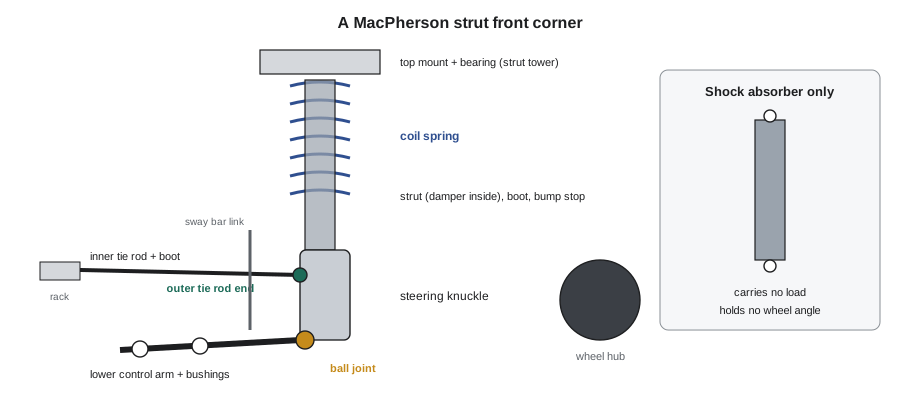
A shock absorber is only a damper. It bolts between the body or frame and the suspension, and it carries no load and holds no wheel angles. Replacing a shock does not change the alignment.
A strut is a damper that is also a structural part of the suspension. In the common MacPherson strut design, used at the front of most FWD cars and crossovers including the Arden and the Vela, the strut body bolts to the steering knuckle, carries the coil spring, and its top mount is the upper pivot for steering. The strut holds the wheel's camber angle, so replacing a strut normally calls for a wheel alignment. Some vehicles use struts at the rear too, without the steering function.
Struts are sold three ways:
- Bare strut: the damper alone. The technician compresses the spring with a spring compressor and moves over the spring, mount, bearing, boot and bump stop. Old mounts and bearings are often worn and noisy.
- Strut with mount kit: the bare strut plus a new top mount and bearing, sold together or separately.
- Complete strut assembly, sometimes called a loaded or quick strut: strut, new spring, mount, bearing, boot and bump stop already assembled. It saves time and the risk of compressing springs, and it replaces every wearing part at once.
Shocks and struts are replaced in axle pairs, left and right together, so the two sides damp equally. Complete assemblies are often side-specific, and some vehicles have different struts for different trims, suspension packages or engine weights. Vehicles with electronic adaptive dampers have struts with an electrical connector and a valve the computer controls; these are specific parts and expensive.
Control arms, bushings and ball joints
Control arms connect the knuckle or axle to the body or subframe and let the wheel move up and down along a controlled path. A MacPherson front has one lower arm on each side; a double wishbone or multi-link design, common at the rear and on trucks, has an upper arm, a lower arm, or several links.
Each arm pivots on bushings, rubber or fluid-filled sleeves pressed into the arm, and joins the knuckle through a ball joint, a ball-and-socket pivot that lets the knuckle both move up and down and turn for steering. Ball joints wear, get loose and, if neglected, can separate, letting the wheel fold under the car. That is why they are a safety part and why technicians check them at every inspection.
Ball joints are sold in three ways, depending on how the vehicle was designed:
- Pressed-in ball joints are pressed out of the arm or knuckle with a special tool and a new one pressed in.
- Bolted-on ball joints bolt to the arm.
- Integral ball joints are part of the control arm and cannot be replaced alone; the whole arm, with new bushings and ball joint, is sold. Many modern cars use this design, and a technician's request for a "ball joint" may really be a request for a control arm.
On some vehicles, especially trucks, the ball joint that carries the vehicle's weight is called the load-carrying joint and the other the follower. Ask which joint, upper or lower, and whether it is pressed, bolted or integral.
Anti-roll bars and links
An anti-roll bar (sway bar or stabilizer bar) is a steel bar joining the left and right suspension, which resists body lean in corners. It mounts to the body or subframe in rubber bar bushings and joins each side through a short end link with small ball joints or bushings at each end. Worn end links rattle over bumps and are among the most common suspension parts sold. Links are often the same left and right, but not always; check.
Steering
Almost every car and light truck now uses rack-and-pinion steering: the steering shaft turns a pinion gear that moves a toothed rack side to side. Each end of the rack has an inner tie rod with a ball joint inside a rubber boot (bellows), threaded into an outer tie rod end that joins the steering knuckle. The threaded joint between inner and outer tie rods sets the toe angle, so any tie rod replacement needs an alignment.
- Inner and outer tie rods are sold separately, and the outer ends are usually side-specific on threads or shape. Ask which, and whether the boot is needed too; a torn boot lets dirt in and ruins the inner joint.
- Power steering is either hydraulic, with a belt- or electric-driven pump, a reservoir, hoses and power steering fluid, or electric (EPS), with an electric motor on the rack or column and no fluid at all. Most new vehicles, including the Vela and the current Arden, use EPS. Hydraulic systems take a specific fluid, often an ATF or the maker's own power steering fluid; never assume.
- Older trucks and some heavy vehicles use a steering gearbox with a pitman arm, idler arm, centre link and drag link instead of a rack. Lesson 10 touches on heavy trucks.
Alignment and the related sale
Wheel alignment sets three main angles: camber (how far the top of the wheel tilts in or out), caster (the tilt of the steering axis forward or back) and toe (whether the fronts of the wheels point in or out). Many steering and suspension parts change at least one of them. When a shop replaces struts, control arms, tie rods or springs, an alignment should follow, and the counter can remind the service advisor. Some vehicles need camber bolts or adjustment kits to bring the angles back into range, and some have parts with built-in offsets.
Suspension jobs also need small parts that often get forgotten: new strut-to-knuckle bolts or nuts where the maker calls them single-use, cotter pins for castle nuts on ball joints and tie rod ends, self-locking nuts that should not be reused, and boot clamps. Suggest them.
Worked problem
Building the front strut order
A shop asks for front struts for a 2018 Arden. The catalogue offers a bare strut, a strut mount and bearing kit, and a complete strut assembly. The shop's technician has no spring compressor free today and the car has 160,000 km on its original mounts. What should the order be?
Show solution
- The struts are replaced in an axle pair, so two of everything.
- No spring compressor and old mounts both point to complete assemblies, which include new springs, mounts, bearings, boots and bump stops.
- Complete assemblies are side-specific: one left, one right.
- Check the trim: sport versions may use a firmer spring.
Answer: One left and one right complete front strut assembly for the right trim, with any single-use strut-to-knuckle bolts the maker specifies, and a reminder that the car needs an alignment afterward.
Suspension complaints and the parts they lead to
Suspension and steering problems also reach the counter as feelings and sounds. The common links:
- Clunk over bumps: worn sway bar end links, worn strut mounts, loose ball joints or worn control arm bushings.
- Bouncing or floating after bumps: worn shocks or struts that no longer damp.
- Uneven tire wear: wear on one edge points to camber or toe problems, often from worn parts or a missed alignment; cupped, scalloped wear often points to worn dampers.
- Wandering or loose steering: worn tie rod ends, inner tie rods, a worn rack or worn ball joints.
- Popping or binding when turning: worn strut bearings at the top mount, a common reason to sell complete strut assemblies.
- Vehicle sitting low at one corner: a sagging or broken coil spring, or a leaking air spring on vehicles with air suspension.
Each points the counter toward a set of parts, and each also points toward an alignment afterward. A good habit is to ask the technician what else was loose or worn: suspension parts tend to wear together, and a car that needs one outer tie rod end at 160,000 km may be due for the inner one soon.
Springs, lift kits and modified vehicles
Some customers want to change their vehicle's suspension rather than just repair it: lowering springs on a car, a levelling kit or lift kit on a pickup, or heavier springs for towing. These parts come with cautions. Changing ride height changes the alignment geometry, the headlight aim and sometimes the readings of sensors that driver assistance systems use; it can affect braking and stability control; and larger tires fitted with a lift change the speedometer reading. Some modifications also affect the vehicle's warranty or its insurance. The counter can sell the parts the supplier lists for the vehicle and should make sure the customer knows the vehicle will need an alignment and, where the supplier says so, a sensor calibration. A shop installing them should follow the kit maker's instructions, which often include new longer brake hoses or sway bar links.
Power steering jobs have their own short list. On hydraulic systems, a leaking rack or pump is sold new or remanufactured with a core charge, along with the maker's fluid, high- and low-pressure hoses if they are seeping, and sometimes a filter for the reservoir; the system is bled after the repair. On EPS systems, the rack or column motor is an electronic part that may need programming or a steering angle sensor calibration after fitting, and the counter should check whether the replacement unit arrives coded or needs a dealer scan tool. Either way, the inner and outer tie rods and the boots are worth inspecting while the rack is out, since the labour to reach them is already done.
Common mistakes
MistakeTreating a hood or hatch gas strut as a suspension strut.
InsteadConfirm the system: a gas lift support holds a hood or hatch; a suspension strut carries the vehicle.
MistakeSelling one strut or shock.
InsteadSell axle pairs so both sides damp equally.
MistakeSelling a ball joint for a vehicle with integral ball joints.
InsteadCheck the design; integral joints are replaced with the control arm.
MistakeForgetting the alignment after struts, arms or tie rods.
InsteadRemind the shop or advisor that the angles change.
Summary and key terms
- Suspension parts are springs, dampers, linkages with their bushings and joints, and anti-roll bars.
- A shock is only a damper; a strut is also structural, carries the spring and usually holds wheel angles.
- Struts are sold bare, with mount kits or as complete assemblies; all are sold in axle pairs.
- Ball joints may be pressed in, bolted on or integral with the control arm.
- Inner and outer tie rods set toe; steering and suspension work usually needs an alignment and new small parts.
- Strut
- A damper that is also a structural suspension part, carrying the spring and holding wheel angles.
- Shock absorber
- A damper only, which controls spring motion but carries no load.
- Complete strut assembly
- A strut sold with spring, mount, bearing, boot and bump stop already assembled.
- Ball joint
- A ball-and-socket pivot joining a control arm to the steering knuckle.
- Tie rod end
- The joint at the outer end of the steering linkage that connects to the steering knuckle.
- Alignment
- Adjustment of camber, caster and toe so the wheels sit and point correctly.
Practice problems
Work each problem on paper first, then reveal the answer to check.
What is the difference between a shock and a strut?
Show answer
A shock only damps; a strut also carries the spring and is part of the suspension structure, usually holding wheel angles.
Why are shocks and struts sold in pairs?
Show answer
So both sides of the axle damp equally.
A technician asks for a lower ball joint, but the vehicle's joint is part of the control arm. What do you sell?
Show answer
The complete lower control arm with its integral ball joint and bushings.
Which steering part sets the toe angle?
Show answer
The threaded joint between the inner and outer tie rods.
Name two small parts often needed on a suspension job.
Show answer
For example, cotter pins, single-use nuts or bolts, boot clamps, or camber bolts.
Lesson quiz · 5 questions
Score 60% or more to complete this lesson.
Create a free account to save your progress, take quizzes and earn a certificate.