
AERO-430 · Lesson 8 of 12 · 26 min
Aircraft maintenance engineers (AME)
Every maintenance task on a Petrel 19 ends with a signature. Somebody certifies that the work was done correctly, to approved data, and that the aircraft or component is fit to return to service. That signature carries legal weight, and the person who gives it must hold the right qualification. This lesson looks at how technicians are licensed, what their privileges are, how a return to service works in practice and why human factors are now a core part of the profession.
The AME licence
In Canada, the aircraft maintenance engineer (AME) licence is issued by TCCA under CAR Part IV, Subpart 3, with the detailed requirements in Standard 566. There are four categories. The M1 rating covers aeroplanes and helicopters that are not turbojet-powered, with a maximum certificated takeoff weight of 8,618 kg (19,000 lb) or less and 19 or fewer passenger seats. The M2 rating covers all aeroplanes and helicopters. The E rating covers avionics and electrical systems. The S rating covers structures. The Petrel 19, with turboprop-style electric propulsion and a turbogenerator rather than a turbojet, falls within the M1 envelope if its weight stays below the limit.
An applicant must be at least 21 years old and must complete required experience, examinations and training. Experience is gained working under supervision in an approved maintenance environment and is recorded in a logbook that shows the tasks performed against a list of tasks for the category. Training at a TCCA-approved training organization earns credit toward the experience requirement, one month for each 100 hours of training, up to 24 months for the M and E categories and 18 months for S. A full-time year of work counts as 1,800 hours. Applicants must also show that they have performed a minimum percentage of the tasks on the applicable list, which Standard 566 sets at 70 percent for most categories.
| Rating | Scope |
|---|---|
| M1 | Non-turbojet aeroplanes and helicopters up to 8,618 kg and 19 seats |
| M2 | All aeroplanes and helicopters |
| E | Avionics and electrical systems |
| S | Aircraft structures |
| Approved maintenance organization signatory | Certifies maintenance within the organization's authority |
Tracking experience
Arjun's cousin Priya is a second-year apprentice at Kivalliq Air Link's main base, working toward an M1 licence. Her supervisor asks her to keep an electronic logbook alongside the paper one. The code below shows how she checks her progress against the experience and task coverage requirements.
# Tracking an apprentice's logged experience against licence requirements.
# Task coverage target 70 % of the tasks in the applicable list (Canadian practice); hours are illustrative.
log = [('airframe', 2400), ('powerplant', 1500), ('electrical', 600), ('avionics', 300), ('structures', 900)]
required_months = 48            # example total experience, months
hours_per_month = 150
tasks_total, tasks_done = 290, 196
months = sum(h for _, h in log) / hours_per_month
print(f"logged {sum(h for _, h in log)} h = {months:.1f} months of {required_months}")
print(f"task coverage {tasks_done/tasks_total:.0%} (target 70 %)")
still = max(0, required_months - months)
print(f"months still needed: {still:.1f}, about {still*hours_per_month:.0f} more working hours")
for area, h in log:
print(f" {area:11s} {h:5d} h {h/sum(x for _, x in log):5.1%}")logged 5700 h = 38.0 months of 48 task coverage 68% (target 70 %) months still needed: 10.0, about 1500 more working hours airframe 2400 h 42.1% powerplant 1500 h 26.3% electrical 600 h 10.5% avionics 300 h 5.3% structures 900 h 15.8%
Priya has 5,700 hours, the equivalent of 38 months of the 48 needed, and 68 percent task coverage against a target of 70 percent. She needs another 10 months, about 1,500 working hours, and a handful of tasks she has not yet performed. The breakdown shows that most of her time is on airframe work and powerplant; avionics is only 5 percent, so her supervisor arranges six weeks in the avionics shop to cover the remaining tasks. Training at an approved organization would have shortened the experience requirement, but she started work directly after high school.
Privileges and limits
An AME licence allows the holder to sign a maintenance release for work within the scope of the licence category and any type ratings, provided the holder meets the recency requirement in CAR 403.05, which requires recent experience exercising the privileges, and has been trained on the type. A licence holder working within an approved maintenance organization signs under that organization's authority and its procedures, and the organization decides who may sign for which tasks.
New technology tests these limits. The Petrel 19's high-voltage system needs training on electrical safety, insulation testing and lockout procedures that a technician trained on conventional turboprops has never had. Borealis Aerospace develops a type training course with modules on high-voltage hazards, battery handling and the power management system. Kivalliq Air Link makes the course a condition for signing for any task on the high-voltage system, and the type certificate holder writes the requirement into the instructions for continued airworthiness.
The maintenance release
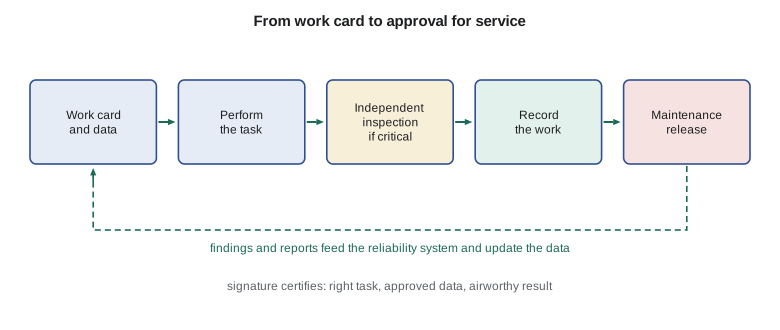
Under CAR 571.10, no person may sign a maintenance release unless the maintenance was performed in accordance with the applicable airworthiness requirements, using approved or acceptable data, and the work has been verified. The release is a statement that the described maintenance has been performed in accordance with the applicable airworthiness requirements. It is made in the technical records, identifying the work, the date, the person who signed and that person's licence or authorization. Certain tasks, particularly those that affect flight controls or engine controls, require an independent inspection by a second qualified person before release.
The signature is not a formality. It certifies three things: that the right task was performed, that it was performed to approved data, and that the result is airworthy. A signature on a task that was not actually checked is one of the most serious offences in the profession, because everyone downstream, the crew and the next technician, relies on it. Investigations of maintenance-related accidents often find a signature where a check was assumed rather than done.
Human factors
Most maintenance errors are not caused by ignorance. They happen to skilled technicians working under time pressure, at night, in the cold, with interruptions and incomplete information. The industry's response has been human factors training, now required for licensed technicians and maintenance organizations in most countries. The best-known framework is the Dirty Dozen, developed in Canada in the 1990s, which lists twelve common preconditions for error: lack of communication, complacency, lack of knowledge, distraction, lack of teamwork, fatigue, lack of resources, pressure, lack of assertiveness, stress, lack of awareness and norms.
For Kivalliq Air Link, the most important factors are fatigue and pressure. A technician at a remote station may be the only qualified person within hundreds of kilometres, working overnight on an aircraft due out at six in the morning with a full load of passengers and medical cargo. The operator's fatigue risk management limits duty hours, and its safety culture, covered in Lesson 10, must make it acceptable to say that the aircraft will not be ready. Sam Littlechild, who flies the route, tells the maintenance staff that a delayed departure is a problem he can manage, while a rushed one may become a problem he cannot.
Procedures help too. Work cards that break tasks into steps, with sign-offs at critical points, reduce memory errors. Tool control prevents objects being left in an aircraft. Shift handovers that are written and discussed, not just verbal, prevent tasks being left half-done. Duplicate inspections of critical systems catch errors before flight. Human factors also shape design: Lesson 7's maintenance working groups ask whether a task can be done correctly by a tired person with cold hands, and whether a connector can be mated the wrong way.
A night at a remote station
The principles become concrete on a winter night at one of Kivalliq Air Link's outstations. The last Petrel 19 of the day lands with a pilot report: the left propulsion unit showed an intermittent inverter temperature caution in the climb, which cleared after a power reduction. The station has one licensed technician on duty, a heated tent that fits over a nacelle and a laptop with the maintenance manual and fault isolation manual. Spares come by scheduled cargo, two days away.
The technician begins with the fault isolation manual, which directs her to download the propulsion unit's fault history. It shows that the inverter coolant temperature rose faster than normal and that the coolant pump speed was low. The manual's next step is a check of the pump connector and the coolant level. She finds the connector partly unseated, probably from vibration after a previous maintenance task. She reseats it, performs the specified functional test with the propulsion unit running at ground power, and records the result.
Now the questions of this lesson apply. Is the task within her privileges? Yes, she holds the right qualification and has completed the operator's high-voltage course. Is there approved data for every step? Yes, the fault isolation manual and the maintenance manual. Is the task one that needs an independent inspection? The operator's program lists high-voltage connector work on the propulsion system as a critical task, so it does, and there is no second qualified person at the station. The procedure in the operator's manual allows a qualified pilot, trained for the purpose, to perform specific independent checks at outstations; the captain has that training and performs the check of connector security and locking. Only then does the technician sign. She also raises a report to the reliability program, because a connector that unseats in service is information the type certificate holder needs.
Tomasz's team later finds three similar reports across the fleet, all on connectors disturbed during a scheduled task a few weeks earlier. The maintenance manual step for reconnecting the connector lacked a positive locking check. The type certificate holder revises the manual, adds a locking check and asks the training team to update the type course. The individual technician's good practice, reporting a minor finding, is what started the correction.
Licences across borders
An AME licence is a Canadian qualification. It does not by itself allow the holder to approve work on a US-registered aircraft, and a US mechanic certificate does not allow work on a Canadian-registered one. Under the maintenance implementation procedures of the bilateral agreement, however, Canadian approved maintenance organizations and US repair stations can be accepted to perform maintenance on each other's aircraft under defined conditions, which matters for the Petrel 19 once operators in both countries fly it. Arjun notes that the M1 weight limit would matter if the Petrel 19 stretch grows past 8,618 kg; technicians at some operators might then need an M2 licence to sign for it.
A changing profession
The maintenance profession is changing quickly. Fleets are increasingly digital: aircraft report faults by data link before they land, and maintenance controllers can see a problem before the crew writes it up. Electric and hybrid aircraft add high-voltage systems, battery health monitoring and software configuration management. Composites, now common in control surfaces and fuselages, need different inspection and repair skills from aluminium. Many operators also face shortages of qualified technicians, particularly in remote regions, as experienced people retire faster than new ones qualify.
For the Petrel 19 program, the implication is that the type certificate holder's responsibility extends to making the aircraft maintainable by the people who will actually maintain it. That means fault isolation that points directly to the failed item, training material written for technicians rather than engineers, tooling that can be shipped to an outstation, and access that does not need two people to hold a panel. Élise adds a maintainability review to every design gate after the first year of service experience shows how much time was spent on access rather than on the tasks themselves.
Organizations and individuals
Most AMEs work within an approved maintenance organization, which holds a certificate under CAR 573 and an approved maintenance policy manual. The organization is responsible for its facilities, tools, data, training and quality system, and authorizes individual licence holders to sign maintenance releases within its scope. This shared responsibility means that a release error can lead to action against both the individual and the organization.
Worked problem
Who can sign?
An M2 licence holder with no Petrel 19 type training is asked to replace a propulsion unit inverter at night. Can she sign the release?
Show solution
- The licence category covers the aircraft.
- Type training and the operator's authorization for high-voltage tasks are also required.
- Without them, she cannot sign.
Answer: No; she or he needs the type training and authorization first.
Worked problem
Tracking experience
Using the code output, if Priya works 150 hours a month, how long until she meets the 48-month requirement?
Show solution
- She needs 10 more months, or 1,500 hours.
Answer: About ten months, provided she also reaches 70 percent task coverage.
Worked problem
Dirty Dozen
A technician completes a brake change at the end of a shift and hands over verbally, mentioning that the torque check is 'nearly done'. The next technician signs the release. Which preconditions are present?
Show solution
- Communication failed, since the handover was not written.
- Fatigue at the end of a shift and possibly pressure to dispatch.
- Complacency by the person who signed without checking.
Answer: Lack of communication, fatigue, pressure and complacency.
Common mistakes
MistakeSigning for work you did not verify.
InsteadThe signature certifies that the work was done and checked.
MistakeAssuming a licence covers any task on any aircraft.
InsteadType training, recency and organizational authorization also apply.
MistakeTreating human factors as a matter of individual carelessness.
InsteadError preconditions are systemic and are managed by procedures and culture.
MistakeRelying on verbal handovers.
InsteadHandover should be written and discussed.
MistakeTreating high-voltage systems like conventional electrical systems.
InsteadThey need specific training and procedures.
Summary and key terms
- Canadian AMEs are licensed by TCCA in the M1, M2, E and S categories under Standard 566, after experience, training and examinations.
- Privileges depend on category, type training and recency.
- A maintenance release under CAR 571.10 certifies that work was done to the airworthiness requirements.
- Critical tasks need independent inspection.
- Human factors training addresses error preconditions such as the Dirty Dozen.
- Most AMEs work within approved maintenance organizations that share responsibility.
- AME
- A licensed aircraft maintenance engineer.
- M1 rating
- The licence category for smaller non-turbojet aircraft.
- Standard 566
- The standard setting AME licensing requirements.
- Maintenance release
- The signed certification that maintenance met the requirements.
- Recency
- Recent experience needed to exercise privileges.
- Independent inspection
- A check of critical work by a second qualified person.
- Dirty Dozen
- Twelve common preconditions for maintenance error.
- Type training
- Training specific to an aircraft type and its systems.
Practice problems
Work each problem on paper first, then reveal the answer to check.
Which AME category covers the Petrel 19 if it stays under the weight limit?
Show answer
M1.
What is the minimum age for an AME licence?
Show answer
21.
What does a maintenance signature certify?
Show answer
That the right task was done to approved data and the result is airworthy.
Name three Dirty Dozen items.
Show answer
For example communication, fatigue and pressure.
Why is type training needed for the high-voltage system?
Show answer
Because its hazards and procedures differ from conventional systems.
Who shares responsibility for a release with the individual?
Show answer
The maintenance organization.
Lesson quiz · 5 questions
Score 60% or more to complete this lesson.
Create a free account to save your progress, take quizzes and earn a certificate.