
AERO-430 · Lesson 6 of 12 · 26 min
Continued airworthiness
Certification is a prediction. The safety assessment estimates failure rates, the structural analysis predicts fatigue lives, and the flight tests sample a few hundred hours of a fleet that will fly millions. Continued airworthiness is the system that checks those predictions against experience and corrects the design, the maintenance or the operation when they turn out to be wrong. It involves the type certificate holder, the operators, the maintenance organizations, the technicians and the authority, each with defined responsibilities. This lesson follows the Petrel 19's first two years in service with Kivalliq Air Link, and shows how a small reliability signal becomes a design change.
Who is responsible for what
The type certificate holder is responsible for the design throughout its life. It must provide instructions for continued airworthiness, collect and analyse reports of failures, malfunctions and defects, report certain occurrences to the authority, and develop corrective action when an unsafe condition is found. The operator is responsible for the airworthiness of each aircraft it operates: maintaining it to an approved program, keeping records, reporting service difficulties and ensuring that all mandatory actions are done on time. The maintenance organization and the technician are responsible for the work they perform and certify. The authority oversees all of them and issues airworthiness directives when an unsafe condition exists.
| Party | Main continued airworthiness duties |
|---|---|
| Type certificate holder | Instructions for continued airworthiness, failure reporting, investigation, service bulletins, design corrections |
| Operator | Approved maintenance program, records, deferral control, service difficulty reports, compliance with directives |
| Maintenance organization (AMO) | Work to approved data, quality system, release of work, reporting |
| AME | Correct performance of tasks, accurate records, signing for work within privileges |
| Authority | Oversight, analysis of reports, airworthiness directives, enforcement |
Instructions for continued airworthiness
The instructions for continued airworthiness are the maintenance documentation the type certificate holder supplies: the maintenance manual, the illustrated parts catalogue, wiring diagrams, the structural repair manual, component maintenance manuals, and the maintenance planning document with recommended tasks and intervals. The airworthiness limitations section is a mandatory part, approved by the authority, that lists life-limited parts, mandatory replacement times and structural inspection intervals. Operators may change most maintenance tasks with approval, but cannot relax an airworthiness limitation.
For the Petrel 19, the airworthiness limitations include the safe life of the main landing gear, the inspection thresholds and intervals for critical structural details, and two new kinds of limit: a maximum calendar life and cycle count for battery modules, and a maximum number of high-voltage connector mating cycles. The battery limits come from the qualification tests and will be revised as fleet experience accumulates. That revision process is part of continued airworthiness too.
Reporting
Information drives the whole system. Canadian operators and maintenance organizations report service difficulties to TCCA, which publishes them in its Web Service Difficulty Reporting System; anyone can search it, which lets operators of the same type learn from each other. The type certificate holder must also report failures, malfunctions and defects that have resulted or could result in an unsafe condition. Reports of accidents and some incidents also go to the Transportation Safety Board, as Lesson 11 describes.
Most reports are minor: a sticking door latch, a cracked fairing, a sensor that reads high. Their value is in aggregation. A single failed actuator means nothing; ten failures in a hundred aircraft over six months may mean a design problem. The type certificate holder therefore runs a fleet-wide reliability analysis that combines service reports, warranty returns, shop findings and operator data.
Reliability programs
Larger operators run their own reliability programs, approved as part of their maintenance program, and the type certificate holder runs one for the fleet. A reliability program defines measures such as unscheduled removals per thousand flight hours, pilot reports per hundred departures and dispatch reliability; sets alert levels from historical data; reviews results each month; and investigates any measure that exceeds its alert level. The investigation may lead to a change in the maintenance program, a service bulletin, a training change or a design change.
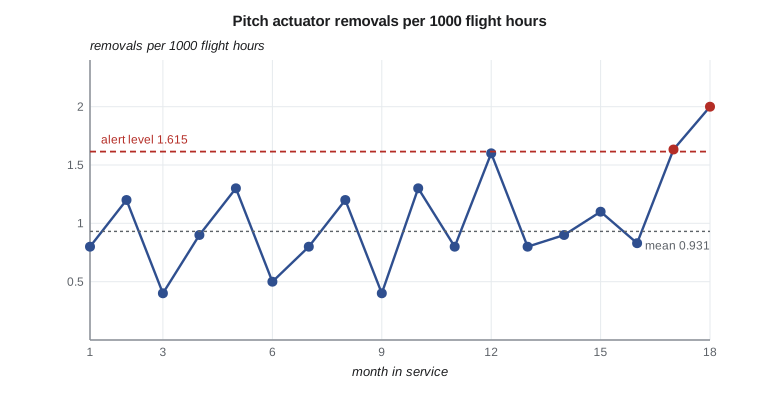
In the Petrel 19's second year, Tomasz Wierzbicki, who moved from aerodynamics to lead the in-service engineering team, sees removals of the propeller pitch actuator rising. The code below shows the method he uses: the alert level is the mean removal rate over the previous twelve months plus two standard deviations.
# Reliability monitoring for the fleet: unscheduled removals of the propeller pitch actuator.
# Alert level = mean + 2 standard deviations of the removal rate over the previous 12 months.
import statistics as st
fleet_hours = [1800, 1850, 1900, 1950, 2000, 2050, 2100, 2150, 2200, 2250, 2300, 2350]
removals    = [2, 1, 3, 2, 2, 1, 2, 3, 2, 2, 1, 2]
rate = [1000 * r / h for r, h in zip(removals, fleet_hours)]   # per 1000 flight hours
mean, sd = st.mean(rate), st.stdev(rate)
alert = mean + 2 * sd
print(f"12-month mean {mean:.3f} per 1000 fh, sd {sd:.3f}, alert level {alert:.3f}")
mtbur = sum(fleet_hours) * 2 / sum(removals)   # two actuators per aircraft
print(f"MTBUR {mtbur:,.0f} actuator hours")
new = [(2400, 2), (2450, 4), (2500, 5)]
for h, r in new:
    x = 1000 * r / h
print(f"month with {h} fh and {r} removals: {x:.3f} {'above alert' if x > alert else 'normal'}")12-month mean 0.931 per 1000 fh, sd 0.342, alert level 1.615 MTBUR 2,165 actuator hours month with 2400 fh and 2 removals: 0.833 normal month with 2450 fh and 4 removals: 1.633 above alert month with 2500 fh and 5 removals: 2.000 above alert
The twelve-month mean is 0.931 removals per thousand flight hours, with a standard deviation of 0.342, giving an alert level of 1.615. The mean time between unscheduled removals is 2,165 actuator hours. A month with two removals in 2,400 flight hours is normal. Two later months, with four removals in 2,450 hours and five in 2,500, are above alert. One high month could be chance; two in succession make Tomasz open an investigation.
Alert levels are a screening tool, not a statistical proof. Setting the level at two standard deviations above the mean means that some false alerts are expected, perhaps a few a year across many measures, and the investigation must sort real trends from noise. Setting the level too high hides real problems; too low, and engineers spend their time chasing nothing. The operator and the type certificate holder agree the method in advance so that nobody adjusts the alert level after the data arrive.
From signal to correction
Tomasz's team pulls the removed actuators and sends them to the supplier for teardown. Most of the units show wear in a seal, and the wear is worst on aircraft that operate on gravel runways. Dust is entering past a boot that was qualified for paved-runway operation. The investigation then asks three questions. Is there an unsafe condition? What is the cause? What is the correction?
The safety assessment classified the loss of one propeller's pitch control as major, not hazardous, because the propeller fails to a safe pitch and the aircraft can continue on the other unit. A seal failure does not by itself create an unsafe condition, so the correction can follow a normal path rather than an emergency one. The supplier redesigns the boot, the type certificate holder issues a service bulletin recommending replacement at the next scheduled actuator removal, and the maintenance planning document adds an inspection of the boot at each A-check for aircraft on gravel operations. If the teardowns had shown a failure that could lead to an uncommanded pitch change, the outcome would have been different: the authority would likely have issued an airworthiness directive.
This distinction is the core of continued airworthiness judgment. Most reliability problems are economic and are corrected by service bulletins and maintenance program changes. A smaller number are safety problems that the authority makes mandatory. The decision between them rests on the same failure condition classification used in certification, which is one reason the safety assessment remains a living document after the type certificate is issued.
Ageing and changing fleets
Continued airworthiness also deals with change over time. Structures age; wiring insulation degrades; corrosion appears in places nobody expected. Operators use aircraft in ways the designers did not anticipate, such as more cycles per day or more operations from contaminated runways. Over decades, ownership changes, records are lost, and parts from different sources are mixed. Programs for ageing aircraft, such as widespread fatigue damage evaluation for transport aeroplanes and supplemental inspections for older small aircraft, address these effects, and the type certificate holder updates its instructions as evidence accumulates.
The Petrel 19 adds the ageing of electrical systems. Battery capacity falls with cycles and calendar time, and the range available on battery power for a go-around or a diversion falls with it. The instructions therefore include a capacity check at defined intervals, and the flight manual performance data account for an end-of-life battery. Kenji Watanabe sees this as a new kind of continued airworthiness task, one that affects performance rather than structural integrity, and asks the team to treat battery health data with the same rigour as structural inspection findings.
Defects, deferrals and the minimum equipment list
Day to day, continued airworthiness is mostly about defects found on the line. A pilot reports that a cabin temperature sensor reads high; a AME finds a chafed wire bundle during a walk-round; a battery module shows a cell imbalance warning. Each defect must be recorded, assessed and either rectified before the next flight or deferred under an approved procedure. The minimum equipment list, approved for the operator and based on the type certificate holder's master minimum equipment list, states which items may be inoperative for dispatch, for how long and under what conditions. An item not on the list must be fixed before flight.
The master minimum equipment list for the Petrel 19 is one of the most negotiated documents in the program. Kivalliq Air Link wants to be able to dispatch with one battery module isolated, because a remote station may wait days for a spare. The safety assessment shows that with one module isolated the aircraft still meets its go-around and diversion requirements at reduced weight, so the item is allowed for a limited number of flight days with a weight restriction and a crew procedure. Sam Littlechild flies the reduced-capability configuration to confirm that the procedure works and that the cockpit indications are clear. Without such provisions a theoretically airworthy aircraft can be commercially useless; with too many, an aircraft can accumulate deferrals until its safety margins have quietly gone. Repeated deferral of the same item is itself a reliability signal that the operator's program must watch.
Repairs and alterations in service
Damaged aircraft are repaired, and operators modify aircraft for new missions. Repairs must follow approved data: the structural repair manual, a repair scheme approved by the type certificate holder, or data approved by the authority or a delegate. Major repairs and alterations need approval and documentation; minor ones can be done to acceptable data. Each repair must be assessed for its effect on the aircraft's damage tolerance, because a repair can change the load path and create a new fatigue-critical location that the original inspection program does not cover.
In Canada, repairs and modifications are classified as major or minor under CAR 571, and major ones need technical data approved under CAR Part V; the work is recorded in the technical records and, for major repairs and modifications, reported as required by the standard.
Worked problem
Reading a reliability chart
A month with 2,450 flight hours has 3 actuator removals. Is it above the alert level of 1.615?
Show solution
- Rate = 3 / 2450 x 1000 = 1.224 per thousand flight hours.
- 1.224 is below 1.615.
Answer: No, it is below alert.
Worked problem
Mandatory or recommended?
A teardown shows that a fuel pump in the turbogenerator can seize, and that both pumps share the same design and life. Seizure of both stops the turbogenerator, which the safety assessment classifies as major because the battery supports a landing. Would you expect a directive?
Show solution
- A single seizure is a reliability issue.
- Both pumps sharing a design and life is a common cause risk; if the battery reserve is degraded, loss of the turbogenerator could become hazardous.
- The authority will review the classification with the holder and decide whether the condition is unsafe.
Answer: Possibly; the common cause and battery dependence may make it an unsafe condition requiring a directive.
Worked problem
MTBUR
Over a year the fleet accumulates 52,000 actuator hours and 24 unscheduled removals. What is the MTBUR?
Show solution
- MTBUR = 52,000 / 24.
Answer: About 2,167 hours.
Common mistakes
MistakeTreating certification as the end of the safety work.
InsteadContinued airworthiness checks and corrects the certification predictions.
MistakeIgnoring small service reports.
InsteadTheir value is in aggregation across the fleet.
MistakeAdjusting alert levels after seeing the data.
InsteadThe method is agreed in advance.
MistakeAssuming every reliability problem needs a directive.
InsteadOnly unsafe conditions are mandated; others are corrected by service bulletins and program changes.
MistakeRepairing structure without assessing damage tolerance.
InsteadRepairs can create new fatigue-critical locations.
Summary and key terms
- Continued airworthiness compares service experience with certification predictions and corrects the design, maintenance or operation.
- The type certificate holder provides instructions for continued airworthiness, including mandatory airworthiness limitations, and analyses reports.
- Operators maintain aircraft to approved programs and report service difficulties.
- Reliability programs set alert levels, typically the mean plus two standard deviations, and investigate exceedances.
- Most problems are corrected by service bulletins; unsafe conditions lead to directives.
- Ageing, repairs and battery degradation are managed over the life of the fleet.
- Instructions for continued airworthiness
- The holder's maintenance documentation for the type.
- Airworthiness limitations section
- The mandatory, approved life limits and inspections.
- Service difficulty report
- A report of a failure, malfunction or defect in service.
- Reliability program
- A process that monitors measures against alert levels and investigates exceedances.
- Alert level
- A threshold, often the mean plus two standard deviations, that triggers investigation.
- MTBUR
- Mean time between unscheduled removals.
- Unsafe condition
- A condition that the authority determines needs mandatory correction.
- Major repair
- A repair that could appreciably affect airworthiness and needs approved data.
Practice problems
Work each problem on paper first, then reveal the answer to check.
Who must provide instructions for continued airworthiness?
Show answer
The type certificate holder.
Can an operator relax an airworthiness limitation?
Show answer
No; it is mandatory.
What alert level results from a mean of 0.931 and a standard deviation of 0.342?
Show answer
1.615 per thousand flight hours.
Why did Tomasz wait for two months above alert?
Show answer
One month could be chance; two in a row suggests a trend.
What decides whether a problem leads to a directive?
Show answer
Whether it is an unsafe condition, judged with the failure classification.
What new ageing effect does the Petrel 19 add?
Show answer
Battery capacity loss, which affects performance.
Lesson quiz · 5 questions
Score 60% or more to complete this lesson.
Create a free account to save your progress, take quizzes and earn a certificate.