
AERO-430 · Lesson 2 of 12 · 25 min
Transport Canada and the Canadian Aviation Regulations
Rachel Oduya's first briefing for the Petrel 19 team is a map of the rulebook. Engineers who have spent their careers on aerodynamics or structures often meet the regulations only as a list of section numbers in a compliance report. Rachel wants them to understand how the system is organized, who wrote each part, and where to look when a question arises that the design standard does not answer. In Canada the authority is Transport Canada Civil Aviation (TCCA), part of the federal department of transport, and its rules are the Canadian Aviation Regulations, made under the Aeronautics Act.
The structure of the CARs
The Canadian Aviation Regulations (CARs) are divided into eight parts. Part I covers general provisions, including definitions and the administrative and enforcement procedures. Part II covers aircraft identification and registration. Part III covers aerodromes and airports. Part IV covers personnel licensing and training, including pilots and aircraft maintenance engineers. Part V covers airworthiness: design approval, manufacture, certificates of airworthiness, maintenance and approved maintenance organizations. Part VI covers general operating and flight rules. Part VII covers commercial air services, from aerial work under Subpart 702 to commuter operations under Subpart 704 and airlines under Subpart 705. Part VIII covers air navigation services.
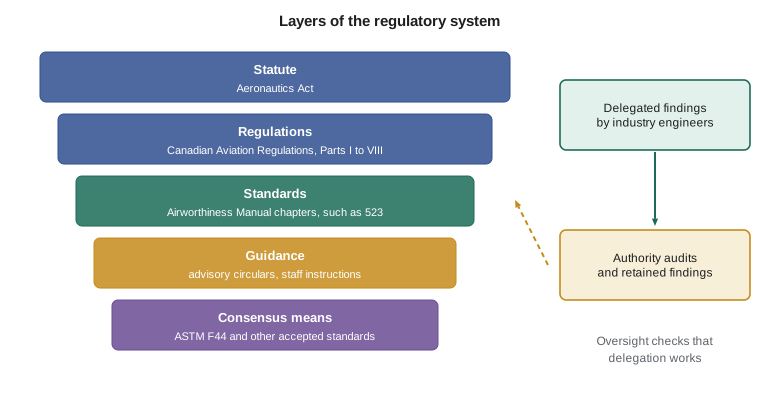
Each CAR is supported by a standard, published in the same numbering. For design, the standards are collected in the Airworthiness Manual: Chapter 523 for normal category aeroplanes, Chapter 525 for transport category aeroplanes, Chapter 527 and 529 for rotorcraft, Chapter 533 for engines and Chapter 535 for propellers. The regulation says that a type design must meet the applicable standard; the standard says what that is. This two-level arrangement lets TCCA update technical detail without amending the regulation itself.
| Subject | Canada | United States |
|---|---|---|
| Definitions and enforcement | CAR Part I | 14 CFR Parts 1 and 13 |
| Design approval procedure | CAR Part V, Subpart 21 | 14 CFR Part 21 |
| Normal category aeroplanes | Airworthiness Manual Chapter 523 | 14 CFR Part 23 |
| Transport category aeroplanes | Airworthiness Manual Chapter 525 | 14 CFR Part 25 |
| Engines and propellers | Chapters 533 and 535 | Parts 33 and 35 |
| Maintenance | CAR 571 | Part 43 |
| Maintenance organizations | CAR 573 | Part 145 |
| Technician licensing | CAR Part IV, Subpart 3 and Standard 566 | Part 65 |
| Commuter operations | CAR 704 | Part 135 |
| Safety management | CAR 107 and Part VII | Part 5 |
How rules are made and changed
New or amended regulations go through a public process. TCCA consults industry through the Canadian Aviation Regulation Advisory Council and publishes proposed regulations in Part I of the Canada Gazette for comment before they are made and published in Part II. Standards are amended through a similar consultation process. Advisory circulars, staff instructions and policy letters are issued by TCCA without the full regulatory process, because they guide rather than bind.
For an applicant, the practical lesson is that the rule text alone is never enough. The preamble or the regulatory impact analysis explains what the rule intends, and the advisory material shows what the authority will accept. Arjun keeps a folder for each requirement with all three, and finds that half his questions are answered by reading why a rule was written.
Delegation
No authority has enough engineers to review every calculation and witness every test for every aircraft. The Canadian system therefore delegates. TCCA authorizes qualified individuals in industry, called design approval representatives (DARs), to make findings of compliance on its behalf in defined areas. An organization may also hold a design approval organization (DAO) authorization, which allows it to manage approvals internally under a TCCA-approved manual. The delegate's finding is legally TCCA's finding, and the delegate must act independently of commercial pressure from the employer.
Delegation does not mean the authority steps back. It retains the findings it judges most significant, typically new technology, novel design features and anything where the company's own engineers might be tempted to accept less. For the Petrel 19, the hybrid powertrain is new to everyone, so TCCA will keep most powerplant and systems findings for itself. The code below estimates the split.
# Who finds compliance? Splitting the Petrel 19 compliance findings between
# the authority's own engineers and delegated company engineers.
findings = {'structures': 96, 'flight': 58, 'powerplant': 71, 'systems': 88, 'crashworthiness': 24}
retained = {'structures': 0.15, 'flight': 0.40, 'powerplant': 0.60, 'systems': 0.45, 'crashworthiness': 0.20}
hours_each = 14  # average review effort per finding, hours (illustrative)
auth = deleg = 0
for k, n in findings.items():
    a = round(n * retained[k]); auth += a; deleg += n - a
    print(f"{k:16s} total {n:3d}  authority {a:3d}  delegate {n - a:3d}")
print(f"authority keeps {auth} findings ({auth/(auth+deleg):.0%}), about {auth*hours_each} review hours")
print(f"delegates make {deleg} findings ({deleg/(auth+deleg):.0%}), about {deleg*hours_each} hours inside the company")structures total 96 authority 14 delegate 82 flight total 58 authority 23 delegate 35 powerplant total 71 authority 43 delegate 28 systems total 88 authority 40 delegate 48 crashworthiness total 24 authority 5 delegate 19 authority keeps 125 findings (37%), about 1750 review hours delegates make 212 findings (63%), about 2968 hours inside the company
The authority keeps a little over a third of the findings, but these are the ones that drive the schedule. Rachel uses the estimate to agree a resourcing plan with the authority's project manager: if the authority's engineers have only a few hundred hours for the project in a given quarter, the company must schedule its submissions so they do not all arrive at once.
Working across the border
Kivalliq Air Link is the launch customer, but operators in Alaska have also shown interest, so the Petrel 19 must be validated by the Federal Aviation Administration. Canada and the United States have a Bilateral Aviation Safety Agreement (BASA) with implementation procedures for airworthiness. Under it, the FAA validates a Canadian type certificate rather than certifying the design again from the beginning. The depth of the validation review depends on how novel the design is and on the FAA's confidence in TCCA's findings. For a hybrid powertrain the FAA will want to understand the special conditions in detail, so Rachel invites FAA specialists to the early technical meetings, a practice the agreement encourages.
Validation also creates a practical rule for the design team: where the two countries' standards differ, design to the more demanding one from the start. Late discovery of a difference, such as a different interpretation of a cold-weather operation requirement, can mean redesign after certification, the most expensive time to change anything.
Enforcement
TCCA can suspend or cancel certificates, issue administrative monetary penalties under the Aeronautics Act, and refer serious matters for prosecution. Penalties are designated in CAR Part I. Appeals go to the Transportation Appeal Tribunal of Canada. Most compliance issues, however, are resolved through findings in audits and corrective action plans, which are part of normal oversight.
Advisory material and consensus standards
Below the regulations and standards sits a large body of guidance. TCCA advisory circulars explain acceptable means of compliance and administrative processes; staff instructions tell TCCA's own inspectors and engineers how to apply the rules, and are published so applicants can see what will be expected. Where Canada has no guidance of its own on a subject, TCCA frequently accepts FAA advisory circulars or EASA acceptable means of compliance, which is efficient but means the Petrel 19 team must track three sets of documents. Rachel's rule is that every acceptance of foreign guidance is written into the certification plan and agreed with TCCA, not assumed.
The newest layer is industry consensus standards. When the normal category rules were rewritten as performance objectives, the detailed design methods were moved into standards written by committees of manufacturers, authorities and specialists, principally ASTM International Committee F44 on general aviation aircraft. An authority can accept a consensus standard as a means of compliance, in whole or with exceptions. The advantage is speed: a committee can update a method far faster than a regulation can be amended. The cost is that an applicant must check which revision of a standard has been accepted, and whether the authority listed any exceptions, before relying on it.
For the Petrel 19, which uses both conventional structure and a hybrid powertrain, the result is a layered compliance picture. Structural loads follow long-established methods that have barely changed in decades. The powertrain relies on special conditions written for this aircraft and on consensus standards that are still evolving. Rachel tells the team that the more novel a feature is, the more of its compliance story must be negotiated rather than looked up, and that negotiation needs to start early.
How the authority oversees the applicant
Oversight of a design organization does not end with individual findings. TCCA audits the company's design approval processes, checks that delegates are working within their authorized areas, samples completed findings to verify them, and reviews the company's handling of problems found after certification. An organization holding a design approval organization authorization must keep its procedures manual current and report changes to TCCA. When oversight finds weaknesses, TCCA can restrict a delegation or require additional authority involvement until the company shows that the problem has been corrected.
From the company side, good oversight is an asset. Marcus Webb, who leads structures, argues that every audit finding the authority raises is a weakness the company would otherwise discover later at greater cost. He asks that audit reports be circulated to all engineering leads, not filed by the quality department alone, so that the lessons reach the people who design the aircraft.
A map for the Petrel 19 team
Rachel closes her briefing with a single page that maps the program onto the rules. Design approval runs under CAR 521 against Chapter 523 of the Airworthiness Manual, with special conditions for the hybrid powertrain. Production approval, covered in Lesson 5, is a separate certificate with its own rules. Once the aircraft enters service, the operator's maintenance program and the technicians who sign for work are governed by CAR 571, the operator's rules and the licensing rules covered in Lesson 8. Airworthiness directives, safety management and accident investigation each sit in their own part of the system. The engineers who will spend the next four years on the Petrel 19 do not need to memorize the rulebook, but they need to know where each question belongs, because a question asked of the wrong rule gets the wrong answer.
Arjun asks the obvious question: what happens when the rules simply do not address something? Rachel's answer is that the system has a tool for that, the special condition, and that Lesson 4 is largely about how such gaps are handled. Until then, she asks the team to flag anything for which they cannot find a clear requirement, rather than deciding on their own what an acceptable answer would be.
Worked problem
Finding the right rule
Arjun needs the rule that governs how a mechanic records a repair on a Petrel 19 in commercial service. Where does he look?
Show solution
- Maintenance records are an airworthiness subject, so CAR Part V.
- CAR 571 covers maintenance, including the maintenance release; Part VII adds the operator's requirements under CAR 704 for commuter operations.
Answer: CAR 571 and its standard, supplemented by the operator's rules in CAR 704.
Worked problem
Estimating authority workload
Using the code output, if the authority's engineers can give the project 600 hours a quarter, how many quarters will their retained findings take at minimum?
Show solution
- Retained findings: 125, at about 14 hours each, give 1750 hours.
- 1750 divided by 600 is 2.9 quarters.
Answer: At least three quarters of authority engineering time, which must be scheduled across the program.
Worked problem
Delegate independence
A DAR at Borealis Aerospace is asked by a program manager to approve a test report quickly because a milestone payment depends on it. The report has an unexplained data gap. What should the delegate do?
Show solution
- The finding is made on the authority's behalf, so commercial pressure is irrelevant.
- The delegate requests the missing data or an engineering explanation before making any finding.
- If pressure continues, the delegate informs the authority, as delegation procedures require.
Answer: Withhold the finding until the data gap is resolved.
Common mistakes
MistakeReading the rule without its advisory material and preamble.
InsteadThe intent and the accepted means of compliance are often explained only there.
MistakeThinking a delegate acts for the company.
InsteadA delegate acts for the authority when making findings.
MistakeAssuming a design certified in one country is automatically accepted in another.
InsteadIt must be validated under the bilateral agreement.
MistakeDesigning to the home country's standard and fixing differences later.
InsteadIdentify differences early and meet the more demanding requirement from the start.
MistakeTreating enforcement as the authority's main tool.
InsteadMost issues are corrected through audit findings and corrective action.
Summary and key terms
- Canadian aviation is regulated by TCCA under the Aeronautics Act through the CARs, organized in eight parts, with Part V covering airworthiness and the Airworthiness Manual chapters setting the design standards.
- Rules are made through public consultation, while advisory circulars guide without binding.
- TCCA delegates findings to DARs and design approval organizations but keeps significant findings.
- The BASA with the United States allows validation rather than recertification.
- CARs
- The Canadian Aviation Regulations.
- Airworthiness Manual
- The collection of Canadian design standards, by chapter.
- DAR
- An individual delegated by TCCA to make findings.
- DAO
- An organization delegated to manage design approvals.
- BASA
- A bilateral agreement allowing validation of each other's approvals.
- Validation
- Acceptance of another authority's certificate with a review scaled to novelty.
- Amendment level
- The version of a standard that applies to a given design.
- Preamble
- The explanation published with a rule describing its intent.
Practice problems
Work each problem on paper first, then reveal the answer to check.
Which CAR part covers airworthiness?
Show answer
Part V.
Which chapter of the Airworthiness Manual applies to the Petrel 19?
Show answer
Chapter 523.
What is a delegate's finding legally?
Show answer
A finding made on behalf of the authority.
Why does the authority keep findings on the hybrid powertrain?
Show answer
Because it is novel and the most safety-significant area for the program.
What does the BASA allow?
Show answer
Validation of the other country's approvals rather than full recertification.
Where does a newcomer find a rule's intent?
Show answer
In its preamble or impact analysis and in the related advisory material.
Lesson quiz · 5 questions
Score 60% or more to complete this lesson.
Create a free account to save your progress, take quizzes and earn a certificate.