
ACCT-101 · Lesson 5 of 12 · 34 min
Adjusting entries I: accrual accounting and deferrals
The trial balance in lesson 4 balanced, but it was not yet ready to become financial statements. Birchwood Bikes had used a month of its insurance policy, used some of its supplies and worn its equipment by a month, yet none of that had been recorded, because no transaction with an outsider had taken place. Adjusting entries fix this. They are made at the end of each period so that revenues are recorded in the period they are earned and expenses in the period they are incurred. This lesson explains why adjustments are needed, contrasts accrual with cash accounting, and covers the first family of adjustments, deferrals: prepaid expenses and unearned revenues. Lesson 6 covers accruals and depreciation and prepares the adjusted trial balance.
Accrual accounting and the cash basis
Under the cash basis, revenue is recorded when cash is received and expenses when cash is paid. It is simple and is sometimes used for very small businesses' internal records and, within limits, for some tax purposes. But it can badly misstate performance. A business that paid a year's insurance in January would show a large expense in January and none for the rest of the year; a business that finished a big job in December but was paid in January would show the revenue in the wrong year. Accrual accounting, required by IFRS, ASPE and US GAAP, records the economic effects of transactions in the periods in which they occur, whether or not cash has moved.
Two ideas guide accrual accounting. Revenue recognition says revenue is recorded when the business satisfies its obligation to a customer, usually when goods are delivered or services performed, at the amount it expects to be entitled to. The full five-step model for contracts with customers (IFRS 15 and ASPE 3400 in Canada, ASC 606 in the US) is covered in ACCT-211; in this course, revenue is earned when the work is done or the goods are handed over. Expense recognition, often called matching, says expenses are recorded in the period in which they help earn revenue or in which the related benefit is used up. Rent for May is a May expense whether it is paid in April, May or June.
Worked problem
Cash basis versus accrual basis
A consultant performs $6,000 of work in December, bills the client, and is paid on 10 January. On 1 December she paid $2,400 for 12 months of software subscriptions. What are December's revenue and software expense under each basis?
Show solution
- Cash basis: December revenue $0 (no cash received); December software expense $2,400 (cash paid).
- Accrual basis: December revenue $6,000 (work done); December software expense 2,400 ÷ 12 = $200 (one month used).
- Cash basis shows a December loss of $2,400; accrual basis shows a profit of $5,800.
Answer: The accrual basis reports what was earned and used in December; the cash basis reports only when cash moved.
Why adjustments are needed
Most transactions are recorded when a source document arrives: an invoice, a receipt, a payroll register. But some revenues and expenses build up continuously or are used up gradually without any document marking each step. Insurance expires day by day. Supplies are used a few at a time. Equipment wears out over years. Employees earn wages every day but are paid every two weeks. Interest grows on a loan between payment dates. At the end of each period, the accountant must record these changes so that the statements are complete. Every adjusting entry involves one income statement account (a revenue or expense) and one balance sheet account (an asset or liability), and no adjusting entry involves cash. If an entry you are calling an adjustment debits or credits cash, it is not an adjustment; it is a transaction.
| Type | Situation before adjustment | Adjusting entry | Example |
|---|---|---|---|
| Prepaid expense (deferral) | Asset recorded when paid; part now used | Debit expense, credit asset | Insurance, supplies, rent paid in advance |
| Unearned revenue (deferral) | Liability recorded when cash received; part now earned | Debit liability, credit revenue | Subscriptions, deposits, gift cards, tune-up packages |
| Accrued revenue (accrual) | Revenue earned but not yet recorded or billed | Debit receivable, credit revenue | Work done at month end, interest earned |
| Accrued expense (accrual) | Expense incurred but not yet recorded or paid | Debit expense, credit liability | Wages, interest, utilities |
| Depreciation (allocation) | Long-lived asset used over many periods | Debit depreciation expense, credit accumulated depreciation | Equipment, vehicles, buildings |
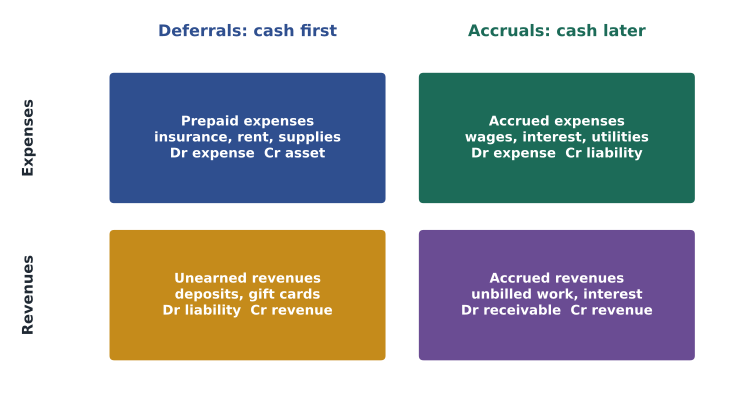
Prepaid expenses
A prepaid expense is a payment for goods or services that will benefit future periods. When it is paid, it is recorded as an asset. As the benefit is used, the used portion is moved to expense by an adjusting entry that debits the expense and credits the asset. Common examples are insurance, rent paid in advance, software subscriptions, supplies and advertising paid before it runs.
Worked problem
Insurance used in May
On 5 May Birchwood Bikes paid $3,600 for a 12-month insurance policy starting 1 May, debiting Prepaid insurance. What adjustment is needed on 31 May?
Show solution
- Monthly cost = 3,600 ÷ 12 = $300; one month has expired.
- Adjusting entry: debit Insurance expense 300; credit Prepaid insurance 300.
- After adjustment, Prepaid insurance = 3,600 − 300 = $3,300, the cost of the 11 months still to come.
- Without the adjustment, May expenses would be understated by $300, net income overstated by $300 and assets overstated by $300.
Answer: Debit Insurance expense $300; credit Prepaid insurance $300.
Worked problem
Supplies used in May
Birchwood Bikes bought $1,500 of repair supplies on 8 May. A count on 31 May finds $900 of supplies on hand. Record the adjustment.
Show solution
- Supplies used = supplies available − supplies on hand = 1,500 − 900 = $600.
- Adjusting entry: debit Supplies expense 600; credit Supplies 600.
- After adjustment, the Supplies account shows $900, matching the count.
Answer: Debit Supplies expense $600; credit Supplies $600.
Supplies are a good example of why a physical count matters. Bookkeepers do not record each tube of grease or roll of tape as it is used, so the only practical way to measure usage is to count what is left. The same logic, on a larger scale, applies to merchandise inventory under a periodic system (lesson 8). If the count is skipped, the asset and the expense are both wrong.
# Prepaid expenses: how much to expense each month (illustrative)
def months_used(start_month, end_month):
    return end_month - start_month + 1

policy_cost, term = 3600, 12
for m in range(1, 4):                      # May, June, July
    used = months_used(1, m)
    expense_to_date = policy_cost * used / term
    print(f"After month {m}: expense to date {expense_to_date:,.0f}, "
          f"prepaid left {policy_cost - expense_to_date:,.0f}")

# Supplies: usage comes from a count
opening, bought, counted = 0, 1500, 900
print("Supplies expense for May:", opening + bought - counted)After month 1: expense to date 300, prepaid left 3,300 After month 2: expense to date 600, prepaid left 3,000 After month 3: expense to date 900, prepaid left 2,700 Supplies expense for May: 600
Unearned revenues
An unearned revenue (deferred revenue, or contract liability) arises when a customer pays before the business delivers. When the cash arrives, the business debits cash and credits a liability, because it owes the customer goods, services or a refund. As the business delivers, it moves the earned portion to revenue by debiting the liability and crediting revenue. Airlines selling tickets in advance, magazines selling subscriptions, retailers selling gift cards, landlords collecting rent in advance and software companies selling annual licences all have large unearned revenue balances.
Worked problem
A tune-up package
On 2 June Birchwood Bikes received $900 for a summer tune-up package: three tune-ups, one in each of June, July and August. It recorded debit Cash 900, credit Unearned revenue 900. The June tune-up was done on 20 June. Record the 30 June adjustment.
Show solution
- One of three services has been performed, so 900 ÷ 3 = $300 is earned.
- Adjusting entry: debit Unearned revenue 300; credit Service revenue 300.
- After adjustment, Unearned revenue is $600, the value of the two tune-ups still owed.
Answer: Debit Unearned revenue $300; credit Service revenue $300.
Worked problem
Gift cards and breakage
A café sells $10,000 of gift cards in December. By 31 January, customers have redeemed $6,500. History shows that about 5 % of cards are never used.
Show solution
- On sale: debit Cash 10,000; credit Unearned revenue (gift card liability) 10,000.
- On redemption, revenue is recognized as coffee is sold: by 31 January, debit Unearned revenue 6,500; credit Sales revenue 6,500.
- Expected unused amounts (breakage) can be recognized as revenue in proportion to redemptions once the pattern is reliable; ACCT-211 covers the rule.
- Some provinces and states restrict expiry dates and fees on gift cards; consumer protection law, not accounting, sets those rules.
Answer: Revenue follows redemptions, not sales; the unredeemed balance remains a liability.
The alternative recording method
Some businesses record prepayments directly as expenses and advance receipts directly as revenue, and then adjust at period end to set up the asset or liability that remains. For example, if the $3,600 insurance payment had been debited to Insurance expense, the 31 May adjustment would debit Prepaid insurance $3,300 and credit Insurance expense $3,300, leaving $300 of expense. Both methods produce the same adjusted balances; the difference is only in the starting point. What matters is to know which method the business uses before writing the adjustment, by looking at where the original amount was recorded.
| Step | Asset-first method | Expense-first method |
|---|---|---|
| 5 May payment | Dr Prepaid insurance 3,600 / Cr Cash 3,600 | Dr Insurance expense 3,600 / Cr Cash 3,600 |
| 31 May adjustment | Dr Insurance expense 300 / Cr Prepaid insurance 300 | Dr Prepaid insurance 3,300 / Cr Insurance expense 3,300 |
| Adjusted balances | Prepaid 3,300; expense 300 | Prepaid 3,300; expense 300 |
Effects of omitting deferral adjustments
It is worth knowing exactly how a missed adjustment distorts the statements, both to understand why adjustments matter and to answer questions about errors. If a prepaid expense adjustment is omitted, expenses are understated, net income is overstated, assets are overstated and equity is overstated, all by the same amount. If an unearned revenue adjustment is omitted, revenue is understated, net income is understated, liabilities are overstated and equity is understated. Cash is never affected by an adjustment, so cash is never misstated by a missed adjustment.
| Omitted adjustment | Revenue | Expense | Net income | Assets | Liabilities | Equity |
|---|---|---|---|---|---|---|
| Prepaid expense used | no effect | understated | overstated | overstated | no effect | overstated |
| Unearned revenue earned | understated | no effect | understated | no effect | overstated | understated |
Professional judgement in deferrals
Most deferrals are simple arithmetic, but some involve judgement. If a tune-up package can be used at any time over a year, should revenue be recognized evenly, or as each tune-up is done? If customers often fail to use what they have paid for, when should that unused amount become revenue? If a supplier invoice covers both past and future periods, how should it be split? The general principle is to follow the pattern in which the business delivers to the customer or consumes the benefit, document the basis, and apply it consistently. Managers sometimes face pressure to recognize deferred revenue early to meet a target; that is one of the most common ways financial statements are manipulated, and auditors test deferred revenue closely for that reason.
Common mistakes
MistakeRecording a full year's insurance as an expense in the month it is paid.
InsteadRecord it as prepaid insurance and expense one month at a time (or adjust at period end if it was recorded as an expense).
MistakeIncluding cash in an adjusting entry.
InsteadAdjusting entries never involve cash; they pair a balance sheet account with an income statement account.
MistakeRecording revenue when a customer pays in advance.
InsteadCredit unearned revenue, a liability; recognize revenue as the goods or services are delivered.
MistakeUsing the amount bought as supplies expense without counting what is left.
InsteadSupplies expense = opening supplies + purchases − supplies on hand at the count.
MistakeWriting an adjustment without checking whether the original amount went to an asset or an expense.
InsteadLook at the unadjusted balance first; the method used determines the adjusting entry.
Summary and key terms
- Accrual accounting records revenues when earned and expenses when incurred, regardless of cash timing.
- Adjusting entries are made at period end and always pair an income statement account with a balance sheet account; they never involve cash.
- Prepaid expenses are assets that become expenses as they are used: debit expense, credit asset.
- Supplies used = supplies available − supplies counted on hand.
- Unearned revenues are liabilities that become revenue as goods or services are delivered: debit liability, credit revenue.
- Asset-first and expense-first recording methods reach the same adjusted balances.
- Missing a deferral adjustment misstates income and either assets or liabilities, but never cash.
- Accrual basis of accounting
- Recording revenues when earned and expenses when incurred, regardless of when cash is received or paid.
- Cash basis of accounting
- Recording revenues when cash is received and expenses when cash is paid.
- Adjusting entry
- An end-of-period entry that updates accounts so revenues and expenses are recorded in the correct period.
- Deferral
- An adjustment for cash received or paid before the related revenue is earned or expense incurred.
- Prepaid expense
- A payment for goods or services that will benefit future periods; an asset until used.
- Unearned revenue
- Cash received before goods or services are delivered; a liability until earned.
- Revenue recognition
- The principle that revenue is recorded when the entity satisfies its obligations to a customer.
- Expense recognition (matching)
- The principle that expenses are recorded in the period in which they help earn revenue or the benefit is used.
- Contract liability
- The term used in revenue standards for an obligation to deliver goods or services for which payment has been received.
- Breakage
- The portion of prepaid amounts, such as gift cards, that customers are not expected to use.
Practice problems
Work each problem on paper first, then reveal the answer to check.
On 1 October a business pays $4,800 for 12 months of rent. Record the payment and the 31 December adjustment (asset-first method).
Show answer
Payment: debit Prepaid rent 4,800, credit Cash 4,800. Adjustment: debit Rent expense 1,200 (3 months × 400), credit Prepaid rent 1,200.
Repeat the previous question using the expense-first method.
Show answer
Payment: debit Rent expense 4,800, credit Cash 4,800. Adjustment: debit Prepaid rent 3,600, credit Rent expense 3,600.
Supplies were $400 at the start of the month, $1,100 were bought and $350 remain. Find supplies expense.
Show answer
400 + 1,100 − 350 = $1,150.
A magazine collects $36,000 in annual subscriptions on 1 September. How much revenue is earned by 31 December?
Show answer
36,000 × 4 ÷ 12 = $12,000.
Why does no adjusting entry involve cash?
Show answer
Adjustments record changes that happen without a cash transaction, such as using up a prepaid asset or earning a deposit.
A business forgot to record $500 of insurance expired. Effects on net income, assets and cash?
Show answer
Net income overstated $500; assets overstated $500; cash unaffected.
A business forgot to record $800 of unearned revenue that was earned. Effects?
Show answer
Revenue and net income understated $800; liabilities overstated $800; equity understated $800.
Give three examples of unearned revenue in businesses you know.
Show answer
Gift cards, airline tickets, gym memberships, software subscriptions, concert tickets.
Under the cash basis, when is wages expense recorded?
Show answer
When wages are paid in cash.
Extend the Python program to show prepaid insurance after 12 months.
Show answer
Expense to date 3,600; prepaid left 0.
Lesson quiz · 5 questions
Score 60% or more to complete this lesson.
Create a free account to save your progress, take quizzes and earn a certificate.