
ACCT-101 · Lesson 11 of 12 · 32 min
Receivables
Selling on credit increases sales: business customers expect to pay on terms such as 30 days, and many consumers buy larger items on instalments. But credit sales create a new asset, receivables, and a new risk, that some customers will never pay. This lesson covers the kinds of receivables, how they are recorded, how a business estimates and reports the amount it expects not to collect, how write-offs and recoveries are recorded, how notes receivable earn interest, how card sales and factoring turn receivables into cash, and how managers measure how well receivables are being collected.
Kinds of receivables
Accounts receivable, also called trade receivables, are amounts customers owe for goods and services sold on credit in the normal course of business. They are usually due within 30 to 60 days, carry no interest unless paid late, and are reported as current assets. Notes receivable are written promises to pay a definite sum, usually with interest, on a specified date; they are used for larger or longer credit arrangements, to settle an overdue account, or for loans. Other receivables include amounts owed by employees, interest receivable, tax refunds receivable and amounts owed by related parties, which are reported separately because they do not arise from ordinary sales.
Large businesses keep a control account, Accounts receivable, in the general ledger and a subsidiary ledger (subledger) with a separate account for each customer. The total of the subledger must equal the control account; reconciling the two each month is a basic control. The subledger also produces customer statements and the aging schedule used below.
Recognizing accounts receivable
A receivable is recorded when revenue is earned and the customer is invoiced, at the amount the business expects to be entitled to: the invoice price less any trade discounts. Sales returns and early-payment discounts reduce receivables as covered in lesson 8. When the customer pays, Cash is debited and Accounts receivable credited.
Why an allowance is needed
Some customers will not pay. Under accrual accounting, the cost of those bad debts belongs in the period of the sales that created them, and the balance sheet should show receivables at the amount the business actually expects to collect. Waiting until a specific customer is known to be uncollectible, months later, would put the expense in the wrong period and overstate the asset in the meantime. So businesses estimate expected losses at each reporting date and record them in an allowance account.
The allowance for doubtful accounts (also called the allowance for expected credit losses or loss allowance) is a contra asset account, deducted from accounts receivable. The adjusting entry debits Bad debt expense (or credit loss expense) and credits the allowance. The net amount, receivables less the allowance, is the amount expected to be collected.
Under IFRS 9, trade receivables without a significant financing component are measured with the simplified approach: the loss allowance is always equal to lifetime expected credit losses, often estimated with a provision matrix that applies loss rates to aging buckets, adjusted for current conditions and reasonable forecasts. ASPE requires receivables to be written down when they are impaired, and in practice uses the same aging and percentage-of-sales techniques. Both are covered in more depth in ACCT-211.
Estimating the allowance
Two traditional techniques are used, often together. The percentage-of-sales approach estimates bad debt expense as a percentage of credit sales for the period, based on experience; it focuses on the income statement and is quick to apply monthly. The aging approach classifies receivables by how long they have been outstanding and applies a higher expected loss rate to older balances; it focuses on the balance sheet, produces the required ending balance of the allowance, and the expense is whatever amount brings the allowance to that balance. The aging approach is closer to the expected-loss thinking of modern standards and is usually used at year end.
# Aging schedule and required allowance (illustrative loss rates)
receivables = [   # customer, amount, days outstanding
    ("Cycling club", 1000, 14), ("Courier Co.", 2400, 38),
    ("School board", 3600, 9), ("R. Singh", 450, 75),
    ("Trail Riders", 1250, 52), ("B. Laurent", 380, 130),
    ("City parks", 2900, 22), ("J. Moreau", 620, 95),
]
buckets = [(0, 30, 0.01), (31, 60, 0.04), (61, 90, 0.15), (91, 10**6, 0.40)]
total_required = 0
for lo, hi, rate in buckets:
    amt = sum(a for _, a, d in receivables if lo <= d <= hi)
    req = amt * rate
    total_required += req
    label = f"{lo}-{hi}" if hi < 10**6 else f"over {lo - 1}"
    print(f"{label:<10} days  {amt:>7,}  x {rate:>4.0%} = {req:>7,.2f}")
print(f"Total receivables {sum(a for _, a, _ in receivables):,}")
print(f"Required allowance {total_required:,.2f}")

existing_credit_balance = 210.00
expense = total_required - existing_credit_balance
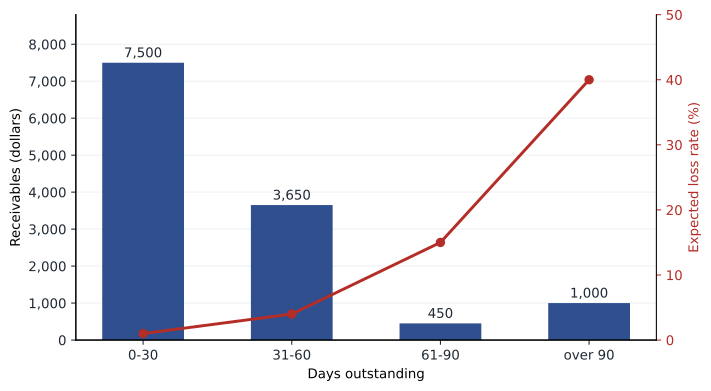
print(f"Bad debt expense to record {expense:,.2f}")0-30 days 7,500 x 1% = 75.00 31-60 days 3,650 x 4% = 146.00 61-90 days 450 x 15% = 67.50 over 90 days 1,000 x 40% = 400.00 Total receivables 12,600 Required allowance 688.50 Bad debt expense to record 478.50
Total receivables are $12,600 and the required allowance is $688.50. If the allowance already has a credit balance of $210 left over from earlier estimates, the adjusting entry records only the difference: debit Bad debt expense $478.50, credit Allowance for doubtful accounts $478.50. If the allowance had a debit balance, because write-offs during the year exceeded earlier estimates, the expense would be the required balance plus that debit balance. Reported net receivables are $12,600 − $688.50 = $11,911.50.
| Days outstanding | Amount | Expected loss rate | Required allowance |
|---|---|---|---|
| 0–30 | $7,500 | 1 % | $75.00 |
| 31–60 | $3,650 | 4 % | $146.00 |
| 61–90 | $450 | 15 % | $67.50 |
| Over 90 | $1,000 | 40 % | $400.00 |
| Total | $12,600 | $688.50 |
Worked problem
Checking the aging schedule by hand
Before booking the adjustment, the bookkeeper recomputes the program's buckets from the customer list. Do the figures hold?
Show solution
- 0–30 days: cycling club 1,000 + school board 3,600 + city parks 2,900 = 7,500; × 1 % = 75.00.
- 31–60 days: courier 2,400 + Trail Riders 1,250 = 3,650; × 4 % = 146.00.
- 61–90 days: R. Singh 450; × 15 % = 67.50. Over 90 days: B. Laurent 380 + J. Moreau 620 = 1,000; × 40 % = 400.00.
- Total = 75.00 + 146.00 + 67.50 + 400.00 = $688.50, matching the program and the table.
- The two oldest accounts make up 8 % of receivables but 58 % of the required allowance, which tells management where to focus collection effort.
Answer: The required allowance is $688.50; the adjustment is $478.50 given the $210 credit balance.
Worked problem
Percentage of sales
Credit sales for the year are $310,000. Experience suggests 0.8 % will prove uncollectible. Record the year's estimate.
Show solution
- Bad debt expense = 0.8 % × 310,000 = $2,480.
- Entry: debit Bad debt expense 2,480; credit Allowance for doubtful accounts 2,480.
- At year end the business should still check the resulting allowance against an aging schedule and adjust if needed.
Answer: Debit Bad debt expense $2,480; credit Allowance $2,480.
Write-offs and recoveries
When a specific account is judged uncollectible, for example because the customer has gone bankrupt or collection efforts have failed, it is written off by debiting the allowance and crediting Accounts receivable (and the customer's subledger account). The write-off does not affect expense or net receivables, because the expense was already recognized when the allowance was set up; it simply removes an amount both from receivables and from the allowance. If the customer later pays after all, the write-off is reversed (debit Accounts receivable, credit Allowance) and the collection recorded as usual (debit Cash, credit Accounts receivable), so the customer's history shows the payment.
Worked problem
Write-off and recovery
In August Birchwood writes off B. Laurent's $380 balance. In November Laurent unexpectedly pays $380.
Show solution
- August write-off: debit Allowance for doubtful accounts 380; credit Accounts receivable 380.
- Net receivables before and after: (12,600 − 688.50) and (12,220 − 308.50) are both $11,911.50.
- November recovery: debit Accounts receivable 380; credit Allowance 380. Then debit Cash 380; credit Accounts receivable 380.
Answer: A write-off changes gross receivables and the allowance equally; net receivables and expense are unaffected.
The direct write-off method, which records bad debt expense only when a specific account is written off, is simple but does not follow accrual accounting. It is acceptable only when bad debts are immaterial. Canadian income tax rules allow a deduction for a reasonable doubtful debt reserve; tax treatment is a separate matter from the accounting.
Notes receivable
A note receivable earns interest. Interest is calculated as principal times annual rate times time, as in lesson 6, and is accrued at each period end if the note spans it. At maturity, the business receives principal plus interest. If the maker fails to pay at maturity, the note is dishonoured: the business transfers the principal and interest to Accounts receivable and pursues collection, and the amount is included in the allowance assessment.
Worked problem
A note receivable spanning year end
On 1 November a customer signs a six-month, 7 % note for $9,000 to settle an overdue account. Birchwood's year ends 31 December.
Show solution
- 1 November: debit Notes receivable 9,000; credit Accounts receivable 9,000.
- 31 December accrual: 9,000 × 0.07 × 2/12 = $105. Debit Interest receivable 105; credit Interest revenue 105.
- 1 May maturity: total interest = 9,000 × 0.07 × 6/12 = $315, of which $210 is earned in the new year. Debit Cash 9,315; credit Notes receivable 9,000; credit Interest receivable 105; credit Interest revenue 210.
Answer: Interest revenue is $105 this year and $210 next year.
Turning receivables into cash
Many businesses avoid carrying receivables at all by accepting credit and debit cards. The card issuer bears the credit risk, and the business receives cash within a day or two, less a processing fee (the merchant discount), commonly between about 1.5 and 3 per cent depending on the card and provider. The fee is recorded as an expense: a $650 card sale with a 2.5 % fee is recorded as debit Cash 633.75, debit Card fees expense 16.25, credit Sales revenue 650. Businesses that need cash sooner can also sell receivables to a factor, usually at a discount, or borrow against them using them as security.
In Canada, merchants may add a surcharge for credit card payments within limits set by the card networks (generally up to 2.4 per cent) and with clear disclosure, following a 2022 class action settlement; Quebec prohibits surcharges under its consumer protection law. Rules can change, so businesses should check the current requirements.
Measuring collection
Two ratios show how quickly receivables are collected. Receivables turnover is net credit sales divided by average net accounts receivable. Days sales outstanding (DSO), also called the average collection period, is 365 divided by the turnover. If credit terms are 30 days and DSO is 48 days, customers are paying late on average, and the business should look at its credit approval and collection procedures. Lesson 12 uses these ratios alongside others.
Worked problem
Receivables ratios
Net credit sales for the year are $310,000. Net receivables were $21,000 at the start of the year and $29,000 at the end. Terms are net 30.
Show solution
- Average receivables = (21,000 + 29,000) ÷ 2 = 25,000.
- Turnover = 310,000 ÷ 25,000 = 12.4 times.
- DSO = 365 ÷ 12.4 ≈ 29.4 days, close to the 30-day terms.
Answer: Receivables turnover 12.4; DSO about 29 days.
Common mistakes
MistakeRecording bad debt expense when an account is written off under the allowance method.
InsteadThe expense was recorded when the allowance was estimated; the write-off debits the allowance, not expense.
MistakeIgnoring the existing balance in the allowance when using the aging approach.
InsteadThe aging schedule gives the required ending balance; the expense is the adjustment needed to reach it.
MistakeReporting receivables at the gross amount.
InsteadReport receivables net of the allowance, the amount expected to be collected.
MistakeRecording a recovery directly as revenue.
InsteadReverse the write-off, then record the collection, so the customer's history is complete.
MistakeForgetting to accrue interest on a note receivable at year end.
InsteadAccrue interest earned to the balance sheet date: debit Interest receivable, credit Interest revenue.
Summary and key terms
- Accounts receivable arise from credit sales; notes receivable are written promises with interest.
- A subsidiary ledger supports the control account and must agree with it.
- The allowance for doubtful accounts is a contra asset that reduces receivables to the expected collectible amount.
- IFRS 9 uses lifetime expected credit losses for trade receivables (simplified approach); ASPE writes down impaired receivables.
- Percentage of sales estimates expense; aging estimates the required allowance balance.
- Write-offs reduce receivables and the allowance equally and do not affect expense or net receivables.
- Receivables turnover and days sales outstanding measure how quickly customers pay.
- Accounts receivable
- Amounts owed by customers for goods and services sold on credit.
- Note receivable
- A written promise to pay a specified amount, usually with interest, at a definite date.
- Subsidiary ledger
- A ledger with an account for each customer (or supplier) that supports a control account.
- Allowance for doubtful accounts
- A contra asset estimating receivables that will not be collected.
- Bad debt expense
- The expense for estimated uncollectible receivables; also called credit loss expense.
- Aging schedule
- A classification of receivables by how long they have been outstanding.
- Expected credit loss
- The probability-weighted estimate of credit losses over the life of a receivable.
- Write-off
- Removing a specific uncollectible account from receivables and the allowance.
- Dishonoured note
- A note the maker fails to pay at maturity.
- Days sales outstanding (DSO)
- The average number of days it takes to collect receivables.
Practice problems
Work each problem on paper first, then reveal the answer to check.
Receivables are $40,000 and the aging schedule requires an allowance of $2,100. The allowance has a credit balance of $600. Record the adjustment.
Show answer
Debit Bad debt expense 1,500; credit Allowance 1,500.
Same facts, but the allowance has a debit balance of $400. Record the adjustment.
Show answer
Debit Bad debt expense 2,500; credit Allowance 2,500.
Write off a $950 account. What happens to net receivables?
Show answer
Debit Allowance 950, credit Accounts receivable 950; net receivables unchanged.
Credit sales are $500,000 and 1.2 % are expected to be uncollectible. Find bad debt expense under percentage of sales.
Show answer
$6,000.
A $12,000, 90-day, 6 % note is collected at maturity. Record the collection (no accrual).
Show answer
Debit Cash 12,180; credit Notes receivable 12,000; credit Interest revenue 180.
Net credit sales are $730,000 and average receivables $80,000. Find turnover and DSO.
Show answer
9.125 times; 40 days.
A $1,000 card sale has a 2.2 % processing fee. Record it.
Show answer
Debit Cash 978; debit Card fees expense 22; credit Sales revenue 1,000.
Why is the direct write-off method not generally acceptable for financial statements?
Show answer
It records the expense in the period of the write-off, not the period of the sale, and overstates receivables meanwhile.
A written-off account of $300 is recovered. Record it.
Show answer
Debit Accounts receivable 300, credit Allowance 300; debit Cash 300, credit Accounts receivable 300.
In the aging program, raise the over-90 loss rate to 60 %. What is the required allowance?
Show answer
75 + 146 + 67.50 + 600 = $888.50.
Lesson quiz · 5 questions
Score 60% or more to complete this lesson.
Create a free account to save your progress, take quizzes and earn a certificate.