
WLD-310 · Lesson 8 of 12 · 16 min
GTAW on stainless steel
The Coldwater skids carry two kinds of stainless tubing and pipe: 1/2 in instrument tubing in 316L, which is mostly joined with compression fittings, and the chemical injection lines in NPS 1 and NPS 3/4 schedule 10S and 40S 316L pipe, which are butt welded and socket welded with GTAW. The chemical is a corrosion inhibitor pumped into the gas line at high pressure, and the client's specification is strict: every butt weld purged, every weld inside a tint limit, ferrite checked on a sample of welds, and the line cleaned and passivated before it is closed. This lesson covers how stainless behaves in GTAW, how heat and contamination damage it, and how Hartwell welds it to meet that specification.
Why stainless is different
WLD-130 explained that austenitic stainless steels such as 304 and 316 contain about 18 % chromium and 8 to 12 % nickel, and that the chromium forms a thin, invisible oxide film that protects the steel from corrosion. Three properties of these steels shape the way they are welded. They conduct heat only about a third as well as carbon steel, so the heat stays near the weld and the pool forms quickly and stays hot. They expand about 50 % more than carbon steel when heated, so they distort more. And they lose their corrosion resistance where the weld gets too hot for too long or where the surface oxidizes or picks up iron.
In practice, that means stainless is welded with less current than carbon steel of the same thickness, at a steady, brisk travel speed, with small beads and a strict limit on interpass temperature. Devon's first stainless beads on 1/8 in plate run at about 90 A, compared with about 120 A for the same carbon steel plate, and the pool still comes up faster.
Sensitization and the L grades
When an austenitic stainless is held between about 800 and 1,500 °F, carbon in the steel combines with chromium to form chromium carbides at the grain boundaries. The metal next to the boundaries loses chromium and with it its corrosion resistance, and in a corrosive service it can be attacked along the grain boundaries, a failure called intergranular corrosion or weld decay. The process is called sensitization. A band in the heat-affected zone a few millimeters from the weld spends just long enough in that range to be sensitized, and multiple passes, high heat input and high interpass temperatures make it worse.
The main defense is low carbon. The L grades, such as 304L and 316L, have at most 0.03 % carbon, too little to form many carbides in the time a weld takes, and the L fillers such as ER308L and ER316L match them. Nearly all welded stainless piping is now L grade or dual-certified, meeting both the L and the standard grade. The other defense is to limit the heat: Hartwell's stainless procedures set a maximum interpass temperature of 350 °F, a common limit in stainless specifications, and an upper limit on heat input.
Ferrite in the weld
An austenitic stainless weld that solidifies fully as austenite is prone to hot cracking, small cracks that form as the last liquid freezes between the grains. A small amount of a second phase, delta ferrite, in the weld metal greatly reduces that risk, and the L fillers are made to give some ferrite in the weld when used with matching base metal. Too much ferrite, on the other hand, can reduce toughness at low temperature and corrosion resistance in some services, so specifications often give a range.
Ferrite content is expressed as a ferrite number, FN, which is measured with a magnetic gauge, because ferrite is magnetic and austenite is not. Diagrams such as the WRC-1992 diagram predict the ferrite number from the chemical composition of the filler and base metal. The Coldwater specification calls for an FN between 3 and 10 in the weld metal, checked with a calibrated gauge on one weld in every ten. Lucia shows Devon how to read the gauge: the probe is placed flat on the ground cap of the weld, three readings are taken along the weld, and the average is recorded.
# Ferrite number check on a sample of stainless welds (specification FN 3 to 10, average of three readings)
FN_MIN, FN_MAX = 3, 10
readings = {"CI-104": (6.8, 7.4, 7.1), "CI-110": (5.2, 4.9, 5.5), "CI-117": (2.6, 3.1, 2.4), "CI-123": (8.9, 9.6, 9.2)}
for weld, r in readings.items():
    avg = sum(r) / len(r)
    ok = FN_MIN <= avg <= FN_MAX
print(f"{weld}: readings {r}, average FN {avg:.1f} -> {'accept' if ok else 'reject, investigate'}")CI-104: readings (6.8, 7.4, 7.1), average FN 7.1 -> accept CI-110: readings (5.2, 4.9, 5.5), average FN 5.2 -> accept CI-117: readings (2.6, 3.1, 2.4), average FN 2.7 -> reject, investigate CI-123: readings (8.9, 9.6, 9.2), average FN 9.2 -> accept
Weld CI-117 averages below FN 3. Elena Marchetti looks into it and finds that the weld was a root and a single cap on schedule 10S pipe with a wide root opening and very little filler. With little filler, the weld metal is mostly melted base metal, and the pipe's composition gave little ferrite. The fix is to keep the root opening in range so that the filler makes up a normal share of the weld; the weld itself is cut out and rewelded.
Heat tint and what it means
When stainless is heated in air, the surface oxide thickens and takes on colors, from pale straw through gold, brown, blue and purple to dark gray, as the temperature and time increase. This heat tint on the outside of a weld shows how well the gas protected the hot metal; on the inside of a purged pipe, it shows how good the purge was. Light tint is a thin oxide; heavy tint is a thick oxide with a chromium-depleted layer underneath that corrodes more easily than the clean metal.
For hygienic and some corrosive services, the acceptable tint is judged against a reference chart. AWS D18.2 is a widely used chart of photographs showing weld discoloration on the inside of stainless tube at increasing levels of oxygen in the purge, numbered from the cleanest to the most oxidized. Specifications then set a maximum level for the inside of the weld. The Coldwater client uses its own chart based on the same idea, with a maximum level that corresponds to a pale straw color, and requires the inside of every butt weld in the injection line to be checked with a borescope or by direct sight before the line is closed.
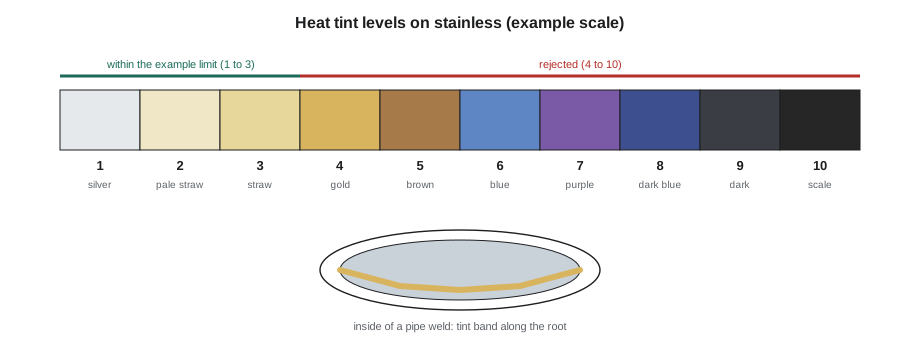
# Classify borescope tint readings against the specification's maximum level (example scale 1 to 10)
MAX_LEVEL = 3
TINT = {1: "silver", 2: "pale straw", 3: "straw", 4: "gold", 5: "brown", 6: "blue",
        7: "purple", 8: "dark blue", 9: "dark", 10: "scale"}
checks = [("CI-101", 1), ("CI-102", 2), ("CI-103", 2), ("CI-104", 3), ("CI-105", 5), ("CI-106", 2)]
rejects = [w for w, lvl in checks if lvl > MAX_LEVEL]
for w, lvl in checks:
    print(f"{w}: level {lvl} ({TINT[lvl]}) -> {'accept' if lvl <= MAX_LEVEL else 'reject'}")
print(f"{len(rejects)} of {len(checks)} rejected: {', '.join(rejects) if rejects else 'none'}")CI-101: level 1 (silver) -> accept CI-102: level 2 (pale straw) -> accept CI-103: level 2 (pale straw) -> accept CI-104: level 3 (straw) -> accept CI-105: level 5 (brown) -> reject CI-106: level 2 (pale straw) -> accept 1 of 6 rejected: CI-105
Weld CI-105 shows a brown band at the bottom of the root. The purge record shows the oxygen was below the limit at the start, but Devon had to stop halfway round to reposition and the tape over the root opening came loose for a minute. The weld is cut out and rewelded.
Technique on stainless
Stainless GTAW uses DCEN, lanthanated tungsten ground to 30 degrees with a small flat, a gas lens with a large cup, argon shielding and an argon back purge. The torch angle is kept closer to vertical than on carbon steel, about 10 degrees, to keep the gas column over the pool. The bead is small and the travel steady. Stainless pools are more sluggish than carbon steel pools: the molten stainless does not wet out as freely, and the pool tends to stand up rather than flow. The welder resists the urge to add more heat to make it flow, because more heat means more distortion, more tint and more sensitization. The ripples on a good stainless bead are fine and even, and the bead on the outside comes out silver to light straw with a gas lens.
Distortion on stainless is controlled the same way as on thin carbon steel but more carefully: tack often, tack on alternating sides, weld in short balanced sections, clamp to copper or aluminum backing where possible, and let the part cool between passes. Pipe and tube distort less than plate, but a stainless spool welded hot from one side can pull out of alignment by several degrees.
Keeping the surface clean
Stainless loses its corrosion resistance where iron is pressed into its surface. Particles from carbon steel brushes, grinding wheels, tools, chains and even a carbon steel bench can embed in the surface and rust in service, starting pitting under the rust. Hartwell's stainless work is done on a separate bench with stainless or plastic covering, stainless brushes and dedicated grinding discs labeled for stainless, and stainless parts are lifted with nylon slings, never chains. Devon learns this the hard way when his practice coupon, left overnight on a steel bench, shows a line of orange rust spots the next morning where it touched the bench.
After welding, the line is cleaned of heat tint and passivated. Light tint on the outside can be removed with a stainless brush or a fine abrasive. On the injection line, the client requires chemical cleaning: the spools are pickled with an acid paste or solution that removes the oxide and the chromium-depleted layer, then passivated with a solution that helps rebuild a clean chromium oxide film, and rinsed. The pickling chemicals are hazardous, and Hartwell sends the spools to a contractor who does the work in a contained area.
Heat input and interpass on stainless
# Heat input and interpass check for a stainless pipe weld (procedure: max interpass 350 F, max 38 kJ/in)
passes = [("root", 68, 10.5, 85, 4.1, 95), ("hot", 285, 11.0, 95, 4.1, 70), ("fill", 375, 11.0, 100, 4.1, 60), ("cap", 320, 11.5, 100, 4.1, 85)]     # (pass, interpass temperature before the pass F, volts, amps, length in, seconds)
TMAX, HMAX = 350, 38
for name, temp, v, a, length, sec in passes:
    speed = length / (sec / 60)
    h = 60 * v * a / (1000 * speed)
    flags = []
    if temp > TMAX: flags.append("interpass too high, wait")
    if h > HMAX: flags.append("heat input over limit")
print(f"{name:5} start {temp:4d} F {speed:5.1f} in/min {h:.1f} kJ/in {'; '.join(flags) if flags else 'ok'}")root start 68 F 2.6 in/min 20.7 kJ/in ok hot start 285 F 3.5 in/min 17.8 kJ/in ok fill start 375 F 4.1 in/min 16.1 kJ/in interpass too high, wait cap start 320 F 2.9 in/min 23.8 kJ/in ok
The log for one NPS 1 schedule 40S butt weld shows the fill pass started above the interpass limit, because Devon went straight from the hot pass to the fill on a small pipe that had no time to cool. He now waits and checks with a contact thermometer or a temperature crayon on every pass. The heat inputs are all within the procedure limit; GTAW on small pipe rarely exceeds it, but the interpass limit is easy to break.
Stainless to carbon steel
Some joints on the skids join stainless to carbon steel, such as a stainless tube support welded to a carbon steel bracket. These dissimilar joints are welded with ER309L, which has more chromium and nickel than the base metals so that, after mixing with the carbon steel, the weld metal is still a sound stainless with some ferrite. The arc is aimed slightly toward the stainless side, the dilution is kept low with small beads, and the joint is cleaned with stainless tools on the stainless side only. ER308L or ER316L would be diluted by the carbon steel into a crack-prone weld.
Common mistakes
MistakeUsing the same current as on carbon steel of the same thickness.
InsteadUse less current; stainless holds heat near the weld.
MistakeRunning the next pass without checking interpass temperature.
InsteadWait and check; the limit is often 350 °F.
MistakeAccepting dark tint on the inside of a purged weld.
InsteadCompare against the specification's tint chart and reject over the limit.
MistakeUsing carbon steel brushes, discs or chains on stainless.
InsteadUse dedicated stainless tools and nylon slings.
MistakeAdding heat to make a sluggish stainless pool flow.
InsteadKeep the heat low and the beads small; accept the sluggish pool.
Summary and key terms
- Austenitic stainless conducts heat poorly and expands more, so it needs low heat and distortion control.
- Sensitization between about 800 and 1,500 °F is limited by L grades and interpass limits.
- A small amount of delta ferrite, measured as FN, protects against hot cracking.
- Heat tint shows how well the hot metal was protected; specifications set a maximum level.
- Keep stainless free of iron contamination and clean or passivate after welding.
- Log interpass temperature and heat input on every pass.
- Sensitization
- Chromium carbide formation at grain boundaries that reduces corrosion resistance.
- Ferrite number
- A measure of the delta ferrite in a stainless weld, read with a magnetic gauge.
- Heat tint
- Colored oxide on stainless formed by heating in air.
- Passivation
- Chemical treatment that helps restore the protective chromium oxide film on stainless.
Practice problems
Work each problem on paper first, then reveal the answer to check.
Three ferrite readings are 4.2, 3.8 and 4.6. Does the weld meet FN 3 to 10?
Show answer
Yes, the average is 4.2.
A pass starts at 375 °F on a 350 °F limit. What does Devon do?
Show answer
Wait until the pipe cools below 350 °F before the next pass.
Why are L grades used for welded stainless?
Show answer
Their low carbon limits chromium carbide formation and sensitization.
Lesson quiz · 5 questions
Score 60% or more to complete this lesson.
Create a free account to save your progress, take quizzes and earn a certificate.