
WLD-310 · Lesson 4 of 12 · 16 min
Tungsten electrodes: types, sizes and preparation
Every GTAW arc starts and ends at the tip of a tungsten electrode, and the shape and condition of that tip decide how the arc behaves. Marta tells Devon that half of good GTAW is a good tungsten, properly chosen, properly ground and changed the moment it is contaminated. This lesson covers the types of tungsten and how they are identified, how to choose a diameter for the current, how to grind and shape the tip for different jobs, and why Hartwell no longer uses thoriated tungsten.
What the oxide additions do
Pure tungsten works as a GTAW electrode, but it does not emit electrons easily, so it needs more current to start and hold an arc, and its tip melts into a ball at moderate current. Small additions of metal oxides, about 1 to 2 % by weight, make the tungsten emit electrons more easily. A tungsten with these additions starts more readily, holds a sharp point at higher current, keeps a more stable arc and lasts longer. The additions used today are oxides of lanthanum, cerium, thorium, zirconium and yttrium, alone or in blends.
Classifications and color codes
Tungsten electrodes are classified by AWS A5.12, and each type is identified by a colored band or tip painted on one end. The color stays on the end that goes into the collet, so the welder grinds the other end.
| Classification | Addition | Color | Typical use |
|---|---|---|---|
| EWP | Pure tungsten | Green | AC on aluminum with older transformer machines; balls easily |
| EWLa-1.5 | 1.5 % lanthana | Gold | AC and DC; a good general-purpose replacement for thoriated |
| EWLa-2 | 2 % lanthana | Blue | AC and DC; holds a point well at higher current |
| EWCe-2 | 2 % ceria | Orange or gray (check the box) | DC at low current, thin material, orbital work; also AC |
| EWZr-1 | Zirconia | Brown | AC on aluminum; resists contamination, forms a stable ball |
| EWTh-2 | 2 % thoria | Red | DC on steel and stainless; slightly radioactive |
| EWG | Other blends (for example rare-earth mixes) | Gray, or as marked by the maker | Maker's recommendations |
The colors are the welder's quick check, but color codes have changed between editions of the standard and some makers use their own colors for blends, so Hartwell keeps tungsten in its labeled boxes and never mixes loose electrodes in a drawer. Devon learns to read the classification on the box first and the color second.
Thoriated tungsten and why Hartwell moved away from it
For decades, 2 % thoriated tungsten, with its red tip, was the standard for DC welding on steel and stainless. It starts easily, holds a point and lasts well. Its drawback is that thorium is naturally radioactive. The radiation outside the body from handling electrodes is very small. The concern is internal: thorium is an alpha emitter, and alpha particles do harm when the material is breathed in or swallowed. Grinding a thoriated tungsten turns some of it into fine dust, and that dust is the main route of exposure. The welding arc itself releases only a tiny amount.
Safety guidance for shops that still use thoriated tungsten centers on the grinding: a dedicated grinder with local dust extraction, the dust collected and disposed of as directed, a respirator during grinding, washing hands before eating, and storing the electrodes in a closed, labeled container. Several welding and safety bodies recommend using alternatives wherever they work, and lanthanated and ceriated electrodes now perform as well or better for nearly all DC work. Priya Natarajan's position, which Hartwell's safety committee adopted, was simple: if an alternative does the job, the shop should not be grinding a radioactive material at all.
The changeover was not quite as simple as swapping boxes. Some of Hartwell's welding procedures named EWTh-2 as the electrode. Elena Marchetti, the welding engineer, checked each procedure against its code. Under the common codes the tungsten classification is usually a non-essential variable, which means a procedure can be revised to another type without new testing, but she checked each one, revised the sheets to name 2 % lanthanated tungsten, and noted the change. The remaining thoriated electrodes were returned to the supplier. Hartwell still keeps one tungsten grinder with extraction for the occasional customer who supplies thoriated electrodes for their own procedure.
Choosing a diameter
The tungsten must be large enough to carry the current without melting or splitting, and small enough to hold a stable arc at the low end of the range. Each diameter has a working range that depends on the type, the polarity and the tip shape. DCEN puts only about a third of the heat into the tungsten, so a given diameter carries much more current on DCEN than on AC.
# Choose a tungsten diameter for a job (Hartwell's working ranges for lanthanated tungsten, typical values)
RANGES = {   # diameter: (DCEN min, DCEN max, AC min, AC max) in amperes
    "0.040 in": (15, 80, 10, 60),
    "1/16 in": (60, 150, 50, 110),
    "3/32 in": (130, 250, 100, 170),
    "1/8 in": (220, 350, 150, 230),
}
jobs = [("stainless sheet, DCEN", "DC", 45), ("stainless pipe root, DCEN", "DC", 95),
        ("carbon steel fillet, DCEN", "DC", 160), ("aluminum tank, AC", "AC", 140), ("heavy aluminum, AC", "AC", 210)]
for name, pol, amps in jobs:
    fits = [d for d, (dmin, dmax, amin, amax) in RANGES.items()
            if (dmin <= amps <= dmax if pol == "DC" else amin <= amps <= amax)]
print(f"{name:26} {amps:3d} A -> {', '.join(fits) if fits else 'no size fits'} (smallest: {fits[0] if fits else '-'})")stainless sheet, DCEN 45 A -> 0.040 in (smallest: 0.040 in) stainless pipe root, DCEN 95 A -> 1/16 in (smallest: 1/16 in) carbon steel fillet, DCEN 160 A -> 3/32 in (smallest: 3/32 in) aluminum tank, AC 140 A -> 3/32 in (smallest: 3/32 in) heavy aluminum, AC 210 A -> 1/8 in (smallest: 1/8 in)
Where two sizes fit, the smaller one gives a more focused arc and a finer pool, and the larger one runs cooler and lasts longer between grinds. Marta's habit for production stainless is to use the smaller size if the current is in the bottom two thirds of its range. For aluminum on AC, she goes one size up, because the tungsten gets so much more heat. Hartwell stocks 1/16, 3/32 and 1/8 in electrodes in 7 in lengths, which covers nearly every job in the shop.
Grinding the tip
For DCEN, the tungsten is ground to a point, or a point with a small flat. The grinding must be done with the electrode held so that the grinding marks run along its length, toward the tip, not around it. Lengthwise marks guide the current and the arc straight off the tip. Circular marks make the arc wander and can start small cracks around the tip that let pieces break off into the weld. The wheel must be used only for tungsten: a wheel that has ground steel leaves particles on the tungsten that contaminate the arc.
The included angle of the point decides the shape of the arc. A sharp point, 15 to 30 degrees, gives a wide, bell-shaped arc and shallow penetration, but it starts easily and is good for thin material at low current. A blunter point, 45 to 60 degrees or more, gives a narrower arc, deeper penetration and a tip that lasts longer at higher current. A small flat, or truncation, on the very tip, about a quarter of the diameter across, keeps the point from melting off and dropping a piece of tungsten into the pool at higher current.
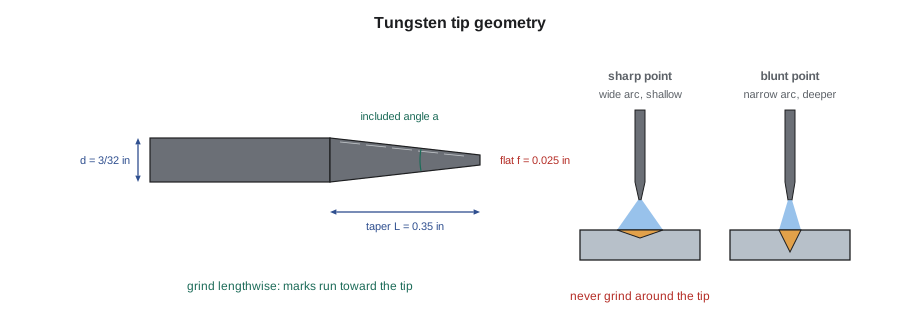
Here L is the length of the taper, d the tungsten diameter, f the width of the flat and α the included angle. A common rule of thumb is a taper about two to two and a half times the diameter, which gives an included angle of about 20 to 25 degrees for a sharp point. Hartwell's tungsten grinders have a guide that sets the angle, so the welder does not judge it by eye.
# Taper length for a ground tungsten tip: L = (d - f) / (2 tan(a/2))
import math
d = 0.094          # tungsten diameter, in
for angle, flat_frac in ((20, 0.0), (30, 0.1), (45, 0.25), (60, 0.25)):
    f = d * flat_frac
    L = (d - f) / (2 * math.tan(math.radians(angle / 2)))
print(f"included angle {angle:2d} deg, flat {f:.3f} in: taper length {L:.3f} in ({L / d:.1f} x diameter)")included angle 20 deg, flat 0.000 in: taper length 0.267 in (2.8 x diameter) included angle 30 deg, flat 0.009 in: taper length 0.158 in (1.7 x diameter) included angle 45 deg, flat 0.024 in: taper length 0.085 in (0.9 x diameter) included angle 60 deg, flat 0.024 in: taper length 0.061 in (0.6 x diameter)
The results show that a 3/32 in tungsten ground to a 20 degree point has a taper almost seven diameters long, which is fragile and heats quickly. Hartwell's standard grind for stainless and carbon steel is 30 degrees with a small flat, about four diameters long, and 45 degrees for currents near the top of the range.
Tungsten for AC
On AC, the electrode-positive half of each cycle heats the tungsten, so a sharp point melts back. With older transformer machines, the welder used pure or zirconiated tungsten and let the end melt into a smooth ball, about one and a half times the diameter, which gives a stable AC arc. With inverter machines and a balance of 65 to 75 % electrode negative, lanthanated tungsten can be ground to a blunt point with a flat, which melts only slightly into a small rounded end and gives a more focused arc. That is what Hartwell does. Devon learns to watch the end as he welds aluminum: a small, bright rounded tip is right; a large, wobbling ball means the tungsten is too small, the balance too low or the current too high.
Contamination and when to regrind
A tungsten must be reground whenever it is contaminated or the tip has lost its shape. Contamination shows as a gray or colored tip, a ball of metal on the end, or an arc that wanders and spits. The usual causes are touching the pool, touching the filler rod, lifting the torch before the post-flow ends, a gas leak, and using too much current for the size. The fix is to break or cut off the contaminated end, not to grind through it, because grinding a lump of steel or aluminum off the tip contaminates the wheel. Devon uses a tungsten cutter that snaps the electrode cleanly, then regrinds.
| What the tip looks like | Likely cause | Fix |
|---|---|---|
| Bright, sharp, clean | Correct | Keep welding |
| Blue or purple after the arc stops | Post-flow too short or torch lifted early | Lengthen post-flow; hold the torch |
| Gray, dull, frosty | Air in the gas: leak or no gas | Check fittings, hose, back cap and cup |
| Metal ball or lump on the tip | Touched the pool or rod | Break off past the lump and regrind |
| Melted, rounded point on DCEN | Too much current for the size | Use a larger tungsten or less current |
| Split or cracked tip | Circular grinding marks, overload | Regrind lengthwise; check the size |
Devon's grinding routine
Devon grinds six tungstens at the start of each shift, in two diameters, and keeps them in a small tube in his pocket. He checks each one under the booth light for lengthwise marks and an even point, then labels the tube with the angle. When he dips, he does not try to finish the bead; he stops, swaps the tungsten, and restarts on a ground taper of the previous bead. By the end of his first week, he dips about once every two beads. By the end of the third week, he dips about once a shift, and the pocket tube lasts all day.
Tungsten length and storage
A new tungsten is used until it is too short to grip properly in the collet, usually about 1 1/2 to 2 in depending on the back cap, and each regrind takes a few millimeters. Devon marks his short tungstens with a dab of paint and keeps them for short-cap torches in tight spaces, where a long tungsten would not fit. Tungsten is stored in its box, dry and away from grinding dust, and the boxes are kept by type so that a lanthanated electrode never ends up in a thoriated box or the reverse.
Common mistakes
MistakeGrinding the tungsten around its circumference.
InsteadGrind lengthwise so the marks run toward the tip.
MistakeGrinding a contaminated lump off on the wheel.
InsteadBreak off the contaminated end and then regrind.
MistakeUsing a steel grinding wheel for tungsten.
InsteadUse a wheel kept only for tungsten, with extraction.
MistakeGrinding thoriated tungsten without dust control.
InsteadUse lanthanated or ceriated, or grind with extraction and a respirator.
MistakeChoosing the tungsten by color from a loose drawer.
InsteadRead the classification on the labeled box.
Summary and key terms
- Oxide additions help tungsten emit electrons, start easily and hold a point.
- AWS A5.12 classifies tungsten; colored tips identify the type but always check the box.
- Thoriated tungsten is slightly radioactive; grinding dust is the main hazard, and alternatives work well.
- Choose a diameter whose range covers the current; DCEN allows much more current than AC.
- Grind lengthwise to a set included angle with a small flat for higher current.
- Break off contaminated tips and regrind; never grind through a lump of metal.
- EWLa-2
- A tungsten with about 2 % lanthanum oxide, marked blue.
- Included angle
- The angle of the ground point of a tungsten electrode.
- Truncation
- A small flat ground on the tip of a pointed tungsten.
- Thoriated tungsten
- Tungsten with about 2 % thorium oxide, marked red, slightly radioactive.
Practice problems
Work each problem on paper first, then reveal the answer to check.
What taper length gives a 30 degree point on a 1/8 in tungsten with no flat?
Show answer
0.125 / (2 tan 15 degrees) = 0.233 in.
A tungsten tip comes out blue after the arc stops. What is the likely cause?
Show answer
Post-flow too short, or the torch was lifted before the gas stopped.
Why is a larger tungsten used for the same current on AC?
Show answer
The electrode-positive half cycle puts much more heat into the tungsten.
Lesson quiz · 5 questions
Score 60% or more to complete this lesson.
Create a free account to save your progress, take quizzes and earn a certificate.