
WLD-310 · Lesson 7 of 12 · 16 min
GTAW on carbon steel
Carbon steel is the metal Devon knows best, and it is the one he welds least often with GTAW. When Hartwell does use GTAW on carbon steel, it is for one of three reasons: the metal is too thin for a wire or stick process to weld without burning through; the part is small and must look clean, such as an instrument bracket or a gauge panel; or the weld is a root pass in pipe or tube that must be sound on the inside. The pipe roots wait for the pipe course. This lesson covers the first two, on sheet, light plate and small-bore fittings, and uses them to build the basic GTAW skills that Devon will carry to stainless and aluminum.
Cleaning comes first
Carbon steel arrives with mill scale, rust, oil and paint, and stick and flux-cored welding handle a fair amount of all of these because the flux deoxidizes and floats the dirt out as slag. GTAW does not. With no flux, mill scale and rust melt into the pool as oxide, and the pool becomes sluggish, spits, and leaves a dirty, porous bead. The joint and about 1 in on each side must be ground or wire-brushed to bright metal, and oil and marker must be removed with solvent. ER70S-2 rod, which contains aluminum, titanium and zirconium as extra deoxidizers along with the usual silicon and manganese, helps with light rust, but it does not replace cleaning.
Hot-rolled steel with heavy mill scale is the worst case. Cold-rolled sheet, which has a thin, smooth oxide, and pickled and oiled steel, which has been descaled and coated with oil, both weld well once degreased. Galvanized steel must have the zinc removed from the weld area before GTAW, because the zinc boils at a low temperature, fills the pool with porosity, contaminates the tungsten and produces fume that causes metal fume fever.
Settings for sheet and light plate
GTAW on carbon steel uses DCEN with a pointed lanthanated tungsten and argon shielding. A useful starting point for current is about 1 A for every 0.001 in of thickness, which gives about 40 A for 0.040 in sheet and about 125 A for 1/8 in plate, adjusted with the pedal as the work heats. Thin material needs a small tungsten, a small rod and a fast hand.
| Thickness | Tungsten | Filler rod | Current (DCEN) | Argon |
|---|---|---|---|---|
| 0.040 in | 1/16 in | 1/16 in | 35 to 50 A | 13 to 15 cfh |
| 1/16 in | 1/16 in | 1/16 in | 55 to 80 A | 13 to 17 cfh |
| 1/8 in | 3/32 in | 3/32 in | 100 to 140 A | 15 to 21 cfh |
| 3/16 in | 3/32 in | 3/32 in | 130 to 170 A | 17 to 23 cfh |
The first beads
Devon's first carbon steel exercise is a series of fusion beads on 1/16 in cold-rolled sheet: no filler, straight lines, the pool held at a steady width of about 3/16 in. He establishes the pool at the start by holding the arc still with the pedal low until a shiny puddle forms, then brings the current up and starts moving. The torch points forward at about 15 degrees. As the sheet heats along the bead, the pool tends to widen, and he backs off the pedal to keep it the same width. At the end, he eases off the pedal slowly so that the crater shrinks and fills, and holds the torch for the post-flow.
The next exercise adds filler. With the rod dabbed at the leading edge, the bead rises above the surface and gets wider ripples. Marta looks for even ripple spacing, which tells her the dab rhythm and travel speed are steady, and for a bead that wets into the base metal at both toes with no undercut. On carbon steel, the bead comes out a dull silver to light gold with a thin, dark line of oxide along the toes. A bead that is black, rough and full of pinholes means poor gas coverage or dirty metal.
Joints on thin steel
Thin steel joints need tight fit-up. A gap on 1/16 in sheet is filled by melting more of the edges, which thins them until they burn through, so butt joints are fitted with little or no gap and tacked every 1 to 2 in to stop the edges moving apart as the weld advances. The tacks are small and made with filler, and each one is fused into the weld as the bead passes over it.
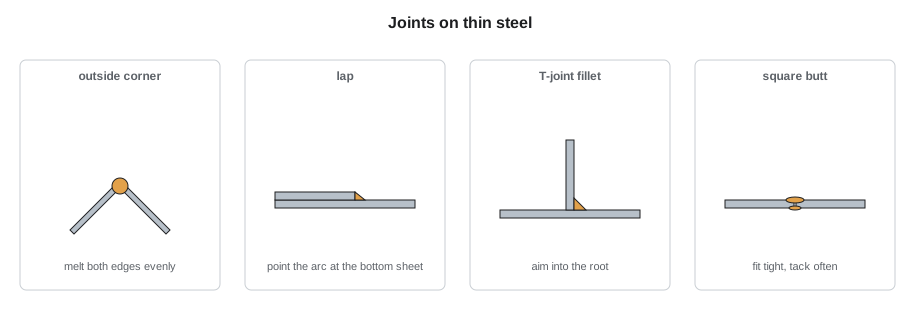
On a lap joint, the top sheet's edge melts much faster than the flat surface of the bottom sheet, so the arc is pointed mostly at the bottom sheet and the pool is allowed to wet up to the edge of the top sheet, with filler added at the edge. On an outside corner, both edges melt quickly, and the job is to keep the pool centered so that it fuses both edges evenly without burning back either one. On a T-joint fillet, the arc is aimed into the root, the torch splits the angle between the two pieces, and the filler goes into the leading edge at the upper side, where gravity would otherwise leave the bead thin.
Distortion on thin steel
Thin steel distorts easily, and GTAW's slow travel puts a lot of heat into the part. A long, continuous weld on sheet buckles it into waves. The ways to control distortion are the same as in WLD-130 but more important: tack often, weld short sections in a skip or backstep sequence, clamp to a heavy fixture or a copper or aluminum backing bar that draws heat away, keep the heat input low with the fastest travel that gives fusion, and avoid overwelding. A 1/8 in fillet on 1/16 in sheet is plenty; a bigger one only adds heat and distortion.
Devon's first production carbon steel GTAW job is a set of 1/16 in sheet guards for the drive couplings on the Coldwater skid pumps. Each guard is a folded box with two welded outside corners about 12 in long. His first guard comes out twisted, because he welded each corner in one pass from one end. On the second, he tacks every 1 1/2 in, welds each corner in four short sections from the middle out, alternating corners, and clamps the guard to an aluminum bar. It comes out flat enough to fit without straightening.
Small-bore fittings and socket welds
The other common carbon steel GTAW job at Hartwell is small-bore piping: vent and drain connections, instrument tappings and socket-weld fittings on the Unit 4 spools, typically NPS 1/2 to 2. A socket weld is a fillet weld around a pipe pushed into the socket of a fitting. The pipe is pushed fully in and then pulled back about 1/16 in before tacking, leaving a gap at the bottom of the socket. The gap allows the pipe to expand when it is heated without cracking the weld. The fillet is usually made in two passes on small pipe, and GTAW gives a neat, sound weld that stick would struggle to match on such a small diameter.
Socket welds are often made in several positions as the welder works around the pipe, because the spool cannot always be rotated. Devon learns to start at the bottom, weld up one side to the top, then return to the bottom and weld up the other side, tying in at the top. The torch angle changes continuously as he goes, and he moves his body around the pipe rather than twisting his wrist. A short gas lens torch head and a small cup let him reach between fittings.
Estimating the time
GTAW is slow, and the time a job takes is mostly arc time divided by the operating factor, the fraction of the welder's time spent with the arc on. On short welds with frequent stops, the operating factor for manual GTAW is low, around 0.2 to 0.3, because the welder spends most of the time fitting, cleaning, changing tungstens and moving.
# Time and cost for the socket welds on a small-bore spool (GTAW, carbon steel)
import math
welds = 14               # socket welds on the spool
od = 1.315                 # pipe outside diameter, in
passes = 2
speed = 3.2               # travel speed, in/min
op_factor = 0.25          # arc-on time as a fraction of total time
rate = 85             # labor rate per hour, dollars
length = math.pi * od * passes * welds
arc_min = length / speed
total_h = arc_min / op_factor / 60
print(f"weld length {length:.1f} in, arc time {arc_min:.0f} min")
print(f"total welding time about {total_h:.1f} h, labor {total_h * rate:,.0f} dollars")weld length 115.7 in, arc time 36 min total welding time about 2.4 h, labor 205 dollars
Fourteen two-pass socket welds on NPS 1 pipe take about three and a half hours, nearly all of it spent on everything except the arc. That is why Glen Teskey groups the small-bore welds on several spools and has one welder do them all at once, with the tungsten, rod and torch set up once.
Positions on carbon steel
GTAW works in every position, and on thin carbon steel the vertical and overhead positions are often easier than with stick or wire, because the pool is small and freezes quickly. Vertical welds on sheet are usually run uphill, with the torch pointed slightly up and the filler dabbed at the top of the pool. On very thin sheet, a short downhill run is sometimes used to reduce penetration, but it risks lack of fusion and is not used on structural work. Overhead GTAW needs a small pool, a short arc and less current, and the welder's sleeves and collar must be closed, because hot metal can fall even with GTAW.
Devon's practice plates in the third week include vertical and overhead fillets on 1/8 in plate. He finds the vertical fillets straightforward after his stick and flux-cored training, because the GTAW pool is so much smaller, but the overhead fillets are hard for a different reason: he cannot rest his torch hand on the work as he does in the flat position. Marta shows him how to brace the side of his hand or a finger against the work or a fixture, and how to use a pedal or thumb control set to a narrow range so that a small movement of the foot does not change the current much.
When GTAW is not the best choice on steel
Because GTAW is slow, Hartwell's foremen move carbon steel work off GTAW as soon as the metal is thick enough for another process. A rule that Glen Teskey uses is that above about 3/16 in, carbon steel is usually welded with pulsed GMAW or stick, unless the job needs a GTAW root, a very clean appearance or access that only a small GTAW torch can reach. The skid's sheet guards, instrument brackets and small-bore socket welds stay on GTAW. The structural frame, the column splices and the deck fillets, which Devon welded with stick and flux-cored wire in the last two courses, never come near it.
Mixing processes on one carbon steel joint is common. A small-bore pipe joint may be rooted with GTAW and capped with stick. When that happens, the procedure lists both processes and the filler for each, and the welder must be qualified for both. Lucia checks that the welder's qualifications cover each process on the joint before the job starts. On the Unit 4 spools, the small-bore vents and drains are rooted with GTAW and capped with a second GTAW pass, because the pipe is too small for stick to be easier, and the welder who roots the joint finishes it.
Common mistakes
MistakeWelding carbon steel GTAW over mill scale.
InsteadGrind or brush to bright metal and degrease first.
MistakeLeaving a gap in a butt joint on thin sheet.
InsteadFit tight and tack every 1 to 2 in.
MistakeWelding a long seam on sheet in one pass from one end.
InsteadWeld short sections in a skip sequence and clamp to a heat sink.
MistakeBottoming the pipe in a socket before welding.
InsteadPull the pipe back about 1/16 in from the bottom of the socket.
MistakePointing the arc at the edge of the top sheet on a lap joint.
InsteadPoint the arc at the bottom sheet and let the pool wet up to the edge.
Summary and key terms
- GTAW on carbon steel is used for thin material, small clean parts and roots.
- Clean to bright metal; ER70S-2 helps with light rust but does not replace cleaning.
- Start at about 1 A per 0.001 in of thickness, DCEN, pointed tungsten.
- Fit thin joints tight, tack often and control distortion with sequence and heat sinks.
- Socket welds need a gap at the bottom of the socket.
- Manual GTAW has a low operating factor, so time is dominated by work other than welding.
- Socket weld
- A fillet weld joining a pipe inserted into the socket of a fitting.
- Operating factor
- The fraction of total working time that the arc is on.
- Heat sink
- A heavy bar or fixture that draws heat away from thin parts to limit distortion.
- Mill scale
- The oxide layer on hot-rolled steel.
Practice problems
Work each problem on paper first, then reveal the answer to check.
What starting current does the rule of thumb give for 0.080 in sheet?
Show answer
About 80 A.
How far is a pipe pulled back from the bottom of a socket?
Show answer
About 1/16 in.
A job has 60 minutes of arc time at an operating factor of 0.25. How long does it take?
Show answer
About 4 hours.
Lesson quiz · 5 questions
Score 60% or more to complete this lesson.
Create a free account to save your progress, take quizzes and earn a certificate.