
WLD-310 · Lesson 3 of 12 · 16 min
Torches, cups, gas lenses and accessories
On his second morning, Marta hands Devon a GTAW torch in pieces on a clean rag and asks him to put it together. There are more parts than he expects: a torch body with its head and handle, a back cap, a collet, a collet body, a gas lens, an insulator, a ceramic cup, a tungsten. Each part does a specific job, and most GTAW problems that look like technique are really torch problems: a cracked cup that pulls in air, a collet that does not grip, a back cap that leaks, a gas lens clogged with spatter. This lesson goes through the torch from the cable to the cup, how to choose the parts for a job, and the accessories a GTAW welder uses every day.
Air-cooled and water-cooled torches
The torch carries current to the tungsten and gas to the cup, and it must get rid of the heat that the current and the arc put into it. Air-cooled torches, sometimes called gas-cooled, are cooled only by the flow of gas and the surrounding air. They are light, simple and need no extra equipment, but they get hot at higher currents and are typically rated up to about 150 to 200 A at a reduced duty cycle. Water-cooled torches have a small pump and radiator, the cooler, that circulates coolant through the torch head and the power cable. They are smaller and cooler in the hand for the same current, and they are rated to 250 A or more, but they need the cooler running whenever the torch is used.
Hartwell's booths have water-cooled torches for production work and air-cooled torches for field kits. The torch head comes in several shapes: a standard head with a long back cap, a short head for tight spaces, and flexible-neck heads that can be bent to reach behind a flange. Devon's first lesson in torch care is that the cooler must be switched on before the arc is struck on a water-cooled torch. Running one without coolant can burn out the power cable inside the hose within a few seconds at high current.
The parts of the torch head
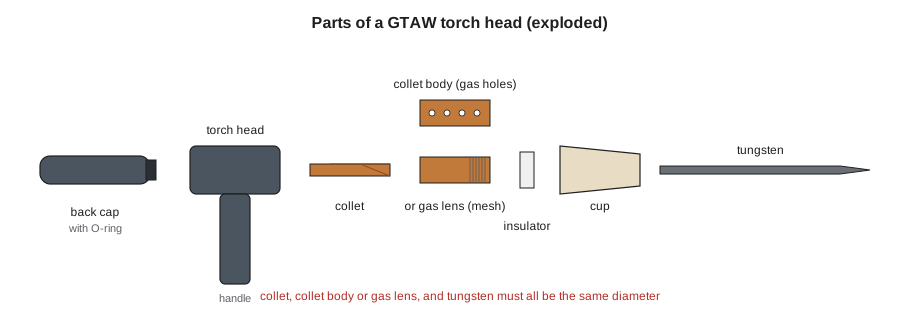
- Back cap. The back cap screws into the rear of the head and pushes on the collet, clamping the tungsten. Long, medium and short back caps allow different lengths of tungsten to be used. The back cap has an O-ring that seals the gas; a missing or cracked O-ring lets air be pulled into the gas stream.
- Collet. The collet is a split copper sleeve that grips the tungsten when the back cap is tightened. It must match the tungsten diameter exactly. A collet that is too large lets the tungsten slip and makes poor electrical contact, which overheats the collet and the tungsten.
- Collet body. The collet body screws into the front of the head and holds the collet. It has holes through which the gas flows out into the cup. Collet bodies are also sized to the tungsten.
- Gas lens. A gas lens replaces the collet body. It contains one or more layers of fine stainless mesh that straighten the gas flow, so that it leaves the cup as a smooth column instead of a turbulent jet. The gas lens is the single most useful upgrade to a torch, and lesson 5 explains why.
- Insulator. A heat-resistant gasket that sits between the head and the cup, protecting the head and sealing the gas path, especially with a gas lens.
- Cup. The cup, also called the nozzle, directs the gas around the tungsten and the pool. Cups are made of ceramic (alumina), of a more heat-resistant ceramic, or of fused quartz glass, which lets the welder see the tungsten through the cup.
Cup sizes
Cups are numbered by their inside diameter at the opening in sixteenths of an inch: a number 4 cup is 1/4 in across, a number 8 is 1/2 in, a number 12 is 3/4 in. The number is the same in Canada and the United States because the parts follow the same American convention. Larger cups give a wider gas shield and need more gas; smaller cups fit into tight corners and narrow grooves but give less coverage. A good starting rule is a cup whose inside diameter is four to six times the tungsten diameter.
| Tungsten | Typical cup | Typical argon flow |
|---|---|---|
| 1/16 in | Number 5 to 7 | 13 to 17 cfh |
| 3/32 in | Number 6 to 8 | 15 to 21 cfh |
| 1/8 in | Number 8 to 10 | 19 to 25 cfh |
| Gas lens, any size | Number 8 to 12 | Raise flow 10 to 30 % |
Large gas lens cups, sometimes called pyrex cups when made of glass, from number 10 up to number 16 or more, are used on stainless and titanium where the hot metal behind the pool must stay shielded until it cools below the temperature at which it oxidizes. Devon's first stainless beads with a number 8 cup leave a straw-colored band on each side; the same beads with a number 12 gas lens cup come out bright silver.
Tungsten stickout
Stickout is how far the tungsten extends beyond the end of the cup. With a standard collet body, the stickout should be no more than about the inside diameter of the cup, and often less, about 1/8 to 1/4 in, because the turbulent gas jet does not protect the tip well beyond that. A gas lens gives a smooth column of gas that stays laminar for a longer distance, so the stickout can be increased to 3/8 to 3/4 in or more. Long stickout lets the welder see the pool better and reach into the bottom of a groove, a fillet or a socket, which is why most root and fillet work on stainless at Hartwell is done with a gas lens.
Stickout also changes the heat in the tungsten. Current flows through the stickout, and the longer it is, the hotter the tungsten runs. On a high-current aluminum weld with a long stickout, the tungsten can overheat and ball even at the right balance.
Gas delivery and the flowmeter
Argon comes from a cylinder, a dewar of liquid argon, or the shop's bulk supply, and passes through a regulator and flowmeter to the machine's gas valve and then to the torch. The flowmeter reads the flow in cubic feet per hour (cfh); many are dual scale. The ball type, with a small ball rising in a tapered glass tube, is read at the center of the ball; the gauge type reads the pressure across an orifice and is less accurate. One liter per minute is about 2.1 cfh, so a 21 cfh flow is a typical setting for a number 8 cup.
# Gas exit velocity from the cup: a quick check of flow against cup size (illustrative band)
import math
CFH_PER_LPM = 2.119
flow = 21                       # cfh
lpm = flow / CFH_PER_LPM
for cup in (6, 8, 10, 12):
    d_m = cup / 16 * 0.0254          # cup bore from its number (sixteenths of an inch)
    area = math.pi * d_m ** 2 / 4
    v = lpm / 1000 / 60 / area       # m/s
    note = "low, check for drafts" if v < 0.5 else ("high, may be turbulent" if v > 2.5 else "ok")
print(f"cup {cup:2d}: bore {cup / 16:.3f} in, exit velocity {v:.2f} m/s {note}")cup 6: bore 0.375 in, exit velocity 2.32 m/s ok cup 8: bore 0.500 in, exit velocity 1.30 m/s ok cup 10: bore 0.625 in, exit velocity 0.83 m/s ok cup 12: bore 0.750 in, exit velocity 0.58 m/s ok
The check shows why more flow is not always better. At 21 cfh, a number 6 cup blows the gas out so fast that it can become turbulent and pull air in, while a number 12 cup gives a gentle flow that a draft can push aside. Marta keeps the booth curtains closed and the fans pointed away from the work, and sets the flow for the cup rather than turning it up whenever something goes wrong.
Leaks are the other gas problem. A loose fitting at the flowmeter, a cracked hose, a missing O-ring in the back cap or a cracked cup lets air into the gas, and the weld comes out gray and porous no matter how high the flow. A flowmeter cannot detect a leak downstream of it, because it measures the flow that leaves it, not the flow that reaches the cup. Devon learns to check for leaks with soapy water on the fittings, and to look at the post-flow: if the tungsten comes out discolored after the gas has stopped, something is leaking.
Accessories
A GTAW welder's kit includes items that a stick welder may never carry:
- A dedicated tungsten grinder or a bench grinder wheel kept only for tungsten, with a guide to grind at a fixed angle and dust extraction.
- Stainless steel wire brushes kept only for stainless or only for aluminum, never used on carbon steel.
- Clean, lint-free rags and a solvent such as acetone or isopropyl alcohol for removing oil, marker and fingerprints.
- Filler rods in a clean tube, marked by type and diameter, never left lying on the bench.
- Thin welding gloves, often goatskin or deerskin, which give feel for the rod and torch, and a heavier pair for handling hot parts.
- A foot pedal, or a thumb control for positions where a pedal cannot be used.
- Spare collets, collet bodies, cups, O-rings and back caps in each size used.
Marta has Devon keep his stainless and aluminum kits in separate labeled boxes. Carbon steel particles on a stainless brush can embed in the stainless surface and later rust, leaving orange stains on a line that is supposed to stay bright. Steel or oil on an aluminum brush carries contamination straight into the pool and makes porosity.
Putting the torch together
Devon assembles the torch for 3/32 in tungsten and a gas lens. He checks that the collet and gas lens are both marked for the tungsten size, threads the gas lens into the head finger-tight, fits the insulator and the number 10 cup, slides the collet and tungsten in from the back and sets the stickout at about 1/2 in before tightening the long back cap. He sets the flow at 23 cfh with the gas flowing through the torch, because a flowmeter reads differently when the gas is stopped. Then he strikes a short arc on a scrap plate, stops it and watches the tungsten through the glass cup during post-flow. The tip stays bright. The torch is ready.
Looking after the torch
A torch that is cared for lasts for years; one that is thrown on the floor lasts weeks. Marta's routine for the end of each shift is short: shut the gas and the cooler, hang the torch on its hook with the cup down so that dirt cannot fall into the head, coil the hose loosely without kinks, and check the cup and the back cap O-ring. Once a week, Devon takes the head apart, wipes the collet, collet body and gas lens, and checks the gas lens screen against the light. A screen clogged with spatter or grinding dust gives a turbulent flow that no flowmeter setting will fix, and a gas lens with a damaged screen is replaced rather than cleaned with a wire, which would tear the mesh.
Water-cooled torches need their coolant checked and changed as the maker specifies. Ordinary tap water leaves scale in the narrow passages of the torch head, and some coolants conduct electricity, which matters with high-frequency start; Hartwell uses the cooler maker's own coolant for that reason. A leak in a water-cooled torch shows as drips at the head, a falling level in the cooler, or steam and porosity in the weld. Any leak means the torch comes out of service until it is repaired.
Power cables in GTAW torches are thinner than stick cables because the current is lower, and on air-cooled torches the gas flowing through the hose carries away some of the heat. Running an air-cooled torch above its rating, or with very little gas, overheats the cable and the head. The torch's rating is printed on the handle or in the manual, and Devon checks it before borrowing a torch from another booth.
Common mistakes
MistakeUsing a collet that is one size larger than the tungsten.
InsteadMatch the collet, collet body or gas lens to the tungsten diameter.
MistakeRunning a water-cooled torch without the cooler.
InsteadSwitch on the cooler before striking the arc.
MistakeTurning the gas flow up to fix porosity.
InsteadLook for leaks, drafts and dirty metal; set the flow for the cup.
MistakeUsing a long stickout with a standard collet body.
InsteadKeep stickout short without a gas lens; use a gas lens for long stickout.
MistakeUsing the same wire brush on carbon steel and stainless.
InsteadKeep separate, labeled brushes for stainless, aluminum and steel.
Summary and key terms
- The torch carries current and gas; air-cooled torches are light, water-cooled ones carry more current.
- The collet, collet body or gas lens must match the tungsten diameter.
- Cup numbers give the bore in sixteenths of an inch; choose four to six times the tungsten diameter.
- A gas lens gives a smooth gas column and allows longer stickout.
- Set gas flow for the cup and check for leaks rather than raising the flow.
- Keep separate tools for stainless, aluminum and carbon steel.
- Collet
- A split copper sleeve that grips the tungsten in the torch.
- Gas lens
- A collet body with mesh screens that make the gas flow smooth and laminar.
- Stickout
- The length of tungsten extending past the end of the cup.
- Cup number
- The inside diameter of a GTAW cup in sixteenths of an inch.
Practice problems
Work each problem on paper first, then reveal the answer to check.
What is the bore of a number 10 cup?
Show answer
10/16 in, or 5/8 in.
A flowmeter is set to 25 cfh. What is that in L/min?
Show answer
About 11.8 L/min.
Why does a gas lens allow a longer stickout?
Show answer
It straightens the gas into a smooth column that protects the tungsten further from the cup.
Lesson quiz · 5 questions
Score 60% or more to complete this lesson.
Create a free account to save your progress, take quizzes and earn a certificate.