
WLD-310 · Lesson 10 of 12 · 16 min
Pulsed GTAW and other techniques
By the fifth week, Devon can run a clean stainless bead and a decent aluminum fillet. Marta now shows him the settings on the machine he has been leaving off, starting with pulse, and the techniques that make GTAW work on difficult joints: walking the cup, keyhole and freeze control, welding thin to thick, and tacking. None of them replaces the basics. Each one solves a particular problem, and knowing which problem each one solves is the point of the lesson.
What pulsing does
Pulsed GTAW switches the current between two levels many times a second, or a few times a second, instead of holding it steady. The high level, the peak current, melts the pool and gives penetration. The low level, the background current, keeps the arc alive but lets the pool cool and partly freeze. The pool grows during each peak and shrinks during each background, and the bead becomes a series of overlapping spots, each fused into the last. The average current is what the part feels as heat, and it is lower than the peak, so pulsing gets the penetration of a high current with the heat input of a lower one.
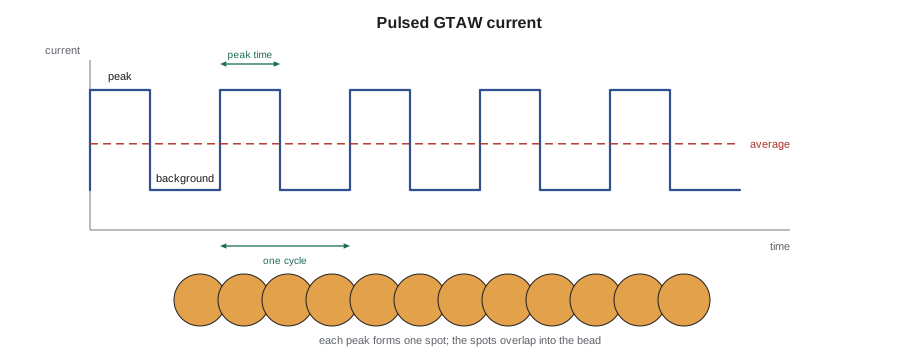
A pulsing machine has four settings: peak current, background current as a percentage of peak, pulse frequency in pulses per second (Hz), and peak time as a percentage of each cycle, also called the duty or on-time. The average current follows directly from them.
Here Ip is the peak current, Ib the background current and D the peak time as a fraction of the cycle.
# Average current and arc energy for pulsed GTAW settings
E = 11                       # arc volts (average)
speed = 3.5                   # travel, in/min
settings = [(120, 40, 0.5), (120, 30, 0.4), (150, 45, 0.33), (100, 100, 1.0)]   # peak A, background A, peak fraction
for ip, ib, d in settings:
    avg = ip * d + ib * (1 - d)
    h = 60 * E * avg / (1000 * speed)
    label = "steady (no pulse)" if d == 1.0 else f"peak {ip} A, background {ib} A, {d * 100:.0f}% on"
print(f"{label:38} average {avg:5.1f} A arc energy {h:.1f} kJ/in")peak 120 A, background 40 A, 50% on average 80.0 A arc energy 15.1 kJ/in peak 120 A, background 30 A, 40% on average 66.0 A arc energy 12.4 kJ/in peak 150 A, background 45 A, 33% on average 79.7 A arc energy 15.0 kJ/in steady (no pulse) average 100.0 A arc energy 18.9 kJ/in
The first setting peaks at 120 A, so it penetrates like a 120 A arc, but its average is 80 A, so the heat input is a third lower than a steady 120 A arc at the same speed. Strictly, arc energy on a pulsed or waveform-controlled weld should be calculated from the instantaneous power the machine measures, because the voltage also changes between peak and background; many machines display it. Hartwell's procedures for pulsed GTAW record the average values shown by the machine.
Slow pulse and fast pulse
Pulse frequency changes how the pulse is used. Slow pulse, about 0.5 to 2 pulses per second, gives a visible rhythm that the welder can follow: the welder dabs filler on each peak and moves the torch on each background, and the bead comes out as clear overlapping ripples, the stacked-coins look. Slow pulse helps beginners keep a steady rhythm and helps everyone on thin metal, out-of-position welds and joints of unequal thickness, because the pool freezes a little in every cycle. Devon finds that slow pulse at about 1.5 Hz turns his uneven aluminum ripples into even ones almost at once.
Fast pulse, from about 20 to several hundred pulses per second, is too quick to see as a rhythm. At high frequency, the arc becomes narrower and stiffer, the pool is agitated, and the heat input is controlled more finely. Fast pulse is useful on thin stainless, where it narrows the heat-affected zone and reduces tint, and on fillets, where the stiff arc goes into the root without wandering up one side. On aluminum, fast AC frequency and fast pulse together give a narrow, focused bead on thin sheet.
| Problem | Pulse setting that helps |
|---|---|
| Burn-through on thin sheet | Slow pulse, background 25 to 35 % of peak, peak time 30 to 50 % |
| Uneven ripples, irregular dabbing | Slow pulse at 1 to 2 Hz to set the rhythm |
| Heavy tint and wide heat-affected zone on thin stainless | Fast pulse, 50 to 200 Hz |
| Arc wanders up one side of a fillet | Fast pulse, or higher AC frequency on aluminum |
| Joining thin to thick | Slow pulse, with the arc aimed at the thick member |
| Out-of-position pool sagging | Slow pulse so the pool freezes slightly each cycle |
Walking the cup
Walking the cup is a technique for pipe and groove welds in which the edge of the cup rests on the bevels and the welder rocks the torch from side to side, rolling the cup in a figure-eight or zigzag along the joint. Because the cup is supported on the work, the arc length and torch angle stay constant no matter how tired the welder's hand gets, and the rocking motion weaves the pool across the joint. A glass or a hard ceramic cup is used, and filler is fed in at the leading edge or laid in the groove. Walking the cup takes practice, and the technique is a large part of the pipe course, but Marta has Devon start it now on 1/4 in plate grooves with backing so that his hand is ready.
Joining thin to thick
When a thin part is welded to a thick one, such as a 1/16 in tube to a 3/8 in flange, the thin part melts long before the thick one is hot enough to fuse. The welder aims the arc mostly at the thick member, lets the pool form there, and brings it across to wet the thin edge only briefly, adding filler on the thin side to protect it. Slow pulse helps. So does a heat sink on the thin side, or preheating the thick part where the procedure allows. The instrument tube supports on the Coldwater skid, thin stainless tube clamps welded to heavier brackets, are Devon's first job with this technique.
Tacking for GTAW
GTAW joints, especially thin ones and stainless ones, need good tacks. A GTAW tack should be small, fully fused and made with filler, because an autogenous tack on a joint with any gap is thin and cracks as the joint shrinks. Tacks on butt joints are spaced closely enough to hold the root opening, every 1 to 3 in on sheet and tube, and they are placed in a balanced order, first one end, then the other, then the middle, so that the shrinkage of each tack does not close the gap ahead of it. On pipe and tube to be purged, the tacks are made with the purge in place, because an unpurged tack on stainless sugars on the inside and must be ground out. The ends of each tack are feathered with a burr or a disc so that the root can blend into them.
Keyhole and freeze control on open roots
On an open-root butt weld without backing, GTAW can be run in two ways. In the keyhole method, the arc melts through both edges to form a small hole at the leading edge of the pool, and filler is added to close the hole as the pool advances, just as in an open-root stick weld. The keyhole shows the welder that the root is fully penetrated. In the freeze method, used on tight-fitting joints, the welder fuses the edges together with little or no filler, watching the pool sink slightly as it penetrates, and adds filler only to keep the face level. Both are pipe-course techniques, but Devon practices keyholing on 1/8 in stainless plate with a purge box underneath, so that he can see the root profile from both sides.
Other GTAW variations
Some GTAW variations are mostly automatic or mechanized. Orbital GTAW uses a motorized head that clamps around a tube and carries the tungsten around the joint, usually autogenously, giving the identical, repeatable welds needed for pharmaceutical, food and semiconductor tubing. Hot-wire GTAW preheats the filler wire electrically before it enters the pool, multiplying the deposition rate for cladding and heavy-wall pipe. Keyhole GTAW at very high current penetrates thick stainless in a single pass in automatic systems. Hartwell does not own an orbital welder, but the client's own sanitary lines are orbital welded, and Lucia explains that the AWS D18.1 specification for sanitary tube welding was written largely with orbital welding in mind.
Setting up a pulse program
Hartwell's inverters store programs, and Marta has Devon set up three pulse programs for his own use and write them on the booth board. The first, for 0.040 in stainless sheet, uses a peak of 60 A, background at 30 % of peak, 1.5 pulses per second and 40 % peak time, giving an average of about 35 A. The second, for stainless pipe roots, uses a peak of 95 A, background 35 %, 2 pulses per second and 50 % peak time, giving an average of about 64 A, with the welder dabbing on each peak. The third, for aluminum sheet on AC, uses a peak of 120 A, background 30 %, 1 pulse per second and 50 % peak time, with the AC frequency at 150 Hz for a narrow arc.
He then welds the same joint with each program and without pulse, and compares the beads. On the thin stainless, the pulsed bead is narrower, with less tint and almost no distortion; the steady bead at the same average current wanders and is harder to control. On the pipe root, the pulse gives him a rhythm for dabbing that makes the root profile more even. On aluminum, he finds the slow pulse helpful on thin sheet but distracting on thicker plate, where the pool is larger and the rhythm does not help, and he turns it off.
Pulse settings are recorded on the welding procedure when they are used, and on code work, changing from steady current to pulsed current, or changing the pulse settings outside the procedure's range, may need a revised procedure. Elena's GTAW procedures list pulse as an option with ranges for each setting, so the welder can use it within those ranges.
Remote amperage and pulse together
With a foot pedal and pulse on, the pedal scales the whole pulse up and down: the peak, and the background as a percentage of it. That keeps the pulse shape the same as the welder adjusts the heat. Some machines can also be set so that the pedal changes only the peak, or so that pulse switches on only above a set current. Devon keeps to the simplest arrangement, pedal scaling everything, until he has enough experience to know when another arrangement would help.
Walking the cup on plate
Devon's first walking-the-cup practice is on 1/4 in plate grooves with backing, using a number 8 glass cup and a 3/32 in tungsten with a short stickout so that the tip sits just above the root when the cup rests on the bevels. He rocks the cup from one bevel to the other, rolling over the center, and moves forward a little with each rock. The rod is laid in the groove ahead of the cup and melted in as the cup passes over it. The first few beads are uneven because his rocking is uneven. After a week of ten minutes a day, the rocking becomes automatic, and the beads come out with even, shallow ripples, which is what the pipe course will build on.
Common mistakes
MistakeTreating pulse as a fix for bad technique.
InsteadUse pulse for a specific problem; the basics still decide the weld.
MistakeRecording the peak current as the welding current.
InsteadRecord the average current, or the machine's measured arc energy.
MistakeMaking autogenous tacks on a joint with a gap.
InsteadMake small, fused tacks with filler and feather the ends.
MistakeTacking stainless pipe before the purge is in place.
InsteadPurge first, then tack, so the tacks do not sugar.
MistakeAiming the arc at the thin member when joining thin to thick.
InsteadAim at the thick member and wet the thin edge briefly.
Summary and key terms
- Pulsed GTAW alternates a peak current for penetration with a background current for cooling.
- The average current, Ip D + Ib (1 - D), sets the heat input.
- Slow pulse sets a visible rhythm; fast pulse narrows and stiffens the arc.
- Walking the cup keeps arc length and angle constant on grooves and pipe.
- Joining thin to thick: aim at the thick member and protect the thin edge.
- Tacks must be fused, made with filler, balanced and, on stainless, purged.
- Peak current
- The high current level in pulsed GTAW.
- Background current
- The low current level that keeps the arc alive between peaks.
- Walking the cup
- Rocking the GTAW cup on the joint to weave the pool at a constant arc length.
- Orbital welding
- Mechanized GTAW in which a head carries the tungsten around a tube.
Practice problems
Work each problem on paper first, then reveal the answer to check.
Peak 140 A, background 50 A, peak time 40 %. What is the average current?
Show answer
140 x 0.4 + 50 x 0.6 = 86 A.
What pulse setting helps a beginner keep an even dab rhythm?
Show answer
Slow pulse at about 1 to 2 pulses per second.
Why are stainless tacks made with the purge in place?
Show answer
Unpurged tacks oxidize (sugar) on the inside and must be ground out.
Lesson quiz · 5 questions
Score 60% or more to complete this lesson.
Create a free account to save your progress, take quizzes and earn a certificate.