
WLD-310 · Lesson 1 of 12 · 17 min
How GTAW works
Devon Okafor starts his third level at Hartwell Fabrication with a new booth, a new machine and a new kind of quiet. Gas tungsten arc welding, GTAW, is the process most people still call TIG, for tungsten inert gas. After two years of stick and wire, where the arc crackles and the electrode melts away into the joint, GTAW feels almost silent: a steady, narrow arc between a tungsten electrode that does not melt and the work, a small bright pool, and a filler rod fed by hand from the other side. Marta Kowalchuk, his mentor, tells him that GTAW is the slowest arc process in the shop and the most precise, and that both facts explain where Hartwell uses it: on stainless instrument and chemical lines for the Coldwater skids, on aluminum for farm and trailer repairs, on thin carbon steel parts that a wire process would burn through, and on the root passes of pipe that will be covered in the pipe course.
This first lesson explains how the process works, what the welder controls, what the process is good and bad at, and where it fits among the processes Devon already knows. The later lessons take each part of the equipment and technique in turn and then apply them to carbon steel, stainless steel and aluminum.
The process in one picture
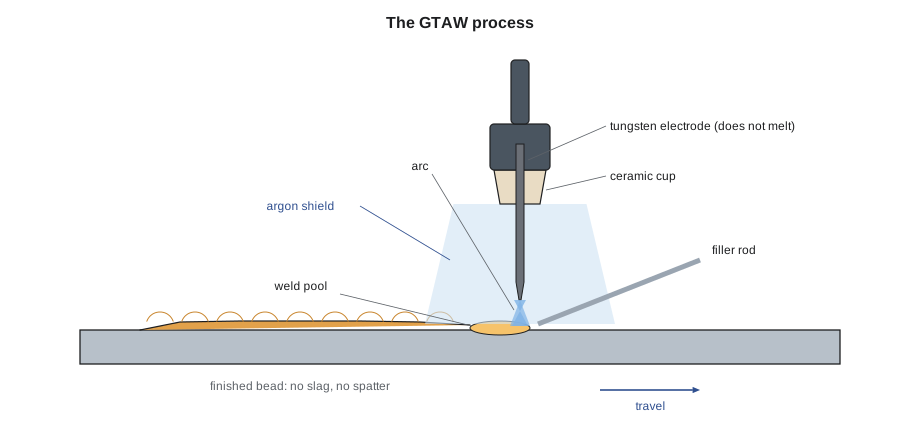
In GTAW, an electric arc forms between a tungsten electrode and the workpiece. Tungsten melts at about 6,200 °F, far above the temperature of the arc's contact with the work, so with the right current and polarity the electrode does not melt and does not become part of the weld. The arc melts the base metal to form the weld pool. If filler metal is needed, the welder adds it separately, as a bare rod dipped into the leading edge of the pool, or on automatic equipment as a wire fed by a motor.
Everything hot is protected by an inert shielding gas, almost always argon, sometimes helium or a mixture. The gas flows through the torch body and out through a ceramic or glass cup around the tungsten, and it pushes the air away from the electrode, the arc, the pool and the hot end of the filler rod. There is no flux and no slag. Whatever protection the weld gets comes from the gas alone, which is why GTAW is so sensitive to drafts, to dirty metal and to poor gas coverage, and why it produces such clean welds when everything is right.
What the welder controls
In stick welding, the welder controls arc length and travel speed with one hand while the electrode burns away. In GTAW, the welder controls more things at once, with both hands and often a foot:
- Current. Most shop GTAW is done with a foot pedal or a thumb control that lets the welder raise and lower the current while welding. The machine sets the maximum; the pedal sets what is used. This lets the welder start cool, bring the pool up to size, back off at a corner or a thin edge, and fade out at the end to fill the crater.
- Arc length. The arc length is the gap between the tungsten tip and the work, usually about the diameter of the tungsten, 1/16 to 1/8 in. Because GTAW is a constant current process, the current stays nearly the same when the arc length changes, but the voltage and the width of the arc change with it. A long arc spreads the heat, widens the bead and weakens the gas shield; a short arc is narrow and concentrated but risks touching the pool.
- Torch angle and travel speed. The torch is pushed, pointing forward about 10 to 20 degrees from vertical, and moved steadily along the joint. Travel speed controls the bead width and penetration together with current.
- Filler. The filler rod is held in the other hand at a low angle, about 15 to 20 degrees above the work, and dipped into the front of the pool, then withdrawn slightly while staying inside the gas shield. The amount and timing of filler controls the bead size and shape.
Coordinating the two hands and the pedal is the skill that takes time. A stick welder's instinct is to push the electrode in as it burns. A GTAW welder must hold the tungsten at a fixed distance from a pool that may be only a few millimeters across, while the other hand dabs filler into it at a steady rhythm. Marta starts Devon with no filler at all, running fusion beads on clean stainless plate to learn arc length and travel, before adding the rod.
Why the tungsten must not touch
If the tungsten touches the pool or the filler rod, it picks up molten metal, the tip balls or splits, and the arc wanders. Worse, small pieces of tungsten can break off into the weld, where they show on a radiograph as bright white spots called tungsten inclusions, a defect that most codes limit or reject. A contaminated tungsten must be stopped, broken off past the contamination and reground. Touching the tungsten, called dipping, is the most common beginner's fault in GTAW, and every welder does it during the first weeks. Devon keeps three ground tungstens in his pocket so that he can change one in a few seconds and keep going.
Starting the arc
Because the tungsten must not touch the work, GTAW machines have ways to start the arc without scratching. Most modern machines use high-frequency start: a high-voltage, high-frequency spark jumps the gap from tungsten to work and ionizes the gas so that the welding current can flow. Others use lift-arc start, in which the tungsten is touched lightly to the work at very low current and lifted, and the machine raises the current as the arc forms. The oldest method, scratch start, strikes the arc like a match and almost always leaves some tungsten on the work, so it is used only where nothing else is available. High-frequency start can disturb nearby electronics, and the machine's high-frequency setting is usually switched to start-only so that it stops once the arc is burning, except on AC, where it may be needed to keep the arc stable.
Strengths and limits
| GTAW is good at | GTAW is limited by |
|---|---|
| Very clean welds with no slag or spatter | Slow travel and low deposition rate |
| Precise heat control on thin metal | High skill demand, two hands and a pedal |
| Almost every weldable metal, including aluminum, stainless, nickel and titanium | Sensitivity to drafts, dirty metal and poor gas coverage |
| Root passes of excellent quality on pipe and tube | Higher labor cost per meter of weld |
| Welding with or without filler | Poor tolerance for rust, mill scale and paint |
The deposition rate of manual GTAW is low, typically 0.5 to 2 lb of filler per hour of arc time, compared with 2 to 5 lb per hour for stick welding and much more for flux-cored wire. On a thick carbon steel joint, that difference decides the process. Hartwell's estimators never price a heavy carbon steel weld with GTAW. They price GTAW where its quality is needed and its slowness does not matter: thin material, small parts, stainless and aluminum, and the first pass in critical pipe.
The low deposition rate is also why GTAW is often combined with other processes on one joint. A pipe joint may be rooted and hot-passed with GTAW, then filled and capped with stick or wire. A stainless line may be all GTAW because the wall is thin. On an aluminum repair, GTAW gives the control needed at the cracked edge, while a larger new part might be welded with pulsed wire.
Heat input in GTAW
Devon already calculates heat input for stick and wire welds as arc voltage times current times 60, divided by travel speed in inches per minute. The same formula applies to GTAW, with one point worth noticing. Not all of the arc energy goes into the work. Some is lost to the tungsten, the gas and radiation, and the fraction that reaches the work, the thermal efficiency, is lower for GTAW than for the consumable-electrode processes. European practice multiplies the arc energy by an efficiency factor, about 0.6 for GTAW and about 0.8 for stick, wire and flux-cored welding. North American codes such as AWS D1.1 and ASME Section IX use the arc energy without a factor, so a Hartwell procedure records the arc energy and the welder does not apply the factor unless a specification calls for it.
Here H is the heat input in kilojoules per inch, E the arc voltage in volts, I the current in amperes, v the travel speed in inches per minute, and η the thermal efficiency, taken as 1 when the code works with arc energy. The voltage of a GTAW arc is low, typically 10 to 14 V in argon, because the arc is short and the gas is easy to ionize. Helium raises the arc voltage by several volts, which is why helium mixtures give more heat at the same current.
# GTAW heat input: arc energy (as North American codes record it) and with the 0.6 efficiency factor
E, I = 11.5, 95        # arc volts, amperes (pedal held steady)
length, seconds = 6, 120   # weld length (in) and arc time (s)
speed = length / (seconds / 60)     # in per minute
arc_energy = 60 * E * I / (1000 * speed)   # kJ/in
print(f"travel speed {speed:.1f} in/min")
print(f"arc energy {arc_energy:.1f} kJ/in (used in a code procedure)")
print(f"heat into the work with factor 0.6: {0.6 * arc_energy:.1f} kJ/in")
print(f"same arc energy with stick at factor 0.8 would put {0.8 / 0.6:.2f} times as much heat into the work")travel speed 3.0 in/min arc energy 21.9 kJ/in (used in a code procedure) heat into the work with factor 0.6: 13.1 kJ/in same arc energy with stick at factor 0.8 would put 1.33 times as much heat into the work
Devon's first fusion bead on 1/8 in stainless runs at a slow 3 in per minute, so its arc energy is similar to a stick pass even though the current is lower. GTAW passes are small, but they are slow, and on stainless the heat builds up quickly in a thin part. This becomes important in lesson 8.
Safety that is different for GTAW
Priya Natarajan, the shop's safety coordinator, walks Devon through the hazards that GTAW adds or changes. The arc gives off strong ultraviolet light, more than a stick arc at the same current because there is no smoke to absorb it, and it can burn skin through a thin shirt in minutes. GTAW welders wear full sleeves, gloves and a helmet with a shade suited to the current, usually shade 9 to 13, and the booth curtains are kept closed. The ultraviolet light also makes ozone from the oxygen in the air around the arc, especially when welding aluminum with argon, which reflects more light; ozone irritates the lungs, and booth ventilation removes it.
There is less fume than with stick or flux-cored welding, but there is fume, and on stainless steel it contains chromium compounds, including hexavalent chromium. The booth's fume extraction stays on for stainless and the nozzle is placed close to the work. Argon is heavier than air and has no smell, so in a tank, a pit or a small closed space it can collect and displace the oxygen without warning; purging a vessel or a pipe with argon makes that space an oxygen-deficient atmosphere until it is ventilated and tested. Finally, high-frequency start can interfere with pacemakers and electronic equipment, which is one more reason the booth's machines are labeled and the high-frequency is switched to start-only where the process allows.
The electrode itself is a hazard if the wrong type is used. For many years the standard tungsten contained about 2 % thorium oxide, which is slightly radioactive. The risk when welding is small, but grinding thoriated tungsten makes a fine dust that can be inhaled. Hartwell stopped buying thoriated tungsten two years ago and uses lanthanated electrodes instead. Lesson 4 explains why and how.
How GTAW fits Devon's path
Devon's GTAW training follows the same pattern as his stick and wire training: fusion beads, then beads with filler, then joints on practice plates, then production work under supervision, and finally a test. The difference is that GTAW is learned on three metals, not one. Marta plans four weeks on stainless and carbon steel sheet and plate, two weeks of aluminum, and two weeks of production work on the Coldwater skid's stainless chemical injection lines, under her supervision, ending with the process line and the aluminum tank repair in the capstone. The pipe roots wait for the next course.
Common mistakes
MistakeTouching the tungsten to the pool and carrying on.
InsteadStop, break off the contaminated tip and regrind before continuing.
MistakeExpecting gas shielding to protect dirty metal.
InsteadClean the joint and filler first; GTAW has no flux to deal with dirt.
MistakeHolding a long arc to see the pool better.
InsteadHold the arc at about one tungsten diameter; a long arc spreads heat and weakens the shield.
MistakeChoosing GTAW for a heavy carbon steel weld.
InsteadUse GTAW where its quality matters; use stick or wire to fill thick joints.
MistakeWorking in an argon-purged vessel without testing the air.
InsteadTreat an argon-filled space as oxygen-deficient until ventilated and tested.
Summary and key terms
- GTAW uses a non-melting tungsten electrode, an inert gas shield and separately added filler.
- The welder controls current with a pedal, arc length, torch angle, travel speed and filler with two hands.
- A touched tungsten must be stopped and reground to avoid tungsten inclusions.
- High-frequency or lift-arc starting avoids scratching the tungsten on the work.
- GTAW is clean and precise but slow, and is used where quality matters more than deposition rate.
- Arc energy is calculated as for other processes; a 0.6 factor gives the heat that reaches the work.
- GTAW
- Gas tungsten arc welding, also called TIG: an arc process using a non-consumable tungsten electrode and inert gas shielding.
- Dipping
- Touching the tungsten electrode to the weld pool or filler rod, contaminating it.
- High-frequency start
- A high-voltage spark that ionizes the gas so the arc can start without touching the work.
- Thermal efficiency
- The fraction of arc energy that enters the workpiece, about 0.6 for GTAW.
Practice problems
Work each problem on paper first, then reveal the answer to check.
A GTAW pass runs at 12 V, 100 A and 3 in/min. What is the arc energy?
Show answer
60 x 12 x 100 / (1000 x 3) = 24.0 kJ/in.
Why does a helium mixture give more heat than argon at the same current?
Show answer
Helium raises the arc voltage, so the arc power is higher.
Name two places where Hartwell uses GTAW and why.
Show answer
Stainless instrument lines for clean, precise welds; aluminum repairs for control on thin, cracked edges.
Lesson quiz · 5 questions
Score 60% or more to complete this lesson.
Create a free account to save your progress, take quizzes and earn a certificate.