
WLD-130 · Lesson 6 of 12 · 16 min
The weld zone and the heat-affected zone
With the basic science in place, Devon can now look inside a real weld. Lucia Ferreira cuts a section across a test weld from the Riverside girder procedure, grinds and polishes it, and etches it with nital, a weak solution of nitric acid in alcohol. Under a low-power magnifier the weld lights up in bands: the weld metal with its columnar grains, a thin line at the fusion boundary, a dark band in the HAZ just outside it, a paler band beyond, and then the plain banded structure of the rolled plate. Each band went through a different thermal cycle, and each has its own structure and properties. This lesson explains what happens in the weld metal as it freezes, how dilution mixes base metal into the weld, what the different parts of the HAZ are and why, and how multipass welding changes the picture.
Making a macro section
A macro section, or macroetch, is one of the oldest and most useful inspection tools for welds. A slice is cut across the weld, the cut face is ground flat through successively finer grits, and it is etched until the structure shows. It reveals penetration and fusion, the shape and number of passes, the size of the HAZ, porosity, slag, lack of fusion and cracks. Procedure qualifications for fillet welds, and many shop checks, include a macro section, and Lucia uses them to show welders exactly what their welds look like inside.
- Cut well away from the area of interest with a saw or abrasive cutoff wheel, keeping the part cool so the cutting does not change the structure.
- Grind flat, then work through finer grits to a smooth, scratch-free face.
- Etch with nital or another etchant, swabbing until the structure appears, then rinse and dry at once.
- Examine with a magnifier, photograph with a scale, and record what is seen.
Etchants are acids and handled with gloves, eye protection and ventilation, under the shop's chemical safety rules.
Weld metal
The weld metal starts as a pool of liquid made of melted filler metal and melted base metal. As the arc moves on, the back edge of the pool freezes. Freezing begins on the partly melted grains of the base metal at the fusion boundary, and new grains grow from them in the direction the heat is flowing, toward the center and rear of the pool. The grains grow as long columns, and inside each one the metal freezes in a branching tree-like pattern called dendrites. Alloying elements and impurities are pushed ahead of the growing solid into the remaining liquid, so the last metal to freeze, between dendrites and at the center line, is richer in them. This uneven distribution is called segregation.
Weld metal is cast metal, not rolled plate, so it cannot get its strength and toughness from rolling. It gets them from careful chemistry. Electrode and wire makers design weld metal with deoxidizers such as silicon and manganese, small amounts of titanium and boron, and low carbon, so that on cooling it forms a fine interlocking structure called acicular ferrite, needle-shaped grains in a basket-weave pattern, which is both strong and tough. Tiny oxide inclusions from the deoxidation reactions act as starting points for the acicular ferrite. Too much oxygen, as with poor shielding, makes coarse inclusions and porosity; too little alloy, or too slow cooling, gives coarser ferrite and lower toughness.
Dilution
The weld metal is not pure filler metal. It contains some melted base metal, mixed in during welding. The fraction of the weld metal that came from the base metal is called dilution. A stringer bead with deep penetration may be 30 to 50 percent base metal; a weave bead on top of earlier passes may be under 10 percent; a submerged arc bead on a square-edged butt may be well over 50 percent.
Dilution matters whenever the base metal and filler metal differ. Welding a high-carbon steel with a low-carbon electrode, for example, mixes carbon into the weld, raising its hardness. Welding stainless steel to carbon steel dilutes the stainless filler with plain iron, which can lose its corrosion resistance or form brittle structures if the filler is not chosen with the dilution in mind. Hardfacing deposits are diluted by the steel underneath, which is why hardfacing procedures often call for a buffer layer or several layers.
# Dilution from the areas of a weld cross-section, and its effect on carbon in the weld
area_base_melted = 0.028     # area of base metal melted below the original surface, sq in
area_filler = 0.05          # area of deposited filler metal above it, sq in
dilution = area_base_melted / (area_base_melted + area_filler)
print(f"Dilution: {100 * dilution:.0f} percent")
c_filler = 0.07             # carbon in the undiluted weld deposit, percent
for name, c_base in (("structural plate", 0.18), ("shaft steel", 0.45), ("cultivator shank", 0.65)):
    c_weld = dilution * c_base + (1 - dilution) * c_filler
print(f"{name:17} base {c_base:.2f} % C -> weld metal about {c_weld:.2f} % C")Dilution: 36 percent structural plate base 0.18 % C -> weld metal about 0.11 % C shaft steel base 0.45 % C -> weld metal about 0.21 % C cultivator shank base 0.65 % C -> weld metal about 0.28 % C
The root pass on the high-carbon cultivator shank picks up enough carbon to make the weld metal itself hardenable. That is one reason repair procedures for high-carbon steel use low-hydrogen electrodes, preheat, small first passes with little penetration, and sometimes a buttering layer of a softer or austenitic filler.
The fusion boundary and partially melted zone
At the edge of the weld is a thin band where the base metal was heated between its solidus and liquidus temperatures: partly melted, mostly at the grain boundaries. In carbon steel this zone is very narrow and rarely causes trouble. In some aluminum alloys, nickel alloys and high-sulfur steels, low-melting films along the grain boundaries can tear apart as the weld shrinks, causing liquation cracking just outside the fusion line. It is one of several kinds of hot cracking covered in the lesson on defects.
The heat-affected zone in steel
The HAZ of a carbon or low-alloy steel weld is not one zone but several, each defined by the peak temperature it reached. Matching each band in the HAZ to a temperature on the iron-carbon diagram explains its structure.
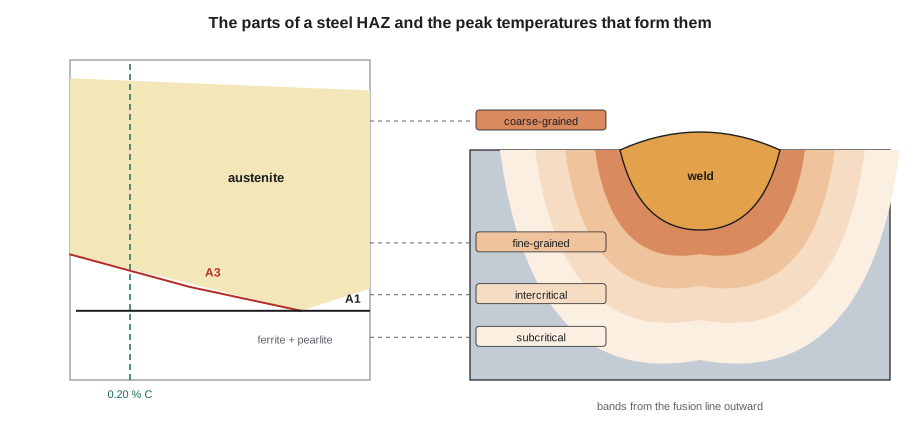
- Coarse-grained HAZ: heated far above A3, close to the melting point. The steel becomes austenite and its grains grow quickly, because the particles that normally pin them dissolve. Large austenite grains are more hardenable, so on cooling this zone forms the hardest structures in the weld: martensite or bainite in susceptible steels. It is where hydrogen cracks and low Charpy values most often occur. It is narrow, often only a millimeter or so wide.
- Fine-grained HAZ: heated just above A3. The steel becomes austenite but has no time to grow coarse grains, and on cooling it forms fine ferrite and pearlite, often finer than the original plate. Normally the best part of the HAZ.
- Intercritical HAZ: heated between A1 and A3. Only part of the structure, the pearlite and some nearby ferrite, turns to austenite. That small amount of austenite is rich in carbon and can transform into small, hard islands on cooling.
- Subcritical HAZ: heated below A1. No austenite forms, but the steel may be tempered, and in cold-worked or quenched and tempered steels it may soften. Its outer limit marks the visible edge of the HAZ.
In a multipass weld, the HAZ of each pass overlaps the HAZ of earlier passes, and an area that formed coarse grains on one pass may be reheated into the intercritical range by the next. That doubly heated zone, called the intercritically reheated coarse-grained HAZ, can be the least tough spot of all in some steels, and high-toughness procedures, such as those for offshore structures, are designed to control it.
Estimating peak temperatures
An engineer named Clarence Adams extended the heat flow work of the previous lesson into a simple estimate of the peak temperature reached at a given distance from the fusion boundary. Like the Rosenthal formulas, it is an idealization, but it gives a feel for how narrow each HAZ band is and how heat input and preheat widen it.
# Peak temperature beside a weld (Adams thin-plate estimate) and the width of each HAZ band
rho_c = 0.0044      # volumetric specific heat of steel, J/(mm3 C)
t_melt = 1510       # melting temperature, C
t_a3 = 850          # upper critical temperature for a 0.2 percent C steel, about, C
t_a1 = 727          # lower critical temperature, C
t_sub = 600         # roughly where tempering effects fade, C
def peak(y_mm, q, d_mm, t0):
    return t0 + 1 / (4.13 * rho_c * d_mm * y_mm / q + 1 / (t_melt - t0))
q = 30 * 1000 / 25.4       # net heat input, J/mm
d = 0.5 * 25.4       # plate thickness, mm
t0 = (70 - 32) / 1.8            # starting temperature, C
edges = {}
y = 0.05
while y < 30:
    tp = peak(y, q, d, t0)
    for name, limit in (("coarse", 1100), ("A3", t_a3), ("A1", t_a1), ("sub", t_sub)):
        if name not in edges and tp < limit:
            edges[name] = y
    y += 0.05
print(f"Distance from the fusion line to each boundary for this weld (in):")
for name, text in (("coarse", "coarse-grained zone ends"), ("A3", "fine-grained zone ends"), ("A1", "intercritical zone ends"), ("sub", "tempering fades")):
print(f" {text:26} {edges[name] / 25.4:6.3f}")Distance from the fusion line to each boundary for this weld (in): coarse-grained zone ends 0.053 fine-grained zone ends 0.108 intercritical zone ends 0.152 tempering fades 0.215
Even at a moderate heat input in 1/2 in plate, the whole HAZ is only about 0.15 in wide, and the coarse-grained band is about 0.05 in. That is why HAZ Charpy specimens are notched with great care, and why a hardness traverse uses light loads and closely spaced indents.
A hardness traverse
To check a procedure for hydrogen cracking risk or sour service, Lucia sends macro sections to a lab for a hardness traverse: a row of small Vickers indents across the weld metal, HAZ and base metal, often at several depths. A typical result on a carbon steel fillet shows base metal around 160 HV, weld metal around 200 HV, and a peak in the coarse-grained HAZ that may reach 250 to 350 HV depending on the steel and the cooling rate. If the peak exceeds the limit, the procedure is changed: more preheat, higher heat input or a different sequence, to slow the cooling of that narrow zone.
HAZs in other kinds of steel
- Quenched and tempered steels: already hardened and tempered at the mill. The HAZ near the weld can reharden, while the subcritical zone further out can be over-tempered and softer than the plate. Procedures limit both minimum and maximum heat input and the interpass temperature.
- Thermomechanically processed steels: their strength comes from fine grains made by controlled rolling. They have low carbon and weld easily, but high heat input can soften the HAZ.
- Cold-formed parts: cold work raises strength; welding heat anneals it in the HAZ.
- Austenitic stainless steels: no phase change, so no hardening, but chromium carbides can form at grain boundaries in a band heated to about 840 to 1,560 °F, reducing corrosion resistance. Low-carbon L grades avoid this.
- Aluminum alloys: no hardening, but strength from cold work or aging heat treatment is lost in a wide HAZ, often one of the most important design limits for welded aluminum.
What the welder can do
The welder cannot see the HAZ, but can influence it directly. Following the procedure's preheat, heat input and interpass limits controls the cooling rate, and so the hardness and toughness of the coarse-grained zone. Using stringer beads and correct overlap in multipass welds lets later passes refine earlier ones. Placing the final passes so their heat tempers the HAZ at the toes, rather than leaving a fresh, untempered toe on the surface, helps in hardenable steels. Avoiding arc strikes on the base metal matters too: a stray arc strike makes a tiny weld with no preheat, a very fast cooling rate and its own hard HAZ, a favorite starting point for cracks.
Common mistakes
MistakeTreating the HAZ as one uniform zone.
InsteadIt has coarse-grained, fine-grained, intercritical and subcritical bands, each with its own properties.
MistakeIgnoring dilution when welding a high-carbon part with a mild steel electrode.
InsteadBase metal carbon mixes into the weld and can make it hardenable.
MistakeLeaving stray arc strikes on the plate.
InsteadAn arc strike has its own fast-cooled, hard HAZ and can start cracks.
MistakeAssuming more heat input always helps.
InsteadIt slows cooling but can coarsen grains and lower toughness, and soften quenched and tempered or worked steels.
MistakeEtching a macro section without gloves and eye protection.
InsteadEtchants are acids; follow the chemical safety rules.
Summary and key terms
- A macro section reveals passes, penetration, the HAZ and defects.
- Weld metal freezes with columnar grains and dendrites; the last metal to freeze is richest in impurities.
- Weld metal toughness comes from chemistry that forms fine acicular ferrite.
- Dilution is the fraction of weld metal that came from melted base metal.
- The steel HAZ has coarse-grained, fine-grained, intercritical and subcritical bands set by peak temperature.
- The coarse-grained HAZ is usually the hardest and least tough region.
- Procedure limits, stringer beads, temper passes and no arc strikes protect the HAZ.
- Macro section
- A polished and etched cross-section of a weld examined at low magnification.
- Dendrite
- A branching, tree-like crystal formed as metal freezes.
- Segregation
- Uneven distribution of alloying elements and impurities in frozen metal.
- Acicular ferrite
- A fine, interlocking needle-like ferrite structure that gives weld metal toughness.
- Dilution
- The fraction of weld metal contributed by melted base metal.
- Coarse-grained HAZ
- The part of the HAZ next to the fusion line, heated far above A3, where grains grow.
- Intercritical HAZ
- The part of the HAZ heated between A1 and A3, partly transformed.
- Hardness traverse
- A line of hardness readings across the weld, HAZ and base metal.
Practice problems
Work each problem on paper first, then reveal the answer to check.
A macro shows 0.024 sq in of melted base metal and 0.056 sq in of deposited metal. What is the dilution?
Show answer
0.024 / 0.080 = 30 percent.
Which part of the HAZ is heated between A1 and A3?
Show answer
The intercritical HAZ.
With 30 percent dilution, a 0.07 percent carbon deposit on 0.45 percent carbon steel gives about what weld carbon?
Show answer
0.3 × 0.45 + 0.7 × 0.07 ≈ 0.18 percent.
Lesson quiz · 5 questions
Score 60% or more to complete this lesson.
Create a free account to save your progress, take quizzes and earn a certificate.