
WLD-130 · Lesson 3 of 12 · 18 min
Iron, carbon and the steel family
Most of what Hartwell welds is steel: iron with a small amount of carbon, some manganese and silicon, and, in many grades, a little of other elements. The amount of carbon, more than any other factor, decides what a steel is used for, how strong it is, and how easily it can be welded. This lesson looks at the iron-carbon phase diagram and the structures it predicts, the main steel families from low-carbon structural plate to high-carbon tool steel and cast iron, what each common alloying element does, the basic heat treatments, and the grades Devon is meeting on the shop floor. By the end of it, a mill test report and a material callout on a drawing should start to tell Devon something about how the steel will weld.
Iron and carbon
Pure iron is soft, ductile and not very strong. Adding carbon changes that dramatically. Carbon atoms dissolve interstitially in iron's crystal lattice and, more importantly, they combine with iron to form cementite, a very hard and brittle compound with the formula Fe3C. The amount of carbon, and how the cementite is distributed, controls the properties. By convention, iron-carbon alloys with up to about 2 percent carbon are steels and those with more are cast irons, although nearly all steels used in fabrication have well under 1 percent and most structural steels have under 0.25 percent.
The iron-carbon diagram
The iron-carbon phase diagram maps which phases are present at each temperature and carbon content when the metal is cooled slowly. Only the steel end of the diagram, up to about 2 percent carbon, matters for most welding, and only a few of its lines need to be memorized.
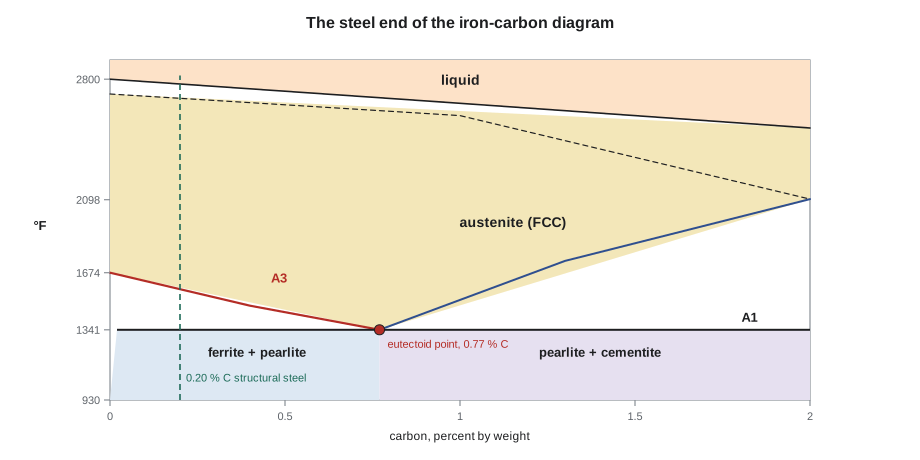
The key features, reading from the top down, are these:
- Above about 2,700 °F steel is liquid; between the liquidus and solidus lines it is partly liquid and partly solid. Low-carbon steel melts a little lower than pure iron.
- The large region in the middle is austenite, FCC iron with carbon dissolved in it. Any plain carbon steel heated into this region becomes all austenite, whatever it was before.
- The eutectoid temperature, about 1,341 °F, is the lowest temperature at which austenite is stable in plain carbon steel. Metallurgists call it the lower critical temperature, A1.
- The upper critical line, A3, slopes down from 1,674 °F for pure iron to meet the eutectoid line at about 0.77 percent carbon. Between A1 and A3, a low-carbon steel is a mixture of austenite and ferrite.
- The eutectoid point, at about 0.77 percent carbon, is where austenite transforms entirely to pearlite on slow cooling.
Steels with less than 0.77 percent carbon are called hypoeutectoid; nearly all structural, pressure vessel and pipe steels are in this group. Steels with more carbon, used for springs, cutting tools and some wear parts, are hypereutectoid.
Structures that form on slow cooling
When a low-carbon steel is cooled slowly from austenite, ferrite starts to form at the austenite grain boundaries as the steel crosses the A3 line. Ferrite can hold almost no carbon, so the carbon is pushed into the remaining austenite, whose carbon content rises. When the temperature reaches A1, the remaining austenite, now at about 0.77 percent carbon, transforms all at once into pearlite: a fine layered mixture of thin plates of ferrite and cementite that looks like mother-of-pearl under the microscope. The result is a structure of light ferrite grains and dark pearlite colonies.
- Ferrite: nearly pure BCC iron. Soft, ductile, tough, magnetic.
- Cementite: Fe3C, about 6.7 percent carbon. Very hard and brittle.
- Pearlite: alternating plates of ferrite and cementite. Stronger and harder than ferrite, less ductile.
The proportions of ferrite and pearlite in a slowly cooled steel can be calculated from the phase diagram with the lever rule, a simple balance of carbon. Just below A1, the ferrite holds about 0.02 percent carbon and the pearlite about 0.77 percent; the steel's own carbon content must be made up of the two in proportion.
Here f_P is the fraction of pearlite and C is the carbon content of the steel in weight percent. The rest is ferrite.
# Lever rule: pearlite and ferrite in slowly cooled plain carbon steels
c_ferrite = 0.022     # carbon in ferrite just below the eutectoid temperature, wt percent
c_pearlite = 0.77     # carbon in pearlite (the eutectoid composition), wt percent
steels = {"low-carbon sheet": 0.06, "structural plate": 0.20, "pipe": 0.28,
          "shaft steel": 0.45, "cultivator shank": 0.60, "rail": 0.75}
for name, c in steels.items():
    f_p = (c - c_ferrite) / (c_pearlite - c_ferrite)
    f_p = max(0.0, min(1.0, f_p))
print(f"{name:17} {c:4.2f} % C: about {100 * f_p:3.0f} % pearlite, {100 * (1 - f_p):3.0f} % ferrite")low-carbon sheet 0.06 % C: about 5 % pearlite, 95 % ferrite structural plate 0.20 % C: about 24 % pearlite, 76 % ferrite pipe 0.28 % C: about 34 % pearlite, 66 % ferrite shaft steel 0.45 % C: about 57 % pearlite, 43 % ferrite cultivator shank 0.60 % C: about 77 % pearlite, 23 % ferrite rail 0.75 % C: about 97 % pearlite, 3 % ferrite
A structural plate with 0.20 percent carbon is mostly ferrite with about a quarter pearlite, which is why it is ductile and easy to weld. A shaft steel with 0.45 percent carbon is more than half pearlite and noticeably harder; a cultivator shank near 0.6 percent is mostly pearlite. As the lessons on cooling rate and hardenability show, it is not the slowly cooled structure that causes trouble in welding but the structures that form when the same steels cool quickly.
Structures that form on fast cooling
Pearlite takes time to form, because carbon atoms must move short distances to collect into the cementite plates. If austenite is cooled faster, carbon has less time to move, and other structures form instead:
- Bainite: a fine mixture of ferrite and tiny carbide particles, formed at intermediate cooling rates and temperatures. Stronger than pearlite and, in its lower forms, still reasonably tough.
- Martensite: formed when austenite is cooled so fast that carbon cannot move at all. The FCC lattice shears into a distorted, body-centered structure with carbon trapped inside. Martensite is very hard and, without tempering, brittle. Its hardness depends almost entirely on its carbon content.
Quenching a 0.45 percent carbon steel in water produces almost all martensite, hard enough to resist a file. Quenching a 0.08 percent carbon steel produces a much softer martensite, or a mixture of ferrite and bainite, because there is so little carbon to trap. This is the root of the welder's concern with carbon: the HAZ next to a weld is heated into austenite and then cooled quickly by the surrounding cold plate, so it can form martensite. Whether it does, and how hard that martensite is, depends on the steel's carbon and alloy content and on the cooling rate.
Heat treatments
Steel mills, fabricators and heat-treat shops use several standard treatments. A welder meets their names on drawings, procedures and mill reports:
- Annealing: heating into austenite and cooling very slowly in the furnace. Produces the softest, most ductile condition.
- Normalizing: heating into austenite and cooling in still air. Refines the grains and gives a uniform ferrite-pearlite structure; many plate and pipe grades are supplied normalized for toughness.
- Quenching and tempering: heating into austenite, quenching to form martensite, then reheating below A1 to temper it. Tempering lets some carbon form fine carbides, trading a little hardness for much better toughness. High-strength plates and many wear plates are quenched and tempered, and welding can soften or reharden them.
- Stress relieving, or post-weld heat treatment: heating a welded part to a temperature well below A1, holding and cooling slowly, to relax residual stresses and temper hard HAZ structures. Codes require it for some thick or alloyed pressure work.
- Thermomechanical controlled processing: rolling the steel in carefully controlled temperature steps so it comes off the mill fine-grained and strong without a separate heat treatment. Many modern structural plates are made this way and have low carbon for their strength.
The steel family
Steels are grouped in several overlapping ways. By carbon content, the plain carbon steels are commonly divided as follows, with the boundaries varying a little between sources:
| Group | Carbon, % | Typical uses | Weldability |
|---|---|---|---|
| Low-carbon (mild) steel | up to about 0.15 | Sheet, light structures, tubing | Excellent |
| Mild to medium structural | about 0.15 to 0.30 | Plate, shapes, pipe, pressure vessels | Good; preheat on thick sections |
| Medium-carbon steel | about 0.30 to 0.60 | Shafts, axles, gears, forgings | Fair; preheat and low hydrogen needed |
| High-carbon steel | about 0.60 to 1.0 | Springs, tillage tools, rail, cutting edges | Poor; special procedures |
| Cast iron | over 2 | Housings, pump bodies, engine blocks | Difficult; special techniques |
Low-alloy steels add up to a few percent of manganese, chromium, molybdenum, nickel, vanadium or copper for strength, toughness, heat resistance or atmospheric corrosion resistance. The chromium-molybdenum pipe steels on the Unit 4 hot service line and the weathering steel of the Riverside bridge are low-alloy steels. High-alloy steels, with more than about 5 percent alloy, include stainless steels and tool steels.
What the alloying elements do
- Carbon: the main strengthener and the main cause of hardening in the HAZ. Every extra hundredth of a percent matters for weldability.
- Manganese: strengthens, combines with sulfur to make harmless manganese sulfide instead of low-melting iron sulfide, and increases hardenability. Structural steels typically carry 0.5 to 1.6 percent.
- Silicon: a deoxidizer added in steelmaking and in filler metals to remove oxygen and prevent porosity.
- Chromium: increases hardenability, strength at high temperature and, above about 11 percent, makes steel stainless.
- Molybdenum: increases hardenability and high-temperature strength; used in creep-resistant pipe.
- Nickel: improves toughness, especially at low temperature, and is the element that keeps austenitic stainless steel austenitic.
- Vanadium, niobium and titanium: microalloying elements, used in hundredths of a percent, that refine grains and strengthen by forming tiny carbide and nitride particles.
- Copper: improves atmospheric corrosion resistance in weathering steel.
- Sulfur and phosphorus: impurities kept as low as possible; sulfur causes hot cracking and phosphorus embrittles steel. Free-machining steels deliberately add sulfur or lead and are very hard to weld without cracking.
Grades at Hartwell
American structural steel is specified to ASTM standards. A36 is the traditional mild structural steel with a minimum yield of 36 ksi. A572 Grade 50 is a high-strength low-alloy plate and shape steel with a minimum yield of 50 ksi, and A992, also 50 ksi, is the standard steel for wide-flange shapes, with limits on carbon equivalent to keep it weldable. Bridges use ASTM A709, whose Grade 50W weathering steel is what the Riverside girders are made of. Pressure vessel plate and pipe follow ASME and ASTM specifications, such as SA-516 Grade 70 plate and SA-106 Grade B pipe.
Every one of these grades limits carbon and the elements that raise hardenability, because the people who wrote the specifications expected them to be welded. The repair bay is different. A farm implement or an old machine may be made of anything, and the parts with the most wear, such as shafts, pins, tillage points and gear teeth, are usually made of the least weldable steels.
Identifying an unknown steel
Lucia Ferreira keeps a short list for the repair bay, from the quickest check to the most reliable:
- Manufacturer information: parts books and service bulletins often name the material and sometimes the welding procedure.
- Magnet test: carbon and low-alloy steels and ferritic stainless are strongly magnetic; austenitic stainless is barely magnetic; aluminum, copper and brass are not.
- File test: a file bites easily into soft, low-carbon steel and skates over hardened steel.
- Spark test: touching the part to a grinder and watching the sparks. Low-carbon steel gives long, light yellow streaks with few bursts; higher carbon gives shorter streaks with many bright, branching bursts; cast iron gives short, dull red streaks.
- Chemical analysis: a handheld X-ray fluorescence or optical emission analyzer gives alloy content in seconds. Optical emission can also measure carbon; most handheld X-ray units cannot.
On the cultivator toolbar, the spark test showed short, bushy bursts and the file skated: higher carbon than the frame steel, and a material that needs preheat, low hydrogen and slow cooling. The previous repairer had treated it like mild steel.
Common mistakes
MistakeAssuming all steel welds like mild steel.
InsteadCarbon content decides weldability; medium- and high-carbon steels need special procedures.
MistakeBelieving the iron-carbon diagram predicts what forms in a weld.
InsteadIt shows slow-cooling equilibrium; fast weld cooling can form bainite or martensite instead.
MistakeTreating tempering as the same as stress relieving.
InsteadBoth reheat below A1, but they serve different purposes and follow different specifications.
MistakeWelding free-machining steel without checking.
InsteadAdded sulfur or lead causes severe hot cracking.
MistakeRelying only on a magnet to identify a repair part.
InsteadA magnet separates broad groups; use parts information, spark and file tests, or chemical analysis.
Summary and key terms
- Carbon combines with iron to form hard cementite; its amount controls strength and weldability.
- Above the A3 line steel is all austenite; at A1, about 727 degrees, remaining austenite becomes pearlite on slow cooling.
- The lever rule gives the fractions of ferrite and pearlite in a slowly cooled steel.
- Fast cooling forms bainite or martensite; martensite hardness depends on carbon.
- Annealing, normalizing, quenching and tempering, and stress relieving change the structure deliberately.
- Alloying elements add strength, toughness, hardenability or corrosion resistance; sulfur and phosphorus are harmful.
- Identify unknown repair steels before welding.
- Cementite
- Iron carbide, Fe3C, a very hard and brittle compound.
- Pearlite
- A layered mixture of ferrite and cementite formed from austenite at the eutectoid temperature.
- Martensite
- A hard, strained structure formed when austenite is cooled too fast for carbon to move.
- Bainite
- A fine ferrite and carbide structure formed at intermediate cooling rates.
- Lower critical temperature (A1)
- The eutectoid temperature, below which austenite is not stable in plain carbon steel.
- Upper critical temperature (A3)
- The temperature above which a hypoeutectoid steel is entirely austenite.
- Normalizing
- Heating into austenite and cooling in still air to refine the structure.
- Low-alloy steel
- Steel with up to a few percent of alloying elements for strength, toughness or corrosion resistance.
Practice problems
Work each problem on paper first, then reveal the answer to check.
Using the lever rule, about what fraction of a slowly cooled 0.40 percent carbon steel is pearlite?
Show answer
(0.40 − 0.02) / (0.77 − 0.02) ≈ 0.51, about half.
Which structure forms when austenite is cooled too fast for carbon to move?
Show answer
Martensite.
What does the letter A mean in a weathering steel grade, and what element gives the effect?
Show answer
Atmospheric corrosion resistant; mainly copper with some chromium and nickel.
A spark test shows short streaks with many bright, branching bursts. What does this suggest?
Show answer
Higher carbon steel, which needs preheat and low hydrogen practice.
Lesson quiz · 5 questions
Score 60% or more to complete this lesson.
Create a free account to save your progress, take quizzes and earn a certificate.