
WLD-130 · Lesson 5 of 12 · 16 min
Heat flow and cooling rate in welding
Every structure that forms in a steel weld and its heat-affected zone depends on how hot the metal got and how quickly it cooled. Those two facts are set by heat flow: how the heat from the arc spreads through the plate and escapes. A welder controls heat flow constantly without thinking of it that way, through current, voltage, travel speed, bead size, preheat and the order of the passes. This lesson explains how heat moves away from a moving arc, what a thermal cycle looks like at different distances from the weld, how plate thickness and joint type change the cooling rate, what the cooling time from 800 to 500 degrees Celsius means and why metallurgists use it, and how preheat and heat input change it. Devon also gets to put numbers on it with a classic set of equations, used here as an illustration rather than a design tool.
How heat leaves a weld
The arc delivers heat to a small spot that moves along the joint. Nearly all of that heat leaves the weld by conduction into the surrounding metal; radiation and convection from the surface take a small share. Because steel conducts heat far more slowly than copper or aluminum, a steep temperature gradient forms around the arc: the weld pool is above 2,700 °F, metal a few millimeters away may be at 1,470 °F, and a few centimeters further it may be barely warm. The pattern of temperatures travels with the arc, elongated behind it like the wake of a boat, with the isotherms, the lines of equal temperature, crowded together in front of the arc and spread out behind it.
Two features of the plate decide how heat flows away:
- Thickness: in thick plate, heat flows away from the weld in three dimensions, sideways, forward and down. In thin plate, the heat reaches the bottom surface almost at once and can only flow sideways, in two dimensions. Thin plate therefore cools more slowly for the same heat input.
- Joint type: a bead on a flat plate has two directions of sideways heat flow. A fillet weld in a T-joint has three plate legs to conduct heat away, and a fillet in a cruciform joint has four. A T-joint fillet cools noticeably faster than a butt weld in plate of the same thickness.
Metal properties matter too. Austenitic stainless steel conducts heat about a third as well as carbon steel, so heat concentrates near the weld and the part distorts more. Aluminum conducts heat about four to five times as well as steel, so it needs more heat input to melt and its HAZ is wide.
Thermal cycles
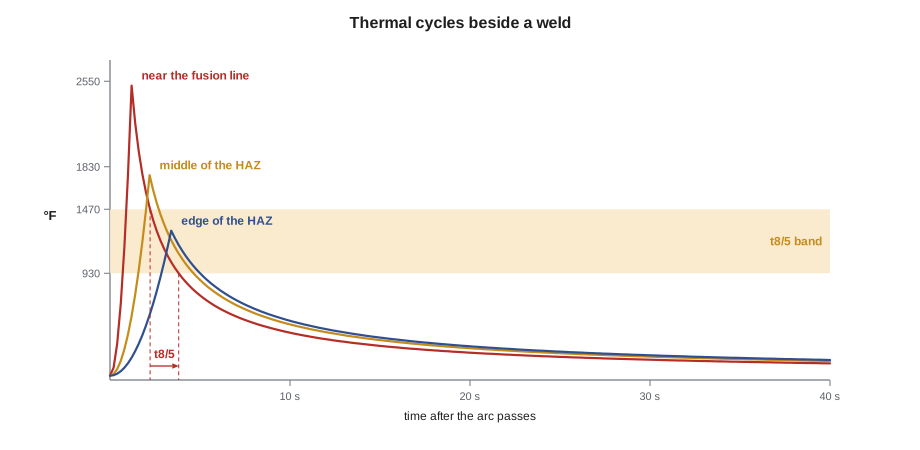
Pick any point in the plate near a weld and record its temperature as the arc approaches, passes and moves away. The record is a thermal cycle: a rapid rise to a peak temperature, then a slower fall. Points close to the fusion line reach high peaks and heat and cool quickly; points further away reach lower peaks, later, and cool more gently. Each point's microstructure is set by its own peak temperature and its own cooling rate. The heat-affected zone is simply the set of points whose peak temperature was high enough to change the structure.
The t8/5 cooling time
For carbon and low-alloy steels, the structure that forms from austenite depends mainly on how quickly the metal cools through the temperature range in which austenite transforms, roughly from 1,470 to 930 °F. Above that range nothing has happened yet; below it, the transformation is finished. Metallurgists therefore describe the cooling of a weld by a single number, t8/5, the time in seconds to cool from 1,470 to 930 °F. A short t8/5, perhaps 3 to 5 seconds, means fast cooling and a risk of martensite in hardenable steels. A long t8/5, say 20 to 40 seconds, means slow cooling, softer structures and, in some steels, coarse grains and lower toughness. Many structural steels give their best combination of hardness and toughness with t8/5 somewhere between about 5 and 25 seconds, though the right range depends on the steel.
An important convenience of t8/5 is that it is nearly the same for every point in the HAZ, because by the time any point cools through 1,470 °F the heat has spread out evenly near the weld. One number describes the cooling of the whole zone.
Estimating t8/5
In the 1930s and 1940s, the engineer Daniel Rosenthal worked out mathematical solutions for the temperature around a moving point or line source of heat. From them come two classic estimates of t8/5, one for thick plate where heat flows in three dimensions and one for thin plate where it flows in two. They assume a perfect point source and constant thermal properties, so they are approximate, but they show clearly how each variable affects cooling.
Here Q is the heat input in joules per millimeter, k is the thermal conductivity of steel, about 0.025 joules per second per millimeter per degree, and T0 is the initial plate temperature in degrees Celsius. The thick-plate formula does not contain the thickness at all: once a plate is thick enough, adding more thickness does not cool the weld any faster. The thin-plate formula contains the thickness squared in the denominator: halve the thickness and the cooling time goes up four times. Between the two lies a transition thickness, which depends on the heat input and preheat.
# Rosenthal estimates of the 800-500 C cooling time (illustrative)
import math
k = 0.025          # thermal conductivity of steel, J/(s*mm*C)
rho_c = 0.0050     # volumetric heat capacity of steel, J/(mm3 C)
def t85_thick(q, t0):              # q in J/mm, t0 in C
    return q / (2 * math.pi * k) * (1 / (500 - t0) - 1 / (800 - t0))
def t85_thin(q, d, t0):            # d plate thickness in mm
    return (q / d) ** 2 / (4 * math.pi * k * rho_c) * (1 / (500 - t0) ** 2 - 1 / (800 - t0) ** 2)
heat_inputs = (25, 50)      # kJ/in
thicknesses = (0.25, 0.5, 1.0, 2.0)   # in
initial = 70                # plate temperature, F
for q_in in heat_inputs:
    q = q_in * 1000 / 25.4                       # to J/mm
    for d_in in thicknesses:
        d = d_in * 25.4                   # to mm
        t0 = (initial - 32) / 1.8                        # to C
        thick, thin = t85_thick(q, t0), t85_thin(q, d, t0)
        t = max(thick, thin)              # the larger value applies (thin plate cools more slowly)
        mode = "thin-plate" if thin > thick else "thick-plate"
print(f"heat input {q_in:5} kJ/in plate {d_in:5} in t8/5 = {t:5.1f} s ({mode})")heat input 25 kJ/in plate 0.25 in t8/5 = 41.5 s (thin-plate) heat input 25 kJ/in plate 0.5 in t8/5 = 10.4 s (thin-plate) heat input 25 kJ/in plate 1.0 in t8/5 = 5.0 s (thick-plate) heat input 25 kJ/in plate 2.0 in t8/5 = 5.0 s (thick-plate) heat input 50 kJ/in plate 0.25 in t8/5 = 165.9 s (thin-plate) heat input 50 kJ/in plate 0.5 in t8/5 = 41.5 s (thin-plate) heat input 50 kJ/in plate 1.0 in t8/5 = 10.4 s (thin-plate) heat input 50 kJ/in plate 2.0 in t8/5 = 10.1 s (thick-plate)
At 25 kJ/in, the 1/4 in plate cools slowly as a thin plate, while every plate from about 1 in up gives the same short cooling time of about 5 seconds: thick-plate behavior. Doubling the heat input doubles the thick-plate cooling time and quadruples it for thin plate. Real welds cool faster than these estimates in T-joints and slower on narrow parts, so procedures rely on tables and tests, but the trends are right.
What preheat does
Preheat raises the starting temperature T0 of the plate. In the thick-plate formula, the cooling time depends on the differences between T0 and 500 and between T0 and 1,470 °F. A warmer plate is closer to 930 °F to begin with, so the metal near the weld takes longer to fall through the critical range. Raising the plate from room temperature to 210 °F or 300 °F lengthens t8/5 substantially. Preheat also does something the formula does not show: it keeps the whole joint warm for longer after welding, so hydrogen has more time to escape before the metal is cold enough for cracking. That second effect is often just as important.
# Effect of preheat on thick-plate t8/5 at a fixed heat input
import math
k = 0.025
q = 38 * 1000 / 25.4          # heat input converted to J/mm
for preheat in (32, 70, 120, 210, 300):
    t0 = (preheat - 32) / 1.8
    t85 = q / (2 * math.pi * k) * (1 / (500 - t0) - 1 / (800 - t0))
print(f"preheat {preheat:4} F -> t8/5 about {t85:4.1f} s")preheat 32 F -> t8/5 about 7.1 s preheat 70 F -> t8/5 about 7.7 s preheat 120 F -> t8/5 about 8.4 s preheat 210 F -> t8/5 about 10.2 s preheat 300 F -> t8/5 about 12.5 s
The jump from a cold plate to 300 °F nearly doubles the cooling time. In winter, a plate stored outside can start below freezing, which shortens t8/5 further and also leaves condensation on the steel. That is why codes require a minimum plate temperature even where no preheat is otherwise needed, and why Hartwell brings plate inside to warm before fitting in the cold months.
What the welder controls
Heat flow is not just theory. The welder changes it every time a parameter changes:
- Current and voltage: more of either means more heat input and slower cooling.
- Travel speed: slower travel means more heat input. A wide weave is effectively a very slow travel speed along the joint and can raise heat input far above the procedure's limit.
- Electrode or wire size: a bigger electrode runs at higher current and makes bigger beads with more heat input.
- Bead placement and number of passes: many small stringer beads give each pass a short thermal cycle and let later passes reheat and refine earlier ones. A few large passes put more heat in at once.
- Preheat and interpass temperature: both raise T0 for each pass.
- Time between passes and between joints: a joint welded continuously builds up heat; one welded with breaks cools between passes.
Procedures often limit heat input in both directions. A minimum keeps cooling slow enough to avoid hard structures in hardenable steel. A maximum protects toughness in steels whose HAZ grains coarsen at high heat input, and protects the properties of quenched and tempered plate, which can be softened by too much heat. On the Riverside girders, the procedure for the flange-to-web welds sets a heat input window, and Lucia checks it by timing travel and reading the meters on the first joint of each shift.
# Check heat input from a timed run against a procedure window
eff = 0.8                       # process efficiency used by the procedure
window = (20, 50)           # allowed heat input, kJ/in
runs = [  # (volts, amps, length welded in, seconds)
    (25, 180, 10, 65),
    (25, 185, 10, 150),
    (24, 175, 10, 70),
]
for v, a, length, sec in runs:
    speed = length / sec * 60                         # in per minute
    q = eff * 60 * v * a / (1000 * speed)
    status = "inside" if window[0] <= q <= window[1] else "OUTSIDE"
print(f"{v} V {a} A {speed:6.1f} in/min -> {q:5.2f} kJ/in {status} the window")25 V 180 A 9.2 in/min -> 23.40 kJ/in inside the window 25 V 185 A 4.0 in/min -> 55.50 kJ/in OUTSIDE the window 24 V 175 A 8.6 in/min -> 23.52 kJ/in inside the window
The second run took more than twice as long for the same length. The welder had started weaving to fill a wide spot in the joint, and the heat input went over the limit. On a procedure with a heat input maximum, that weld would need to be evaluated, and the welder would need to go back to stringer beads.
Multipass welds
In a weld of many passes, each new pass reheats the passes and HAZ below it. Metal reheated above the upper critical temperature transforms again and, on cooling, often forms a finer grain structure; metal reheated to lower temperatures is tempered. A well-planned multipass weld uses this deliberately, with each pass refining and tempering the one before. Temper bead techniques, used for some repairs where post-weld heat treatment is impossible, place passes with carefully controlled overlap and heat input so the last layer tempers the HAZ of the layer before. Uncontrolled multipass welding, on the other hand, can build up heat until the interpass temperature is far too high and the toughness suffers. The interpass temperature limit, covered in the lesson on preheat, keeps that in check.
Common mistakes
MistakeAssuming a thicker plate always cools the weld faster.
InsteadAbove the transition thickness, extra thickness makes no difference to t8/5.
MistakeWeaving wide to fill a joint on a procedure with a heat input limit.
InsteadWeaving cuts travel speed and raises heat input; run stringers.
MistakeThinking preheat only slows cooling.
InsteadIt also gives hydrogen time to escape before the joint is cold.
MistakeTreating the Rosenthal formulas as exact.
InsteadThey are idealized estimates; procedures rely on tables, tests and experience.
MistakeWelding a frosty plate because the procedure says no preheat.
InsteadCodes set a minimum plate temperature; warm the steel and drive off moisture.
Summary and key terms
- Heat leaves a weld mainly by conduction; thickness and joint type set the paths available.
- Each point in the HAZ has its own thermal cycle with a peak temperature and a cooling rate.
- The cooling time from 800 to 500 degrees Celsius, t8/5, describes the cooling of a steel HAZ.
- Thick-plate t8/5 is proportional to heat input; thin-plate t8/5 goes with heat input squared over thickness squared.
- Preheat lengthens t8/5 and gives hydrogen time to escape.
- The welder controls heat input through current, voltage, travel speed, weave, bead size and pass sequence.
- Heat flow
- The movement of heat from the weld into the surrounding metal.
- Isotherm
- A line joining points at the same temperature.
- Thermal cycle
- The record of temperature against time at a point near a weld.
- Peak temperature
- The highest temperature reached at a point during the thermal cycle.
- t8/5
- The time to cool from 800 to 500 degrees Celsius through the austenite transformation range.
- Transition thickness
- The thickness at which cooling changes from thin-plate to thick-plate behavior.
- Temper bead technique
- A sequence of passes placed so later passes temper the HAZ of earlier ones.
Practice problems
Work each problem on paper first, then reveal the answer to check.
Using the thick-plate formula, what happens to t8/5 if the heat input doubles?
Show answer
It doubles.
For thin plate, what happens to t8/5 if the thickness is halved at the same heat input?
Show answer
It goes up four times.
A 10 in run takes 60 s at 25 V and 180 A, efficiency 0.8. What is the heat input?
Show answer
Speed 10 in/min; 0.8 × 60 × 25 × 180 / (1000 × 10) = 21.6 kJ/in.
Lesson quiz · 5 questions
Score 60% or more to complete this lesson.
Create a free account to save your progress, take quizzes and earn a certificate.