
WLD-110 · Lesson 8 of 12 · 16 min
Oxyfuel cutting technique
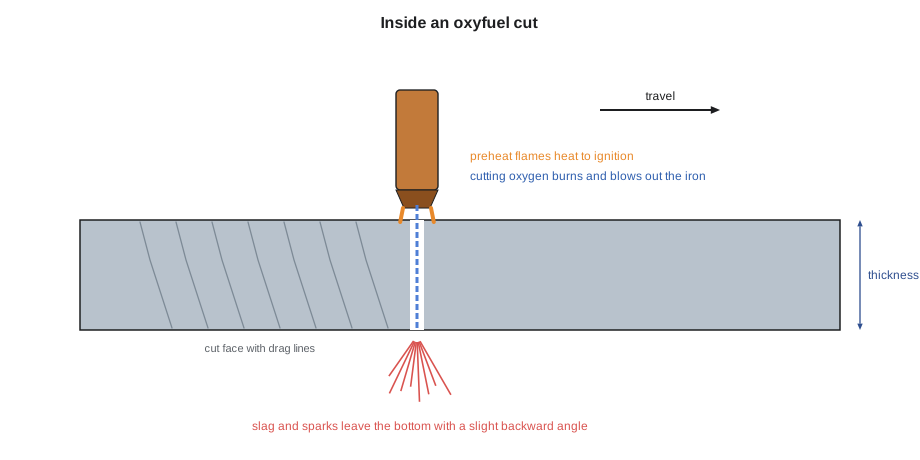
An oxyfuel torch does not melt its way through steel. It burns it. The preheat flame raises a spot on the surface to the temperature at which iron ignites in pure oxygen, and the cutting oxygen stream then burns the iron to iron oxide and blows the molten oxide out of the kerf, the narrow slot left behind. The reaction gives off so much heat that, once a cut is started in carbon steel, it would almost keep itself going without the preheat. Understanding that chemistry explains which metals can be cut, why the tip size, oxygen pressure and travel speed must match the thickness, and what each kind of bad cut is telling the welder. This lesson covers the process, the technique for straight cuts, piercing and bevels, how to read a cut face, and the safety of handling the pieces.
How oxyfuel cutting works
Iron and plain carbon steel can be cut with oxygen because of three facts. Their ignition temperature in oxygen, roughly 1,600 °F, a dull to bright red heat, is below their melting point, so the metal burns before it melts. The iron oxide that forms melts at a lower temperature than the steel, so it runs as a fluid slag that the oxygen jet can blow away. And the burning reaction releases a large amount of heat, which preheats the steel ahead of the cut. Low-alloy steels behave similarly, although high carbon content and some alloying elements make the cut harder and can harden the cut edge.
Stainless steel, aluminum, copper and cast iron do not meet those conditions. Stainless steel and aluminum form oxides with melting points higher than the metal itself, which smother the cut. Cast iron melts before it reaches its ignition temperature, and its graphite interferes. These metals are cut with plasma, mechanically or, for some specialized work, with powder or flux injection, not with a standard oxyfuel torch.
Oxygen purity matters more than most people expect. Cutting oxygen is normally at least 99.5 percent pure, and even a small drop in purity slows the cut noticeably and makes it rougher, because the impurities dilute the jet at the cutting face. That is one reason oxygen is not drawn from a cylinder at a flow so high that the regulator freezes, and why the cutting oxygen passage in the tip must be clean and round.
Setting up for a cut
The tip is chosen from the manufacturer's chart for the fuel and the thickness. The chart gives the cutting oxygen pressure, the preheat oxygen and fuel pressures or flows, the expected travel speed and the kerf width. A tip that is too small for the thickness cuts slowly and may not reach the bottom; one that is too large wastes gas, widens the kerf and rounds the top edge. Tips are cleaned with the correct size of tip cleaner, pushed straight in and out, so the holes are not reamed oversize or bell-mouthed.
The work is set up so the cut can be finished without moving the body awkwardly, the cut-off piece is supported or free to fall into a safe place, and the slag stream has somewhere to go. Plate is cut on a cutting table with slats or a grid, never directly on a concrete floor: the heat makes moisture in the concrete turn to steam and can spall the concrete explosively, throwing chips. A line is marked with soapstone or a scribe, and a straight-edge guide, a circle-cutting attachment or a portable track carriage is used where accuracy matters.
Making a straight cut
The basic technique for a hand cut starting at the edge of a plate:
- Hold the torch with the tip square to the plate surface, and the inner cones of the preheat flames about 1/16 to 1/8 in above the surface.
- Heat the edge of the plate at the start of the line until a small spot turns bright red to yellow. Starting at the very edge, or with the flames half over the edge, makes the start faster.
- Press the cutting oxygen lever slowly. Sparks and slag blow through the bottom of the plate when the cut has penetrated.
- Move along the line at a steady speed, keeping the tip height and angle constant, listening to the steady sound of the cut and watching the spark stream under the plate, which should leave the bottom of the cut at a slight angle backward.
- At the end, carry the cut through the edge before releasing the lever, so the last bit of metal does not hold the piece.
The speed is the variable most often wrong. The chart gives a starting value, and the cut itself shows whether it is right. Too fast, and the bottom of the cut lags far behind the top, the drag lines curve strongly backward, and the cut may be lost, leaving an uncut section that has to be restarted. Too slow, and the top edge melts and rounds, the cut face is gouged, and heavy slag welds itself to the bottom edge.
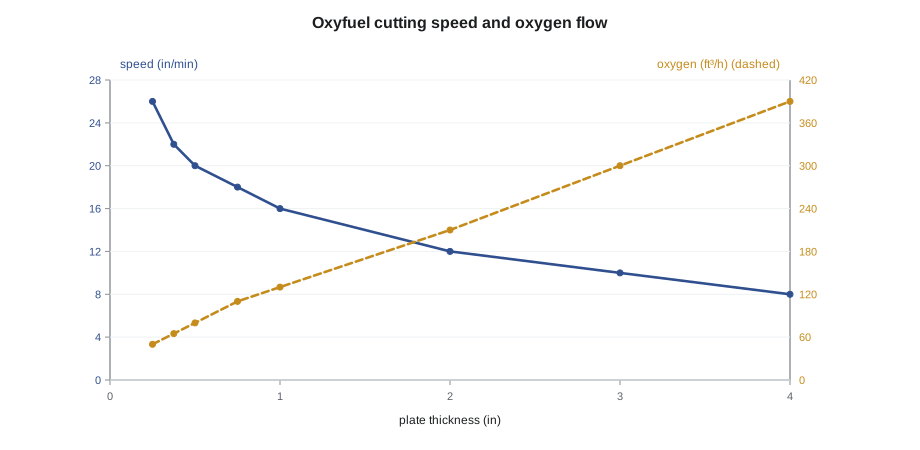
# Cut speed and gas use from a tip chart (interpolated), and the cost per length of cut
chart = [  # thickness, speed, cutting+preheat oxygen, fuel (acetylene)
    (0.25, 26, 50, 9), (0.375, 22, 65, 10), (0.5, 20, 80, 11), (0.75, 18, 110, 12),
    (1.0, 16, 130, 14), (2.0, 12, 210, 18), (3.0, 10, 300, 20), (4.0, 8, 390, 22),
]
def interp(t, col):
    for a, b in zip(chart, chart[1:]):
        if a[0] <= t <= b[0]:
            f = (t - a[0]) / (b[0] - a[0])
            return a[col] + f * (b[col] - a[col])
    raise ValueError("thickness outside the chart")
t = 0.625                       # plate thickness (in)
length = 80                  # length of cut (ft)
o2_price, fuel_price = 0.10, 0.70  # gas cost (dollars per ft³)
speed = interp(t, 1)                  # in/min
o2, fuel = interp(t, 2), interp(t, 3) # ft³ per hour
minutes = length * 12 / speed
o2_used, fuel_used = o2 * minutes / 60, fuel * minutes / 60
cost = o2_used * o2_price + fuel_used * fuel_price
print(f"{t} in plate: about {speed:.0f} in/min, {minutes:.1f} min of cutting for {length} ft")
print(f"oxygen {o2_used:.2f} ft³, acetylene {fuel_used:.3f} ft³, gas cost {cost:.2f} dollars")
print(f"gas cost per ft of cut: {cost / length:.2f} dollars")0.625 in plate: about 19 in/min, 50.5 min of cutting for 80 ft oxygen 80.00 ft³, acetylene 9.684 ft³, gas cost 14.78 dollars gas cost per ft of cut: 0.18 dollars
The chart values in the example are typical of machine cutting with acetylene and are illustrative; real charts differ by tip maker and fuel, and hand cutting is usually slower. The cost figures are only for gas, which is a small part of the true cost of a cut once labor, the cleanup of the edge and any rework are added. That is why a clean cut at the right speed is cheaper than a fast, dirty one that has to be ground.
Reading the cut face
A good oxyfuel cut has a square, sharp top edge with little rounding, a smooth face with fine drag lines that are nearly vertical, a slight lag at the bottom, and little slag that comes off with a light tap. Each fault has a usual cause:
| What you see | Likely cause |
|---|---|
| Top edge melted and rounded, beads along the top | Preheat too strong, tip too close, or speed too slow |
| Deep gouges in the face | Speed too slow or uneven, or torch movement unsteady |
| Drag lines curving strongly backward, bottom uncut | Speed too fast or oxygen pressure too low |
| Heavy, hard slag welded to the bottom edge | Speed too slow, preheat too high, or dirty tip |
| Beveled or undercut face on a cut meant to be square | Tip not square to the plate or oxygen stream distorted by a dirty tip |
| Wavy, irregular face | Tip height varying, oxygen pressure too high, or damaged tip |
Marta has Devon make a series of test cuts on scrap 3/4 in plate, deliberately too fast, too slow, too high and too low, then lay the pieces in a row and label them. Devon keeps the row on the bench for a month, and every production cut is compared with it.
Piercing and bevel cutting
Starting a cut in the middle of a plate, to cut a hole or an opening, needs a pierce. The spot is preheated until it is bright red, then the tip is raised slightly and tilted, and the cutting oxygen is opened gradually so the first blast of slag blows away from the tip rather than up into it. Once the oxygen breaks through, the tip is brought back to its normal height and angle and the cut continues. Piercing throws molten slag upward, so the face and hands are protected, and the welder never pierces with the face over the tip. On thick plate, it is often better to drill a starting hole.
Bevel cuts, made at an angle for weld preparation, are cut with the tip tilted to the bevel angle, usually with a guide or a track carriage to hold the angle. The thickness through the cut is greater than the plate thickness, so a larger tip or a slower speed is needed, and preheating takes longer. Bevels for the Riverside girder flanges are cut on the CNC table, but Devon practices hand bevels on pipe for the Unit 4 spools, which Lesson 11 returns to.
Distortion and hardening
A cut puts a lot of heat into a narrow strip, and the strip shrinks as it cools. Long narrow strips cut from plate bow toward the cut edge, and plates cut on one side curve. Cutting both edges of a strip at the same time, or in the right sequence, and leaving small uncut tabs that hold the piece in the plate until the end, keep pieces straight. On higher-carbon and alloy steels, the cut edge can harden and crack, and preheating the plate before cutting or grinding the edge afterwards may be required. Welding procedures sometimes require the cut surface to be ground to bright metal before welding.
Handling the work safely
Most injuries in the cutting area happen not from the flame but from the work: a cut-off piece that drops on a foot, a hot edge picked up without gloves, a plate that slides off a table, or slag that rolls under a boot. The rules are to support the piece being cut off or let it fall where no one is, to treat every cut piece as hot until checked, to mark hot pieces with soapstone ("HOT") when leaving them, and to keep feet out from under the cut line. Cutting tables are cleaned of slag regularly, because the build-up both blocks the slag stream and holds heat.
Coated material needs extra thought. Paint, galvanizing, oil and plastic coatings burn and fume heavily when cut, and lead paint is common on old equipment. Coatings are removed back from the cut line where practical, and fume extraction or respiratory protection is used. The loader bucket from the farm has old paint that tests positive for lead, so Priya has Devon grind it off along the cut lines with a shrouded grinder and extraction before any cutting, and Devon wears a respirator for both jobs.
Cutting with propane
The shop's portable outfit runs on acetylene, but the large manual cutting station and the field crew's heavy cutting use propane, because it is cheaper per cut on thick plate and has no withdrawal limit of the kind acetylene has. Propane changes the technique in a few ways. Its preheat is slower, so the starting spot takes longer to reach ignition temperature, and piercing takes more patience. The preheat flame has a less distinct inner cone, so it is set by the tip maker's pressures and by the look of the cut rather than by the cone alone. The tip is set slightly higher, with the inner cones further from the plate. And because propane needs far more preheat oxygen than acetylene, the oxygen cylinder empties faster; a long day of heavy cutting on propane is usually supplied from a bulk oxygen system or a manifold rather than single cylinders.
Once a cut in thick plate is going, the speed with propane is close to that with acetylene, because the oxygen jet does most of the work. Propane's slower preheat matters most on thin plate and on jobs with many starts, which is why the CNC table uses plasma for the bridge's small parts and the oxyfuel torch is kept for thick plate.
Common mistakes
MistakeCutting directly on a concrete floor.
InsteadUse a cutting table or raise the work; concrete can spall violently.
MistakePiercing with the face over the tip.
InsteadRaise and tilt the tip and keep the face to the side as the oxygen breaks through.
MistakeSpeeding up to save gas.
InsteadCut at the speed that gives a clean face; rework costs far more than gas.
MistakeReaming a dirty tip with a drill.
InsteadClean it with the correct size of tip cleaner, straight in and out.
MistakeTrying to cut stainless steel with an oxyfuel torch.
InsteadUse plasma or mechanical cutting; stainless forms a refractory oxide.
Summary and key terms
- Oxyfuel cutting burns iron in a jet of pure oxygen and blows the molten oxide out of the kerf.
- It works on carbon and low-alloy steel, not on stainless, aluminum, copper or cast iron.
- The tip, pressures and speed come from the chart for the thickness and fuel; the cut face shows whether they are right.
- Inner cones sit about 1/16 to 1/8 in above the plate; the cut is carried through the end.
- Pierces start with a raised, tilted tip; bevels need more heat or a slower speed.
- Cut pieces are hot and heavy; coatings are removed before cutting and fume is controlled.
- Kerf
- The slot left by a cut.
- Ignition temperature
- The temperature at which steel burns in pure oxygen, about 1,600 °F.
- Drag lines
- Lines on the cut face showing how far the bottom of the cut lags the top.
- Piercing
- Starting a cut away from the edge of the plate.
- Slag
- Molten iron oxide and metal blown from the cut, which may stick to the bottom edge.
- Track carriage
- A motorized carriage that moves a cutting torch along a rail at a set speed.
Practice problems
Work each problem on paper first, then reveal the answer to check.
Using the chart in the example, what is the speed for 1-1/2 in plate?
Show answer
Between 16 at 1 in and 12 at 2 in: about 14 in/min.
A cut has a melted top edge and heavy slag. What change would you make first?
Show answer
Increase the travel speed (and check the preheat and tip height).
Why can't the farm loader bucket be cut before the paint is removed?
Show answer
The old paint contains lead, which would be released as toxic fume.
Lesson quiz · 5 questions
Score 60% or more to complete this lesson.
Create a free account to save your progress, take quizzes and earn a certificate.