
WLD-110 · Lesson 12 of 12 · 20 min
Capstone: a safe cutting job from layout to cleanup
The capstone brings the whole course into one job, followed from the first conversation to the last sweep of the floor. It is a real kind of job, the sort a first-year apprentice helps with during a plant turnaround: cut out a corroded section of carbon steel pipe in a refinery, cut and bevel a replacement from new pipe in the shop, and prepare the field ends so the welders can install it. Every hazard in the earlier lessons appears at some point. The point of the lesson is not that each hazard is new, but that a real job presents them all at once, in a particular order, and that a safe job is one in which the right control is in place at each step before the work reaches it.
The job
During the Unit 4 turnaround, the refinery's inspectors find thinning on a NPS 8 carbon steel line on a pipe rack about 16 ft above grade. The line carries light hydrocarbon in service. The repair is to replace a 8 ft section: cut out the old pipe at two points, remove it with the refinery's crane, bevel the two remaining ends, and fit a new spool prepared in the Hartwell shop. Glen assigns the job to Marta, with Devon as her apprentice and a second apprentice, Sam, as fire watch. Priya coordinates the permits with the refinery.
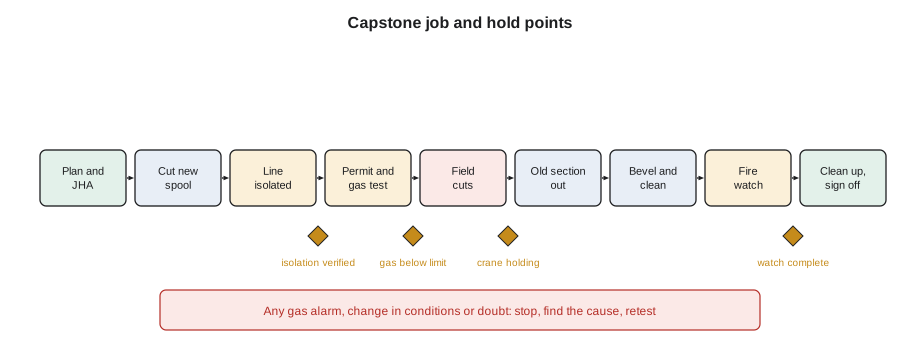
The work divides into four parts: planning, shop preparation of the new spool, field cutting and preparation, and cleanup. At each part, the crew stops at a hold point and checks that the conditions for the next step are met before going on.
Planning and the hazard analysis
The job starts at a table in the shop office with the isometric drawing of the line, the refinery's work package and a blank job hazard analysis. A job hazard analysis, or JHA, breaks the job into steps, lists the hazards at each step and the controls for each, and names who is responsible. It is written by the people who will do the work, reviewed by the supervisor and the safety coordinator, and signed by everyone on the crew. It is a working document: if the job changes, the JHA is updated before the work continues.
# Build a simple job hazard analysis table from the job steps
steps = [
    ("Cut new spool in shop", ["burns", "fume", "noise", "heavy lifting"],
     ["oxyfuel outfit inspected, flashback arrestors in date", "extraction arm at the cut", "plugs at the grinder", "crane and magnet lifter"]),
    ("Line isolated by refinery", ["hydrocarbon release", "stored pressure"],
     ["operations isolate, drain, purge and blind the line", "isolation verified with the operator"]),
    ("Field cuts on the rack", ["fire", "flammable gas", "fall from height", "falling cut piece"],
     ["hot work permit, gas test before and during", "drains sealed, fire blankets, fire watch", "harness tied off away from torch and hoses", "crane holding the section before the second cut"]),
    ("Bevel and grind field ends", ["sparks", "kickback", "dust", "noise"],
     ["sparks directed away from the rack", "guard on, both hands, work supported", "respirator", "plugs and muffs"]),
    ("Fire watch and cleanup", ["hidden fire", "hot slag and stubs"],
     ["fire watch 60 min after last hot work (OSHA minimum 30), then monitoring", "slag swept, stubs in a metal can"]),
]
for n, (step, hazards, controls) in enumerate(steps, 1):
    print(f"{n}. {step}")
    for h, c in zip(hazards, controls):
        print(f"     hazard: {h:20s} control: {c}")
print(f"{sum(len(h) for _, h, _ in steps)} hazards, each with a named control; review and sign before starting")1. Cut new spool in shop
hazard: burns control: oxyfuel outfit inspected, flashback arrestors in date
hazard: fume control: extraction arm at the cut
hazard: noise control: plugs at the grinder
hazard: heavy lifting control: crane and magnet lifter
2. Line isolated by refinery
hazard: hydrocarbon release control: operations isolate, drain, purge and blind the line
hazard: stored pressure control: isolation verified with the operator
3. Field cuts on the rack
hazard: fire control: hot work permit, gas test before and during
hazard: flammable gas control: drains sealed, fire blankets, fire watch
hazard: fall from height control: harness tied off away from torch and hoses
hazard: falling cut piece control: crane holding the section before the second cut
4. Bevel and grind field ends
hazard: sparks control: sparks directed away from the rack
hazard: kickback control: guard on, both hands, work supported
hazard: dust control: respirator
hazard: noise control: plugs and muffs
5. Fire watch and cleanup
hazard: hidden fire control: fire watch 60 min after last hot work (OSHA minimum 30), then monitoring
hazard: hot slag and stubs control: slag swept, stubs in a metal can
16 hazards, each with a named control; review and sign before startingThe JHA for the real job is longer than the example, and it also covers the access to the rack, which is on a scaffold built by the refinery's scaffold contractor and inspected and tagged, the crane lift, which the refinery's rigging crew plans and runs, and the weather. Marta makes sure that each hazard in the JHA has a control that someone on the crew will actually check, not a general statement such as "be careful".
The JHA also answers the question the course began with: can the hazard be eliminated? Marta asks whether the field cuts could be made cold. The line is too large for the crew's pipe cutters, and a clamshell cold-cutting machine would take a day to arrange, so the cuts will be made with an oxyfuel torch under permit. The bevels on the field ends, however, will be made with a clamp-on cold beveling machine instead of a torch, which removes one round of hot work from the rack and gives a better bevel.
Shop preparation of the new spool
The new section is cut from a length of new pipe in the shop. Devon marks the length from the drawing, allowing for the root openings at each end, and wraps a cutting band around the pipe to mark a square line. Because the pipe is new and clean, and the shop's cutting area is a designated hot work area, the cut is made with the track torch on the shop's oxyfuel outfit. Devon inspects the outfit, finds a fuel hose with a burned spot near the torch end, replaces the hose, leak tests the connections, purges the lines, lights the torch and sets a neutral preheat with the cutting oxygen on. The cut goes around the pipe in one pass. The spool ends are then beveled on the pipe beveling machine, ground to the root face, and cleaned to bright metal back from the bevel. Devon checks each bevel with the gauge, records the measurements, and marks the spool with the line number and the heat number from the pipe.
The shop part of the job ends with its own small cleanup: the outfit shut down and drained, the cutting table cleaned of slag, the grinder dust vacuumed, and the scrap ends marked as hot until cool.
Isolation by the refinery
No hot work happens on the line until the refinery's operations team has isolated it. The line is shut in, drained to the closed drain system, purged with nitrogen and then steam, and isolated from the live system by blinds, solid plates installed at flanges on each side of the work. The isolation points are locked and tagged under the refinery's lockout program, and each member of the Hartwell crew applies a personal lock to the group lockout box. Before any work starts, the operator walks the isolation with Marta and shows her each blind and each drain valve, and a bleed valve close to the work is opened to confirm there is no pressure and no flow.
This is a hold point. The crew does not climb the scaffold until the isolation is verified. Devon writes the blind locations in the notebook, because the JHA's control for the hydrocarbon hazard depends on them.
The hot work permit and gas test
The refinery issues hot work permits under its own system, which meets and goes beyond the standards described in Lesson 5. The refinery's permit issuer and Priya walk the area with Marta. The checks are the ones in the course: combustibles within the spark zone removed; the rack's open grating covered with fire blankets below the cut points so slag cannot fall to the next level; two process sewer drains at grade, almost directly below the work, sealed with drain covers; a fire hose and two extinguishers at the base of the scaffold and one on the platform; a continuous four-gas monitor clipped to the rack at the work and a second at the drains; and Sam assigned as fire watch, at the base of the scaffold where both the cut points and the grade below are visible.
The gas test at the cut points, inside the open bleed and at the drains reads zero percent of the lower explosive limit, oxygen at 20.9 percent and no hydrogen sulfide. The refinery's permit sets a strict limit for flammable gas for any hot work, and requires the work to stop if either monitor alarms. The permit is signed for the day shift.
The field cuts
The oxyfuel outfit is set up at grade, with the cylinders on a cart chained at the base of the scaffold, outside the spark zone, and the hoses run up the scaffold, tied off clear of the platform edge and protected where they cross the handrail. Flashback arrestors are on the regulators and check valves at the torch. Marta and Devon are tied off to the scaffold's anchor points with lanyards rigged away from the hoses and the torch, and their lanyards are made of material suited to hot work.
Before the first cut, the refinery's rigging crew rigs the old section to the crane with two slings, taking a little of its weight, so that when it is cut free it hangs from the crane and does not drop or swing. That is another hold point: the crane must be holding the section before the second cut is made.
Marta makes the first cut with a hand torch, working around the pipe while Devon watches the spark stream and the gas monitor. The pipe has a heavy layer of scale and old coating, which smokes; the refinery's portable extraction fan, set up downwind, takes most of it. Halfway through the second cut, the monitor at the drains alarms at a low level of flammable gas. Marta closes the torch valves at once and calls a stop. The permit issuer returns, finds that one drain cover has lifted at a corner because a hose was pulled across it, and the reading clears when it is reseated. The area is retested and the permit is endorsed before work resumes, and the hose is rerouted. Devon notes it as a near miss for the shift report: the control was in place, but it was disturbed by the work itself.
The second cut is finished, the section hangs from the crane, and the rigging crew lands it at grade. The cut ends on the rack are still hot, so they are marked and left to cool while the fire watch continues.
Preparing the field ends
When the ends are cool, Devon fits the clamp-on beveling machine to the first open end and machines a bevel and root face to match the spool, then does the second end. The machine is cold, but it has its own hazards: a rotating cutter head and the weight of the machine on a vertical pipe. The machine is clamped and its supports are tied off before it is started, and Devon's sleeves and gloves are kept clear of the rotating head. The ends are then cleaned inside and out with a wire wheel on a grinder, with the guard on and sparks directed away from the rack, which counts as hot work and stays under the permit. Marta checks the bevels with the gauge, and the inspectors confirm the wall thickness at the new ends with an ultrasonic thickness gauge.
# Time and gas for the field job, and when the area can be released
cuts = 2
circumference = 3.1416 * 8.625       # pipe outside circumference (in)
speed = 12                       # hand cutting speed for this wall, with scale (in per min)
o2_rate, fuel_rate = 90, 11      # oxygen and acetylene use while cutting (ft³ per h)
cut_min = cuts * circumference / speed
stop_min = 25                       # the gas alarm stop, investigation and retest
o2 = o2_rate * cut_min / 60
fuel = fuel_rate * cut_min / 60
print(f"arc-on cutting time {cut_min:.0f} min, plus {stop_min} min for the alarm stop")
print(f"gas used: oxygen {o2:.2f} ft³, acetylene {fuel:.3f} ft³")
last_hot_work = 13 * 60 + 50        # wire brushing of the second end ended at 13:50
watch, monitor = 60, 60             # minutes
release = last_hot_work + watch + monitor
print(f"fire watch to {(last_hot_work + watch) // 60}:{(last_hot_work + watch) % 60:02d}, "
f"area released at {release // 60}:{release % 60:02d} after the final walk-through")arc-on cutting time 5 min, plus 25 min for the alarm stop gas used: oxygen 6.77 ft³, acetylene 0.828 ft³ fire watch to 14:50, area released at 15:50 after the final walk-through
Fire watch, cleanup and sign-off
Sam keeps the fire watch for the full hour after the last hot work, which was the wire brushing of the second end, watching the rack, the grating below and the drains, and then walks the area every fifteen minutes for the hour of monitoring that the refinery's permit requires. Meanwhile, the crew cleans up: slag and scale swept from the platform and the grating below and put in a metal container; the fire blankets inspected and folded; electrode stubs and grinding discs collected; the oxyfuel outfit shut down, the cylinder valves closed, the lines drained, the regulators backed off and the hoses coiled and lowered; and the cylinders capped and returned to the refinery's contractor storage area. The open pipe ends are capped to keep dirt and rain out until the spool is fitted.
At the end of the monitoring period, Marta and the permit issuer walk the area together: on the platform, under it, along the grating and at the drains. Nothing is warm except the sun on the steel. The permit is signed off and returned. The crew removes their personal locks from the group box only after the work for the day is complete; the line stays isolated by the refinery until the new spool is welded and tested.
The review
Back at the shop, Glen holds a short review of the job with the crew. The new spool fitted well because the shop bevels matched the field bevels within the tolerance. The fuel hose with the burned spot was found at inspection, which is what inspection is for. The near miss at the drain cover is written up and shared with the field crews: drain covers are now weighted or strapped, and hoses are routed so they cannot cross a cover. Devon is asked what would have happened without the second gas monitor at grade. The honest answer, that the vapor at the drain would probably not have been noticed by anyone on the rack, is the reason the refinery requires two.
Devon's last entry for the job lists every hold point and who confirmed it, and the note Marta wanted to see: the right control at each step, in place before the work got there.
Common mistakes
MistakeTreating the JHA as paperwork to finish before the real work.
InsteadWrite it with the crew, check each control, and update it when the job changes.
MistakeStarting hot work because the permit is signed, before the isolation is verified.
InsteadConfirm isolation with the operator at each blind and drain first.
MistakeMaking the second cut before the crane holds the section.
InsteadRig and take the weight before the section is cut free.
MistakeIgnoring a low-level gas alarm because the reading cleared.
InsteadStop, find the cause, retest and have the permit endorsed before resuming.
MistakeReleasing the area as soon as the welding crew leaves.
InsteadComplete the fire watch and monitoring, then walk the area and sign off.
Summary and key terms
- A real job presents the hazards of the whole course at once, in a particular order.
- The JHA breaks the job into steps, hazards and named controls, and asks first whether a hazard can be eliminated.
- Hold points stop the work until isolation, the permit and gas test, the crane and the fire watch are confirmed.
- Controls can be disturbed by the work itself, so monitoring continues and alarms stop the work.
- Cleanup, the fire watch and the final walk-through are part of the job, not an afterthought.
- A review after the job turns near misses into changes that protect the next crew.
- Job hazard analysis
- A step-by-step list of a job's hazards and the controls for each, prepared by the crew.
- Hold point
- A point in a job where work stops until specified conditions are confirmed.
- Blind
- A solid plate installed between flanges to positively isolate a line.
- Group lockout
- A lockout in which each worker places a personal lock on a common lockbox.
- Near miss
- An event that could have caused harm but did not.
- Permit endorsement
- A recorded review and approval to continue work after conditions change.
Practice problems
Work each problem on paper first, then reveal the answer to check.
The last hot work ends at 3:10 pm with a one-hour fire watch and one hour of monitoring. When can the area be released?
Show answer
5:10 pm, after the final walk-through.
Name three hold points in the capstone job.
Show answer
Isolation verified, permit and gas test complete, crane holding the section before the second cut (also fire watch complete before release).
How did the crew eliminate one round of hot work?
Show answer
By beveling the field ends with a cold clamp-on beveling machine instead of a torch.
Lesson quiz · 5 questions
Score 60% or more to complete this lesson.
Create a free account to save your progress, take quizzes and earn a certificate.