
WLD-110 · Lesson 11 of 12 · 17 min
Mechanical cutting, grinding and edge preparation
Not every cut needs heat. Saws, shears, punches and abrasive wheels cut steel cold, without fume from the cut, without a heat-affected edge and often with better accuracy. Grinders then finish what every cutting method starts: removing slag and dross, cleaning mill scale, shaping bevels and taking off the hardened layer left by thermal cutting. In most shops, the angle grinder is also the tool that causes more injuries than any other. This lesson covers mechanical cutting machines, abrasive wheels and grinders and how to use them safely, and then the edge preparation that turns a cut piece into a joint ready to weld.
Saws
Band saws cut bar, structural shapes and pipe with a continuous toothed blade running over two wheels. Horizontal band saws clamp the work in a vise and feed the blade down through it, often automatically, and are used for cutting stock to length. Vertical band saws are used for contours and small parts, with the work fed by hand into the blade. Cold saws use a circular toothed blade at low speed with coolant and give a square, burr-free cut on bar and tube. Abrasive cut-off saws, often called chop saws, use a thin abrasive wheel at high speed; they are fast and cheap but throw sparks, make noise and dust, and leave a burr and a heated edge.
The hazards of saws are contact with the blade, work that is not clamped and spins or kicks, flying chips, sparks from abrasive saws, and long or heavy stock that falls when the cut finishes. The controls: guards in place and adjusted so the least possible blade is exposed; work clamped in the vise, never held by hand on a cut-off saw; supports for long stock on both sides of the cut; hands kept out of the line of the blade and a push stick used on vertical saws for small pieces; and the machine stopped and locked out before changing blades, clearing chips or adjusting guides.
Shears, punches and ironworkers
Plate shears cut sheet and plate along a straight line between a moving upper blade and a fixed lower one, and an ironworker combines a punch, a shear for flat bar and angle, and a notcher in one hydraulic machine. They cut with very large forces and give no warning: a finger in the wrong place is gone before the operator can react. Shears and ironworkers have fixed guards and hold-downs at the point of operation, adjustable guards set to the thickness of the work, and controls that need the operator's hands or foot in a safe place. Only one person operates the machine, and the operator never reaches past a guard, never holds small pieces with fingers near the blade or punch, and never works on the machine without locking it out.
Shearing and punching are rated by the thickness and strength of the material, and exceeding the rating can break the machine. The capacity chart is posted on the machine, and stainless steel, which is stronger than mild steel, typically has a lower rated thickness.
Grinders and abrasive wheels
Portable angle grinders run small abrasive wheels at very high speed: a 5 in grinder may run at 11,000 rpm or more, so the edge of the wheel moves at around 14,000 to 16,000 ft/min. At that speed, a wheel that breaks throws fragments with enough energy to kill, and a wheel that catches in the work can kick the grinder back at the operator faster than anyone can react.
Each wheel is marked with its maximum operating speed, in rpm and surface speed, its dimensions, its type and what it is for. The most important rule of grinding is that the wheel's marked maximum speed must be equal to or higher than the no-load speed of the grinder it is mounted on. A larger wheel on a grinder made for a smaller wheel, or a wheel with a lower speed rating, can burst.
# Check that a wheel is rated for the grinder, and find the surface speed
import math
grinder_rpm = 11000            # no-load speed on the grinder nameplate
wheels = [  # (description, diameter in, maximum rpm marked on the wheel)
    ("5 in grinding disc", 5, 12250),
    ("5 in flap disc", 5, 12200),
    ("7 in disc on a 5 in grinder", 7, 8500),
]
for name, d, wheel_max in wheels:
    speed = math.pi * d * grinder_rpm / 12
    verdict = "OK" if wheel_max >= grinder_rpm else "DO NOT MOUNT: wheel rated below grinder speed"
print(f"{name:30s} edge speed {speed:7.0f} ft/min {verdict}")5 in grinding disc edge speed 14399 ft/min OK 5 in flap disc edge speed 14399 ft/min OK 7 in disc on a 5 in grinder edge speed 20159 ft/min DO NOT MOUNT: wheel rated below grinder speed
The third wheel would also not fit under the grinder's guard, which is the point: removing the guard to fit a bigger wheel is one of the most common causes of serious grinder injuries.
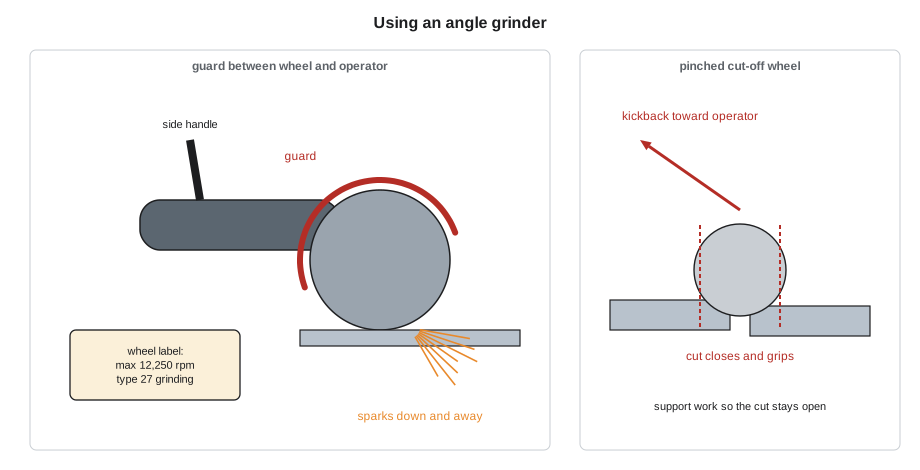
Wheels come in types. Depressed-center grinding wheels, type 27, are thick and made for grinding with the face of the wheel at a shallow angle. Thin cut-off wheels, type 1 or 41, are made only for cutting with their edge; side pressure, such as using a cut-off wheel to grind a weld flush, can shatter them. Flap discs, made of overlapping abrasive flaps, grind and blend with less gouging and less vibration. Wire wheels and brushes clean scale, rust and slag, and they shed wires that can pierce skin and eyes. Each type is used only for its own purpose and with the guard the grinder maker specifies for it.
Using a grinder safely
Before use, the operator checks the grinder's cord or battery, switch and guard, and the wheel's type, speed rating, size, expiry date where one is marked, and condition. A wheel that is chipped, cracked, wet or has been dropped is discarded. Vitrified wheels on bench and pedestal grinders are given a ring test before mounting: tapped lightly with a non-metallic tool, a sound wheel rings clearly and a cracked one gives a dull sound. Wheels are mounted with the correct flanges, tightened with the grinder's own wrench, and the new wheel is run at full speed for a minute with the operator and everyone else standing out of line with it.
During use, the grinder is held with both hands, with the side handle fitted, and the guard is positioned between the wheel and the operator's body. Sparks are directed down and away from the body, other people, cylinders, hoses and combustibles. The operator stands to the side of the plane of the wheel, never in line with it, and lets the grinder reach full speed before touching the work. Cut-off wheels are fed straight into the cut without twisting, with the work supported so the cut does not close and pinch the wheel, which causes kickback. The grinder is not put down until the wheel has stopped. Work is clamped, not held in the other hand or underfoot.
Grinding produces dust from the wheel and the metal, sparks that start fires, noise often around 95 to 100 dBA, and vibration. Grinding stainless steel or painted or plated metal produces the same hazardous metals as welding fume, as dust. Local extraction, shrouded grinders with vacuum attachments, respirators where needed, hearing protection, and a face shield over safety glasses are the normal controls. Long periods of grinding cause hand-arm vibration syndrome, with numbness, tingling and loss of grip, so the shop rotates grinding tasks and uses low-vibration tools and flap discs.
Bench and pedestal grinders have their own rules: the work rest is set within about 1/8 in of the wheel, so work cannot jam between them, and the adjustable tongue guard at the top within about 1/4 in. Grinding is done on the face of the wheel, not the side, and gloves are not worn where they could be caught.
OSHA's abrasive wheel rules, 1910.215 for general industry and 1926.303 for construction, require guards on abrasive wheels, wheels rated for the spindle speed, a ring test before mounting, work rests within 1/8 inch and tongue guards within 1/4 inch on bench grinders. ANSI B7.1 gives further detail.
Edge preparation
A joint is prepared so that the weld can fuse the full thickness the design requires. Thin plate can be welded square-edged. Thicker material is beveled, or grooved, so the arc can reach the root. The drawings and the welding procedure specify the joint: the bevel angle, the root face, also called the land, and the root opening, the gap between the pieces at the root. A single-V groove might be beveled at 30 to 37.5 degrees on each piece for a total groove angle of 60 to 75 degrees, with a root face of a couple of millimeters and a similar root opening. The drawing and weld symbols course covers joint designs in detail; here the concern is how the edges are made.
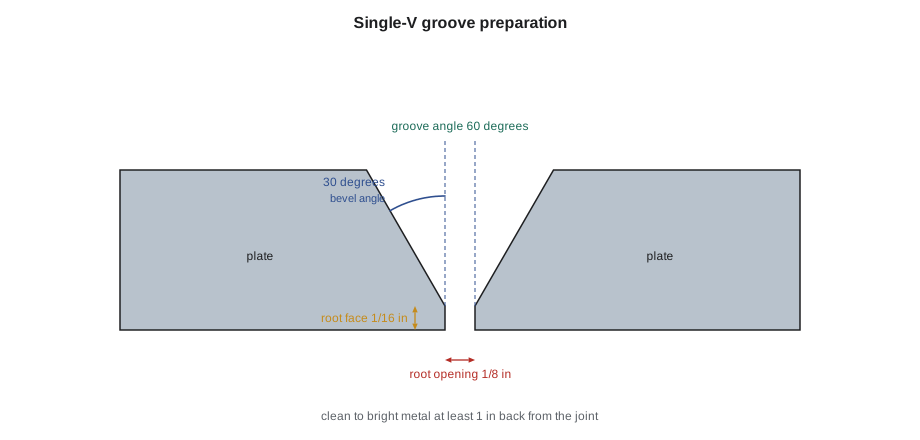
Bevels on plate are cut by oxyfuel or plasma on the CNC table or with a track carriage, then ground to remove slag, dross and the oxidized and hardened surface and to form the root face. Pipe bevels are cut with a pipe beveling machine, a track torch that clamps around the pipe, or a hand torch for field work, and then ground. Mill scale, rust, paint, oil and moisture are removed for a distance back from the joint, usually at least 1 in, because they cause porosity and lack of fusion. Stainless steel is ground with wheels and brushes kept only for stainless, because particles of carbon steel left on stainless rust and spoil its corrosion resistance.
The bevel is checked with a bevel protractor or gauge, and the root face with a scale or a gauge. An apprentice who learns to prepare an edge accurately makes the welder's job easier: a bevel that is too steep needs more weld metal, one too shallow may not allow full fusion, and a root face that varies along the joint makes a consistent root pass almost impossible.
Kerf and material yield
Every cut removes a strip of metal as wide as its kerf, and every part nested on a plate leaves scrap around it. The kerf width depends on the process: roughly 1/16 to 3/32 in for plasma on medium plate, 3/32 to 5/32 in for oxyfuel depending on thickness, about 0.04 in for a band saw, and 3/32 to 1/8 in for an abrasive cut-off wheel. A cutting list allows for it, and so does the layout of a cut: the cut line is put on the waste side of the layout line, so the part comes out to size.
# How many strips can be cut from a plate, allowing for kerf, and what is the yield?
plate_w, plate_l = 96, 240     # plate width and length (in)
strip_w = 6                    # strip width needed (in)
trim = 0.375                       # edge trim to remove mill edge (in)
for process, kerf in [("plasma", 0.08), ("oxyfuel", 0.125), ("abrasive saw", 0.1)]:
    usable = plate_w - 2 * trim
    n = int((usable + kerf) // (strip_w + kerf))
    yield_pct = 100 * n * strip_w / plate_w
print(f"{process:16s} kerf {kerf:5.3f} in: {n} strips, yield {yield_pct:.1f} %")plasma kerf 0.080 in: 15 strips, yield 93.8 % oxyfuel kerf 0.125 in: 15 strips, yield 93.8 % abrasive saw kerf 0.100 in: 15 strips, yield 93.8 %
The difference between processes is one strip at most on this plate, but on a large nesting job with hundreds of parts the kerf and the spacing add up to whole plates. That is why the CNC programs at Hartwell nest parts with shared cut lines where the design allows, and why Devon learns to lay out a hand cut with the kerf on the scrap side.
The Unit 4 spools
For the Unit 4 turnaround, Devon's first real cutting task is preparing the ends of twelve carbon steel pipe spools: cut to length on the band saw, beveled at 37.5 degrees with the clamp-on beveling machine, then ground to a root face of about 1/16 in with a flap disc. The stainless spools are done separately with the stainless-only grinder and discs, in the pressure bay with the extraction on. Marta checks the first two ends with a gauge, then every fourth. The last check is the cleaning: bright metal 1 in back from each bevel, inside and out, with no oil from the band saw coolant left on the pipe.
Common mistakes
MistakeFitting a larger wheel by removing the guard.
InsteadUse only wheels the grinder and its guard are made for.
MistakeUsing a cut-off wheel to grind a weld flush.
InsteadUse a grinding wheel or flap disc; cut-off wheels are for edge cutting only.
MistakeHolding a short piece by hand on the chop saw.
InsteadClamp it in the vise.
MistakeGrinding stainless with the same disc used on carbon steel.
InsteadKeep wheels and brushes for stainless only.
MistakePutting the grinder down while the wheel is still turning.
InsteadWait for the wheel to stop.
Summary and key terms
- Saws, shears, punches and ironworkers cut cold, with guards, clamping and lockout as the main controls.
- A wheel's marked maximum speed must be equal to or above the grinder's no-load speed, and the guard stays on.
- Use each wheel type only for its purpose; cut-off wheels are never side-loaded.
- Hold grinders with both hands, stand out of the wheel's plane, direct sparks away and support work to avoid pinching.
- Edge preparation sets the bevel angle, root face and root opening, and removes scale, oil and the thermally cut surface.
- Kerf and nesting decide how many parts a plate yields.
- Kerf
- The width of material removed by a cut.
- Type 27 wheel
- A depressed-center grinding wheel used on its face.
- Cut-off wheel
- A thin abrasive wheel used only for cutting with its edge.
- Ring test
- Tapping a vitrified wheel to detect cracks by its sound.
- Root face
- The unbevelled portion at the root of a groove weld joint, also called the land.
- Root opening
- The gap between the members at the root of a joint.
Practice problems
Work each problem on paper first, then reveal the answer to check.
A grinder runs at 10,000 rpm. Which wheel is acceptable: one rated 8,500 rpm or one rated 12,000 rpm?
Show answer
Only the 12,000 rpm wheel.
A 48 in wide plate is cut into 4 in strips by plasma with a 0.08 in kerf and 3/8 in trim each side. How many strips?
Show answer
(47.25 + 0.08) / 4.08 = 11 strips.
Why is the cut line put on the waste side of a layout line?
Show answer
So the kerf comes out of the scrap and the part stays to size.
Lesson quiz · 5 questions
Score 60% or more to complete this lesson.
Create a free account to save your progress, take quizzes and earn a certificate.