
WLD-110 · Lesson 4 of 12 · 19 min
Electrical safety and arc welding power
Every arc welding and plasma cutting process puts the welder inside an electrical circuit. The electrode holder, the torch, the wire, the work piece, the table and often the floor are all part of it, and the welder's hands are never more than a glove's thickness from a live conductor. Most of the time the voltage is low enough that dry skin and dry gloves keep the current to a tingle. Wet, hot, cramped or steel-enclosed conditions change that, and the primary supply that feeds the welding machine can kill at once. This lesson explains how a welding power source and its circuit work, what makes shock dangerous, how the work lead is connected so that welding current goes where it should, and how welders inspect their equipment and work safely in hazardous locations.
The welding circuit
A welding power source takes electricity from the building supply, the primary side, and converts it to the high current and low voltage needed for welding, the secondary side. On the secondary side, current flows out through the electrode lead to the electrode holder or torch, across the arc into the work, through the work piece to the work clamp, and back through the work lead to the machine. The work lead is often called the ground lead, but it is not an earth ground. It is the return conductor of the welding circuit, and treating it as a ground is the source of some serious mistakes described below.
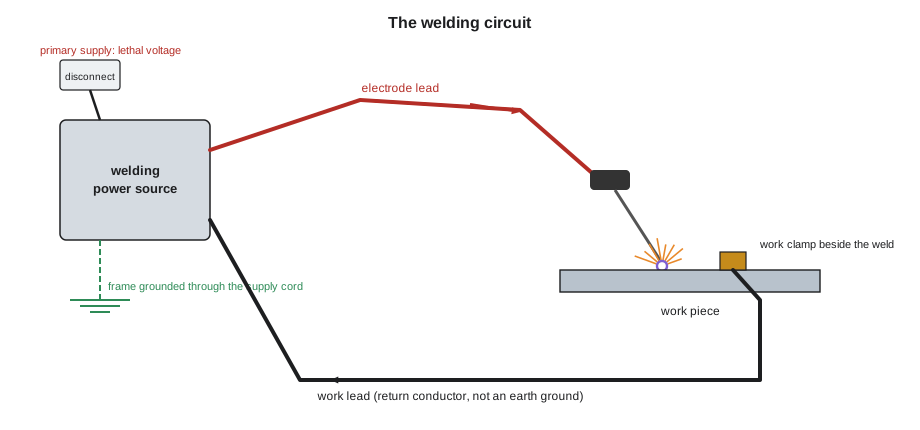
Power sources are described by their output characteristic. Constant current machines, used for SMAW and GTAW, hold the current fairly steady as the arc length changes with the welder's hand. Constant voltage machines, used for GMAW and FCAW, hold the voltage steady and let the current follow the wire feed. Plasma cutters use constant current. Output can be alternating current or direct current; direct current is described by polarity, electrode positive or electrode negative, which affects penetration and which electrodes will run. The shielded metal arc welding course covers these in detail.
The rated output of a machine comes with a duty cycle: the percentage of a ten-minute period it can deliver that current without overheating. A machine rated at 300 A at 60 percent can weld at 300 A for six minutes out of every ten. At lower current the duty cycle is higher, roughly in proportion to the square of the ratio of currents, and running a machine beyond its duty cycle trips its thermal protection or damages it.
Open-circuit voltage and shock
When the machine is on and not welding, the voltage between the electrode and the work is the open-circuit voltage. It is higher than the arc voltage, because it has to be high enough to strike the arc: typically about 50 to 80 V for SMAW machines, often around 15 to 40 V for constant voltage machines, and much higher for plasma cutters, whose open-circuit voltage can be 250 V or more and which are designed so that the torch parts cannot be touched while live. Open-circuit voltage is the voltage the welder is exposed to when changing an electrode or touching the electrode and the work at the same time.
Whether a shock is felt as a tingle or stops the heart depends on the current through the body, and that depends on the voltage and on the resistance of the path. Dry skin has a resistance of tens of thousands of ohms; wet, sweaty or broken skin can fall below one thousand ohms. A current of about 1 mA can be felt, about 10 to 20 mA prevents a person from letting go, and about 50 to 100 mA through the chest for a fraction of a second can cause ventricular fibrillation. The arithmetic is Ohm's law: 80 V across 1,000 ohms drives 80 mA.
That is why the welding rules all come back to dryness and insulation. The welder wears dry gloves and dry clothing, stands or kneels on a dry insulating mat or board when working on steel or in wet conditions, never wraps a lead around the body or drapes it over the shoulders, and never changes electrodes with bare hands or wet gloves. In hot weather, sweat-soaked clothing is a real hazard. Where the risk is high, as in a wet location, inside a steel vessel, or where the welder is in contact with the work over a large area, the machine should have a voltage-reducing device that drops the open-circuit voltage to a safe level until the electrode touches the work, or the welding is done with direct current, which is less likely than alternating current to cause fibrillation at the same voltage.
Two machines welding on the same work piece, or one welder with two holders, can put the full open-circuit voltage of both machines in series between the two electrodes if their polarity is opposite. That doubles the voltage a person touching both would get. Welders working on the same piece are told not to touch each other's electrodes or holders, and the machines are connected with the same polarity where possible.
# Shock current through the body: Ohm's law with different conditions
ocv = 80                      # open-circuit voltage of the machine (V)
paths = {
    "dry gloves, dry skin":       100_000,
    "damp gloves":                 10_000,
    "sweaty skin, hot day":         2_000,
    "wet skin, kneeling on steel":    800,
}
for case, ohms in paths.items():
    mA = ocv / ohms * 1000
    effect = ("barely felt" if mA < 1 else "painful" if mA < 10 else
              "cannot let go" if mA < 50 else "can stop the heart")
    print(f"{case:30s}{ohms:8,d} ohm  {mA:6.1f} mA  {effect}")
vrd = 12                      # voltage with a voltage-reducing device active (V)
print(f"with a VRD the worst case drops to {vrd / 800 * 1000:.0f} mA")dry gloves, dry skin 100,000 ohm 0.8 mA barely felt damp gloves 10,000 ohm 8.0 mA painful sweaty skin, hot day 2,000 ohm 40.0 mA cannot let go wet skin, kneeling on steel 800 ohm 100.0 mA can stop the heart with a VRD the worst case drops to 15 mA
The resistances are rough, but the pattern is the one that matters: the same machine that is harmless with dry gloves can drive a dangerous current through a wet body. Devon writes in the notebook: dry gloves are not comfort, they are insulation.
The primary side
The primary supply to a welding machine is usually 208, 230 or 480 V, single phase or three phase, and contact with it can kill. Machines are connected through a disconnect switch or a plug and receptacle rated for the load, installed to the National Electrical Code (Article 630 covers welders), and the machine frame is grounded through the supply cord's equipment grounding conductor. Only qualified electricians install or repair primary connections. If a primary cord is damaged, the machine is disconnected and tagged out; welders do not tape primary cords or open machine covers.
Before a machine is moved, serviced, or has its input connections changed, it is switched off and disconnected from the primary supply, and if anyone works inside the cabinet, it is locked out under the shop's hazardous energy control procedure. Machines that run from an engine-driven generator on a field job are grounded as the manufacturer specifies, and their output is treated exactly like a shop machine's.
Connecting the work lead
The work clamp goes on the work piece, or on the fixture holding it, as close as practical to the weld, on clean metal, with a tight connection. Three things go wrong when it does not.
- Stray current. If the work clamp is attached to a steel table, a building column or a pipe rack far from the work, welding current looks for its own way back, through structural steel, bolted joints, conduit, crane rails, hoist chains, slings, motor bearings or the equipment grounding conductors of other circuits. Current through a loose joint or a small conductor heats it, and fires and damage to bearings and electronics have started this way. Hoist chains and wire rope slings have been weakened by arcing from stray welding current.
- Poor connections. A clamp on rust, paint or mill scale has high resistance, heats up, and makes the arc unstable, and a loose clamp can arc against the work.
- Hidden paths through people. A welder holding a work piece that is not connected to the work lead can become part of the return path.
Welding is never done on a piece that is hanging from a crane hook or a hoist unless the work lead is clamped to the piece itself and the hook and rigging are insulated or kept out of the circuit. The Riverside girders are welded on stands in the structural bay with the work clamp moved along the girder as the welder moves, never left at the far end.
Leads, holders and connectors
Welding leads are flexible copper cables with heavy insulation, sized for the current and the length. A lead too small for its current overheats, and a long lead loses voltage, which makes the arc unstable and tempts the welder to turn the machine up. Leads are inspected before use for cuts, cracked insulation, exposed conductor and loose lugs. Damaged insulation is repaired only with splices and connectors made for welding cable, never with tape alone, and leads with repeated damage are replaced. Electrode holders and torches are fully insulated; a holder with cracked jaw insulation or exposed metal is replaced.
Leads are run where they will not be driven over, walked on or cut, and are kept away from hot work, sharp edges and oil. Coiling a long, live lead in a tight loop can create a magnetic field and heating, so excess lead is laid out in long loops. When the welder stops work, the electrode is removed from the holder, the holder is hung on an insulated hook or placed where it cannot touch the work or a person, and the machine is turned off if the welder is leaving.
# Arc power, heat input and how long the machine can run
volts = 24          # arc voltage (V)
amps = 160           # welding current (A)
speed = 6          # travel speed (in/min)
eff = 0.8            # arc efficiency for SMAW, the share of arc power that enters the work
power_kw = volts * amps / 1000
heat = eff * volts * amps * 60 / (1000 * speed)
print(f"arc power {power_kw:.1f} kW")
print(f"heat input {heat:.2f} kJ/in (with efficiency {eff})")
rated_amps, rated_duty = 300, 60   # machine nameplate: 300 A at 60 % duty
duty = min(100, rated_duty * (rated_amps / amps) ** 2)
print(f"allowed duty cycle at {amps} A: {duty:.0f} % of each 10 minutes")arc power 3.8 kW heat input 30.72 kJ/in (with efficiency 0.8) allowed duty cycle at 160 A: 100 % of each 10 minutes
Heat input, the energy put into each unit length of weld, is one of the variables a welding procedure controls, because it affects the strength and toughness of the weld and the heat-affected zone. The welding metallurgy course covers why. For now, the point is that the arc puts several kilowatts into a spot a few millimeters across, which is why welding and cutting burn people and start fires so easily.
Hazardous locations for arc work
Some conditions call for extra care, and several of them often occur together on field jobs:
- Wet locations, including outdoor work in rain, work on wet floors and work near water. Welders stand on dry insulation, use dry gloves and, where possible, a voltage-reducing device or direct current.
- Inside vessels, tanks, boxed members and pipe, where the welder is surrounded by and leaning on the work. The machine stays outside the space, the welder is insulated from the steel, and the attendant can switch off the machine quickly.
- Elevated work, where a shock that would be harmless on the ground can cause a fall. Fall protection lanyards are kept away from the welding leads and from the arc, and the lead is supported so its weight does not pull on the welder.
- Work near overhead lines or energized equipment, which is done only under the site's electrical safety procedures.
Strong magnetic fields around welding leads and machines can affect implanted medical devices such as pacemakers. Workers with such devices consult their doctor and the device maker before welding or working close to welding equipment.
OSHA's arc welding rules, 1910.254 for general industry and 1926.351 for construction, require machines installed to the National Electrical Code, frames grounded, work leads of adequate size and connected to the work, damaged cables removed from service, and electrodes removed from holders that are left unattended. ANSI Z49.1 gives further detail on arc welding equipment and hazardous conditions.
A field case
During the Unit 4 turnaround, Marta and Devon are sent to cut out and replace a short section of pipe on a rack in the refinery. It rained overnight. The engine-driven welder is on the road below the rack, 80 ft of lead away. Marta's checklist before the first arc: leads inspected along their full length and run off the walkway; work clamp on the spool itself, not on the rack; the machine's voltage-reducing device switched on; Devon's gloves dry, a spare pair in a bag; a rubber mat on the platform grating; the fall protection lanyard clipped above, away from the lead; and a check that nothing on the rack, such as an instrument tube or a tracing line, is between the clamp and the weld. The refinery's hot work permit, which is the subject of the next lesson, is in Priya's hand.
Common mistakes
MistakeClamping the work lead to a steel column across the bay.
InsteadClamp on the work piece, close to the weld, on clean metal.
MistakeChanging electrodes with wet gloves.
InsteadKeep gloves dry and switch off or use a voltage-reducing device in wet conditions.
MistakeTaping a cut in a primary cord.
InsteadDisconnect and tag out the machine; primary repairs are for an electrician.
MistakeWelding on a part hanging from a hoist chain with the clamp on the table.
InsteadClamp on the part and keep the rigging out of the welding circuit.
MistakeDraping the lead over the shoulder for overhead work.
InsteadSupport the lead separately; never wrap it around the body.
Summary and key terms
- The welding circuit runs from the machine through the electrode lead, the arc, the work and the work lead back to the machine.
- Open-circuit voltage, typically up to about 80 V for SMAW, is the shock exposure when the welder touches electrode and work.
- The current through the body, set by voltage and resistance, decides how severe a shock is; wet skin and clothing make it far worse.
- The primary side is lethal and is handled by electricians, with lockout for internal work.
- The work clamp goes on the work near the weld to prevent stray current through structures, chains and equipment.
- Wet, enclosed and elevated locations need insulation, voltage-reducing devices or direct current, and extra supervision.
- Primary circuit
- The supply that feeds the welding power source.
- Secondary circuit
- The welding output circuit, from the machine through the arc and back.
- Open-circuit voltage
- The voltage between electrode and work when the machine is on but not welding.
- Work lead
- The return conductor of the welding circuit, clamped to the work.
- Duty cycle
- The percentage of a ten-minute period a machine can deliver a given current.
- Voltage-reducing device
- A device that lowers open-circuit voltage until the electrode touches the work.
Practice problems
Work each problem on paper first, then reveal the answer to check.
A machine is rated at 250 A at 40 percent duty. About what duty cycle is allowed at 200 A?
Show answer
40 × (250 / 200)² = about 62 percent.
An 80 V open-circuit voltage is applied across a 2,000 ohm body path. What current flows?
Show answer
40 mA, enough to prevent letting go.
Why is the work lead not an earth ground?
Show answer
It is the return conductor of the welding circuit; the machine frame is grounded separately.
Name two things stray welding current can damage.
Show answer
Hoist chains or slings, and motor bearings or electronics (also building conductors).
Lesson quiz · 5 questions
Score 60% or more to complete this lesson.
Create a free account to save your progress, take quizzes and earn a certificate.