
WLD-110 · Lesson 7 of 12 · 17 min
Oxyfuel equipment and setup
An oxyfuel outfit is simple: two cylinders, two regulators, two hoses and a torch. It is also unforgiving. Most oxyfuel accidents come from a few predictable faults: a mixed-up or leaking connection, oil on an oxygen fitting, a hose burned by slag, a missing flashback arrestor, a torch lit in the wrong order, or acetylene drawn from a cylinder faster than it can safely supply. This lesson takes the outfit apart piece by piece, explains what each part does and how it can fail, and then puts it back together in the order Marta teaches Devon: inspect, assemble, test, purge, light, adjust, shut down.
The parts of an oxyfuel outfit
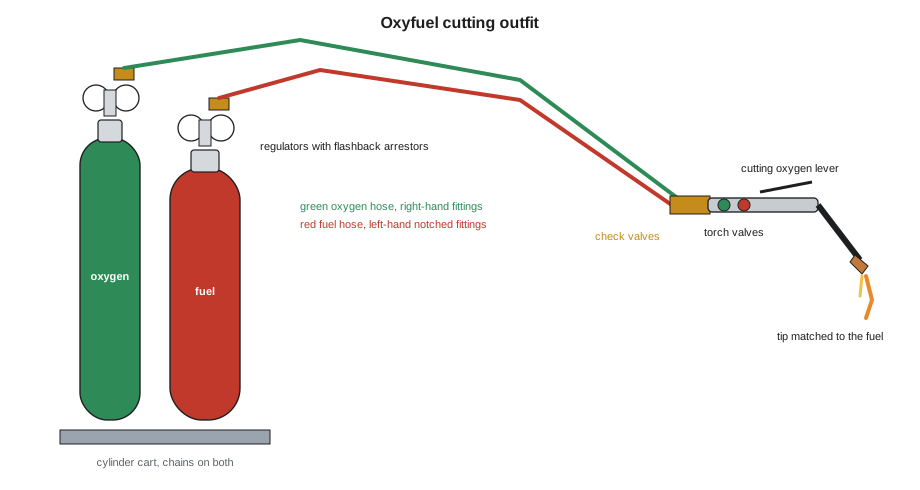
- Cylinders and regulators, covered in the previous lesson.
- Hoses. Oxyfuel hose is a twin hose, with the oxygen line green and the fuel line red in North America, and fuel fittings with left-hand threads and a notched nut. Hose is graded for the gases it can carry: grade R is for acetylene only, and grade T is for all fuel gases, including propane and propylene, which attack the lining of grade R hose. Hoses are kept as short as practical, protected from slag, sparks, traffic and sharp edges, and never repaired with tape.
- Reverse-flow check valves, which let gas flow only toward the torch, and flashback arrestors, which also stop a flame front traveling back through the hose and usually include a check valve and a thermal shutoff. They are fitted at the regulator outlets, and check valves are also fitted at the torch inlets. They are tested at intervals the manufacturer specifies, because a check valve that sticks open gives no warning.
- The torch handle, with an oxygen valve and a fuel valve, and either a cutting attachment or a straight cutting torch. In a cutting torch, the preheat oxygen and fuel are mixed in a mixer and burn at a ring of preheat holes around the tip, while a separate cutting oxygen passage through the center of the tip is opened by the cutting oxygen lever.
- Tips, sized by number for the thickness of metal, and made for a specific fuel gas. Acetylene and propane tips are not interchangeable: propane needs a different preheat hole arrangement and more preheat oxygen.
- A friction spark lighter. Matches and lighters are never used to light a torch, because the hand is too close to the tip when the gas ignites.
Fuel gases compared
The choice of fuel affects the flame, the cutting speed, the cost and the safety precautions.
| Fuel gas | Neutral flame temperature | Oxygen to fuel ratio for neutral preheat | Notes |
|---|---|---|---|
| Acetylene | about 5,600 °F | about 1.1 to 1 | Fast preheat, best for welding, piercing and bevel cutting; withdrawal rate limited |
| Propylene | about 5,200 °F | about 3.5 to 1 | Good cutting fuel, stored as liquid |
| Propane | about 5,100 °F | about 4 to 4.5 to 1 | Cheap, slower preheat, uses much more oxygen, heavier than air |
| Natural gas | about 5,000 °F | about 1.5 to 2 to 1 | Piped supply, slow preheat, used for heavy cutting where available |
Propane and propylene are heavier than air, so leaks collect in low places, pits and basements. Acetylene is slightly lighter than air. Acetylene also has a smell added at the plant and a garlic-like odor of its own, and propane is odorized, but no one relies on smell to detect a leak.
How fast can acetylene be drawn?
Acetylene comes out of solution in the acetone as it is used. If it is drawn too fast, acetone comes with it, which damages regulators, hoses and torches, gives a purple-tinged flame and can leave the cylinder with too little acetone to keep the remaining acetylene stable. The general rule is that acetylene should not be withdrawn from a single cylinder at a rate greater than one-seventh of the cylinder's contents per hour, and some suppliers set lower limits in cold weather. Larger torches that need more than one cylinder can supply are fed from two or more cylinders joined by a manifold.
# Acetylene: can one cylinder feed this torch, and how many does a manifold need?
import math
cyl_contents = 300        # acetylene in a full cylinder (ft³)
rule = 1 / 7               # maximum withdrawal per hour as a share of contents
tips = {"cutting, 1/2 in plate": 11, "cutting, 2 in plate": 30, "heating tip (rosebud)": 90}   # fuel flow, ft³/h
max_rate = cyl_contents * rule
print(f"one cylinder of {cyl_contents} ft³ may supply up to {max_rate:.2f} ft³/h")
for job, flow in tips.items():
    n = max(1, math.ceil(flow / max_rate))
    note = "one cylinder is enough" if n == 1 else f"manifold {n} cylinders"
    print(f"{job:26s}{flow:7.2f} ft³/h  -> {note}")
# as the cylinder empties, the allowable rate falls with the contents left
for share in (1.0, 0.5, 0.25):
print(f" at {share:4.0%} full the limit is {cyl_contents * share * rule:.2f} ft³/h")one cylinder of 300 ft³ may supply up to 42.86 ft³/h cutting, 1/2 in plate 11.00 ft³/h -> one cylinder is enough cutting, 2 in plate 30.00 ft³/h -> one cylinder is enough heating tip (rosebud) 90.00 ft³/h -> manifold 3 cylinders at 100% full the limit is 42.86 ft³/h at 50% full the limit is 21.43 ft³/h at 25% full the limit is 10.71 ft³/h
The calculation shows why heating with a large rosebud tip, used to preheat or bend heavy parts, nearly always needs several acetylene cylinders on a manifold, or a switch to propane, which has no such limit but whose withdrawal is limited instead by how fast the liquid can vaporize, especially in cold weather. It also shows why a cylinder that is nearly empty cannot keep up with a torch that ran well on a full one.
Inspecting and assembling the outfit
Before setting up, the welder inspects every part: cylinders secured and labeled; regulators free of oil and damage, gauges reading zero, adjusting screws backed out; hoses free of cuts, burns, cracking, soft spots and oil, with tight fittings; flashback arrestors and check valves in place and within their test date; torch valves closing fully; tip seats and threads clean and undamaged; and the spark lighter working. Anything that fails goes back to the crib with a tag on it.
The assembly order is: secure the cylinders, crack the valves (oxygen, and the fuel valve away from any ignition source), attach the regulators, attach the flashback arrestors to the regulator outlets, attach the hoses, attach the check valves and the torch handle, then the cutting attachment and tip. All connections are tightened with the right wrench; oxyfuel fittings seal metal to metal and do not need sealant or tape, which can contaminate oxygen fittings.
Pressurizing and leak testing
With the torch valves closed and the regulator adjusting screws backed out, the welder stands to the side and opens the oxygen cylinder valve slowly, then fully, and the acetylene valve up to the limit described in the previous lesson. The regulators are then set to the working pressures for the tip from the manufacturer's chart.
Every connection is then tested for leaks with an approved leak test solution: cylinder valve stems and outlets, regulator inlets and outlets, hose connections at both ends, and the torch valves and connections. Bubbles mean a leak. A quick system test is also used: with everything pressurized and the torch valves closed, the cylinder valves are closed and the high-pressure and low-pressure gauge readings are watched for a few minutes. A falling reading means a leak somewhere in the system. Leaks are fixed before the torch is lit; a leak at a cylinder valve stem that cannot be stopped by closing the valve is a reason to take the cylinder outside, tag it and call the supplier.
Purging and lighting
Before lighting, each hose is purged separately: the oxygen valve on the torch is opened for a few seconds to flush the oxygen line, then closed, and the fuel valve is opened and closed in the same way. Purging removes any mixture of gases that could have formed in the hoses, for example from a leaking check valve or from gas that crossed over while the outfit was stored, and that would burn back into the hose when the torch is lit. Purging is done in a ventilated area away from flames and sparks, one gas at a time, and never with the torch pointed at a person or the cylinders.
The lighting sequence for an acetylene cutting torch is:
- Put on goggles or a face shield with the correct shade over safety glasses, and make sure the tip points away from people, cylinders and combustibles.
- Open the torch fuel valve about a quarter to a half turn and light the gas immediately with the friction lighter.
- Increase the fuel until the flame stops smoking and just begins to leave the tip, then back off slightly until it returns to the tip.
- Open the preheat oxygen valve slowly until the inner cones of the preheat flames are sharp and clearly defined, which is a neutral flame.
- Press the cutting oxygen lever. The preheat flames often turn slightly carburizing when the cutting oxygen flows, so the preheat oxygen is readjusted to neutral with the lever held down.
Propane and other fuels follow the same pattern with their own pressures and flame appearance, given in the tip maker's chart.
Backfire and flashback
A backfire is a loud pop when the flame goes out and immediately relights, or goes out completely. It is usually caused by touching the tip to the work, overheating the tip, a dirty or damaged tip, or pressures set too low for the tip. A sustained backfire is a flame that burns back inside the torch with a hissing or squealing sound; the torch head gets hot quickly. A flashback is a flame that travels back through the torch into the hoses, and possibly to the regulators, which can burst hoses and set the outfit on fire.
The response to a sustained backfire or flashback is the same: close the torch oxygen valve, then the fuel valve, then close the cylinder valves, and let the torch cool. The cause is found and fixed before relighting, and a torch or hose that had a flashback is inspected, and the flashback arrestors are checked or replaced as the manufacturer directs. Flashback arrestors prevent most flashbacks from reaching the regulators and cylinders, which is why they are required on every outfit at Hartwell.
Shutting down
To put the torch down for a short time, the torch valves are closed in the order the manufacturer specifies, and the torch is hung up or laid where it cannot be knocked or burned. A lit torch is never hung on a cylinder or laid down while still burning. At the end of a job, or when leaving the outfit, the system is shut down completely:
- Close the torch valves.
- Close both cylinder valves.
- Open the torch oxygen valve to drain the oxygen line until both oxygen gauges read zero, then close it; do the same for the fuel line.
- Back out both regulator adjusting screws, so the regulators are closed when the cylinders are next opened.
- Coil the hoses without kinks and hang the torch, or disassemble the outfit and cap the cylinders if it is moving.
Draining the lines matters. A hose left pressurized overnight can leak gas into a closed area, and a regulator left with its adjusting screw turned in takes the full cylinder pressure onto its seat the next time the valve is opened.
Devon's first setup
Marta has Devon set up the shop's portable outfit for the farm repair job on the loader bucket. Devon reads the tip chart for a 3/8 in cut, finds that the tip needs about 30 psi of cutting oxygen and 5 psi of acetylene, inspects the outfit and finds a flashback arrestor with a test date that has passed. It goes back to the crib, a new one comes out, and the rest of the setup goes in order. When Devon lights the torch, the flame is carburizing until the cutting lever is pressed and the preheat is adjusted again. Marta says nothing until Devon shuts it down and drains the lines without being reminded.
Common mistakes
MistakeUsing grade R hose with propane.
InsteadUse grade T hose for all fuel gases other than acetylene.
MistakeLighting a torch with a cigarette lighter.
InsteadUse a friction spark lighter.
MistakeSkipping the purge because the hoses were used yesterday.
InsteadPurge each line separately before every lighting.
MistakeDrawing acetylene faster than one-seventh of the contents per hour.
InsteadManifold enough cylinders or use another fuel.
MistakeLeaving the regulators adjusted after closing the cylinders.
InsteadDrain the lines and back out the adjusting screws.
Summary and key terms
- An oxyfuel outfit is cylinders, regulators, flashback arrestors, hoses, check valves, a torch and tips matched to the fuel.
- Oxygen hose is green with right-hand fittings; fuel hose is red with left-hand notched fittings; grade T hose is used for propane.
- Acetylene is withdrawn at no more than one-seventh of the cylinder contents per hour.
- Every connection is leak tested with solution, never a flame, and each line is purged before lighting.
- Light the fuel first with a friction lighter, then add oxygen to a neutral flame, readjusting with the cutting oxygen on.
- A sustained backfire or flashback means close the torch valves and cylinder valves and find the cause.
- Flashback arrestor
- A device that stops a flame front traveling back through a hose and prevents reverse gas flow.
- Check valve
- A valve that lets gas flow in one direction only.
- Neutral flame
- A flame with balanced oxygen and fuel and a sharp, rounded inner cone.
- Backfire
- A momentary burning back of the flame into the tip with a pop.
- Flashback
- A flame traveling back through the torch into the hoses or regulators.
- Purging
- Flushing each hose with its own gas before lighting.
Practice problems
Work each problem on paper first, then reveal the answer to check.
A 300 ft³ acetylene cylinder is half full. What is the most it should supply per hour?
Show answer
150 / 7 = 21 ft³/h.
A heating tip needs 65 ft³/h of acetylene. How many full 300 ft³ cylinders must be manifolded?
Show answer
65 / 43 = 1.5, so two cylinders.
What is the difference between a backfire and a flashback?
Show answer
A backfire burns back into the tip with a pop; a flashback travels back into the hoses or regulators.
Lesson quiz · 5 questions
Score 60% or more to complete this lesson.
Create a free account to save your progress, take quizzes and earn a certificate.