
WLD-110 · Lesson 5 of 12 · 18 min
Fire prevention and hot work permits
Hot work, meaning any welding, cutting, brazing, soldering, grinding or other work that produces flame, sparks or heat, is one of the leading causes of fires in industrial buildings, construction sites and refineries. Most of those fires start in a way the welder never saw: a spark that rolled under a door, slag that fell through a gap in a floor, heat that traveled along a steel beam into insulation on the other side of a wall, or vapor inside a drum that everyone thought was empty. Many start after the welder has gone home. This lesson covers how hot work starts fires, how the work area is prepared, how hot work permits and fire watches work, and why containers are a special case.
How hot work starts fires
A fire needs fuel, oxygen and heat. Hot work supplies the heat in several forms, and the shop and the site supply the fuel.
- Sparks and spatter. Particles of molten metal from cutting, gouging and grinding fly a long way and stay hot enough to ignite paper, sawdust, rags and dust for some seconds. Cutting sparks thrown at floor level can travel 35 ft or more, and further on a smooth floor or downhill.
- Slag and hot metal. Larger globules from cutting and gouging fall and roll, and they are hot enough to burn through plastic sheeting, cardboard and some floor coverings. Cut-off pieces and the work itself stay hot for minutes.
- Conduction. Heat travels along metal: a weld on a steel beam, pipe or wall can ignite combustibles touching the far side, out of sight. Pipes that pass through walls and floors can carry heat into the next room.
- Openings. Sparks fall through floor gaps, open grating, pipe sleeves, ducts, wall cracks and gaps under doors to places no one is watching.
- Flammable atmospheres. Vapor from solvents, fuels and process fluids, combustible dust, and fuel gas from leaking hoses can ignite explosively.
Oxygen enrichment makes all of these worse. A small leak of oxygen into a confined area or into clothing turns a smoldering spark into a flame.
Fires from hot work often start slowly. A spark lodges in a crack, in insulation or in a pile of dust, smolders for half an hour or more, and breaks into flame long after the work stopped. That is why a fire watch continues after the work ends, and why the work area is checked again before the crew leaves.
Preparing the work area
The first choice is to move the work to a designated hot work area, such as a welding bay in the shop built of non-combustible materials with screens and extraction, where hot work is part of normal operations. When the work cannot be moved, the area around it is prepared:
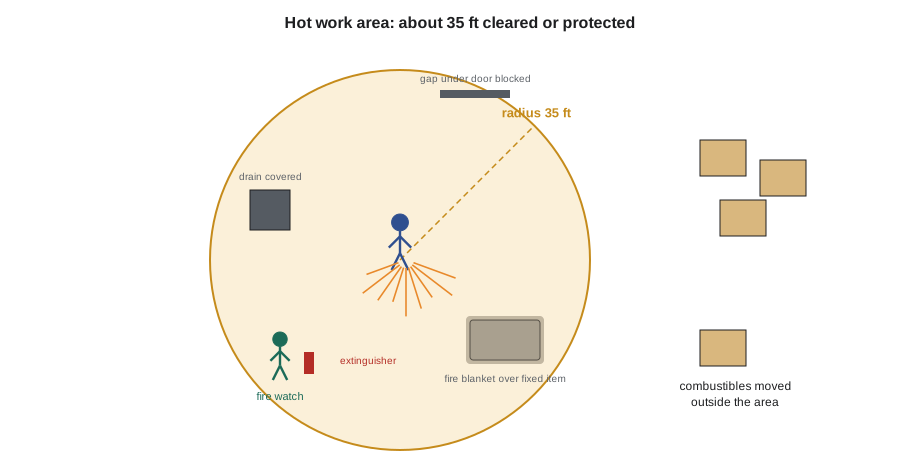
- Combustible materials within 35 ft of the work are moved away. Where they cannot be moved, they are protected with fire-resistant blankets, curtains or metal guards. Floors are swept clean, and combustible floors are wetted, covered with damp sand or protected with fire-resistant covers.
- Openings in floors, walls and ceilings within that area are covered or blocked, including cracks, pipe holes, ducts and the gaps under doors.
- Walls, partitions, ceilings and roofs of combustible construction near the work are protected, and if the work is on a metal wall, pipe or beam that touches combustibles on the other side, the far side is checked and the combustibles moved, or the work is not done.
- Flammable liquids, gases and dusts are removed or isolated, and the atmosphere is tested with a calibrated combustible gas detector where vapors or gases could be present.
- Sprinklers and fire detection stay in service. If a system must be impaired, it is done under the building's impairment procedure, with extra precautions.
- Suitable fire extinguishers, usually multipurpose dry chemical, are at the work, charged and inspected, and the fire watch knows how to use them and how to raise the alarm.
In the refinery during the Unit 4 turnaround, the preparation goes further because the area may contain hydrocarbons. Drains and sewer openings near the work are sealed, the line being cut has been drained, purged and isolated by the operators, and a continuous gas monitor runs at the work point and alarms if flammable gas appears.
The hot work permit
A hot work permit is a written authorization, issued for a specific job at a specific place for a limited time, after a responsible person has checked that the precautions are in place. It turns the preparation list into a signed record. Permits are used for hot work outside designated areas: on site, in the field, in buildings and in plants.
OSHA's fire prevention rules for welding and cutting, 1910.252(a) and 1926.352, require that work be moved away from combustibles or combustibles be moved away or protected, that openings be covered, that fire extinguishing equipment be ready, and that a fire watch be posted where there is a risk of fire. Under 1910.252, a responsible person must authorize hot work outside designated areas, preferably in writing. NFPA 51B, Standard for fire prevention during welding, cutting and other hot work, sets out the permit system in detail, and most industrial clients, including the refinery, require their own permit for any hot work on their property.
Whatever the name of the form, a hot work permit typically records:
- The location, the work to be done, the equipment and the people doing it.
- The date and the time the permit is valid, usually no longer than a shift.
- A checklist of precautions: combustibles cleared or protected, openings covered, floor swept, gas test results and frequency, fire protection in service, extinguishers in place, fire watch assigned.
- The names and signatures of the person authorizing the work, the person doing it, and the fire watch.
- A final check after the fire watch ends, signed when the area is confirmed safe.
The people have distinct roles. The person authorizing the permit, called the permit authorizing individual in NFPA 51B, inspects the area and signs only when the precautions are complete. The hot work operator, the welder, keeps the permit at the work, follows its conditions and stops if conditions change. The fire watch watches for fires and does nothing else. If the wind changes, a gas alarm sounds, someone starts painting nearby or the welder needs to move to a new location, the permit is stopped and reissued for the new conditions.
Marta's rule about permits is that the signature is the end of the check, not the check. Before the first arc she walks the area herself, looks down through the grating and behind the nearest wall, and asks the operator what is in every pipe within reach.
The fire watch
A fire watch is a trained person whose only job, while the work is going on and afterwards, is to look for fires and deal with them. They can see the whole area, including below and on the other side of walls or floors where sparks could go, and have an extinguisher and a way to raise the alarm. A fire watch who is also fitting, grinding or holding parts is not watching.
OSHA requires the fire watch to continue for at least half an hour after the completion of welding or cutting, under 1910.252 and 1926.352. Current editions of NFPA 51B require at least one hour, with further monitoring of the area for up to several hours where the permit authorizing individual requires it, and most insurers and industrial clients follow the NFPA requirement.
Where the work is in an area that could not be fully cleared, or where sparks could go to several levels, more than one fire watch is posted. Fire watches are trained to use extinguishers and to recognize when a fire is beyond them: the first action is to raise the alarm, and an extinguisher is used only on a small fire with a safe way out.
# Fire watch schedule from the time hot work ends
from datetime import datetime, timedelta
end = datetime(2026, 11, 3, 14, 40)        # time the last cut or weld finished
watch_min = 60                          # required fire watch after work (minutes)
monitor_min = 60                       # extra monitoring set by the authorizing person (minutes)
checks = 15                               # walk the area at least this often during monitoring (minutes)
fw_end = end + timedelta(minutes=watch_min)
mon_end = fw_end + timedelta(minutes=monitor_min)
print(f"hot work ended      {end:%H:%M}")
print(f"fire watch until    {fw_end:%H:%M}  (continuous, extinguisher in hand)")
t = fw_end
while t < mon_end:
    t += timedelta(minutes=checks)
    print(f"  monitoring check  {min(t, mon_end):%H:%M}")
print(f"final sign-off at {mon_end:%H:%M} after a last walk-through above, below and beside the work")hot work ended 14:40 fire watch until 15:40 (continuous, extinguisher in hand) monitoring check 15:55 monitoring check 16:10 monitoring check 16:25 monitoring check 16:40 final sign-off at 16:40 after a last walk-through above, below and beside the work
The schedule matters most at the end of a shift. Work that finishes at 3:30 pm on a job with a one-hour fire watch and an hour of monitoring keeps someone on site until 5:30 pm. Glen plans the last cut of the day with that in mind; the alternative, a welder who leaves at the end of the shift with the fire watch cut short, is how many hot work fires start.
Containers, drums and tanks
Cutting or welding on a container that holds or has held a flammable or combustible material is one of the most dangerous jobs in the trade. Drums, tanks, fuel lines and pipe can hold enough vapor, residue or sludge to explode when heated, even after they have been drained and appear empty. Vapor can come out of residue in seams, under scale and in the sludge at the bottom when the metal heats up. Welders have been killed cutting the tops off drums that held only a little oil or a small amount of solvent years before.
The rule is that no container is assumed to be empty or safe. Before hot work on any container that may have held a flammable or combustible substance, it is identified, cleaned by a method suited to the material, and then either tested and shown to be free of flammable vapor or made inert by filling it with water, or with an inert gas such as nitrogen or carbon dioxide, and kept that way during the work. Containers are vented so that pressure cannot build up from heating. Testing is repeated during the work. The AWS publishes a recommended practice for preparing containers for hot work, and the welding safety standards refer to it.
The farm work at Hartwell is where this comes up most often. The farmer from near Katy has brought in a loader bucket and asks whether the shop can also cut down an old fuel tank to make a parts washer. Glen says no to the tank: the shop does not cut fuel tanks, and the farmer can buy a parts washer. The loader bucket is fine, after the grease and oil on it are cleaned off, because they would otherwise smoke, burn and add to the fume.
When hot work is not allowed
Some places and conditions rule out hot work altogether until they change: where sprinklers are impaired and no adequate alternative is in place; where the atmosphere is or could become flammable and it cannot be controlled; near large quantities of exposed readily ignitable material such as bulk sawdust, grain dust or cotton; in areas the owner has not authorized; and on equipment with residue or coatings that cannot be removed safely. The welder's right and duty to stop applies here, and Priya tells every new worker that a welder who refuses an unsafe hot work job will have the shop's support.
Common mistakes
MistakeAssuming the hot work is safe because the permit is signed.
InsteadWalk the area yourself, including below and behind, before the first arc.
MistakeLetting the fire watch help with the fitting.
InsteadThe fire watch does nothing but watch, during the work and afterwards.
MistakeEnding the fire watch when the welder leaves.
InsteadKeep the fire watch for the full required time after the last hot work.
MistakeCutting an empty drum without cleaning and testing.
InsteadTreat every container as holding vapor until cleaned and tested or made inert.
MistakeCovering combustibles with ordinary tarps.
InsteadUse fire-resistant blankets or guards, or move the combustibles.
Summary and key terms
- Hot work starts fires through sparks, slag, conduction, openings and flammable atmospheres, often after the work stops.
- Combustibles within about 11 m (35 ft) are moved or protected, openings covered and the atmosphere tested where needed.
- A hot work permit authorizes specific work at a specific place for a limited time; NFPA 51B sets out the system and OSHA requires authorization outside designated areas.
- The fire watch has no other duty and continues after the work, at least 30 minutes under OSHA and one hour under current NFPA 51B.
- Containers that have held flammable material are cleaned and tested or made inert before hot work, never assumed empty.
- Hot work
- Welding, cutting, grinding or any work producing flame, sparks or heat that can ignite material.
- Hot work permit
- A written authorization for hot work at a specific place and time after precautions are checked.
- Fire watch
- A trained person who watches for and controls fires during and after hot work.
- Designated area
- A permanent location built and approved for hot work, such as a welding bay.
- Lower explosive limit
- The lowest concentration of a gas or vapor in air that can ignite.
- Inerting
- Filling a container with water or inert gas so it cannot hold a flammable atmosphere.
Practice problems
Work each problem on paper first, then reveal the answer to check.
Hot work ends at 11:20 with a one-hour fire watch and one hour of monitoring. When can the area be signed off?
Show answer
13:20, after a final walk-through.
Name four ways hot work can start a fire out of the welder's sight.
Show answer
Sparks through floor openings or under doors, conduction through metal walls or pipes, smoldering in cracks or insulation, and falling slag to lower levels.
What must happen before cutting an old fuel drum?
Show answer
Clean it and test it free of vapor, or fill it with water or inert gas, vent it, and retest during the work; or do not cut it.
The wind changes during refinery hot work and blows toward a tank farm. What happens to the permit?
Show answer
Work stops and the permit is reviewed and reissued for the new conditions.
Lesson quiz · 5 questions
Score 60% or more to complete this lesson.
Create a free account to save your progress, take quizzes and earn a certificate.