
SMW-330 · Lesson 7 of 12 · 19 min
Proportional balancing
Once the readings are in, the real work starts: moving dampers so that every outlet gets its share. A beginner tends to go outlet by outlet, closing the ones that are high and opening the ones that are low, and finds that every adjustment upsets the outlets already set. Close a damper near the fan and the air it was taking goes elsewhere, raising every other outlet a little. Open one at the far end and the others drop. Chasing these interactions round and round can take a day for a single branch. The proportional method, sometimes called the ratio method, avoids that by using the one property of a duct system that does not change when dampers move: the outlets on a branch keep their flows in proportion to one another when the upstream flow changes.
The principle
Consider two outlets on the same branch. If the air entering the branch increases by 10 percent, both outlets increase by about 10 percent; their ratio to each other stays the same. The same holds for branches on a trunk and for trunks on a fan. That means a technician can set the outlets on a branch so that each is at the same percentage of its own design, without worrying about what the total is, and then raise or lower the branch, or the whole fan, to bring them all to design together. It does not matter that the percentage was 70 percent at the time; once they are all at 70 percent, a single change upstream brings them all to 100 percent.
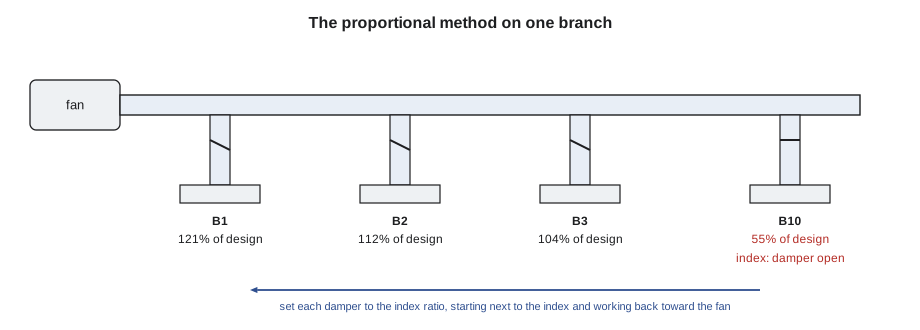
The method works from the outlet that is furthest below design, the index outlet, usually but not always the one at the end of the longest branch. Its damper stays wide open, because it cannot be given more air by closing anything except the others. Every other outlet on the branch is then throttled until its ratio, measured flow divided by design flow, matches the index outlet's ratio. Because closing other outlets raises the index outlet a little, the index is read again after each adjustment and the target moves up with it.
The sequence
The full procedure, as the TAB standards describe it, runs from the outlets back to the fan. First, with all dampers open and the fan running at a speed that gives at least close to design total, read every outlet on a branch and calculate its ratio. Second, identify the index outlet with the lowest ratio. Third, starting with the outlet next to the index and working back toward the trunk, adjust each outlet's damper until its ratio equals the index's current ratio, checking the index from time to time. Fourth, when the branch is done, move to the next branch.
When every branch is internally proportioned, the same method is applied one level up. The branches on a trunk are read, by traverse or by adding up their outlets, the branch with the lowest ratio becomes the index branch with its damper open, and the other branch dampers are set to its ratio. Then the trunks are proportioned at the fan, if there are several. Finally the fan speed is adjusted so that the index path reaches design, and every outlet, branch and trunk rises with it to design. The last step is a full set of final readings to confirm.
Done this way, at least one path from the fan to an outlet has every damper wide open. That is the condition for minimum fan energy: the fan develops only the pressure the system needs, and no more is burned in dampers than is needed to share the air.
# Proportional balancing of the Ashgrove library outlets (one branch level, first readings with dampers open)
design = [420, 420, 420, 420, 420, 420, 245, 245, 245, 245]
read   = [510, 469, 438, 365, 330, 303, 213, 181, 166, 134]
names = [f"B{k}" for k in range(1, len(design) + 1)]
ratios = [r / d for r, d in zip(read, design)]
index = min(range(len(ratios)), key=lambda k: ratios[k])
print(f"index outlet {names[index]} at {100*ratios[index]:.0f}% of design (damper stays open)")
# Closing the other dampers sends more air to the index; on this run it settles near the value below
target = 0.86
for k in range(len(design)):
    if k == index:
        continue
    print(f"{names[k]}: {100*ratios[k]:.0f}% -> set to {100*target:.0f}% = {design[k]*target:.0f} cfm")
# Then the fan is speeded up so the index reaches design; all outlets follow in proportion
speed_up = 1 / target * 1
print(f"after the branches are proportioned, the fan must deliver about {100/target:.0f}% of the proportioned total")index outlet B10 at 55% of design (damper stays open) B1: 121% -> set to 86% = 361 cfm B2: 112% -> set to 86% = 361 cfm B3: 104% -> set to 86% = 361 cfm B4: 87% -> set to 86% = 361 cfm B5: 79% -> set to 86% = 361 cfm B6: 72% -> set to 86% = 361 cfm B7: 87% -> set to 86% = 211 cfm B8: 74% -> set to 86% = 211 cfm B9: 68% -> set to 86% = 211 cfm after the branches are proportioned, the fan must deliver about 116% of the proportioned total
The index outlet at Ashgrove is B10, the smallest outlet at the far end of trunk T3, reading 55 percent of design with its damper open. As Kai throttled the other nine outlets toward its ratio, B10 rose, because the air the others gave up went down the trunk to it. After two passes all ten outlets read within a couple of percent of each other at about 86 percent of design. The remaining 14 percent had to come from the fan, which is the subject of lesson 9 and the capstone.
When the index outlet cannot reach design
Sometimes the index outlet stays far below the others even with every other damper on its branch closed hard. That means the problem is not sharing but resistance: something on its path, a crushed flexible duct, a closed fire damper, a damper wired shut, an undersized branch or a ceiling obstruction, is restricting it. The proportional method then stops while the cause is found. Closing every other outlet to an extreme to force air to one bad outlet wastes fan energy and makes the rest of the system noisy. Kai found exactly this on one of the Ashgrove classroom branches: the index diffuser read 40 percent with everything else throttled, and the cause was the flexible connection, which had been compressed during the ceiling work after the SMW-310 inspection.
The opposite case also occurs: an outlet that remains high with its damper nearly closed. That usually means the damper is missing, broken or set at the face of the outlet rather than in the branch, or that the outlet is fed from a different branch than the drawing shows. Each of these is a deficiency to report.
Dampers: authority and position
A volume damper can only control flow well over part of its range. Near fully open, moving the blade changes the flow very little; near fully closed, a small movement changes it a lot and the damper becomes noisy. Ideally, after balancing, most dampers are somewhere in the middle of their range and the index path is open. If most dampers on a system end up nearly closed, the fan is running faster than it needs to and should be slowed; if many are fully open and outlets are still low, the system or the fan is short of capacity.
Every damper is locked in its final position, and the position is marked, typically with a paint mark or a scribe line on the quadrant, so that if someone moves it later the balance can be restored. Opposed-blade dampers behind outlet faces are marked or noted as well. Marisol's rule is that a damper not marked is a damper not balanced.
Other balancing methods
The proportional method is the standard for constant-volume systems with manual dampers, but it is not the only method. In the stepwise method, the technician sets outlets in sequence from the fan outward, overshooting each a little to allow for the effect of later adjustments; it is quicker on small systems but needs more experience. Some modern systems have pressure-independent terminals, VAV boxes or constant-airflow regulators, that maintain their set airflow regardless of upstream pressure; these are balanced by setting each terminal's airflow and then setting the fan to satisfy the most demanding one, as lesson 8 describes. On exhaust and return systems, the same proportional logic applies with the airflow reversed: the index is the inlet furthest below design.
Working order and communication
Balancing is easier with two people and radios: one at the outlets with the hood, one at the dampers above the ceiling or at the trunk. The technician at the outlets calls out readings and ratios; the one at the dampers moves them in small steps and waits for the readings to settle. In a school or hospital, where ceilings are often tight and access is limited, the dampers' locations should be marked on the reflected ceiling plan or with labels on the ceiling grid so the second person can find them quickly. On a large job, branches are balanced in a fixed order so that the record makes sense, and partial readings are saved to the report file at the end of each day.
Worked problem
Proportioning branch B5 to B7
On trunk T2 at Ashgrove, after outlets are proportioned on each branch, the branch totals read B5 330 cfm (design 420), B6 303 cfm (design 420) and B7 213 cfm (design 245). Which branch is the index on this trunk, and what should the others be set to?
Show solution
- Ratios: B5 330/420 = 0.79, B6 303/420 = 0.72, B7 213/245 = 0.87.
- Index: B6 at 0.72; leave its damper open.
- Set B5 to 0.72 × 420 = 302 cfm and B7 to 0.72 × 245 = 176 cfm, then read B6 again, which will have risen slightly.
- Repeat until all three match, then move up to the trunk level.
Answer: The branch dampers on T2 now share air in proportion, and the trunk can be compared with T1 and T3 at the next level.
When proportioning does not converge
Proportional balancing usually needs one pass through a branch and a quick check of each outlet afterwards. When the ratios keep drifting after the second or third pass, something is wrong with the system, not the method. Common causes include a damper that slips after it is set because its locking quadrant is loose, a VAV box upstream that is still controlling, a fire damper partly closed, or a branch duct so undersized that it has almost no pressure to spare. Marisol's rule is that a branch that will not settle after two careful passes gets inspected before it gets a third pass, because a third pass rarely fixes a physical problem.
At Ashgrove, that rule found the kinked flexible duct at B8. After the first pass B8 still read well below its neighbors, its damper was already wide open and the other outlets were at their ratios. Rather than throttling everything else down to match it, Kai climbed up, found the kink above the ceiling tile, and had Sean Doucette's crew replace the flexible run with a straight, supported length. B8 then proportioned normally.
Recording damper positions
Once an outlet is set, its damper position is marked so it can be found again. Some technicians use a paint pen across the quadrant and the damper shaft; others note the number of turns from closed on a concealed damper regulator. Either way, the mark tells the next technician, or the commissioning reviewer, that this damper was set deliberately. An unmarked damper may be opened by a well-meaning service technician chasing a hot-room complaint, which throws the branch out of balance without anyone knowing why.
Common mistakes
MistakeAdjusting outlets one at a time to design with no plan.
InsteadProportion all outlets to the index ratio, then raise the total.
MistakeClosing the index outlet's damper.
InsteadLeave the index path wide open.
MistakeForcing air to an outlet that will not respond by closing all the others hard.
InsteadStop and find the restriction on that outlet's path.
MistakeLeaving dampers unmarked after balancing.
InsteadLock and mark every damper's final position.
MistakeEnding with most dampers nearly closed.
InsteadSlow the fan so the system meets design with dampers in a usable range.
Summary and key terms
- Outlets on a branch keep their proportions when the upstream flow changes.
- The index outlet has the lowest ratio of measured to design flow; its damper stays open.
- Set every other outlet to the index ratio, working back toward the trunk, then repeat at branch and trunk levels.
- Finally adjust the fan so the index reaches design and everything follows.
- An index outlet that will not respond points to a restriction to find and fix.
- Lock and mark dampers; at least one open path means minimum fan energy.
- Proportional method
- Balancing by setting outlets to the same ratio of measured to design flow, then adjusting the total.
- Index outlet
- The outlet with the lowest ratio of measured to design flow.
- Ratio
- Measured flow divided by design flow.
- Damper authority
- How well a damper controls flow over its range.
- Stepwise method
- Balancing outlets in sequence with an allowance for later interaction.
- Pressure-independent terminal
- A device that holds its airflow regardless of upstream pressure.
Practice problems
Work each problem on paper first, then reveal the answer to check.
Three outlets read 190, 152 and 171 cfm against designs of 210, 190 and 190. Which is the index?
Show answer
Ratios 0.90, 0.80 and 0.90; the second is the index at 0.80.
What should the other two be set to?
Show answer
0.80 × 210 = 168 cfm and 0.80 × 190 = 152 cfm, rechecking the index after.
After proportioning, all outlets are at 0.80. What increase in total flow brings them to design?
Show answer
1 ÷ 0.80 = 1.25, so a 25 percent increase.
Why should at least one path be wide open?
Show answer
So the fan runs at the lowest pressure that satisfies the system.
Lesson quiz · 5 questions
Score 60% or more to complete this lesson.
Create a free account to save your progress, take quizzes and earn a certificate.