
SMW-330 · Lesson 6 of 12 · 19 min
Outlet and hood readings
Traverses measure ducts; occupants feel outlets. Most of the hours on a balancing job are spent under diffusers and grilles, reading what each one delivers and setting the damper behind it. At Ashgrove there are ten supply outlets in the library alone and dozens more across the wing; at Eastgate every patient room has supply diffusers and exhaust grilles whose airflows set the room's pressure relationship. This lesson covers the three ways outlet airflow is measured, capture hoods, velocity readings with an area factor, and branch traverses, and how to make each one reliable.
Outlets, terminals and their dampers
Supply outlets are ceiling diffusers, sidewall grilles, slot diffusers, floor registers and displacement diffusers; return and exhaust inlets are grilles and registers. A register is a grille with a damper built in behind its face. Most commercial outlets, however, are fed by a branch duct with a separate manual volume damper, usually a quadrant-handled butterfly damper in the branch near the trunk, as Kai fabricated and installed in SMW-220 and SMW-310. Balancing is done with the branch damper wherever possible, because a damper close to the outlet face throttles the air where the occupant can hear it, and an outlet throttled at its face makes noise and distorts its air pattern.
Each outlet has a manufacturer's performance table relating its airflow to its neck velocity, pressure drop, throw and sound level. The TAB technician uses the design flow from the drawings and the outlet's data from the submittal, including the area factor for velocity readings if one is given.
Capture hood readings
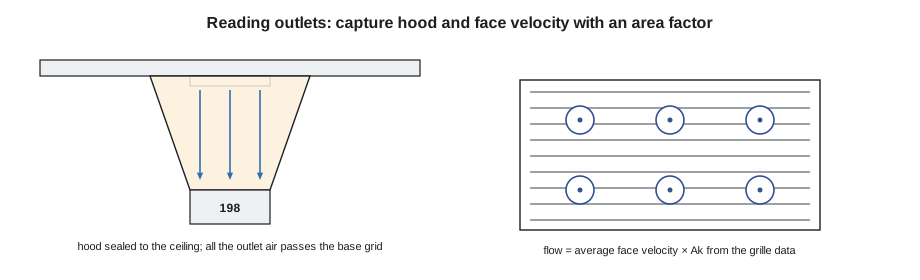
A capture hood is the fastest and most common way to read diffusers and grilles. The technician fits a hood top that covers the whole outlet, presses the skirt against the ceiling to seal it, and holds the hood steady until the reading settles, typically a few seconds. Digital hoods average automatically and can store readings by outlet number. The reading is the airflow the outlet is delivering with the hood in place.
Good hood technique comes down to a few habits. The hood top must be larger than the outlet and sealed against the ceiling all round; gaps at a T-bar or a light fixture let air escape and the hood reads low. The hood must be held square and still. The meter must be in the right mode, supply or exhaust, and set for the right hood top size if it asks. Back-pressure compensation is used on outlets where the hood's resistance is significant, usually larger flows or low-pressure outlets. And each reading is compared with the expected value before moving on, so that a doubtful reading can be repeated while the ladder is still in place.
Velocity readings and the area factor
Where a hood will not fit, for example on long linear diffusers, very large grilles or outlets behind obstructions, the airflow is found from velocity readings at the outlet face. The difficulty is that the outlet's free area is not its nominal size: bars, blades and frames block part of it, and the air leaving the face accelerates and contracts. Manufacturers therefore publish an area factor, usually written Ak, for each outlet type and size. The airflow is the average measured velocity, taken with a specified instrument at specified points, times Ak.
The Ak factor is valid only for the instrument and the reading positions the manufacturer used when determining it. If the data sheet says a rotating vane anemometer at the face center of each blade opening, a thermal anemometer at a different spot will give a different answer. Ak also depends on the deflection setting of adjustable blades. When no Ak is available, or the outlet has been modified, the outlet is read by traversing its branch duct instead.
# Outlet airflow from face velocity readings and the manufacturer's area factor
readings = [570, 630, 670, 650, 590, 550]       # vane anemometer readings across the grille face, fpm
ak = 0.58            # area factor from the grille data, sq ft
v_avg = sum(readings) / len(readings)
q = v_avg * ak
print(f"average face velocity {v_avg:.0f} fpm")
print(f"airflow {q:.0f} cfm")
nominal = 1.0      # nominal face area, sq ft
print(f"free-area ratio implied by Ak: {ak / nominal:.2f}")average face velocity 610 fpm airflow 354 cfm free-area ratio implied by Ak: 0.58
The example is the library's return grille RG-1, a 12 × 12 in fixed-blade grille. Its free area is only about 58 percent of the nominal face, which is why multiplying the face velocity by the nominal size would have overstated the flow by more than two thirds.
Reading the branch instead
When the outlet itself cannot be read reliably, the alternative is a pitot or thermal anemometer traverse of the branch duct that feeds it, in a straight section upstream of the outlet. For a round branch with a straight run, a short traverse on two diameters is quick and accurate. This is also the check used to confirm hood readings: Marisol's procedure is to traverse at least one branch on every trunk and compare it with the hood readings of the outlets it feeds. If the hood consistently reads, say, 5 percent low on a particular diffuser type, the TAB supervisor may apply a correction factor to all of that type, as the TAB standards allow, and state it in the report.
On the Ashgrove library branches, Kai's hood reading on B4, a 10 in round branch to a 24 × 24 in square diffuser, was 365 cfm, and his branch traverse 3 ft upstream gave 380 cfm. The difference of 4 percent was within the hood's accuracy and Marisol accepted the hood readings without correction.
Special outlets
Linear slot diffusers are read with a hood top designed for slots, or by velocity readings along the slot with the manufacturer's Ak per unit length, or by traversing the plenum's inlet duct. Displacement diffusers, which deliver low-velocity air at floor level, are best read at their inlet duct. Exhaust grilles in kitchens, labs and isolation rooms are read with the hood in exhaust mode, and their readings are especially important because exhaust sets the room pressure. Transfer grilles, which let air pass between rooms, are not balanced directly but are checked for velocity and direction.
Outlets with integral dampers, opposed-blade dampers behind the face adjusted through the face with a screwdriver or key, are set only for fine trim after the branch damper has done most of the work, and the TAB report notes which outlets were trimmed at the face.
Throw, noise and comfort
Airflow is not the only result. An outlet delivering exactly its design flow can still cause a complaint if its air pattern dumps cold air onto desks or blows across a whiteboard. While reading outlets, the technician checks that pattern controllers and adjustable blades are set as the drawings show, that the throw is reasonable, and that nothing blocks the outlet. A smoke pencil or a ribbon on a stick shows the air pattern quickly. Noise is also noted: a hissing outlet usually means too much pressure at the outlet or a damper closed too far near the face; a rumble usually means a fitting or damper upstream. The TAB report notes noise problems as deficiencies for the engineer to resolve.
In an occupied building like Ashgrove, where readings are taken in summer with the library empty, Marisol also asks the school to report any comfort complaints in the fall, so that a fine adjustment can be made under real occupancy.
Organizing outlet readings
A typical job has hundreds of outlets, and a disorganized approach wastes days. The TAB technician works from the marked-up drawings prepared in the design review, with every outlet numbered and its design flow shown, and a data sheet listing each outlet's number, size, type, design flow and room. Readings are entered as they are taken, preferably directly into a tablet or the hood's memory. At the end of each run the technician adds up the outlet readings on each branch and compares them with the branch design and, if taken, the branch traverse. A branch that is far low overall points to an upstream problem, a closed damper or a disconnected duct, rather than to the outlets.
# First readings on the Ashgrove library outlets (hood), as a percentage of design
design = [420, 420, 420, 420, 420, 420, 245, 245, 245, 245]
first  = [510, 469, 438, 365, 330, 303, 213, 181, 166, 134]
for k, (d, f) in enumerate(zip(design, first), 1):
    print(f"B{k}: design {d}, read {f} cfm, {100*f/d:.0f}%")
print(f"total read {sum(first)} of {sum(design)} cfm ({100*sum(first)/sum(design):.0f}%)")B1: design 420, read 510 cfm, 121% B2: design 420, read 469 cfm, 112% B3: design 420, read 438 cfm, 104% B4: design 420, read 365 cfm, 87% B5: design 420, read 330 cfm, 79% B6: design 420, read 303 cfm, 72% B7: design 245, read 213 cfm, 87% B8: design 245, read 181 cfm, 74% B9: design 245, read 166 cfm, 68% B10: design 245, read 134 cfm, 55% total read 3109 of 3500 cfm (89%)
With all dampers wide open and the fan at its first speed, the outlets nearest RTU-2 run well above design and those at the far end well below, and the total is about 89 percent of design. This is the normal starting point for a balance and is exactly the picture the proportional method in lesson 7 is designed to fix. The total from the outlets is a little below the 92 percent found by the trunk traverse, which is consistent with a little leakage and the accuracy of the hood.
Worked problem
Reading a linear slot diffuser at Eastgate
A 6 ft two-slot linear diffuser in the Eastgate nursing station has an Ak of 0.070 ft² per foot of length. Six thermal anemometer readings along the slots average 510 fpm. What is the airflow?
Show solution
- Total Ak: 0.070 × 6 = 0.42 ft².
- Airflow: 510 × 0.42 = 214 cfm.
- That is about 214 cfm, against a design of 210 cfm.
Answer: The diffuser is within 2 percent of design. The reading is valid only because the technician used the instrument and positions given with that Ak.
Hood readings on unusual outlets
Not every outlet fits under a standard hood. Long linear slot diffusers, high sidewall grilles and outlets above shelving or equipment all make hood readings awkward or impossible. For linear diffusers, manufacturers often publish a velocity-based method using a specific anemometer position and an area factor per length of slot, and the technician follows that method rather than improvising. For high sidewall grilles that a hood cannot reach safely, a branch traverse or a face velocity reading from a proper platform is usually better than balancing a hood on a ladder, which gives poor readings and is unsafe.
At Ashgrove, two return grilles at the west end of the library were mounted high on a wall above the stacks. Kai measured them with a vane anemometer and the grille manufacturer's area factor from a scissor lift, and checked the total against a traverse of the return main. The two methods agreed within four percent, which Marisol accepted and recorded on the return sheet.
Back pressure and hood corrections
A capture hood adds a small resistance in front of the outlet. On most ceiling diffusers the effect is small, but on outlets served by a branch with little pressure available, or on exhaust grilles in a low-pressure system, the hood can reduce the flow it is trying to measure. Some hoods have a back-pressure compensation feature that takes a second reading with a flap open and corrects for the effect. Where the instrument has this feature, the technician uses it on low-pressure outlets, and records that it was used, so a later reviewer with a different hood can reproduce the reading.
Common mistakes
MistakeThrottling an outlet at its face damper instead of the branch damper.
InsteadBalance with the branch damper and use face dampers only for trim.
MistakeMultiplying face velocity by the nominal grille size.
InsteadUse the manufacturer's area factor Ak for that outlet and instrument.
MistakeHolding a hood with gaps at the ceiling.
InsteadSeal the skirt all round and use a top larger than the outlet.
MistakeReading exhaust grilles in supply mode.
InsteadSet the hood to exhaust mode.
MistakeAccepting hood readings without any check.
InsteadTraverse sample branches and compare with the hood.
Summary and key terms
- Outlets are read with capture hoods, face velocity times Ak, or branch traverses.
- Hoods must seal, be square and be in the right mode; use back-pressure compensation where needed.
- Ak depends on the outlet, its blade setting, the instrument and the reading positions.
- Branch traverses check hood readings and replace them where hoods cannot be used.
- Balance with branch dampers; check throw, pattern and noise as well as airflow.
- Organize readings by numbered outlets and compare branch totals with traverses.
- Capture hood reading
- An outlet airflow read by sealing a hood over the outlet.
- Area factor (Ak)
- A manufacturer's effective area used to convert face velocity to outlet airflow.
- Register
- A grille with an integral damper behind its face.
- Branch damper
- A manual volume damper in the branch duct serving an outlet.
- Throw
- The distance an outlet's air travels before slowing to a set velocity.
- Transfer grille
- An opening that lets air pass between rooms.
Practice problems
Work each problem on paper first, then reveal the answer to check.
A grille has Ak 0.43 ft² and an average face velocity of 600 fpm. What is the airflow?
Show answer
600 × 0.43 = 258 cfm.
Why not use the nominal size of the grille?
Show answer
Bars and frames block part of the face; the effective area is smaller.
A branch's hood readings add up to 15 percent less than its traverse. What should be checked?
Show answer
Hood seal and mode, the outlet type correction, leaks between traverse and outlets, and the traverse location.
Where should most of the throttling be done?
Show answer
At the branch damper near the trunk.
Lesson quiz · 5 questions
Score 60% or more to complete this lesson.
Create a free account to save your progress, take quizzes and earn a certificate.