
SMW-230 · Lesson 7 of 12 · 19 min
GTAW fundamentals
Gas tungsten arc welding is the opposite of GMAW in almost every way that matters. It is slow where GMAW is fast, it needs two hands and often a foot where GMAW needs one trigger finger, and it takes much longer to learn. In return, it gives the welder complete, separate control of the heat and the filler metal, a clean arc with no spatter, and the narrowest, neatest welds of any arc process. On thin stainless steel and aluminum, and anywhere a weld will be seen or must be smooth and sanitary, it is the process the sheet metal trade uses. Aggie MacLeod did most of Keelson's GTAW, and she started Kai on it with carbon steel scrap before letting him near stainless.
How GTAW works
In GTAW, the arc runs between a tungsten electrode and the work. Tungsten melts at a very high temperature, so the electrode does not melt into the weld; it only carries the arc. An inert shielding gas, usually pure argon, flows from a ceramic or glass cup around the tungsten and protects both the electrode and the pool from the air. The welder melts the edges of the joint with the arc and, when filler is needed, dips a bare filler rod into the leading edge of the pool by hand. On thin outside corners and flanged joints, the edges can often be fused with no filler at all, called an autogenous weld.
Because the heat source and the filler are separate, the welder can change one without the other: hold the arc to melt the edges, add more rod to build up the joint, back off to let a spot cool. That independence is what makes GTAW so controllable on thin metal.
The power source and current types
GTAW uses a constant-current power source: the welder sets the current, and the machine holds it nearly steady even as the arc length changes slightly. A foot pedal or a thumb control on the torch lets the welder vary the current while welding, from a low start to full heat and back down at the end. Most modern machines can supply three kinds of current.
- Direct current, electrode negative, DCEN. The tungsten is negative and the work positive. About two-thirds of the arc's heat goes into the work and a third into the tungsten, so the tungsten stays cool and the weld penetrates well. DCEN is used for carbon steel, stainless steel, copper and most metals other than aluminum and magnesium.
- Direct current, electrode positive, DCEP. Most of the heat goes into the tungsten, which overheats unless it is very large. It is rarely used for GTAW.
- Alternating current, AC. The current reverses many times a second. In the electrode-positive half of each cycle, the arc breaks up the tough oxide layer on aluminum, a cleaning action; in the electrode-negative half it heats and penetrates. AC is the normal current for aluminum. Modern inverter machines let the welder set the balance between the two halves and the frequency; lesson 9 covers those settings.
Inverter machines also offer pulsed GTAW, which switches between a peak current and a lower background current a set number of times a second. The pool freezes a little during each background period, so the average heat is lower and the bead has a regular ripple. Pulsing is a powerful tool on thin stainless, where it narrows the heat-affected zone and the heat tint.
Tungsten electrodes
Tungsten electrodes come in several types, identified by a color band and an AWS classification. Pure tungsten, green, was the traditional choice for AC aluminum welding on older machines. Tungsten with small additions of other oxides starts more easily, carries more current and keeps its point longer. Lanthanated electrodes, with lanthanum oxide, are now the most common general choice for both DC and inverter AC welding; ceriated electrodes, with cerium oxide, are good at low currents on thin metal. Thoriated electrodes, long the standard for DC work, contain a small amount of radioactive thorium; the dust from grinding them is a health concern, so many shops, including Keelson, have replaced them with lanthanated electrodes.
The electrode diameter is chosen for the current: small diameters for low currents on thin metal, larger ones as current rises. A 1/16 in electrode covers most thin sheet at DCEN; a 3/32 in electrode covers heavier sheet and most aluminum work.
For DC welding, the tungsten is ground to a point with the grinding marks running along the electrode, not around it, on a wheel kept for tungsten only. A sharp point gives a narrow, focused arc for thin sheet; a slightly blunted tip lasts longer at higher current. The included angle of the point, the taper length and a small flat at the tip affect the arc width and penetration. For AC on inverter machines, a slightly truncated point is common; older transformer machines formed a ball on pure tungsten. A tungsten that touches the pool or the filler rod is contaminated and must be stopped, broken back past the contamination and reground, because a contaminated tungsten gives an erratic arc and puts tungsten into the weld.
Shielding gas and cups
Argon is the standard GTAW shielding gas for steel, stainless and aluminum. Mixtures with helium give a hotter arc for thick aluminum and copper, but thin sheet rarely needs them. The flow rate is set with a flowmeter, typically around 7 to 10 liters per minute or 15 to 20 cubic feet per hour for a medium cup on sheet. More is not better: excess flow becomes turbulent and pulls in air. A gas lens, a fine mesh screen in the collet body, smooths the flow so the tungsten can stick out further from the cup with good coverage, which helps on inside corners and fillet joints. Pre-flow before the arc starts and post-flow after it stops protect the hot tungsten and the end of the weld; post-flow of several seconds is normal, longer at higher currents.
| Item | Thin carbon steel | Thin stainless | Thin aluminum |
|---|---|---|---|
| Current | DCEN | DCEN, often pulsed | AC |
| Tungsten | Lanthanated, 1/16 in | Lanthanated or ceriated, 1/16 in | Lanthanated, 3/32 in |
| Shielding gas | Argon | Argon, plus back purge | Argon |
| Filler | ER70S-2 or ER70S-6 | ER308L for 304, ER316L for 316 | ER4043 or ER5356 |
| Current for 18 ga | about 50 to 65 A | about 40 to 60 A | about 60 to 80 A |
Starting the arc
Older GTAW machines started the arc by scratching the tungsten on the work, which contaminates both. Modern machines use high-frequency start, which jumps a spark from the tungsten to the work without contact, or lift-arc start, in which the tungsten touches the work at very low current and lifts off as the arc starts. High-frequency start interferes with nearby electronics, so in hospitals and labs, like the Eastgate job, lift-arc may be required on site. Either way, the tungsten is held at a short, steady distance from the work, the arc length, about the same as the electrode diameter.
Technique
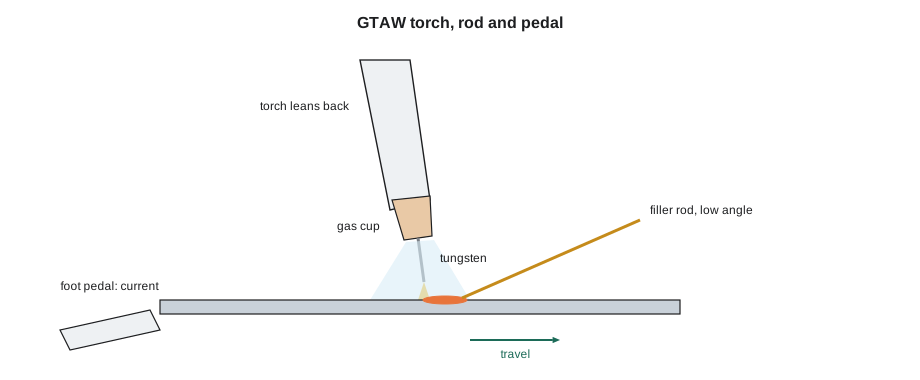
Aggie taught GTAW one hand at a time. First, the torch alone: running a fused bead along a flat sheet with no filler, holding a steady arc length and a torch angle of about 15 degrees from vertical, leaning back from the direction of travel, so the arc points ahead into the joint. The torch moves forward; the pool follows. Kai's first beads wandered, the arc length grew and shrank, and the bead widened and narrowed with it. Within a few days they were straight and even.
Then the filler: the rod is held at a low angle, about 15 to 20 degrees from the work, and dipped into the leading edge of the pool, not into the arc. The arc melts the rod off; the rod itself should not touch the tungsten. Between dips the rod tip stays inside the gas shield, so it does not oxidize. The rhythm is dip, move, dip, move, and the size of each dip and the spacing decide the bead size and ripple. The rod diameter is chosen to suit the joint: a rod about the thickness of the sheet is a good starting point on thin metal.
Finally the pedal: the welder starts at low current, brings the current up until the pool forms, welds at the set current, eases off where the joint thins or the metal heats up, and tapers off slowly at the end so the crater fills and does not crack. Many welders set the machine's maximum a little above what they need and use the pedal to work below it.
Travel speed in GTAW is much slower than GMAW, and that is part of why heat input on thin metal can still climb. Kai used the script below to compare three ways of welding the same 18 gauge stainless seam, with the current and speed Aggie measured on scrap.
# GTAW heat input for three ways of welding one thin stainless seam
runs = [('steady current, careful', 10.5, 60, 5.5), ('too hot and slow', 11.0, 75, 4.0), ('pulsed, same speed as the first', 10.5, 47, 5.5)]      # (method, average volts, average amps, travel speed ipm)
for name, v, a, s in runs:
    q = v * a * 60 / (1000 * s)
    print(f"{name:<34} {a:>3} A at {s} ipm: {q:.2f} kJ/in")
print("pulsed: the average current is (peak x on-time + background x off-time) / period")
peak, bg, duty = 80, 25, 0.4
avg = peak * duty + bg * (1 - duty)
print(f"80 A peak, 25 A background, 40 percent on-time: average {avg:.0f} A")steady current, careful 60 A at 5.5 ipm: 6.87 kJ/in too hot and slow 75 A at 4.0 ipm: 12.38 kJ/in pulsed, same speed as the first 47 A at 5.5 ipm: 5.38 kJ/in pulsed: the average current is (peak x on-time + background x off-time) / period 80 A peak, 25 A background, 40 percent on-time: average 47 A
The hot, slow run put in about 80 percent more heat than the careful one, and the pulsed run about a fifth less, which showed as a narrower heat tint and a flatter panel on the scrap.
Filler metal
GTAW filler rods are bare wire in straight lengths, about a meter or 36 inches long, identified by an AWS classification stamped or tagged on each rod. The filler is matched to the base metal: carbon steel rods for carbon steel, stainless rods matched to the grade of stainless, aluminum rods chosen for the alloy and the service. A wrong rod can crack, corrode or fail to match the color of the base metal after finishing. Rods are kept clean, dry and in their labeled tubes; a rod that has picked up oil or shop dust carries it into the weld. On stainless and aluminum, the end of a rod that has been in the pool and oxidized is clipped off before it is used again.
Worked problem
Average current with pulsing
Aggie sets a pulsed GTAW program with a peak of 70 A, a background of 20 A and a 50 percent on-time. What is the average current?
Show solution
- Average = peak × on-time + background × off-time.
- Average = 70 × 0.5 + 20 × 0.5 = 35 + 10 = 45 A.
Answer: About 45 A, so the average heat is like a 45 A weld, while each peak still melts the pool fully.
Building the skill
GTAW is learned in stages, and Aggie did not let Kai skip any of them. He ran fused beads with no filler until they were straight and even, then added filler on flat beads, then made outside corners, which are the easiest joint on sheet, then butt joints, lap joints and tees. Only then did he move to stainless and finally aluminum. Each stage took days, not hours. She judged progress by consistency, not by the best bead of the day: ten beads in a row of even width and ripple meant Kai was ready to move on. The welder's position matters as much as the hands. Sitting comfortably with both forearms supported on the bench, the torch hand steadied by a finger resting on the work, gives far steadier arc length than holding the torch in the air.
Common mistakes
MistakeDipping the filler rod into the arc.
InsteadDip into the leading edge of the pool and keep the rod tip inside the gas shield.
MistakeCarrying on after touching the tungsten to the pool.
InsteadStop, break off the contaminated end and regrind.
MistakeGrinding tungsten across its length on a general wheel.
InsteadGrind lengthwise on a wheel kept for tungsten only.
MistakeTurning up the argon flow to cure porosity.
InsteadExcess flow becomes turbulent; check for drafts, leaks and cup size instead.
MistakeUsing high-frequency start near sensitive hospital or lab equipment.
InsteadUse lift-arc start where the site requires it.
Summary and key terms
- GTAW runs the arc from a non-melting tungsten electrode, with filler added by hand and argon shielding.
- It uses a constant-current source; DCEN for steel and stainless, AC for aluminum, pulsing to reduce average heat.
- Lanthanated and ceriated tungsten are common; tungsten is ground lengthwise and kept clean.
- Argon flow should be moderate and smooth; a gas lens and post-flow protect the tungsten and weld.
- Technique: steady arc length, slight torch lean, rod dipped into the leading edge, pedal to control heat and fill the crater.
- Filler is matched to the base metal and kept clean and labeled.
- GTAW
- Gas tungsten arc welding, with a non-consumable tungsten electrode and separate filler.
- DCEN
- Direct current, electrode negative: most of the heat goes into the work.
- Autogenous weld
- A weld made by fusing the base metal edges with no filler.
- Gas lens
- A screen in the torch that smooths the shielding gas flow.
- Post-flow
- Shielding gas that keeps flowing after the arc stops.
- Pulsed GTAW
- GTAW alternating between a peak and a background current to lower the average heat.
Practice problems
Work each problem on paper first, then reveal the answer to check.
What is the heat input of a GTAW weld at 10 V, 50 A and 5 ipm?
Show answer
10 × 50 × 60 ÷ (1000 × 5) = 6.0 kJ/in.
Why is DCEN used for stainless rather than DCEP?
Show answer
DCEN puts most of the heat into the work and keeps the tungsten cool.
What should happen when the tungsten touches the pool?
Show answer
Stop, break it back past the contamination and regrind it.
Why are thoriated electrodes being replaced?
Show answer
Thorium is slightly radioactive and grinding dust is a health concern.
Lesson quiz · 5 questions
Score 60% or more to complete this lesson.
Create a free account to save your progress, take quizzes and earn a certificate.