
SMW-230 · Lesson 5 of 12 · 19 min
GMAW fundamentals for thin gauge
Gas metal arc welding is the process most people picture when they think of a welding shop: a gun with a trigger, a spool of wire feeding out of it, and a steady crackle as the bead goes down. It is fast, it can be learned quickly, and on carbon steel it covers everything from 24 gauge sheet to heavy plate. For the sheet metal trade it is the workhorse for curbs, frames, stands, supports, brackets, carbon steel grease duct and repairs. It is also easy to do badly on thin metal, because the same speed that makes it productive puts heat in quickly. This lesson covers how the process works and how to set it up for thin gauge; lesson 6 covers technique on carbon and galvanized sheet.
The GMAW system
A GMAW setup has a constant-voltage power source, a wire feeder, a gun on a cable assembly, a work clamp and a shielding gas supply. The welder sets the voltage at the power source and the wire feed speed at the feeder. On a constant-voltage machine, the current is not set directly: it follows from the wire feed speed, because the machine supplies whatever current is needed to melt the wire as fast as it arrives. More wire speed means more current and more heat. The voltage mainly controls the arc length and the shape of the bead: higher voltage gives a longer arc and a wider, flatter bead; too low a voltage makes the wire stub into the work.
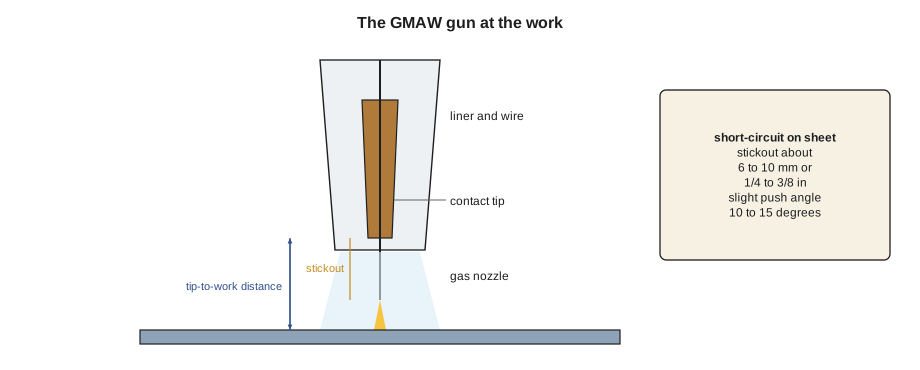
Inside the gun, the wire passes through a liner to a copper contact tip, where the current transfers to it. The distance from the end of the contact tip to the work is the contact-tip-to-work distance, and the length of wire sticking out past the tip is the stickout. For short-circuit welding on sheet, a short stickout, about a quarter to three-eighths of an inch, gives a stable arc. A longer stickout heats the wire by resistance before it reaches the arc, which lowers the current and the penetration; welders sometimes use that deliberately on very thin metal, but a wandering stickout gives an uneven weld.
Metal transfer modes
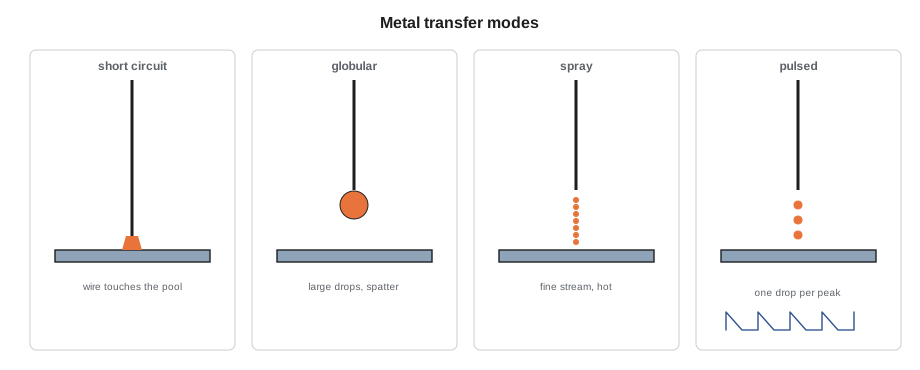
How the melted wire crosses the arc to the pool is called the transfer mode, and it depends mainly on the current, the voltage and the gas. Four modes matter.
- Short-circuit transfer. At low current and voltage, the wire touches the pool many times a second. Each touch is a short circuit; the current surges, the end of the wire melts off into the pool, the arc relights, and the cycle repeats, with the familiar crackle. The arc is on only part of the time, so the heat input is low, and the small, cool pool freezes quickly. That makes short circuit the mode for thin sheet and for welding out of position. Its weakness is incomplete fusion on thick metal, where the cool pool can sit on the surface without melting in.
- Globular transfer. At somewhat higher settings, especially with carbon dioxide gas, large irregular drops form and fall across the arc, with lots of spatter. It is rarely used on purpose.
- Spray transfer. At high current and voltage with an argon-rich gas, the wire melts into a fine stream of droplets that spray across the arc. It is hot, fast and smooth, and used on thicker steel in the flat position. It burns straight through sheet.
- Pulsed transfer. The power source switches between a high peak current that detaches one droplet and a low background current that keeps the arc alight. The average heat is low, like short circuit, but the transfer is smooth and spatter-free, like spray. Pulsed GMAW is good for thin stainless and aluminum and for visible welds, but needs a more advanced machine.
Wire and gas for thin carbon steel
For carbon steel sheet, the usual wire is a solid carbon steel wire with extra silicon and manganese to clean up the pool, classed as ER70S-6 in the AWS system. Thin sheet uses small diameters: 0.023 in for the thinnest gauges, 0.030 in for most sheet work, and 0.035 in for heavier gauges and light sections. A smaller wire carries less current for the same wire speed, which gives finer control. The drive rolls, liner and contact tip must match the wire size; a worn or wrong tip gives an erratic arc.
The usual shielding gas for short-circuit welding on carbon steel is a mix of 75 percent argon and 25 percent carbon dioxide, often called C25. It gives a stable short-circuit arc with less spatter and a flatter bead than pure carbon dioxide, which is cheaper and gives deeper penetration but more spatter. Mixes with less carbon dioxide, such as 90/10, suit spray and pulsed transfer. Gas flow is typically about 12 to 16 liters per minute or 25 to 35 cubic feet per hour for a short-circuit gun indoors; more is needed in a draft, but too much flow causes turbulence that drags in air. In a breeze on site, the shield blows away and the weld fills with porosity, so field GMAW needs screens.
| Sheet | Wire | Wire feed speed | Voltage | Gas flow |
|---|---|---|---|---|
| 26 ga | 0.023 in | 120 ipm | 15 V | 25 cfh |
| 22 ga | 0.030 in | 135 ipm | 16 V | 25 cfh |
| 20 ga | 0.030 in | 150 ipm | 16.5 V | 30 cfh |
| 16 ga | 0.030 in | 200 ipm | 17.5 V | 30 cfh |
| 11 ga | 0.035 in | 250 ipm | 19 V | 35 cfh |
Wire feed, current and deposition
Because the current follows the wire, welders think in wire feed speed. The amount of filler metal put into the joint, the deposition rate, is close to the volume of wire fed per minute times the density of steel, less a few percent lost as spatter. That is useful for estimating how much wire a job will use and how much metal each centimeter or inch of weld carries.
Kai estimated the wire for the Ashgrove roof curbs and the carbon steel parts of the Brine & Ember grease duct support frame in the script below. The fillet size and the weld lengths came from Lin Zhao's shop drawings.
# GMAW deposition and wire use (short circuit, steel wire)
import math
dia = 0.9                  # wire diameter, mm
wfs = 6.4                  # wire feed speed, m/min
eff = 0.93                   # share of wire that ends up in the weld (rest is spatter)
rho = 7.85                   # steel density, g/cm3
area_wire = math.pi * (dia / 10) ** 2 / 4          # cm2
dep = area_wire * wfs * 100 * rho * eff * 60 / 1000  # kg per arc hour
print(f"wire 0.035 in at 250 ipm: deposition about {dep:.2f} kg per hour of arc time")
leg = 5                  # fillet leg, mm
weld_area = leg ** 2 / 2 * 1.1                      # mm2, with a little convexity
jobs = [('Ashgrove curbs, 6 units', 28.0), ('Brine & Ember duct support frame', 9.5), ('Eastgate fan stand', 6.0)]                # (item, weld length in m)
total_kg = 0.0
for item, meters in jobs:
    kg = weld_area * meters * 1000 * rho / 1e6
    total_kg += kg
    print(f"{item:<32} {meters:>5} m of fillet  {kg:.2f} kg weld metal  {kg / dep * 60:5.1f} min arc time")
print(f"total {total_kg:.2f} kg; order about {total_kg / eff * 1.3:.1f} kg of wire allowing for spatter, tacks and waste")wire 0.035 in at 250 ipm: deposition about 1.78 kg per hour of arc time Ashgrove curbs, 6 units 28.0 m of fillet 3.02 kg weld metal 101.7 min arc time Brine & Ember duct support frame 9.5 m of fillet 1.03 kg weld metal 34.5 min arc time Eastgate fan stand 6.0 m of fillet 0.65 kg weld metal 21.8 min arc time total 4.70 kg; order about 6.6 kg of wire allowing for spatter, tacks and waste
The script works in metric internally because wire density is given in grams per cubic centimeter. The result, about 4.7 kg (10.4 lb) of weld metal, or a little under 7 kg (about 15 lb) of wire once spatter, tacks and waste are allowed for, covers all three items: about half of a 33 lb spool. The arc time, a little under three hours, is short; as with cutting, most of the labor is in cutting, fitting, tacking and cleaning.
Gun angle and direction
The angle of the gun and the direction of travel change the heat and penetration as much as the machine settings. Pointing the gun ahead in the direction of travel, the push or forehand technique, directs the arc onto cold metal ahead of the pool, gives a flatter, wider bead with less penetration and a better view of the joint. Pointing it back at the finished weld, the drag or backhand technique, directs the arc into the pool, gives deeper penetration and a narrower, higher bead. On thin sheet, a slight push angle of about 10 to 15 degrees is usually preferred, because it spreads the heat and reduces burn-through. The work angle, sideways across the joint, splits the heat between the two parts: on a lap joint the gun favors the thicker or bottom sheet, because the top edge melts easily.
Travel speed completes the picture. Too slow and the pool grows, the heat builds and the sheet burns through or warps; too fast and the bead is narrow, ropy and not fused at the edges. On sheet, a fairly brisk, steady speed with the arc on the leading edge of the pool is the target.
Setting up and tuning
Aggie had Kai tune every new setting on scrap of the same thickness and coating before welding the job. Set the wire speed for the thickness from the chart, set the voltage, run a short bead and listen. A good short-circuit arc has a steady, even crackle, like bacon frying. A popping, irregular sound with large spatter means the voltage is too high for the wire speed; the wire stubbing and pushing the gun back means it is too low or the wire speed too high. Adjust one setting at a time. Then check the bead: it should be even and slightly convex, fused into both edges, with a small amount of penetration showing on the back of thin butt joints and no burn-through.
- Check the drive roll tension: just enough to feed without slipping when the wire is pinched at the tip; too tight crushes the wire.
- Keep the contact tip and nozzle clean of spatter; anti-spatter gel on the nozzle helps.
- Replace contact tips when the hole wears oval; an oval tip gives an unstable arc.
- Keep the gun cable as straight as practical; tight loops make the wire drag.
- Check the gas: open the cylinder, set the flow with the trigger pressed, and listen for leaks.
Worked problem
Picking a starting setting
Kai has 16 gauge carbon steel gussets to weld to a curb angle. Using the bay chart, what is his starting setting, and which direction should he push?
Show solution
- Chart row for 16 ga: 0.030 in wire, about 200 ipm, 17.5 V, 30 cfh of C25.
- Tune on a scrap gusset and angle: listen for an even crackle and check fusion into the heavier angle.
- Use a slight push angle, with the work angle favoring the thicker angle so the gusset edge does not melt back.
Answer: Start from the chart setting, tune on scrap, and aim the heat at the heavier part.
Common mistakes
MistakeTurning up the current to fix poor fusion on sheet.
InsteadCheck fit-up, gun angle and travel speed first; more heat usually burns through.
MistakeUsing spray transfer settings on thin metal.
InsteadThin sheet needs short-circuit or pulsed transfer.
MistakeLetting the stickout wander.
InsteadHold a steady, short stickout for a stable arc and even penetration.
MistakeWelding outdoors in a breeze without screens.
InsteadScreen the work or use a process suited to wind; lost gas means porosity.
MistakeWelding the job without trying the setting on scrap.
InsteadTune on scrap of the same thickness and coating first.
Summary and key terms
- GMAW feeds a solid wire through a gun under shielding gas; on a constant-voltage machine, wire speed sets current and voltage sets arc length.
- Short-circuit and pulsed transfer suit thin sheet; spray transfer is too hot.
- Thin carbon steel uses small ER70S-6 wire, typically with 75/25 argon and carbon dioxide gas.
- Deposition and wire use can be estimated from wire size, wire speed and density.
- A slight push angle spreads heat; the work angle favors the thicker or bottom part.
- Tune every setting on scrap: an even crackle and a fused, even bead with no burn-through.
- Constant-voltage power source
- A welding machine that holds the arc voltage steady and supplies the current the wire needs.
- Wire feed speed
- How fast the wire is fed; on GMAW it sets the current.
- Stickout
- The length of wire extending past the contact tip.
- Short-circuit transfer
- A low-heat transfer mode in which the wire touches the pool many times a second.
- Pulsed transfer
- A transfer mode alternating peak and background current, one droplet per pulse.
- Push technique
- Pointing the gun ahead in the direction of travel for a flatter bead and less penetration.
Practice problems
Work each problem on paper first, then reveal the answer to check.
A 0.030 in wire is fed at 160 ipm. Roughly how many ounces of wire per minute is that?
Show answer
Area 0.000707 sq in × 160 in = 0.113 cu in; × 0.284 lb/cu in = 0.032 lb, about 0.5 oz per minute.
The arc pops and throws large spatter. What is the likely cause?
Show answer
Voltage too high for the wire feed speed.
Why is a slight push angle preferred on thin sheet?
Show answer
It spreads the heat ahead of the pool and reduces penetration and burn-through.
What gas mix is usual for short-circuit GMAW on carbon steel?
Show answer
75 percent argon and 25 percent carbon dioxide.
Lesson quiz · 5 questions
Score 60% or more to complete this lesson.
Create a free account to save your progress, take quizzes and earn a certificate.