
SMW-230 · Lesson 3 of 12 · 19 min
Thermal cutting: plasma, oxy-fuel and laser
Most of the metal Kai had cut in his first two years went through the squaring shear, the notcher or a pair of snips. Thermal cutting does what those cannot: it cuts shapes of any outline in flat sheet, cuts openings in finished duct and casings, cuts steel angle, channel and plate for curbs and stands, and cuts stainless and aluminum that are tough on blades. Keelson used three thermal processes: the CNC plasma table in the shop, a hand plasma torch for the shop and field, and an oxy-fuel cutting torch for heavier carbon steel. Laser cutting was done for Keelson by a supplier with a fiber laser, for parts that needed very fine detail. This lesson covers how each works, what it can cut, and how to cut safely and cleanly. SMW-420 covers programming and running the CNC plasma table; here the focus is on the process itself and on hand cutting.
How plasma cutting works
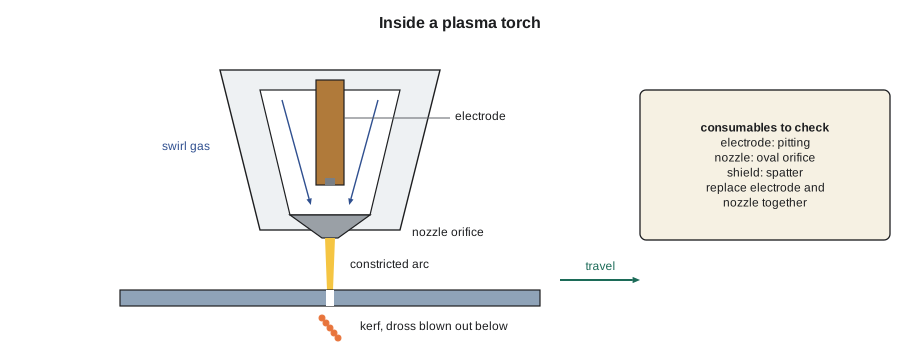
Plasma is gas heated so hot that it becomes electrically conductive. A plasma torch forces a gas, usually compressed air for sheet metal work, through a small nozzle around a tungsten or hafnium electrode. A pilot arc starts inside the torch, and when the torch is brought to the work, the main arc transfers to the metal through the gas jet. The constricted arc reaches extremely high temperatures, melts a narrow line of metal, and the fast gas jet blows the molten metal out of the cut, called the kerf. Because the arc carries current to the work, plasma cuts any electrically conductive metal: carbon steel, galvanized steel, stainless steel, aluminum, copper and brass.
The main parts of a hand plasma system are the power supply, the torch and lead, the work clamp, the compressed air supply with a filter and dryer, and the consumables at the torch tip: the electrode, the swirl ring, the nozzle and the shield cap. Consumables wear with use. A worn nozzle with an enlarged, oval hole gives a wide, beveled, dross-covered cut; a pitted electrode starts poorly. Keelson's rule was to check consumables at the start of every shift and replace the electrode and nozzle as a pair.
Current, thickness and speed
A plasma system is rated by its output current, and the current decides how thick a metal it can cut and how fast. Manufacturers publish three thicknesses for each machine: a recommended thickness it cuts at a good speed with a clean edge, a larger thickness it can cut more slowly, and a severance thickness it can just get through with a rough edge. For sheet metal work the relevant range is thin: the duct, casing and hood gauges are well inside the recommended range of even a small hand unit, and the work is mostly about cutting cleanly and fast enough not to overheat the sheet.
Cutting speed matters on thin metal. Too slow, and the kerf widens, the edge melts and rounds over, dross builds underneath, and the heat warps the panel. Too fast, and the arc lags behind the torch, the cut does not go through, and molten metal sprays back up. The right speed shows as a clean cut with the spark stream leaving the bottom of the sheet angled slightly back from the direction of travel. For thin sheet, a lower current setting and a fine-cut nozzle give a narrower kerf and less heat than full power.
Keelson kept a cut chart taped to each machine, drawn up from the manufacturer's data and its own trials. The script below works from an illustrative version of the chart for the shop's 45 A hand unit, and estimates the time to cut the openings Kai had for the week.
# Hand plasma cut chart (illustrative values for a 45 A air plasma unit)
chart = [(0.040, 25, 200), (0.064, 35, 160), (0.125, 45, 100), (0.25, 45, 40), (0.375, 45, 16)]     # (thickness in in, amps, cut speed in ipm)
def speed(t):
    for th, amps, sp in chart:
        if t <= th:
            return amps, sp
    raise ValueError('beyond the recommended range of this machine')
jobs = [('grease duct cleanout door, 18 ga', 0.048, 55), ('lab exhaust branch opening, 20 ga', 0.036, 43), ('curb base plate holes, 1/4 in', 0.25, 36), ('casing access opening, 18 ga', 0.052, 87)]       # (opening, thickness in in, cut length in in)
total = 0.0
for name, t, length in jobs:
    amps, sp = speed(t)
    minutes = length / sp
    total += minutes
    print(f"{name:<34} {t:>6} in at {amps} A, {sp:>5} ipm: {minutes:5.2f} min of arc time")
print(f"total arc time {total:.1f} min; allow layout, setup and cleanup on top")grease duct cleanout door, 18 ga 0.048 in at 35 A, 160 ipm: 0.34 min of arc time lab exhaust branch opening, 20 ga 0.036 in at 25 A, 200 ipm: 0.21 min of arc time curb base plate holes, 1/4 in 0.25 in at 45 A, 40 ipm: 0.90 min of arc time casing access opening, 18 ga 0.052 in at 35 A, 160 ipm: 0.54 min of arc time total arc time 2.0 min; allow layout, setup and cleanup on top
Arc time is a small part of the job. Laying out, clamping a straightedge or template, piercing, cleaning dross and checking the cut take longer. The script's real use is spotting work that is outside a machine's recommended range, where a bigger unit or another process is better.
Plasma technique on sheet
Aggie taught Kai to cut thin sheet with a drag tip or a standoff guide resting on the metal, which keeps the torch-to-work distance constant, and to guide the torch along a clamped straightedge or a template for straight lines and circles. Freehand cuts wander. A few habits make clean cuts.
- Start at an edge where possible. Piercing in the middle of a sheet blows molten metal back up at the nozzle and shortens its life; on thin sheet, tilting the torch slightly at the start and straightening it as the arc pierces helps.
- Keep the torch square to the work unless a bevel is wanted, and move at a steady speed.
- Support the work so the cut-off piece does not drop and pinch the torch at the end of the cut, and so the sparks go down into a safe area, not onto the floor, a hose or someone's boots.
- Clamp the work lead to the piece being cut, close to the cut.
- Mind the dross. Some dross on the underside is normal; heavy dross means the speed, current or consumables are wrong. Low-speed dross is a heavy bead that comes off in a lump; high-speed dross is a thin, tough line welded to the edge.
Cutting galvanized steel with plasma makes zinc fume, and cutting stainless makes hexavalent chromium fume, so the fume controls from lesson 2 apply. The plasma table's down-draft or water bed handles shop cutting; hand cutting needs a fume arm or an extraction table. Plasma is also loud and bright: hearing protection and at least a light filter shade are needed even at low current.
Oxy-fuel cutting
Oxy-fuel cutting works on a different principle from plasma. A preheat flame of fuel gas and oxygen heats carbon steel to its ignition temperature, a bright red. Then a jet of pure oxygen from the center of the tip is turned on, and the hot steel burns in the oxygen, forming iron oxide that the jet blows out of the kerf. The steel is burned, not melted. That only works on metals whose oxide melts at a lower temperature than the metal itself and which burn readily in oxygen: carbon and low-alloy steels. Stainless steel, aluminum, copper and brass form oxides that stop the reaction, so oxy-fuel cannot cut them cleanly.
Oxy-fuel is excellent for carbon steel from a few millimeters or an eighth of an inch up to very thick sections, needs no electricity, and is portable. On thin sheet, though, it is a poor choice: the preheat flame heats a wide area, the sheet warps, the edges melt and stick back together, and the cut is ragged. In a sheet metal shop it is used mainly for cutting steel angle, channel, pipe and plate for curbs, stands and supports, for removing old steel on site, and with a heating tip for bending and straightening.
- Set up the torch for the fuel used. Acetylene gives the hottest flame and fastest preheat; propane and other fuels are cheaper and safer to store but preheat more slowly and need different tips.
- Use flashback arrestors at the regulators and check valves at the torch, and purge each hose before lighting.
- Light the fuel first, then add oxygen to a neutral preheat flame; shut off oxygen first when finishing, then fuel, unless the torch maker's procedure says otherwise.
- Never use oxygen to blow dust off clothing or to ventilate a space. Clothing in oxygen-enriched air burns fiercely.
Laser cutting
A laser cutter focuses a beam of light, from a fiber laser or a carbon dioxide laser, into a tiny spot that melts or vaporizes the metal, while an assist gas blows the kerf clear. Nitrogen as the assist gas gives clean, oxide-free edges on stainless steel and aluminum; oxygen speeds up cutting of carbon steel. Lasers cut thin sheet very fast with a narrow kerf, a very small heat-affected zone and almost no dross, and hold tight tolerances for small holes and fine detail. They are expensive machines, and many sheet metal contractors buy laser-cut parts from a supplier, as Keelson did for the louver blades and perforated panels on the Eastgate project.
Laser beams used for cutting are invisible or nearly so and can blind instantly, which is why production lasers are fully enclosed with interlocked doors. Apprentices do not open or bypass a laser enclosure.
| Process | Cuts | Thin-sheet quality | Heat into the part | Typical use at Keelson |
|---|---|---|---|---|
| Air plasma, hand | All conductive metals | Good with a fine nozzle | Moderate | Openings, field cuts, curb plates |
| CNC plasma table | All conductive metals | Good to very good | Moderate | Flat patterns for duct and fittings |
| Oxy-fuel | Carbon and low-alloy steel only | Poor: warps and melts | High | Angle, channel, plate, demolition |
| Fiber laser | Steel, stainless, aluminum, some copper | Excellent | Low | Fine parts bought from a supplier |
The heat-affected zone and cut edges
Every thermal cut heats the metal next to the kerf. That band, the heat-affected zone, may be harder, more brittle or discolored than the rest of the sheet. On carbon steel cut with plasma or oxy-fuel, the cut edge can be hard enough to crack when bent sharply, so parts that will be folded along a cut edge are better sheared or have the edge ground. On stainless steel, the heat tint along a plasma cut is an oxide layer that reduces corrosion resistance, and on food service or laboratory parts it must be ground or pickled away. On galvanized steel, the zinc is burned off a narrow strip along the cut, which is then protected with a zinc-rich paint where the part will be exposed. Lesson 4 covers edge preparation for welding.
Worked problem
Checking a job against the cut chart
The Ashgrove pool exhaust needs 14 openings cut in 0.064 in aluminum casing panels, each with a cut length of 36 in. The 45 A unit cuts 0.064 in aluminum at about 120 ipm. How much arc time is that?
Show solution
- Total cut length = 14 × 36 = 504 in.
- Arc time = 504 ÷ 120 = 4.2 minutes.
Answer: About 4 minutes of arc time; the layout, clamping and edge cleanup will take far longer.
Keeping cut parts accurate
A thermal cut removes a strip of metal as wide as the kerf, so a template or a straightedge must be offset by half the kerf from the line, on the waste side, or every part comes out undersize. The CNC plasma table applies this kerf offset automatically from its settings; on a hand cut, Kai clamped his straightedge so the torch nozzle ran along it with the arc on the waste side of the scribed line. He checked the first piece of any batch against the drawing before cutting the rest, measuring both length and squareness, because a straightedge that slipped by a thirty-second of an inch on one part slips on all of them. Parts are labeled as they come off the table, before the offcuts are cleared, so nothing gets mixed up.
Common mistakes
MistakeTrying to cut stainless steel or aluminum with an oxy-fuel torch.
InsteadOxy-fuel only cuts carbon and low-alloy steel; use plasma or laser for the others.
MistakeCutting thin sheet slowly at full current.
InsteadUse a lower current and a fine-cut nozzle and move fast enough for a clean, angled spark stream.
MistakeRunning plasma consumables until they fail.
InsteadCheck them every shift and replace the electrode and nozzle together.
MistakeLeaving heat tint on stainless parts for food or laboratory use.
InsteadGrind or pickle the tinted strip to restore corrosion resistance.
MistakeUsing oxygen to blow off dust.
InsteadNever; oxygen-enriched clothing burns violently.
Summary and key terms
- Plasma cutting uses a constricted arc in a gas jet to melt and blow out a narrow kerf in any conductive metal.
- Machine current sets the thickness and speed; thin sheet cuts best at lower current with a fine nozzle and the right speed.
- Oxy-fuel cutting burns carbon steel in an oxygen jet; it cannot cut stainless, aluminum or copper and warps thin sheet.
- Laser cutting gives fine, fast, low-heat cuts and is often bought in from a supplier.
- Every thermal cut leaves a heat-affected zone; stainless heat tint and burned zinc need treatment.
- Fume, light, noise and fire controls apply to cutting as well as welding.
- Plasma
- Gas heated until it conducts electricity, used as a constricted arc for cutting.
- Kerf
- The slot of metal removed by a cut.
- Dross
- Resolidified metal and oxide stuck to the underside of a thermal cut.
- Consumables
- The wearing parts at a plasma torch tip: electrode, swirl ring, nozzle and shield.
- Oxy-fuel cutting
- Cutting carbon steel by heating it and burning it in a jet of oxygen.
- Heat-affected zone
- The band of metal next to a cut or weld whose properties were changed by heat.
Practice problems
Work each problem on paper first, then reveal the answer to check.
A cut 96 in long in 20 ga steel runs at 200 ipm. How long is the arc on?
Show answer
96 ÷ 200 = 0.48 minutes, about 29 seconds.
Why does oxy-fuel not cut stainless steel?
Show answer
Its chromium oxide melts at a higher temperature than the steel and stops the burning reaction.
What does a thin, tough line of dross welded to the bottom edge suggest?
Show answer
The cut is too fast.
Name two ways to treat a plasma-cut edge on galvanized steel exposed to weather.
Show answer
Grind it clean and coat it with zinc-rich paint.
Lesson quiz · 5 questions
Score 60% or more to complete this lesson.
Create a free account to save your progress, take quizzes and earn a certificate.