
SMW-130 · Lesson 8 of 12 · 19 min
Soft soldering
Soldering is the oldest way of making sheet metal joints tight, and in architectural copper and some specialty work it is still the best. A soldered joint is a metallurgical bond: molten solder flows into a close-fitting joint by capillary action, wets both surfaces, and freezes into a continuous seal. Done well, a soldered copper seam outlasts the roof. Done badly, it looks fine and fails in a few winters, as the 1980s repairs at St. Brendan's had. This lesson covers solders and fluxes, heat sources, preparing and tinning, the technique of sweating solder through a seam, soldering different metals, and the hazards of the work.
How soldering works
Soldering joins metals with a filler metal that melts below the melting point of the parts and below 840 °F. Above that temperature, the same idea is called brazing, covered in Lesson 9. The parts are not melted. Instead, the hot solder wets the clean metal surface, which means it spreads over it and forms a thin layer of alloy where it touches, the way water spreads over clean glass but beads on a waxed car. Wetting is the whole secret of soldering. Solder will only wet a surface that is clean, free of oxide and hot enough. If any of those is missing, the solder balls up and sits on the surface without bonding.
Capillary action then pulls the molten solder into narrow gaps between the parts. This is why soldered joints are designed as laps and locks with close fits. A gap of a fraction of a millimeter fills completely; a wide gap does not fill and leaves a weak, porous joint. Heat flow matters as much: solder flows toward the hotter metal, so the joint is heated from the side away from where the solder is fed, drawing the solder through.
Solders
Soft solders are alloys of tin with lead, antimony, silver, copper or other metals. Each alloy melts over a range of temperature, from the solidus, where melting starts, to the liquidus, where it is fully liquid. Between the two the solder is pasty. A wide pasty range is useful for wiping and filling seams; a narrow range is better for joints that must set quickly.
| Solder | Approximate melting range | Typical sheet metal uses |
|---|---|---|
| 50/50 tin-lead | 361–421 °F | Traditional roofing and architectural copper, tinware; not for drinking water |
| 60/40 tin-lead | 361–374 °F | General work where a quicker set is wanted; not for drinking water |
| 95/5 tin-antimony | 450–464 °F | Lead-free work, food and water contact where allowed, higher service temperatures |
| Tin-silver and tin-copper alloys | About 430–450 °F | Lead-free plumbing and food equipment |
Lead-bearing solders are restricted. They must not be used on anything carrying drinking water, and lead-free solders and fluxes are required by plumbing codes in both countries for potable water work. Lead solder is still widely used for architectural copper, where its long pasty range makes good seams, but some owners and specifications now call for lead-free solder on roofing as well, and runoff from roofs to rain barrels is one reason. The St. Brendan's specification allowed 50/50 tin-lead for the roof seams, as the original roof had used, and required lead-free solder on the new copper downspouts where water was collected for the church garden.
Solder comes as bar, wire and paste. Bar solder is used with soldering coppers on roofing. Solid wire is used with irons and torches. Flux-cored wire carries flux inside it, convenient for small work but often the wrong flux for sheet metal. Every reel and bar is marked with its alloy, and Keelson kept lead and lead-free solder on separate shelves, clearly labeled, so they could not be mixed up.
Fluxes
Flux has three jobs. It removes the thin oxide film from the metal, it stops new oxide forming while the joint is hot, and it helps the solder wet and flow. Without flux, solder will not wet most metals, however hot they are.
- Acid fluxes, such as zinc chloride solutions, sometimes called cut acid or killed acid, are strong cleaners used on copper, brass, galvanized steel and terne. They are corrosive, and their residue must be washed off after soldering or it will keep corroding the metal.
- Stainless steel needs a special aggressive flux formulated for it, because its chromium oxide film is very stable. Ordinary acid fluxes do not work on stainless.
- Rosin and mild organic fluxes are used on electrical and electronic work and are too weak for most sheet metal.
- Paste fluxes for plumbing are formulated for copper tube and are often water-soluble and suitable for drinking water systems.
The rule is to match the flux to the metal and the job, use as little as does the work, and clean off the residue afterwards. On St. Brendan's, Kai neutralized acid flux residue on every seam with a baking soda solution and rinsed it with water, as the copper specification required. Flux left on copper turns green and streaks the roof below.
Heat sources
Soldering coppers, also called soldering irons in the trade although the business end is copper, are heavy copper heads on steel shanks, heated in a furnace or by a torch, or electrically. A heavy copper stores a great deal of heat and delivers it to the seam steadily, which is exactly what roofing and seam work needs. Coppers come in pairs so one can heat while the other is used. Electric irons of high wattage are used in the shop and on small work. Propane and air-acetylene torches heat quickly and are used for heavier metal and for tube, but a torch is easy to overheat with and burns flux, so most experienced roofers prefer coppers for seams.
The working face of a copper must be tinned, coated with solder, to transfer heat and to carry solder to the work. A copper that is not tinned, or is pitted and black, will not transfer heat well. Kai learned to file the faces of a copper bright, heat it, rub it on a block of sal ammoniac or dip it in flux, and coat it with solder. He re-tinned it whenever it went black.
Preparation and pre-tinning
Most failed soldered joints fail before the solder is applied, because the metal was not clean. Preparation is therefore most of the job.
- Clean the joint surfaces to bright metal with an abrasive pad, wire brush or emery cloth, both faces, wider than the solder will reach.
- On weathered copper, clean off the patina completely; solder will not wet it.
- Apply flux to the cleaned areas, including inside any locks that will be hidden once the seam is closed.
- Pre-tin the surfaces: heat them and flow a thin coat of solder over each face that will be in the joint, front and back where both will be inside the seam.
- Assemble and close the joint, then solder it.
Pre-tinning is the step most often skipped and the one that most decides how long a seam lasts. When both surfaces are tinned before the seam is closed, the solder in the final step only has to remelt the coats and join them, and it can do so through the whole seam. When the surfaces are bare, the solder has to wet the metal from scratch inside a closed seam it cannot see, and it often does not. The SMACNA test study of soldered copper flat lock seams found that pre-tinning both pieces, front and back, gave the best results.
Sweating a seam
Sweating means heating a closed seam until the solder flows right through it. On a flat lock seam, the copper is held flat on the seam, heating it, while solder is fed at the edge of the seam. As the seam comes up to temperature, the solder melts and is drawn in by capillary action, and the copper is moved slowly along the seam just ahead of the solder. The sign that the seam is full is solder appearing along the back edge of the lock, or flowing out the far side. The study found that seams whose solder reached all three legs of the flat lock reached the long service life expected, while seams soldered only part way failed far sooner. Solder piled on the surface does not make up for solder missing inside.
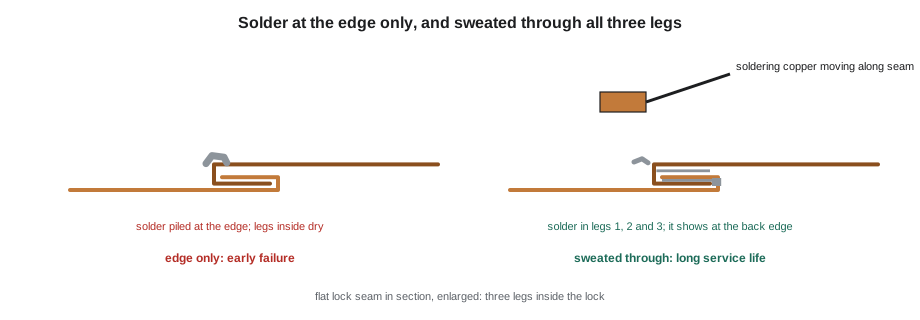
Speed matters. A copper moved too fast leaves the seam too cool for the solder to penetrate. One moved too slowly overheats the metal, burns the flux and lets the solder run out the far side. Aggie had Kai practice on flat lock offcuts until he could sweat a 24 in seam at an even pace, then cut the seam apart with a hacksaw to see whether the solder had reached the third leg. His first three test seams had not. The fourth had.
Finished seams are wiped smooth, with solder feathered out to the metal on each side, no lumps, no pinholes and no bare spots at the ends. Then the flux residue is neutralized and rinsed.
Soldering different metals
Copper solders easily with the right flux and enough heat, and it conducts heat away so quickly that heavy coppers are needed on large sheets. Galvanized steel solders well with acid flux, because the zinc coating is readily wetted; the coating is not damaged at soldering temperatures if the work is not overheated. Terne-coated steel, now rare, solders very well. Stainless steel solders with special flux and care; it conducts heat poorly, so it is easy to overheat locally. Aluminum is difficult to solder with ordinary solders and fluxes because of its tough oxide; it is usually joined by welding, riveting or adhesive instead. Zinc sheet solders well with tin-lead or tin solder and a mild flux, but it melts at a low temperature, about 790 °F, so it must be heated gently.
How strong is a soldered joint?
Solder is weak compared with the metals it joins. A soldered joint is strong only because the overlap is large compared with the metal thickness, so the solder carries load in shear over a wide area. That is why soldered lap seams are given generous laps, and why flat lock seams, where the solder fills three legs, are much stronger than butt joints. The script below compares the shear capacity of a soldered lap with the tensile capacity of the sheet, using illustrative strength values, to show how much lap is needed for the joint to be as strong as the metal.
# Lap length for a soldered seam to match the sheet: solder shear area vs sheet tension (illustrative strengths)
t = 0.0216              # sheet thickness, in
sheet_ult = 32000     # copper sheet tensile strength, psi
solder_shear = 3600  # solder shear strength, psi
for lap in [0.0625, 0.125, 0.25, 0.5]:
    joint = lap * solder_shear      # per unit width of seam
    sheet = t * sheet_ult
    print(f"lap {lap} in: joint {joint:.0f}, sheet {sheet:.0f} per in of seam -> {'joint stronger' if joint >= sheet else 'joint weaker'}")
print(f"lap needed to match the sheet: about {t * sheet_ult / solder_shear:.3f} in")lap 0.0625 in: joint 225, sheet 691 per in of seam -> joint weaker lap 0.125 in: joint 450, sheet 691 per in of seam -> joint weaker lap 0.25 in: joint 900, sheet 691 per in of seam -> joint stronger lap 0.5 in: joint 1800, sheet 691 per in of seam -> joint stronger lap needed to match the sheet: about 0.192 in
For 16 oz copper, about 0.0216 in thick, a lap of about 3/16 in of fully soldered joint matches the strength of the sheet. A flat lock seam soldered through all three legs has several times that, which is why such seams outlast the metal. A seam soldered only along its edge may have barely a sixteenth of an inch of solder bond, and it is the seam that fails.
The strength values in the script are rough figures for annealed copper and a tin-lead solder at room temperature. Solder strength falls as temperature rises and under long-term load, which is another reason for generous laps on roofs that get hot in the sun.
Safety in soldering
Soldering is hot work and must follow the shop's or the site's hot work procedure, covered in Lesson 9 with brazing. Beyond the fire hazard, soldering has hazards of its own.
- Fumes. Heating flux produces irritating and sometimes toxic fumes, and acid fluxes give off hydrogen chloride. Work with ventilation that carries the fumes away from the breathing zone, especially indoors.
- Lead. Lead solder does not give off much lead vapor at soldering temperatures, but lead dust and residue on hands and clothes is a real hazard. Wash hands before eating, drinking or smoking, do not eat in the work area, and keep lead solder off food surfaces.
- Burns. Coppers, torches, molten solder and the work itself are hot long after they look cool. Use a holder for hot coppers and gloves for handling hot work.
- Acid. Acid fluxes burn skin and eyes. Wear eye protection and gloves when handling them, and keep a supply of clean water nearby.
OSHA's lead standard for construction sets exposure limits and requirements for hygiene and training where workers may be exposed to lead, and Keelson's program included hand washing stations and lead awareness training for everyone doing roof soldering.
Common mistakes
MistakeSoldering on weathered or dirty metal.
InsteadClean to bright metal, wider than the solder will reach, and flux it.
MistakeSkipping pre-tinning inside a flat lock.
InsteadPre-tin both pieces, front and back, before forming and closing the seam.
MistakePiling solder on the surface of the seam.
InsteadSweat solder through all three legs until it shows at the back edge.
MistakeLeaving acid flux residue on copper.
InsteadNeutralize and rinse the residue after soldering.
MistakeUsing lead solder on anything carrying drinking water.
InsteadUse lead-free solder and flux wherever water may be collected or drunk.
Summary and key terms
- Soldering uses a filler that melts below 840 °F and bonds by wetting clean, fluxed, hot metal.
- Capillary action pulls solder into close-fitting joints; solder flows toward the hotter metal.
- Common sheet metal solders are 50/50 tin-lead for roofing and lead-free tin alloys where lead is not allowed.
- Flux removes oxide and must suit the metal; acid flux residue must be neutralized and rinsed.
- Clean, flux and pre-tin before closing a seam, then sweat solder through the whole seam.
- A soldered joint is strong because of its large lap area; solder only at the edge is a weak joint.
- Wetting
- The spreading of molten solder over a clean metal surface, forming a bond.
- Capillary action
- The drawing of a liquid into a narrow gap.
- Pre-tinning
- Coating joint surfaces with solder before the joint is closed.
- Sweating
- Heating a closed seam until solder flows right through it.
- Soldering copper
- A heavy copper head on a shank, heated and used to solder seams.
- Flux
- A chemical that removes oxide and helps solder wet the metal.
Practice problems
Work each problem on paper first, then reveal the answer to check.
Why does solder ball up on a surface instead of spreading?
Show answer
The surface is dirty or oxidized, not fluxed, or not hot enough, so the solder does not wet it.
Which solder would you use on a copper downspout feeding a rain barrel?
Show answer
A lead-free solder with a suitable flux.
How do you know solder has been sweated through a flat lock seam?
Show answer
Solder appears along the back edge of the lock or the far side of the seam.
What happens if acid flux is left on copper?
Show answer
It keeps corroding the metal and turns green, streaking the roof.
Lesson quiz · 5 questions
Score 60% or more to complete this lesson.
Create a free account to save your progress, take quizzes and earn a certificate.