
SMW-130 · Lesson 1 of 12 · 20 min
Why joints matter: strength, tightness and codes
A sheet metal worker spends more of every working day joining metal than cutting it. A straight run of duct, a kitchen hood, a copper roof or a gutter is a set of flat pieces that become one useful object only when they are joined, and almost every failure of sheet metal work in service starts at a joint. A duct leaks at its seams and connections, not through the middle of a sheet. A roof fails where two panels meet. A hood drips grease where a seam was left open. This course is about the joints themselves: how they are formed, how they are fastened, how they are sealed, and how to tell a good one from a bad one.
This first lesson sets out why joints matter, the families of joints the trade uses, what each joint has to do, and where the rules for joints come from. The rest of the course takes the families one at a time, and Lesson 12 brings them together on a piece of the Ashgrove school duct and a copper panel for St. Brendan's Church.
Kai's first leak
Two weeks into the Ashgrove job, Kai had helped hang a run of 24 × 16 in supply duct in the school gym. When Sean ran the new rooftop unit for the first time, the balancer walking the gym found air hissing out of three of the transverse joints. Two had drive cleats that had been driven short, leaving the corners open. One had a gap in the mastic where the sealant had been skipped around a corner. None of it was dangerous, but the air leaking into the gym ceiling was air the classrooms at the end of the run would never get, and the fan was working harder to make up for it.
Aggie took Kai back to the shop the next morning and laid three joints on the bench: a Pittsburgh lock from a duct section, a slip-and-drive transverse joint and a soldered copper seam from an old St. Brendan's flashing. Each one, she said, has the same four jobs. It has to hold the parts together, it has to keep in whatever is inside, it has to survive what the building will do to it for decades, and it has to be built the way the drawings and the codes say. A joint that does three of the four is still a failed joint.
The four jobs of a joint
- Strength. A joint carries load: the weight of the duct between hangers, the pressure of the air inside pushing the walls outward or pulling them in, the pull of wind on a roof panel, the weight of snow on a gutter. A joint that is weaker than the sheets it joins becomes the point where the assembly fails.
- Stiffness. In duct, a transverse joint does more than connect two sections. A standing joint or flange stiffens the duct wall across its width, and duct construction standards count some joints as reinforcement. A soft, floppy joint lets the walls drum and flex, which makes noise and opens seams over time.
- Tightness. Duct joints must keep air in, roofs must keep water out, kitchen exhaust must keep grease in, and some industrial systems must keep fumes or dust in. Each job sets a different standard: an air leak costs energy, a water leak rots a building, and a grease leak can feed a fire.
- Durability. Joints live with movement, vibration, corrosion and heat. A copper roof moves every day as it heats and cools. A duct joint near a fan vibrates for years. A joint between two different metals can corrode. A joint that is fine on the day it is made but fails in five years has not done its job.
Most joints in the trade rely on more than one of three ideas to do these jobs. Some depend on the metal being folded and locked together, so that the shape of the metal holds the parts. Some depend on separate fasteners, such as rivets, screws or clips. And some depend on joining the metals themselves, by soldering, brazing or welding. A sealant or gasket is then often added to make the joint tight, because a folded joint is strong long before it is airtight.
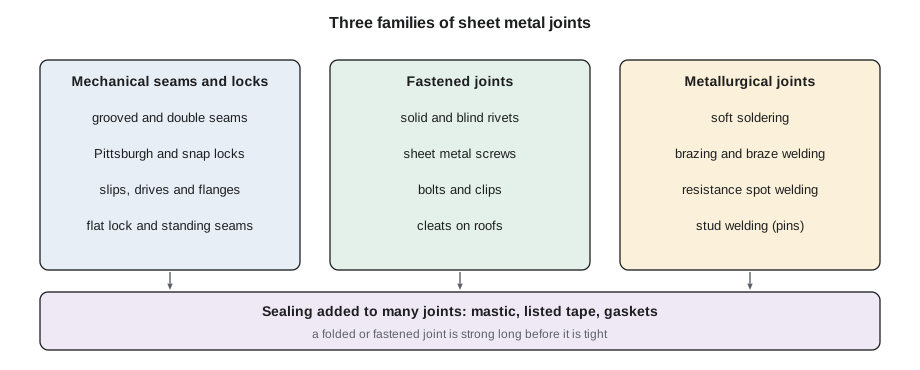
The three families of joints
The first family is the mechanical seam or lock: two edges folded so they hook into each other and are then flattened, closed or locked. Grooved seams, Pittsburgh locks, snap locks, standing seams, flat locks and the slips and drives used to join duct sections all belong here. Mechanical seams are fast, need no heat and work on coated metal without damaging the coating. Their weakness is that they are not tight on their own. Air and water find the tiny paths through the folds, so most mechanical seams need sealing, soldering or both where tightness matters.
The second family is the fastened joint, where separate pieces of metal hold the parts together. Rivets, sheet metal screws, bolts and clips are the common fasteners, and SMW-110 introduced the screws and simple blind rivets used every day in the shop. Fastened joints are easy to make in the field and easy to inspect. Their weaknesses are the holes they need, which must be sealed if the joint must be tight, and the fact that each fastener carries a concentrated load.
The third family is the metallurgical joint, where the metals themselves are joined. In soldering and brazing a filler metal flows into a close-fitting joint and bonds to both parts without melting them. In welding the parts themselves are melted and fused. Resistance spot welding and stud welding are the forms of welding most used on light gauge sheet metal, and they are covered in Lesson 10. Arc welding of sheet metal is a skill of its own and has its own course, SMW-230. Metallurgical joints can be both strong and tight, but they need heat, they damage coatings, and they need skill to do well.
A single fitting often uses all three families. Lin's shop drawing for one Ashgrove plenum called for Pittsburgh locks on the corners, drive slips on the transverse joints, rivets on the access door frame, mastic on every joint, and capacitor discharge pins to hold the acoustic liner. The kitchen hood at Brine & Ember called for welded and liquid-tight grease duct joints, because a grease duct is a fire hazard, while the hood's outer skin used riveted and sealed seams.
Longitudinal and transverse joints
Duct workers sort joints in a second way as well, by direction. A longitudinal seam runs along the length of a duct section, closing the sheet into a tube. On rectangular duct, longitudinal seams are usually at the corners: Pittsburgh locks, snap locks or corner standing seams. On round duct, the longitudinal seam is usually a grooved seam or, in spiral duct, the spiral lock seam that winds around the pipe.
A transverse joint runs across the duct, joining one section to the next. On rectangular duct, transverse joints are slips and drives, standing slips, or flanges. On round duct, they are crimped slip joints, beaded joints, couplings or flanges. Transverse joints are usually made in the field, at height, often in awkward places, and they leak more air than longitudinal seams. That is why the duct construction standards sort sealing requirements into classes that treat transverse joints first, and why Lesson 11 spends so much time on them.
The difference matters for planning too. Longitudinal seams are made in the shop on machines, under good conditions, and are rarely the problem. Transverse joints are made by hand in the field. A shop that wants tight duct makes as much of each joint as possible in the shop, so that the field crew has less to do. Prefabricated flanges, factory-fitted gaskets and pre-sealed slip joints all exist for this reason.
Where the rules come from
A sheet metal worker does not invent joints. The joint used in a given place is set by the drawings and specifications for the job, which in turn point to codes and to industry standards. It helps to know how these fit together, because the answer to the question "is this joint allowed here?" is almost always in one of them.
In Ohio, the state's building and mechanical codes are based on the International Building Code and International Mechanical Code, with state amendments, and the energy code sets duct sealing requirements. These codes do not draw every joint. The International Mechanical Code requires that joints and seams of ducts be made substantial and airtight and sealed with approved products, and it points to the SMACNA HVAC Duct Construction Standards, published by the Sheet Metal and Air Conditioning Contractors' National Association, for how metal duct is built. Kitchen exhaust follows NFPA 96 and the mechanical code, and OSHA rules govern hot work and fumes.
The SMACNA HVAC Duct Construction Standards for metal and flexible duct is now in its fourth edition, designated 2020 and released in 2021. It sets out which seams, transverse joints and reinforcements may be used for each duct size, pressure class and gauge, and how ducts are to be sealed. SMACNA also publishes an Architectural Sheet Metal Manual for roofing, flashing and gutter work, and an HVAC Air Duct Leakage Test Manual for leakage testing. The duct construction standard is covered in depth in SMW-220. This course uses its ideas without reproducing its tables, and every table of joint limits in this course is a simplified Keelson shop chart, labeled as such.
On top of the codes and standards sit the project specifications. The Ashgrove specification, for example, called for all supply duct to be built to the 2 in w.g. pressure class and sealed to the strictest seal class, with listed mastic, and for joints to be left exposed until the duct passed a leakage test. A specification can ask for more than the code but never less. When the code, the standard and the specification disagree, the strictest requirement usually governs, and the foreman or the engineer decides any real conflict.
Choosing a joint
Before a joint is formed, someone decides which joint to use. Most of the time that is the detailer or the shop foreman, working from the standard and the specification. As Kai would learn, though, every journeyworker needs to understand the choice, because jobs change in the field and not every situation is on the drawings. Aggie gave him a list of questions to ask about any joint.
- What does it have to hold? The load, the pressure and the movement it must take.
- What does it have to keep in or out? Air at a given pressure, water, grease, dust or fumes.
- What metal and what gauge is it in? Some joints cannot be formed in heavy gauge; some cannot be soldered or welded in coated metal without damage.
- Where will it be made? In the shop on a machine, or in the field by hand, at height.
- Will it be seen? Architectural work and exposed duct need neat joints with hidden fasteners.
- What does the standard and the specification allow? The answer to everything else must fit inside this.
The script below is a simple version of the thinking Aggie meant. It takes a short list of joints with the limits Keelson's shop chart gives them and filters out the ones that do not fit the job. The numbers are illustrative values from Keelson's own chart, not the limits of any standard, but the logic is the logic used in practice: a joint must meet every requirement, not most of them.
# Filter candidate joints against a job's requirements (illustrative shop chart values)
joints = [
    # name,               max pressure in w.g., field-made?, airtight alone?, max thickness gauge
    ("drive slip",          2, True,  False, 22),
    ("standing drive slip", 3, True,  False, 18),
    ("roll-formed flange",  4, True,  False, 16),
    ("soldered lap",        1, False, True,  24),
]
job = {"pressure": 3, "field": True, "thickness": 22}
for name, pmax, field_ok, tight, tmax in joints:
    ok = pmax >= job["pressure"] and (field_ok or not job["field"]) and tmax <= job["thickness"]   # gauge numbers run backwards
    note = "" if tight else " (needs sealant)"
print(f"{name:20s} {'fits' if ok else 'no'}{note if ok else ''}")drive slip no standing drive slip fits (needs sealant) roll-formed flange fits (needs sealant) soldered lap no
For a 3 in w.g. duct of 22-gauge steel made in the field, the plain drive slip and the soldered lap are out, and the standing drive slip and the flange both fit, both needing sealant. That was close to the real choice on the Ashgrove mains, where Lin chose the roll-formed flange for the large ducts because it also gave the wall the stiffness it needed.
One detail in the script trips people up. Gauge numbers run backwards: a heavier sheet has a smaller gauge number. In the script the comparison is reversed for that reason: a joint rated to 18 gauge accepts 22 gauge because 22 gauge is thinner. When you write or read joint limits, check which way the numbers run before you trust a comparison.
Joints and the people who inspect them
Joints are where inspectors look. A mechanical inspector checking a duct installation looks at transverse joints, sealing, hangers at joints and the fasteners in slips. A building inspector on a roof looks at seams, cleats and flashings at penetrations. A fire inspector on a kitchen exhaust job looks at grease duct joints and will want them welded or listed as liquid-tight. A test and balance technician looking at a system that will not deliver its airflow often finds the reason at joints. A good sheet metal worker builds every joint as if the inspector will open it, because sometimes they do.
Joints are also where warranties fail. When St. Brendan's last copper roof was patched in the 1980s, someone soldered new copper to old with too little heat and too little solder in the lock. Forty years later the leaks Keelson had been called to fix were almost all at those seams, while the original seams from the 1920s were still sound. A joint made right lasts the life of the metal. A joint made fast lasts until the first hard winter.
Safety at joints
Joining work brings hazards of its own, on top of the shop hazards in SMW-110. Forming locks and seams puts hands close to rolls and brakes, and the edges of hemmed and folded metal are sharp. Riveting and screw driving throw chips and slivers. Soldering, brazing and welding produce heat, fumes and fire hazards. Some fluxes are corrosive acids, and some solders contain lead. Mastics and sealants may contain solvents. Each lesson that follows covers the specific hazards of its joint, but the habits are the same throughout: guards in place, eyes and hands protected, hot work done under the shop's hot work procedure, fumes ventilated away from the breathing zone, and hands washed before eating.
Common mistakes
MistakeTreating a folded seam as airtight because it looks closed.
InsteadAssume a mechanical seam leaks until it is sealed or soldered.
MistakeChoosing a joint because it is the one you know how to make.
InsteadChoose from what the standard and the specification allow for the pressure, gauge and use.
MistakeDriving drive cleats short at the corners to save time.
InsteadDrive every cleat its full length and bend the tabs over at the corners.
MistakeReading a gauge limit as if bigger numbers mean thicker metal.
InsteadRemember that a smaller gauge number means a heavier sheet.
MistakeMaking a joint that holds today but ignores movement and corrosion.
InsteadDesign and build every joint for its service life, not just for the day it is made.
Summary and key terms
- Most failures in sheet metal work start at a joint.
- A joint must be strong, stiff where needed, tight for what it contains, and durable for its service life.
- The three families are mechanical seams and locks, fastened joints and metallurgical joints, with sealing added to many of them.
- Duct joints are longitudinal, along the section, or transverse, between sections; transverse joints leak more and are made in the field.
- Codes refer to standards such as the SMACNA HVAC Duct Construction Standards, and project specifications can ask for more but never less.
- A joint must meet every requirement of the job, not most of them.
- Longitudinal seam
- A seam running along the length of a duct section, closing the sheet into a tube.
- Transverse joint
- A joint running across the duct, connecting one section to the next.
- Mechanical seam
- A joint in which folded edges hook together and are closed or locked.
- Metallurgical joint
- A joint in which the metals are bonded by solder or braze, or fused by welding.
- Pressure class
- The static pressure, positive or negative, a duct is built to resist.
- Seal class
- A level of duct sealing that sets which joints, seams and penetrations must be sealed.
Practice problems
Work each problem on paper first, then reveal the answer to check.
Name the four jobs of a joint.
Show answer
Strength, stiffness where needed, tightness for what it contains, and durability for its service life.
Why do transverse duct joints leak more than longitudinal seams?
Show answer
They are made by hand in the field, often in awkward places, and they have more joint length per section.
A specification asks for a stricter seal class than the code. Which governs?
Show answer
The specification, because it can ask for more but never less.
Which family does a soldered copper flat lock belong to?
Show answer
Both: it is a mechanical seam made tight by a metallurgical solder joint.
Lesson quiz · 5 questions
Score 60% or more to complete this lesson.
Create a free account to save your progress, take quizzes and earn a certificate.