
SMW-110 · Lesson 6 of 12 · 17 min
Hand tools: snips, seamers, hammers and punches
Aggie's toolbox was older than Kai. Most of what was in it had been bought one piece at a time over twenty years, and every tool had a purpose she could explain in a sentence. On Kai's first Friday she laid out the contents on the bench and went through them one by one, then handed him the list of hand tools Keelson expects a first-year apprentice to own. The company supplies the machines and the specialty tools; the apprentice builds a personal kit, piece by piece, the way Aggie had. This lesson covers the hand tools of the trade, how they are used safely, and how to look after them.
Snips
Snips are the tools a sheet metal worker uses most. They cut by shearing, like scissors: two hardened blades pass each other and part the metal along the line between them. The type of snip decides what shape of cut it makes well and how heavy a material it handles.
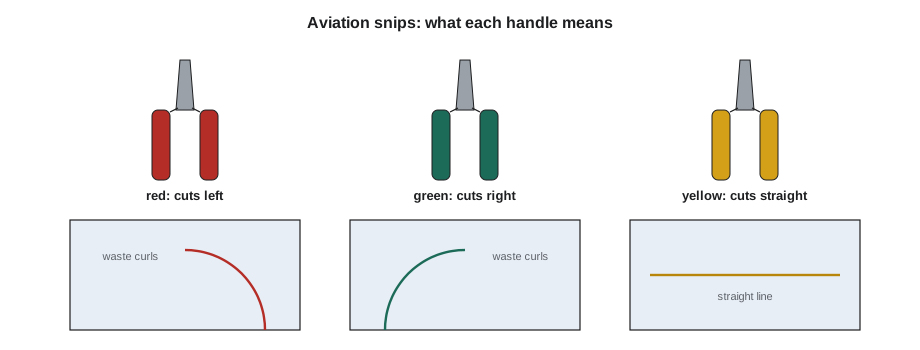
Compound-lever snips, usually called aviation snips, multiply the hand's force through a linkage and are the everyday snips of the trade. They come in three versions, color-coded on the handles by a convention most makers follow. Red-handled snips cut to the left: they cut curves that turn left and straight lines where the waste curls away to the left. Green-handled snips cut to the right. Yellow-handled snips cut straight and gentle curves either way. A worker cutting a circle uses whichever snip lets the waste curl away from the hand and the good piece lie flat. Offset aviation snips have their jaws angled so the hand stays above the sheet, which makes long cuts in a full sheet much easier.
Tin snips, the older straight-blade design without compound levers, cut long straight lines in light material with a long blade stroke, and heavy-pattern tin snips, sometimes called bulldog snips, cut thicker material close to the hinge. Double-cut snips remove a narrow strip as they cut, so the sheet on both sides stays flat; they are used for cutting into the side of a finished duct or fitting, such as for a branch tap, where ordinary snips would bend the edges. Hole snips cut tight circles.
Every snip has a capacity, usually printed on the tool or its packaging. A common rating for good aviation snips is about 18-gauge mild steel and about 24-gauge stainless steel. Stainless is stronger and work-hardens, so it needs much more force for the same thickness. Cutting beyond the rating springs the jaws apart, so the blades no longer meet, and the snip then folds the metal instead of cutting it.
A few techniques make snip work clean and safe. Cut on the waste side of the line so the line remains visible and the finished piece is the right size. Do not close the jaws completely at the end of each stroke; stopping just short of the tips leaves a smooth edge instead of a small notch at each bite. For an inside corner, make a relief cut or drill a small hole at the corner first so the snip does not tear past it. Keep the free hand well away from the jaw and the sharp edge that the cut is making. And wear gloves: a snipped edge is sharper than a sheared one.
Hand seamers and pliers
Hand seamers, also called hand tongs, have wide flat jaws, often 3 to 6 in wide, for bending and flattening edges by hand. They are used for small flanges, hems, tabs and adjustments on site where a brake is not available, such as turning up the edge of a flashing or closing a lock seam at a corner. Duckbill or offset seamers reach into tight places. Locking pliers with wide jaws, sometimes called sheet metal clamps, hold pieces together for drilling, riveting or screwing and hold a straightedge to a sheet for scribing.
Crimpers make a ring of small corrugations around the end of a piece of round duct or pipe, so that it slides inside the next piece in the direction of airflow. Hand crimpers are used on site; the shop has a machine for long runs. The crimped end always points downstream, so air flows over the joint rather than catching on it, a detail SMW-130 returns to.
Hammers, mallets and stakes
Sheet metal workers use several hammers, each with a different job. A setting hammer has a square flat face and a tapered peen and is used to close and set seams and to form edges. A riveting hammer is similar but lighter, for setting rivets. A ball peen hammer is a general machinist's hammer for punching, forming and peening. Mallets of rawhide, plastic or wood form metal without marking it, which matters on stainless, copper and pre-painted work, and soft-faced dead-blow mallets do not bounce. A hammer is used with its face flat to the work: a blow with the edge of the face leaves a crescent-shaped mark that cannot be removed.
Stakes are anvils of particular shapes that fit into a stake plate or a bench hole. The work is held over the stake and formed against it with a mallet or hammer. A hatchet stake has a sharp straight edge for bending and folding. A blowhorn stake, with a tapered horn at each end, forms cones and funnels. A beakhorn stake has a round horn and a square end. A hollow mandrel stake supports seams on round work. A conductor stake forms small cylinders such as downspouts. Many of these shapes are now done by machines, but the stakes are still used for repairs, short runs and the architectural and heritage work where hand forming gives the best result. Aggie's favorite was a battered blowhorn stake that had come to Keelson with the founder.
Hammering is loud and sends vibration through the arms, so hearing protection stays on and gloves with some padding help on long jobs. Check that hammer heads are tight on their handles and that faces are not chipped; a chipped face can throw a fragment, and safety glasses are always worn.
Punches and notchers
Hand lever punches cut clean round holes in sheet for screws, rivets and wiring. The operator places a matching punch and die in the tool, sets the punch point on a center punch mark and squeezes the handles. The punch shears a slug out of the sheet. Compared with drilling, a punched hole is cleaner, has no burr spiral and no chips, and the tool is quick to use, but every punch has a capacity in thickness and hole size. Solid punches and hollow punches, struck with a hammer, make holes in soft materials and gaskets.
The force needed to punch a hole is the area being sheared, the hole's circumference times the thickness, multiplied by the shear strength of the material. That is why a punch that easily makes a hole in light galvanized steel struggles with stainless of the same thickness, and why a bigger hole needs more force than a small one. The script works out the force for a few holes and compares it with a hand punch's rated capacity.
# Force to punch a round hole: circumference x thickness x shear strength
import math
shear_strength = {  # approximate ultimate shear strength
    "galvanized mild steel": 45000, "aluminum 3003-H14": 14500, "stainless 304": 75000}
capacity = 2000    # lbf                       # rated force of the hand lever punch
jobs = [("galvanized mild steel", 0.25, 0.0336), ("galvanized mild steel", 0.3125, 0.0516), ("aluminum 3003-H14", 0.3125, 0.0508), ("stainless 304", 0.3125, 0.0438)]                          # (material, hole diameter, thickness)
for mat, d, t in jobs:
    force = math.pi * d * t * shear_strength[mat] # psi x in^2 = lbf
    ok = "within capacity" if force <= capacity else "too much for this punch: drill or use the shop punch"
print(f"{mat:22s} {d} in hole in {t} in: {force:5.0f} lbf {ok}")galvanized mild steel 0.25 in hole in 0.0336 in: 1188 lbf within capacity galvanized mild steel 0.3125 in hole in 0.0516 in: 2280 lbf too much for this punch: drill or use the shop punch aluminum 3003-H14 0.3125 in hole in 0.0508 in: 723 lbf within capacity stainless 304 0.3125 in hole in 0.0438 in: 3225 lbf too much for this punch: drill or use the shop punch
The stainless hole needed more force than the galvanized hole of the same size, even though the stainless was thinner, and both of the larger steel holes were over the punch's rating. That is when a worker drills the hole, steps it up with a step drill, or takes the part to the shop's machine punch.
Hand notchers cut a V or a square notch from the edge of a sheet in one squeeze, for corners where a flange is bent up. They save time on repetitive small parts, and they make cleaner notches than snips. Larger notching is done on the shop's power notcher in Lesson 8.
Files, deburring tools and the rest of the kit
Cut and punched edges have burrs, small raised lips of metal that cut hands and stop parts fitting. A deburring tool with a swivelling blade runs along an edge or around a hole and shaves the burr off. A fine-cut flat file does the same on edges, and a half-round file reaches inside curves. Files cut on the push stroke only and are lifted on the return; dragging them backward dulls them. They are always used with a handle, because a bare tang can be driven into the palm.
The rest of a first-year kit is practical: a 16 ft tape, a steel rule and combination square, a scriber and punches, a set of aviation snips in all three directions, hand seamers, a setting hammer and mallet, a cordless drill and driver with bits, nut drivers in the common sizes, a utility knife, a pencil and fine markers, a level, and a sturdy tool bag. Gloves, glasses and hearing protection are part of the kit, not optional extras.
| Tool | Main use | Watch out for |
|---|---|---|
| Aviation snips (red, green, yellow) | Everyday cutting of curves and lines | Capacity, especially in stainless; keep the free hand clear |
| Double-cut snips | Cutting into finished duct without distorting it | The narrow strip they remove is very sharp |
| Hand seamers | Bending and flattening small edges | Pinching fingers between jaws and work |
| Setting hammer and mallets | Closing seams, forming edges | Edge-of-face marks; loose heads |
| Stakes | Forming against a shaped anvil | Secure the stake before hammering |
| Hand lever punch | Clean round holes | Rated thickness and hole size |
| Files and deburring tool | Removing burrs and sharp edges | Use a handle; cut on the push stroke |
Looking after hand tools
Hand tools last decades if they are looked after and fail quickly if they are not. Snips are kept clean, the pivot bolt is adjusted so the blades meet without play, and a drop of oil goes on the pivot now and then. Snips are never used to cut wire, nails or hardened steel, which nick the blades, and they are never used as a pry bar. Hammer faces are kept smooth and free of rust, because any mark on the face transfers to every piece it strikes. Stakes are kept polished and are not hit with steel hammers directly, which dents them. Files are stored so they do not knock against each other.
A worn or damaged tool is a safety problem as well as a quality problem. Snips that do not close cleanly need more force, and the hand slips. A mushroomed punch head sends chips flying. A cracked hammer handle breaks. Keelson's rule was simple: a damaged tool is tagged and taken out of use, and the apprentice tells Walt the same day.
At the end of the week, Kai bought his first pair of offset aviation snips, a green-handled right cut. Aggie told him to buy the red pair next week and to learn to use both hands.
Common mistakes
MistakeUsing a right-cut snip for a left-turning curve.
InsteadChoose the snip whose waste side matches the direction of the cut, so the good piece stays flat.
MistakeCutting stainless steel at the rated thickness for mild steel.
InsteadStainless needs much more force; check the stainless rating, which is much lower.
MistakeClosing snip jaws fully at each stroke.
InsteadStop just short of the tips to avoid notching the edge.
MistakeStriking with the edge of a hammer face.
InsteadStrike with the face flat to the work; edge blows leave marks that cannot be removed.
MistakeUsing a file without a handle.
InsteadFit a handle; a bare tang can be driven into the hand.
Summary and key terms
- Aviation snips are color-coded: red cuts left, green cuts right, yellow cuts straight.
- Every snip and punch has a capacity that is much lower in stainless steel than in mild steel.
- Hand seamers bend and flatten small edges; crimpers prepare round duct ends, which point downstream.
- Setting hammers, mallets and stakes form and set metal; strike with the face flat.
- Punch force is circumference times thickness times shear strength.
- Deburr every edge people will touch, and take damaged tools out of use the same day.
- Aviation snips
- Compound-lever snips, color-coded by cutting direction.
- Double-cut snips
- Snips that remove a narrow strip, used to cut into finished work without distortion.
- Hand seamer
- Wide-jawed pliers for bending and flattening sheet metal edges.
- Stake
- A shaped anvil used with a hammer or mallet to form sheet metal.
- Burr
- A raised, sharp lip of metal left on a cut or punched edge.
- Shear strength
- The stress at which a material fails when cut, used to estimate cutting and punching forces.
Practice problems
Work each problem on paper first, then reveal the answer to check.
Which aviation snip color cuts a curve that turns to the right?
Show answer
Green.
What force is needed to punch a 1/4 in hole in 20-gauge (0.0396 in) mild steel with a shear strength of 45,000 psi?
Show answer
π × 0.25 × 0.0396 × 45,000 ≈ 1,400 lbf.
Why are double-cut snips used to cut a branch opening in finished duct?
Show answer
They remove a strip, leaving both edges flat instead of bent.
Which direction does the crimped end of round duct point?
Show answer
Downstream, in the direction of airflow.
Lesson quiz · 5 questions
Score 60% or more to complete this lesson.
Create a free account to save your progress, take quizzes and earn a certificate.