
SMW-110 · Lesson 3 of 12 · 18 min
Sheet metal materials and coatings
The material racks at the back of Keelson's shop look, at first, like a wall of gray sheets. Aggie spent Kai's third morning walking him along them and making him name what he saw. Galvanized steel in four thicknesses, stacked by gauge. Galvannealed steel for parts that would be painted. A rack of aluminum, bright and noticeably lighter to lift. Stainless steel in its own rack, kept separate so that steel dust from the other racks could not rust its surface, with a brushed finish on one side under a protective film. Copper sheet for the St. Brendan's Church roof, in wooden crates. Pre-painted steel coil for flashings, in a dozen colors. "You'll pick the wrong one once," Aggie said. "Make sure it's on something small."
Choosing a material means balancing several properties: how strong and stiff it is, how it resists corrosion, how easily it can be cut, bent and joined, how it looks, how much it weighs and how much it costs. This lesson describes the materials of the trade and what makes each one suitable for its jobs. The next lesson covers how their thicknesses are specified.
Carbon steel and its coatings
Most sheet metal work is done in low-carbon steel. It is strong, stiff, easy to cut and form, easy to weld and inexpensive. Its weakness is corrosion: bare steel rusts quickly in damp air. Uncoated steel, often called black iron in the trade, is used where it will be painted or protected, or where it must be welded and coatings would cause problems, such as kitchen grease duct, which must be liquid-tight and is joined by continuous welds. For almost everything else the steel is coated with zinc.
Galvanized steel is steel sheet that has passed through a bath of molten zinc. The zinc bonds to the steel and forms a coating that protects it in two ways. First, it is a barrier that keeps moisture away from the steel. Second, zinc is more reactive than steel, so where the coating is scratched or the steel is cut, the zinc around the damage corrodes first and protects the exposed steel. This sacrificial protection is why a cut edge of galvanized duct can stay sound for years indoors.
The amount of zinc is specified by the coating mass, the total on both sides of the sheet, under ASTM A653. G60 has 0.60 oz of zinc per square foot of sheet in total, and G90 has 0.90 oz/ft². Metric designations appear on imported material and some specifications: Z180 is about the same as G60, and Z275 about the same as G90. Indoor ductwork in dry spaces is usually G60 or G90, depending on the specification; G90 is used where duct is exposed to humidity or outdoors, and heavier coatings are used for harsh conditions.
Galvanneal is galvanized steel that has been heated just after the zinc bath, so that iron from the steel diffuses into the zinc and forms a dull gray zinc-iron alloy. It has less zinc than ordinary galvanized steel, but paint sticks to it much better, so it is used for parts that will be painted, such as grilles, equipment cabinets and some architectural work. Aluminum-zinc coated steel, sold under trade names and specified under ASTM A792, has a coating of about 55 % aluminum and 45 % zinc. It resists corrosion in the weather better than zinc alone and is common for metal roofing and cladding. Pre-painted steel has a factory-applied paint system over a metallic coating and comes in color-matched coils for flashings, trims and roofing.
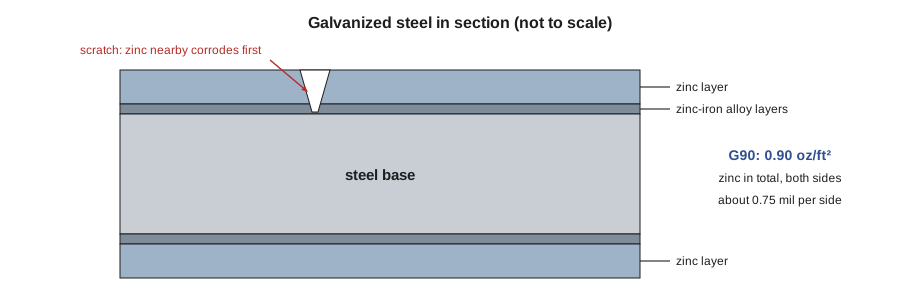
Kai asked how thick the zinc actually was. Aggie gave him the arithmetic: divide the total mass by two for one side, then divide by the density of zinc, about 7.1 grams per cubic centimeter. The script does the conversion for the common coatings.
# Zinc coating thickness per side from the coating designation
zinc_density = 7.14                 # g/cm^3
coatings = {"G60": 0.60 * 305.15, "G90": 0.90 * 305.15, "G185": 1.85 * 305.15}                  # designation: total grams of zinc per square meter, both sides
for name, total_g_m2 in coatings.items():
    per_side = total_g_m2 / 2               # g/m^2 on one side
    microns = per_side / zinc_density       # 1 g/m^2 at 1 g/cm^3 is 1 micrometer
    mils = microns / 25.4
print(f"{name}: {total_g_m2 / 305.15:.2f} oz/ft^2 in total, about {mils:.2f} mil ({microns:.0f} micrometers) per side")G60: 0.60 oz/ft^2 in total, about 0.50 mil (13 micrometers) per side G90: 0.90 oz/ft^2 in total, about 0.76 mil (19 micrometers) per side G185: 1.85 oz/ft^2 in total, about 1.56 mil (40 micrometers) per side
The answer surprised Kai: about two hundredths of a millimeter, thinner than a sheet of paper. That thin layer is why galvanized sheet must not be scraped, dragged across concrete or bent around too tight a radius, which cracks the coating, and why cut and damaged areas exposed to weather are touched up with zinc-rich paint.
Aluminum
Aluminum weighs about one third as much as steel for the same thickness, does not rust and forms a thin oxide film that protects it in most environments. It is easy to cut and bend, which makes it pleasant to work, but it is also about one third as stiff as steel and has lower strength in the grades used for sheet work, so aluminum parts are often made thicker than steel parts doing the same job. Aluminum is used for duct in humid or corrosive locations such as pool enclosures and some laboratories, for architectural flashings, gutters and soffits, and for parts where weight matters.
Aluminum sheet is made in many alloys and tempers, identified by a four-digit alloy number and a temper code. Alloy 3003 in the H14 temper, a half-hard condition, is a common general-purpose choice for duct and flashing because it bends well without cracking. Alloy 5052 is stronger and resists salt air better, so it is used near the sea and on boats. Alloy 1100 is nearly pure aluminum, very soft and easy to form. Aluminum is specified by its decimal thickness rather than by gauge in most current work, a point Lesson 4 explains.
Aluminum expands with heat about twice as much as steel, and it reacts with some other metals and with wet concrete and mortar, so it must be isolated from them. Its soft surface scratches easily, and it work-hardens, so repeated bending in the same place makes it brittle until it cracks.
Stainless steel
Stainless steel is steel with at least about 10.5 % chromium, which forms a thin, invisible chromium oxide film that heals itself when scratched. That film gives stainless steel its corrosion resistance and its appearance. The common grades in sheet metal work are 304, an austenitic stainless with about 18 % chromium and 8 % nickel, used for kitchen hoods, food equipment, hospital work and many exhaust systems; and 316, which adds molybdenum for better resistance to chlorides and is used near salt water, in pools and in chemical exhaust. Grade 430, a cheaper ferritic grade without nickel, appears in some appliances and trim; it is magnetic, which 304 and 316 normally are not.
Stainless steel is harder to work than carbon steel. It is stronger, it work-hardens quickly as it is cut and bent, and it springs back more after bending. Machines rated for a given thickness of mild steel can handle only a thinner stainless sheet, which Lesson 8 shows. Its surface finish matters: a mill finish such as 2B is smooth and dull, and a No. 4 finish is brushed in one direction for visible work, so pieces must be laid out with the grain running the same way. Stainless must be kept away from carbon steel dust, steel wool and steel wire brushes, because embedded carbon steel particles rust and stain the surface. The Brine & Ember hood was being built from 304 stainless with a No. 4 finish, and Walt had a separate set of tools, brushes and a cleaned bench just for it.
Copper, zinc and other metals
Copper has been used for roofing and flashing for centuries because it lasts a very long time and is easy to form, solder and join. Roofing copper is cold-rolled to a controlled temper and is specified by its weight per square foot, an old trade measure that has stayed in use: 16-ounce copper is about 0.0216 in thick and 20-ounce copper is about 0.027 in. Over years outdoors, copper darkens to brown and then forms the green patina seen on old church roofs. The St. Brendan's roof was copper laid more than a century ago, and the restoration would use 16-ounce and 20-ounce sheet matched to the original work.
Rolled zinc, an alloy of zinc with small amounts of copper and titanium, is used for roofing and cladding in architectural work and is formed and soldered much like copper. Lead sheet is now rarely used new because of its toxicity, but sheet metal workers meet it in old roofs and flashings, and lead-coated copper on heritage buildings; handling it requires precautions against lead exposure. Brass and bronze appear in ornamental work, and titanium and nickel alloys in specialized industrial applications.
Dissimilar metals and galvanic corrosion
When two different metals touch in the presence of moisture, the more reactive one corrodes faster and the less reactive one is protected. This is galvanic corrosion, the same effect that makes zinc protect steel. It becomes a problem when the metal that corrodes is the one you care about. Aluminum flashing fastened with copper nails, or galvanized gutters below a copper roof, will corrode quickly, because water carrying copper ions runs onto the zinc and aluminum and attacks them. The galvanic series ranks metals in sea water from most reactive to least: magnesium, zinc, aluminum, carbon steel, lead, tin, brass, copper and passive stainless steel.
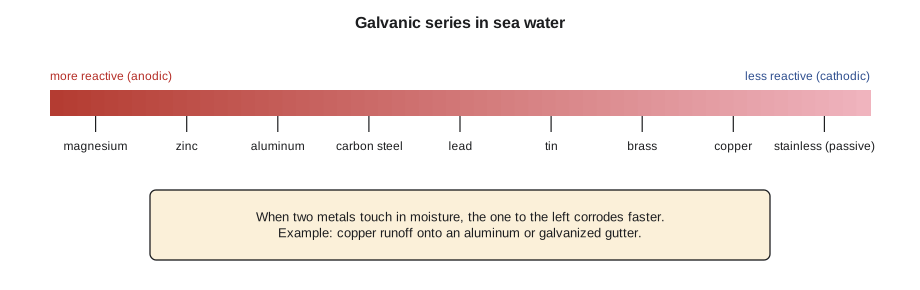
The controls are to use compatible metals together, to use fasteners of the same metal or a more noble one in small amounts, to separate dissimilar metals with non-conductive tape, membrane or coatings, and to arrange water flow so that it never runs from copper onto zinc, galvanized steel or aluminum. On the St. Brendan's job, Aggie pointed out, every fastener, cleat and solder joint in the copper roof would be copper or a copper alloy, and the old galvanized downspouts at the base of the roof would be replaced with copper for the same reason.
Thermal movement
All metals expand when they warm and contract when they cool. On ductwork indoors the movement is small, but on roofs, gutters and cladding, where the metal can swing from below freezing in winter to well above air temperature in summer sun, it is large enough to tear fasteners and buckle panels if it is not allowed for. The change in length is the coefficient of expansion times the length times the temperature change.
# Thermal movement of a gutter run in four metals
length = 20.0 * 12  # in (20 ft)            # length of the run
swing = 144  # degrees F           # temperature swing from coldest night to hottest sun on the metal
alpha = {  # coefficient of linear expansion, per degree (approximate)
    "galvanized steel": 6.7e-6, "aluminum": 12.8e-6, "copper": 9.4e-6, "zinc": 12.2e-6}
for metal, a in alpha.items():
    change = a * length * swing
print(f"{metal:16s} moves {change:5.2f} in over the run")galvanized steel moves 0.23 in over the run aluminum moves 0.44 in over the run copper moves 0.32 in over the run zinc moves 0.42 in over the run
A 20-foot aluminum gutter moves about 0.44 in between its coldest and hottest, nearly twice a steel gutter. That is why long runs of gutter, coping and roofing need expansion joints and sliding cleats, which SMW-320 covers.
| Material | Main strengths | Main limits | Typical jobs |
|---|---|---|---|
| Galvanized steel | Strong, stiff, cheap, easy to form; sacrificial zinc protection | Zinc fume when welded; coating cracks if abused | HVAC duct, fittings, hangers, general work |
| Galvanneal | Paint adheres well | Less zinc than galvanized | Painted grilles, cabinets |
| Aluminum | Light, corrosion-resistant, easy to cut and bend | Less stiff and strong; large expansion; reacts with copper and concrete | Humid-space duct, flashing, gutters |
| Stainless steel | Corrosion-resistant, hygienic, attractive | Harder to cut and bend; work-hardens; stains from steel dust | Kitchen hoods, food and hospital work, exhaust |
| Copper | Very long life, easy to form and solder | Expensive; runoff attacks zinc and aluminum | Heritage roofing, flashing, gutters |
| Black iron | Weldable without zinc fume | Rusts unless protected | Welded grease duct |
By the end of the morning, Kai could walk along the racks and name everything on them, and he had learned one trick he would use for years: a magnet. A magnet sticks to carbon steel and to 430 stainless, but not to aluminum, copper or the usual 304 and 316 stainless, so it settles most arguments about what a scrap is made of.
Common mistakes
MistakeFastening aluminum or galvanized flashing with copper fasteners, or letting copper runoff reach zinc or aluminum.
InsteadUse compatible metals, separate dissimilar ones and route water away from less noble metals.
MistakeUsing a steel wire brush or steel wool on stainless steel.
InsteadUse stainless or non-metallic tools; embedded steel particles rust and stain the surface.
MistakeAssuming the zinc on galvanized steel is thick enough to survive scraping.
InsteadThe coating is only about 20 micrometers per side; handle sheets carefully and touch up damage.
MistakeTreating aluminum as a lighter steel.
InsteadAluminum is about one third as stiff and expands about twice as much; parts are often thicker.
MistakeIgnoring the grain of brushed stainless when laying out parts.
InsteadLay out visible parts with the grain running the same way.
Summary and key terms
- Galvanized steel is specified by total coating mass: G60 and G90, or Z180 and Z275 in metric.
- Zinc protects steel as a barrier and by sacrificial action at cuts and scratches.
- Galvanneal takes paint well; aluminum-zinc coated steel is common for roofing and cladding.
- Aluminum is light and corrosion-resistant but less stiff and has high thermal expansion.
- Stainless steel grades 304 and 316 resist corrosion through a chromium oxide film and are harder to work than carbon steel.
- Galvanic corrosion attacks the more reactive of two metals joined in moisture; copper runoff must not reach zinc, galvanized steel or aluminum.
- Galvanized steel
- Steel sheet coated with zinc by dipping in molten zinc.
- Coating mass
- The total mass of zinc per unit area on both sides of the sheet.
- Galvanneal
- Galvanized steel heat-treated to form a zinc-iron alloy coating that takes paint well.
- Sacrificial protection
- Protection of steel by a more reactive metal, such as zinc, that corrodes first.
- Galvanic corrosion
- Accelerated corrosion of the more reactive of two dissimilar metals in electrical contact in moisture.
- Work hardening
- The increase in hardness and loss of ductility when a metal is bent or cut repeatedly.
Practice problems
Work each problem on paper first, then reveal the answer to check.
What is the approximate metric equivalent of G90?
Show answer
Z275.
Why is grease duct often made of uncoated steel?
Show answer
It is joined by continuous welds, and zinc coatings cause fume and weld problems.
Which stainless grade is preferred near salt water, and why?
Show answer
316, because its molybdenum improves resistance to chlorides.
A 20 ft copper gutter sees a 144 °F swing. About how much does it move?
Show answer
About 0.32 in (9.4 × 10⁻⁶ × 240 in × 144).
Lesson quiz · 5 questions
Score 60% or more to complete this lesson.
Create a free account to save your progress, take quizzes and earn a certificate.