
SMW-110 · Lesson 11 of 12 · 18 min
Fasteners, sealants and adhesives
The Ashgrove ductwork needed more than duct. On the morning the first load went out, Kai helped Walt pull the rest of the order from the stores cage: boxes of hex-head screws, bags of blind rivets, pails of duct sealant, rolls of foil tape, gasket tape for the flanged joints, insulation pins and adhesive for the lined sections, and a case of caulking tubes for the rooftop curbs. "Half the leaks on a job are in the stuff in these boxes," Walt said, "and the other half are in how people use it." This lesson covers the fasteners, sealants and adhesives of the trade and how they are chosen and used. The seams and joints they help to make are covered in SMW-130.
Sheet metal screws
Most screws used in ductwork are self-drilling screws with a hex washer head. The tip is a small drill point that cuts its own hole; the thread then taps into the hole and pulls the sheets together; the hex head takes a nut setter on a driver; and the built-in washer spreads the load on the thin sheet. Self-tapping screws, with a sharp point instead of a drill tip, need a pilot hole or a punched hole in heavier material but pierce light sheet on their own. Pan-head and other head styles are used where a hex head would be in the way, and screws with painted heads or sealing washers are used on visible architectural work and roofing.
Screws are sized by a screw number for the thread diameter and by their length. The common sizes in duct work are #8 and #10 in lengths of 1/2 in and 3/4 in. A higher screw number is a larger screw, the opposite of a sheet gauge. The drill point has a capacity, the total thickness of metal it can drill through before its point is used up, which is printed on the box.
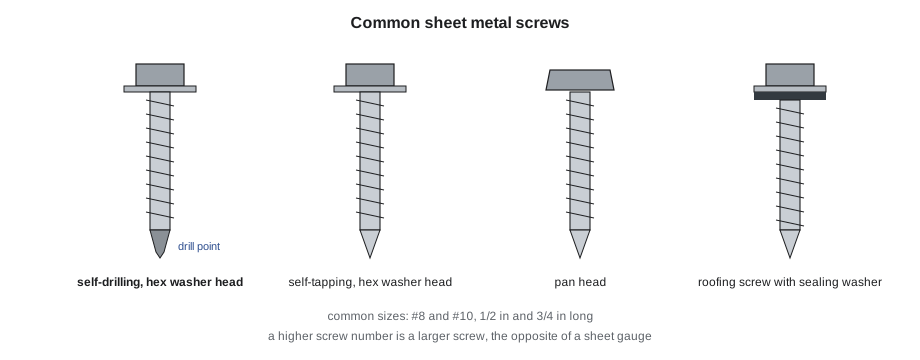
Screws have to suit the metal they go into. Zinc-plated carbon steel screws are used in galvanized steel indoors. Stainless steel screws are used in stainless and aluminum work and in corrosive locations. Copper and aluminum roofing take fasteners of compatible metals, as Lesson 3 explained. A screw's length matters too: the point should pass through the joint far enough that the full thread engages, but screws that stick far into the airstream catch lint and dust inside duct and can cut a worker's hand reaching in later. Screws in duct that carries grease, as at Brine & Ember, are a different matter altogether, because grease ducts must be liquid-tight and are welded; SMW-410 covers them.
Rivets
Blind rivets, often called pop rivets, are set from one side of the work, which makes them useful where the back of a joint cannot be reached. The rivet is a hollow body on a mandrel. It is pushed through a hole drilled or punched to match its diameter, and a hand or power rivet tool pulls the mandrel, which expands the rivet body on the far side until the mandrel breaks off. The finished rivet clamps the sheets between its head and the expanded tail.
Blind rivets are sized by body diameter and by grip range, the total thickness of the sheets they will clamp. Common diameters are 1/8, 5/32 and 3/16 in, roughly 3.2, 4.0 and 4.8 mm, and boxes often show them as 4, 5 and 6, meaning the diameter in thirty-seconds of an inch. The grip range is given by a second number or a range; a rivet that is too short for the joint does not expand properly, and one that is too long buckles. The hole should be only slightly larger than the rivet. Rivets come in aluminum, steel, stainless steel and copper, and the rivet's material should suit the sheet's: aluminum rivets in aluminum, stainless in stainless, copper in copper.
Solid rivets, set by hammering with a rivet set, are used in traditional work such as the tinner's rivets in heritage copper roofing and in some heavy and watertight work. Their sizes are a trade tradition of their own, sold by weight per thousand rivets, and SMW-130 explains how they are set.
Bolts, threaded rod and other hardware
Bolts with nuts and washers join heavier parts, such as angle-iron frames, duct flanges with corner pieces, equipment curbs and hood supports. Flanged duct joints use bolts at the corners and clips or cleats along the sides. Threaded rod and channel strut are the backbone of hanger systems in the field, with beam clamps, concrete anchors and other attachments that SMW-310 covers. In the shop, Kai's job was mostly to know what was in which bin and to choose plated hardware for galvanized work and stainless hardware for the stainless.
Duct sealants and tapes
Sheet metal duct leaks at its seams and joints unless they are sealed, and codes and energy standards now limit how much duct may leak. The duct construction standards assign seal classes that say which seams and joints must be sealed for a given pressure, and SMW-220 and SMW-310 cover them. The materials used for the sealing are the subject here.
The most common duct sealant is a water-based mastic: a thick, fiber-reinforced paste applied with a brush, trowel or caulking gun that cures into a flexible seal. Gun-grade mastics go into joints and seams before or after assembly; brush-grade mastics are spread over the outside of a joint. For gaps wider than a few millimeters, the mastic is applied over a reinforcing fiberglass mesh tape. Solvent-based sealants cure faster and work in colder conditions but give off more fumes and are restricted in some jurisdictions for their volatile organic compounds. Gasket tapes, usually foam or butyl, go between the faces of flanged transverse joints before they are bolted. Foil-backed butyl tapes and listed foil tapes seal some joints and small repairs.
Tapes and mastics sold for ductwork are often listed to UL 181, the standard for closure systems on factory-made air ducts and connectors. UL 181A covers closures for rigid fibrous glass duct board, marked 181A-P for pressure-sensitive tape, 181A-H for heat-activated tape and 181A-M for mastic. UL 181B covers flexible ducts and connectors, marked 181B-FX for tape, 181B-C for clamps and 181B-M for mastic. Materials used inside plenums and ducts must also meet the flame spread and smoke developed limits that the mechanical and building codes set, tested under UL 723 or ASTM E84; the usual requirement is a flame spread index of no more than 25 and a smoke developed index of no more than 50.
Ordinary cloth-backed duct tape, despite its name, is not a duct sealant: its adhesive dries out and lets go within a few years, especially on warm duct, and it is not listed for the purpose. Walt's shop does not stock it.
Sealant only works if it is applied properly. The surfaces must be clean, dry and free of oil; galvanized sheet often has a light oil from the mill that is wiped off at joints. The temperature must be within the product's range, which matters in an unheated building in winter. The sealant must be applied in the amount the maker specifies, worked into the joint rather than smeared over it, and given time to cure before the duct is pressure-tested or put into service.
Estimating sealant is arithmetic. The volume needed is the length of joint times the cross-section of the bead or the coating thickness times its width, plus waste. The script estimates the mastic for the Ashgrove supply duct joints and the number of caulking tubes and pails it takes.
# Estimate duct mastic for a set of joints
joints = [("transverse joints, 24 x 16 duct", 40, 80), ("transverse joints, 16 x 12 duct", 64, 56), ("branch taps", 24, 40)]  # in          # (description, number of joints, perimeter of each joint)
bead_width, bead_thick = 3.0, 0.06   # in (3 in band, 1/16 in wet)     # brush-applied band over each joint
waste = 1.15                # allow 15 % for waste and laps
total_len = sum(n * p for _, n, p in joints)
volume = total_len * bead_width * bead_thick * waste / 231    # in^3 to US gallons
print(f"joint length {total_len:.1f} in, mastic needed about {volume:.2f} gal")
tube, pail = 0.08, 3.5   # gallons per tube and per pail
print(f"that is about {volume / tube:.0f} caulking tubes, or {volume / pail:.1f} pails")joint length 7744.0 in, mastic needed about 6.94 gal that is about 87 caulking tubes, or 2.0 pails
The estimate came to about 6.9 gallons, roughly two pails. Walt sent three, because the field crew would also seal the longitudinal seams on the larger duct, which the estimate had not included.
Architectural sealants
Architectural sheet metal relies mainly on its design to shed water, with laps, cleats, hems and standing seams, and sealant is a second line of defense rather than the first. Where sealant is used, it is a durable elastomer chosen for the metals and exposure: silicone, polyurethane or a hybrid polymer for joints that move, and butyl tape for laps that are concealed. Sealant joints are designed with a width the sealant can stretch across as the metal moves, and with a backer rod so the sealant bonds to two sides only. On copper roofs such as St. Brendan's, joints are soldered instead, which SMW-130 and SMW-320 cover.
Adhesives
Adhesives in a sheet metal shop mainly fix things to sheet metal rather than metal to metal. Duct liner, the acoustic and thermal insulation glued to the inside of some ducts, is fixed with a listed liner adhesive and mechanical fasteners such as weld pins or adhesive-backed pins, at spacings the duct liner standard sets. Contact adhesives fix gaskets and seals. Structural adhesives and two-part epoxies bond panels and stiffeners in some architectural and specialty work, and construction adhesives fix trims. Every adhesive has its own surface preparation, open time, temperature range and cure time, set out in its data sheet, and many give off solvent vapors that need ventilation and keep sparks away.
| Material | Main use | Key point |
|---|---|---|
| Self-drilling hex washer head screws | Joining duct sheets and fittings | Drill point capacity; match the metal; length |
| Blind rivets | Joints reached from one side | Diameter and grip range; match the metal |
| Water-based duct mastic | Sealing seams and joints | Clean, dry, in range; mesh over gaps; cure before testing |
| Gasket tape | Flanged transverse joints | Continuous, at corners too |
| Listed foil tape | Some joints and repairs | Check the listing; clean surface; press firmly |
| Elastomeric sealant | Architectural joints that move | Joint width, backer rod, compatible with the metal |
| Liner adhesive and pins | Fixing duct liner | Listed product and pin spacing |
Kai's job for the rest of the week was in the shop, applying gun-grade sealant into the Pittsburgh seams of the large Ashgrove sections before the seams were closed. Aggie showed him how much to use, a continuous bead into the pocket, not a smear on the outside, and checked his first ten sections. On the tenth she found a gap where the bead had skipped. "That's your leak," she said. "Now you know what one looks like."
Storing and handling the materials
Sealants, adhesives and tapes have shelf lives and storage conditions, and the stores cage is where many field failures start. Water-based mastics must not freeze, so pails are kept in the heated part of the shop through the winter and are not left overnight in an unheated truck. Solvent-based products are kept in a ventilated flammables cabinet. Tapes lose their tack if they are stored hot or dusty. Every product has a date on it, and the oldest stock is used first. Screws and rivets are kept in labeled bins by size, material and length, and loose fasteners swept up from the floor go into a mixed tray rather than back into a labeled bin, because one wrong screw in a box of stainless screws can start a rust stain on a hood. Walt's rule for the cage was the same as for the material racks: if you take the last of something, write it on the reorder board before you leave.
Each product has a safety data sheet. Kai found that the duct mastic the shop used was low in volatile compounds and safe to use indoors with ordinary ventilation, while the solvent cleaner used to wipe stainless before sealing needed gloves and good ventilation and kept away from sparks.
Common mistakes
MistakeUsing cloth duct tape to seal ductwork.
InsteadUse listed mastics and tapes; cloth duct tape fails within a few years.
MistakeApplying mastic to oily or wet metal or in cold conditions.
InsteadClean and dry the surface and stay within the product's temperature range.
MistakeChoosing aluminum rivets for copper or galvanized work.
InsteadMatch fastener metal to the sheet to avoid galvanic corrosion.
MistakeUsing screws so long that they project far into the airstream.
InsteadChoose a length that engages the full thread without leaving long points inside the duct.
MistakePressure-testing duct before the sealant has cured.
InsteadAllow the cure time on the product data sheet.
Summary and key terms
- Self-drilling hex washer head screws in sizes 8 and 10 are the everyday duct fastener; a higher screw number is a larger screw.
- Blind rivets are sized by diameter and grip range and should match the sheet's metal.
- Duct seams and joints are sealed with mastics, gasket tapes and listed tapes to meet the seal class.
- UL 181A and 181B listings mark closure materials for duct board and flexible duct; plenum materials must meet a 25 flame spread and 50 smoke developed index under UL 723 or ASTM E84.
- Sealants need clean, dry surfaces, the right temperature, the right amount and full cure.
- Architectural work sheds water by design; sealant and adhesives are chosen for the metal and exposure.
- Self-drilling screw
- A screw with a drill-point tip that drills its own hole and taps its thread.
- Blind rivet
- A rivet set from one side by pulling a mandrel that expands the far side.
- Grip range
- The range of total material thickness a rivet is designed to clamp.
- Duct mastic
- A thick sealant used to seal duct seams and joints.
- Seal class
- A classification of which duct seams and joints must be sealed for a given pressure.
- Flame spread rating
- A measure of how quickly flame spreads over a material in a standard test.
Practice problems
Work each problem on paper first, then reveal the answer to check.
Which is the larger screw: a #8 or a #10?
Show answer
A #10.
A box of blind rivets is marked 4-3. What is the rivet diameter?
Show answer
4/32 in, or 1/8 in; the second number refers to the grip range.
How much mastic does 1,200 in of joint need with a 3 in band 1/16 in thick, plus 15 % waste?
Show answer
1,200 × 3 × 0.0625 × 1.15 ÷ 231 ≈ 1.12 gal.
Why is ordinary cloth duct tape not used to seal duct?
Show answer
Its adhesive fails within a few years and it is not listed for the purpose.
Lesson quiz · 5 questions
Score 60% or more to complete this lesson.
Create a free account to save your progress, take quizzes and earn a certificate.