
SMW-110 · Lesson 4 of 12 · 19 min
Gauges, thickness and weight
Walt handed Kai a work order for twelve straight sections of duct for the Ashgrove Elementary job and told him to pull the material. The order said 24 ga galvanized for the smaller sizes and 22 ga for the larger ones. Kai went to the rack and stopped, because both stacks looked identical. Aggie handed him a small steel disc with notched slots around its edge. "Gauge wheel," she said. "Try the slots until one fits snugly. And remember the strange part: the bigger the number, the thinner the sheet."
This lesson explains how sheet thickness is specified, why the gauge system works the way it does, how to measure thickness, and how to work out the weight of sheet and parts, which matters for lifting, shipping, hangers and the estimate.
What a gauge number means
Sheet metal thickness has traditionally been given by a gauge number rather than a dimension. The system grew out of nineteenth-century wire and sheet manufacturing, where the number related to the number of drawing or rolling passes, so a higher gauge meant more passes and thinner material. The relationship is not linear, and, more confusingly, different materials use different gauge tables. A 24-gauge galvanized sheet, a 24-gauge uncoated steel sheet and a 24-gauge aluminum sheet are three different thicknesses.
For carbon steel, the table in common use is the Manufacturers' Standard Gauge, which is based on weight per square foot rather than thickness. Galvanized sheet has its own gauge table that adds the zinc coating to the base steel, so a galvanized sheet of a given gauge is slightly thicker than an uncoated one. Stainless steel uses a table close to the steel tables but not identical. Aluminum, when a gauge is given, follows the Brown and Sharpe or American Wire Gauge series, which runs much thinner for the same number. Copper is usually specified by weight in ounces per square foot, as Lesson 3 described.
Because of that confusion, many specifications and duct construction tables give the decimal thickness in inches beside the gauge, and some give the metric thickness as well. Aluminum is ordered by decimal thickness, such as 0.032 in or 0.040 in, almost everywhere, and stainless steel is often specified the same way.
| Gauge | Galvanized steel | Uncoated steel | Aluminum (Brown and Sharpe) | Typical use in the shop |
|---|---|---|---|---|
| 26 | 0.0217 in | 0.0179 in | 0.0159 in | Small round duct, light flashing |
| 24 | 0.0276 in | 0.0239 in | 0.0201 in | Smaller rectangular duct, fittings, flashing |
| 22 | 0.0336 in | 0.0299 in | 0.0253 in | Medium rectangular duct |
| 20 | 0.0396 in | 0.0359 in | 0.0320 in | Larger duct, plenums, casings |
| 18 | 0.0516 in | 0.0478 in | 0.0403 in | Large duct, equipment curbs, hoods |
| 16 | 0.0635 in | 0.0598 in | 0.0508 in | Heavy plenums, grease duct, brackets |
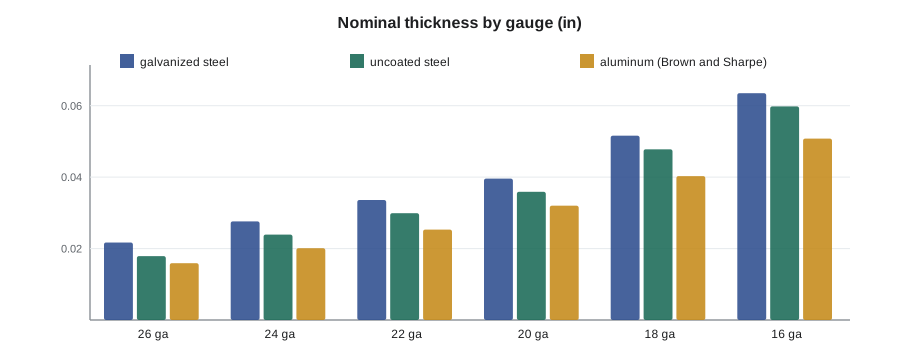
Two features of the table are worth learning early. First, each gauge step is not the same size: the step from 26 to 24 gauge adds about 0.006 in, while the step from 18 to 16 adds about 0.012 in. Second, the even gauges from 26 to 16 are the ones a duct shop uses almost every day, and their galvanized thicknesses are worth memorizing in the units used on the drawings.
Measuring thickness
There are three common ways to check thickness in the shop. A sheet metal gauge wheel, the tool Aggie handed Kai, has precisely sized slots for each gauge; the sheet edge is slid into the slots until one fits snugly without forcing. It is quick but only as good as the wheel's table, so a shop keeps separate wheels for steel and for aluminum. A micrometer measures thickness directly to 0.001 in or better and is the right tool when a thickness is disputed. Digital calipers are handy and accurate enough for most checks if the jaws are clean and square to the sheet.
Whichever tool is used, measure away from the sheared edge, where the shear can roll or burr the metal, and measure the sheet itself rather than the packaging label. Coated sheet includes the coating in the measured thickness, and painted coil includes the paint, so pre-painted material measures thicker than its base metal.
Real sheet is not exactly its nominal thickness. Mill standards allow a tolerance above and below the nominal value that depends on the thickness and width of the sheet. A sheet that measures a little under nominal is not necessarily wrong, but a sheet that measures closer to the next gauge than to its own has probably been mislabeled or put in the wrong rack. Kai's twelve duct sections were worth the two minutes it took to check, because a section made from the wrong gauge would either fail a pressure class requirement or waste money on heavier metal than the job needed.
Worked problem
Which gauge is it?
Kai measures an unlabeled galvanized sheet with a micrometer at three points away from the edge and gets 0.0331, 0.0338 and 0.0335 in. Which gauge is it?
Show solution
- \[\bar{t} = \frac{0.0331 + 0.0338 + 0.0335}{3} = 0.0335\ \text{in}\]
- Compare with the galvanized table: 22 gauge is 0.0336 in; 24 gauge is 0.0276 in and 20 gauge is 0.0396 in.
Answer: The sheet is 22-gauge galvanized steel.
Weight of sheet and parts
Weight matters more than apprentices expect. It sets how many sheets one person can safely carry, how many duct sections fit on a truck, what hangers a run of duct needs, and a large part of the material cost of a job. The weight of a flat piece is its area times its thickness times the density of the metal.
For steel, with a density of about 490 lb/ft³, every inch of thickness weighs about 40.8 lb per square foot. Galvanized sheet tables usually give the weight directly: 24-gauge galvanized weighs about 1.156 lb/ft², 22-gauge about 1.406 and 20-gauge about 1.656, because the galvanized gauges were originally defined in steps of weight. Aluminum weighs a little over a third as much as steel of the same thickness, stainless steel about the same, and copper about 14 % more.
The script looks up the galvanized gauge, then works out the weight of a full sheet and of Kai's twelve duct sections, each formed from a blank of the size given.
# Gauge lookup and weight of sheet and parts (galvanized steel)
galv = {26: (0.0217, 0.55), 24: (0.0276, 0.70), 22: (0.0336, 0.85), 20: (0.0396, 1.00), 18: (0.0516, 1.31), 16: (0.0635, 1.61)}
density = 490 * 1.02     # lb/ft^3, plus about 2 % for the zinc
def thickness(gauge):
    return galv[gauge][0]
sheet_w, sheet_l = 4.0, 8.0          # ft
for g in (24, 22, 20):
    t = thickness(g)
    w = sheet_w * sheet_l * t / 12 * density
    print(f"{g} ga galvanized: {t} in thick, full sheet weighs about {w:.1f} lb")
blank_w, blank_l, count, gauge = 4.0, 5.0, 12, 24   # ft, ft, pieces, gauge
t = thickness(gauge)
each = blank_w * blank_l * t / 12 * density
print(f"{count} duct sections at {gauge} ga: about {each:.1f} lb each, {each * count:.0f} lb in total")24 ga galvanized: 0.0276 in thick, full sheet weighs about 36.8 lb 22 ga galvanized: 0.0336 in thick, full sheet weighs about 44.8 lb 20 ga galvanized: 0.0396 in thick, full sheet weighs about 52.8 lb 12 duct sections at 24 ga: about 23.0 lb each, 276 lb in total
A full 24-gauge sheet weighs about 37 lb and a 20-gauge sheet about 53 lb. The twelve sections came to about 280 lb, which was why Walt had them loaded on a cart rather than carried to the truck.
The weight of duct also drives its supports. Hanger spacing and size depend on the weight per unit length of the duct, its insulation and anything inside it. SMW-310 covers hanger selection, but the arithmetic always starts here: the developed perimeter of the duct, times its thickness, times the density.
Choosing a gauge
Apprentices do not choose gauges for ductwork; the specification, the duct construction standards and the shop drawings do. But it helps to know what drives the choice. For rectangular duct, the gauge depends on the duct's largest dimension, the pressure class it must withstand and the reinforcement used, and the duct construction tables that SMW-220 covers trade gauge against reinforcement spacing. For round duct, the gauge depends on the diameter and the pressure. For architectural work, it depends on the span between supports, the exposure to wind and the appearance required, since thin sheet shows waves and dents. Codes set minimum thicknesses for some kinds of work, such as kitchen grease duct, hood construction and fire damper sleeves.
Two practical rules follow. Never substitute a lighter gauge than the work order says, even if the rack is empty, because the lighter duct may fail its pressure test or sag between hangers. And do not substitute a heavier gauge without asking, because heavier material costs more, weighs more, may not fit the machines' settings for the job and may not form the same way in the locks and seams. In either case the right answer is to ask the shop foreman.
By the end of the day, Kai had pulled the right sheets, checked each stack with the gauge wheel and the micrometer, and found one sheet in the 22-gauge stack that was actually 24 gauge. Walt moved it back to the right rack and wrote on the whiteboard: "Check the sheet, not the label."
Reading thickness on drawings and work orders
Thickness information reaches the shop in several forms, and an apprentice has to read all of them. On Keelson's shop drawings for Ashgrove, every duct section carried a tag such as 24 × 16 – 24 ga – TDC, meaning a 24 by 16 inch duct in 24-gauge galvanized steel with a transverse duct connector at each end. The duct construction table on the drawing's cover sheet listed each size range with its gauge, its joint type and its reinforcement. Architectural drawings for the church gave the copper by weight, such as 16 oz, and the flashings by decimal thickness. The work orders Walt printed for the shop repeated the gauge and added the decimal thickness, because the specification for the hospital job gave thickness in decimals only.
When two documents disagree, such as a shop drawing that says one thickness and a specification that says another, the apprentice does not choose. The question goes to the shop foreman, who checks with the detailer or the project manager. The document that governs is set by the contract, not by whichever is easiest to read.
Other numbers that look like gauges
Sheet metal workers meet several other numbering systems that resemble sheet gauges and are easily confused with them. Hanger wire and tie wire are sized by a wire gauge, in which a higher number is also a thinner wire, but the table is different again. Sheet metal screws are sized by a screw number, such as a number 8 or number 10, in which a higher number is a larger screw, the opposite of sheet gauges. Rivets are sized by the diameter in thirty-seconds of an inch on many boxes, so a 4-size rivet is 1/8 inch. And copper is sized by weight. Lesson 11 returns to screws and rivets. The rule for all of them is the same as for sheet: when in doubt, measure, and read the full description on the box rather than guessing from a number.
Aggie kept a laminated card in her pocket with the galvanized table on one side and the screw and rivet sizes on the other. Kai copied it into the back of his logbook that evening and had the common gauges memorized within a month, which was about how long it took before he stopped reaching for the gauge wheel on every sheet.
Common mistakes
MistakeAssuming a higher gauge number means a thicker sheet.
InsteadHigher gauge numbers mean thinner sheet.
MistakeUsing the steel gauge table for aluminum.
InsteadAluminum gauges follow a different table and run thinner; order aluminum by decimal thickness.
MistakeMeasuring thickness at the sheared edge.
InsteadMeasure away from the edge, where shearing can roll or burr the metal.
MistakeSubstituting a lighter gauge because the right one is out of stock.
InsteadNever go lighter than specified; ask the shop foreman.
MistakeForgetting the coating or paint when comparing measured thickness with base metal tables.
InsteadGalvanized and painted material measures thicker than the base steel.
Summary and key terms
- Thickness is given by gauge, usually with the decimal thickness in inches.
- Galvanized, uncoated steel, stainless steel and aluminum each have their own gauge table.
- Common galvanized thicknesses: 26 ga 0.0217 in, 24 ga 0.0276 in, 22 ga 0.0336 in, 20 ga 0.0396 in, 18 ga 0.0516 in, 16 ga 0.0635 in.
- Gauge wheels, micrometers and calipers measure thickness; measure away from the edge.
- Steel weighs about 40.8 lb/ft² per inch of thickness; aluminum a little over a third as much.
- The specification, duct standards and shop drawings set the gauge; never substitute a lighter one.
- Gauge
- A number that indicates sheet thickness; higher numbers are thinner, and each material has its own table.
- Manufacturers' Standard Gauge
- The gauge table used for uncoated carbon steel sheet, based on weight per unit area.
- Gauge wheel
- A notched disc used to check sheet thickness against a gauge table.
- Micrometer
- A precision instrument that measures thickness directly.
- Tolerance
- The permitted variation of a dimension, such as sheet thickness, from its nominal value.
Practice problems
Work each problem on paper first, then reveal the answer to check.
Which is thicker: 20-gauge galvanized steel or 20-gauge aluminum?
Show answer
20-gauge galvanized steel (0.0396 in against 0.0320 in).
What does a 4 ft by 8 ft sheet of 22-gauge galvanized steel weigh?
Show answer
About 32 ft² × 1.406 lb/ft² ≈ 45 lb.
A micrometer reads 0.0273, 0.0279 and 0.0276 in on a galvanized sheet. What gauge is it?
Show answer
24 gauge.
Why should you not substitute 24-gauge sheet for a 22-gauge work order?
Show answer
The duct may fail its pressure class or sag; never go lighter than specified.
Lesson quiz · 5 questions
Score 60% or more to complete this lesson.
Create a free account to save your progress, take quizzes and earn a certificate.