
SLS-257 · Lesson 8 of 12 · 21 min
Personalization
▶ Video coming soon A video version of this lesson is on the way.
On Friday, November 6, 2026, the marketing meeting began with a phone held up for everyone to see. It was Bev's own phone, showing an email from a large online retailer. "I bought a crib for my niece three weeks ago," she said, "and now every email I get from them is about baby monitors, nursing chairs and parenting books. I don't have a baby. I find it slightly creepy." Tessa laughed and then opened the results of her own first personalized email, sent on Monday, November 2, to Juniper & Pine customers who had bought a sofa without a rug. "This is the other side of it," she said. "When it fits, it works. The trick is knowing where the line is."
This lesson is about personalization: tailoring messages, offers and service to individual customers or small groups based on what the store knows about them. It covers the levels of personalization, the main tools a store can use, how to test whether personalization pays, and where it becomes intrusive, unfair or unlawful. It builds directly on the data and segments in lesson 7.
Levels of personalization
Personalization is not all or nothing. Stores move up a ladder, and each step needs better data and more care.
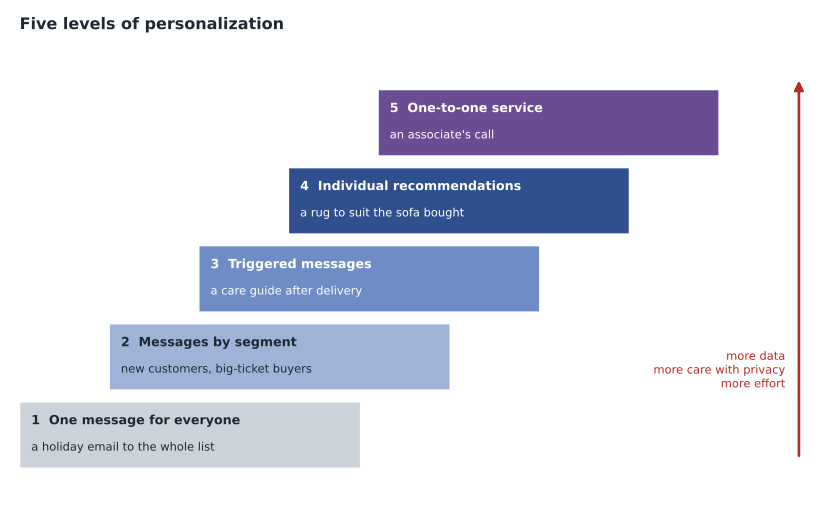
At the bottom is one message for everyone, such as a holiday email to the whole list. Next comes segment messages, written for a group such as new customers or lapsing customers. Then come triggered messages, sent automatically when a customer does something: a care guide two days after a leather sofa is delivered, a reminder of the comfort exchange deadline on night 80 of the 90-night mattress trial, or a note on the anniversary of a purchase. Above that are individual recommendations, such as rugs chosen to suit the specific sofa a customer bought. At the top is one-to-one service: an associate who remembers the household and calls with something genuinely useful, the clienteling covered in SLS-250. A small store often does the top step better than any website, and the lower steps more cheaply than any associate.
Tools a store can use
| Tool | Example | Data needed |
|---|---|---|
| Merge fields | Using the customer's name and the product they bought in an email | Name, purchase records |
| Segment content | Different main images for new customers and loyal regulars | Segments from lesson 7 |
| Triggered messages | Care guide after delivery; comfort-exchange reminder on night 80 | Delivery dates, product type |
| Product recommendations | Rugs and lamps that suit the sofa model the customer owns | Purchase history and product attributes |
| Website personalization | Showing recently viewed items to a returning visitor | Website account or cookies, with consent where required |
| Clienteling outreach | An associate texting a customer that the chair she asked about is back in stock | Notes, preferences, consent to be contacted |
| Personal offers | A Home Club certificate on the anniversary of joining | Loyalty program records |
Many of the most valuable personalized messages are not offers at all. A care guide for a leather sofa, a reminder that a mattress trial is ending, or a note that the warranty on an appliance can be registered online are useful in themselves, and they keep the store in mind without asking for anything. Tessa called these service messages with a light touch: one line at the end, such as a link to matching cushions, and nothing more.
Triggered messages also need their own legal checks. A care guide or a warranty reminder about a product the customer bought is closely connected to the purchase, but if it carries promotional content it may count as marketing and need the consent rules from lesson 6. Juniper & Pine's rule was that a service message could mention a related product only if the customer had agreed to marketing messages; otherwise it carried no offers at all.
Testing whether personalization pays
Personalization takes effort, and the only way to know whether it is worth it is to compare it with doing nothing or with a generic message. The clearest method is a holdout group: a randomly chosen share of the customers who would receive the message are held back, and the two groups' purchases are compared afterward. Because the groups are chosen at random, the difference between them can be put down to the message rather than to the kind of customer who received it.
Worked problem
Did the rug email work?
Of the 795 households that had bought a sofa or sectional without a rug, 610 had agreed to marketing email. Tessa chose 61 of them at random as a holdout and sent the personalized email, showing rugs and lamps that suited each household's sofa model, to the other 549 on November 2. By November 12, 22 of the 549 emailed households had bought a rug or lamp, against 1 of the 61 held back. The average purchase was about 380 dollars, at a gross margin of about 52 in 100. Estimate the purchases and margin the email added.
Show solution
- Purchase rate in each group:
- \[22 \div 549 \approx 0.040 \qquad 1 \div 61 \approx 0.016\]
- Extra purchases caused by the email, applied to the emailed group:
- \[(0.0401 - 0.0164) \times 549 \approx 13\]
- Extra sales and gross margin:
- \[13 \times 380 = 4{,}940 \qquad 4{,}940 \times 0.52 \approx 2{,}569\]
Answer: The email appears to have added about 13 purchases, about 4,900 dollars of sales and about 2,600 dollars of margin in ten days, at almost no cost. The holdout group was small, with only one buyer, so the estimate is uncertain; a single extra purchase in the holdout would change it noticeably. Tessa planned to repeat the test with the next group of sofa buyers before treating the result as reliable.
The test also showed something the numbers alone did not. Seven customers replied to the email, most of them to say thank you for the room ideas, and two asked whether an associate could bring rug samples to their home. Personalization done well feels like service, not selling.
Where personalization goes wrong
Bev's crib email shows the first problem: wrong inferences. A single purchase rarely tells a store who someone is. Gifts, purchases for other people and one-off needs all confuse automatic recommendations. A widely reported 2012 newspaper account described how a large retailer's analysts built a model to predict which customers were pregnant from their purchases, and how its coupons reached one family before the parents knew. Whatever the full details of that story, it became a lasting lesson: inferring sensitive facts about people from their purchases, and acting on them in ways they can see, crosses a line most customers feel strongly about.
The second problem is creepiness: messages that reveal how much the store knows, or use information in ways customers did not expect. An email that says "we noticed you looked at this sofa three times on Tuesday night" is accurate and unwelcome. A good test is whether the customer would be surprised to learn how the store knew what it knew. If yes, the store should not use it that way, or should explain plainly why it is relevant.
The third problem is unfairness. Personalized prices, where different customers see different prices for the same item based on their data, are legal in many situations but corrode trust when customers discover them, and they can harm vulnerable customers. Juniper & Pine's rule was simple: personalization chooses which products and messages a customer sees, never the price of a product. Every customer pays the same ticket price, and member offers are the same for every member.
Personalization and privacy law
No federal US law requires consent for a store to use its own customers' purchase history to recommend products, but the FTC treats it as deceptive to use data in ways that contradict a company's privacy promises, and as unfair to use sensitive data in ways that harm consumers. In the states with comprehensive privacy laws, residents can usually opt out of targeted advertising and profiling for significant decisions, and processing sensitive data, such as health information, often needs opt-in consent. South Dakota has no such law, but a store serving customers in neighboring states with privacy laws should honor those rights, and Juniper & Pine's privacy notice offered every customer the same choice to opt out of personalized marketing.
Juniper & Pine's practical rules for personalization were written on one page. Use purchase history to suggest things that go with what the customer bought. Never infer or act on health, family situation, finances or other sensitive matters. Never personalize prices. Explain in the privacy notice how recommendations work, and give every customer an easy way to turn them off. And test every new kind of personalization against a holdout before rolling it out.
Personalization at the counter and on the floor
Not all personalization is digital. When a customer returns to the store, an associate who checks the clienteling app and says, "Welcome back, how is the dining set working out?" is personalizing. When Aiden called the three Design Night households about rugs with their room measurements in hand, he was personalizing. The same rules apply: use what the customer told you, for the purpose they expected, and do not show off what you know. Bev's guidance to associates was to mention a past purchase only when it helped the conversation, and never to mention online browsing at all.
Worked problem
Planning triggered messages for mattresses
Juniper & Pine sells about 130 mattresses a month. Tessa planned two triggered messages for each: a sleep guide two days after delivery and a reminder on night 80 of the 90-night comfort exchange, inviting customers who were not sleeping well to call before the deadline. About 85 in 100 of mattress buyers have email consent for service messages. How many messages would the plan send a month, and why might the night-80 reminder lower costs rather than raise them?
Show solution
- Mattress buyers with email for service messages each month:
- \[130 \times 0.85 \approx 110\]
- Two messages for each:
- \[110 \times 2 = 220\]
Answer: The plan sends about 220 messages a month. The night-80 reminder may sound as if it invites exchanges, but customers who are unhappy and discover the deadline has passed become angry and post reviews; a customer helped before the deadline, often by adding a topper or adjusting a base, usually stays a customer. A reminder that prevents one bad review or one disputed return a month can easily pay for itself.
Personalization for Home Club
Home Club would give the store more reasons to personalize, and more risk of overdoing it. Tessa's plan for 2027 limited personalization to three uses: reminders of points and certificates about to lapse; suggestions that complete a room after a big purchase; and invitations to events matched to the household's segment. Members would see a short explanation in their account of why they were receiving each kind of message, with a switch to turn recommendations off. Each use would be tested against a holdout in its first month before it went to every member.
Aiden added one more rule from the floor. When an associate looks up a member at the counter, they should use what they see to help, not to impress: "Your sofa was delivered in October; how is it working in the room?" is welcome, while reciting a customer's full purchase history is not. The test, as Bev put it, is whether the customer would be comfortable if they could see the screen.
Common mistakes
MistakePersonalize everything as much as the data allows.
InsteadUse data the way customers would expect; when they would be surprised by how the store knew something, do not use it that way.
MistakeOne purchase tells you who the customer is.
InsteadGifts, purchases for others and one-off needs make inferences unreliable; avoid acting on guesses, especially sensitive ones.
MistakePersonalized prices are just good targeting.
InsteadDifferent prices for the same item based on personal data damage trust; personalize messages, not prices.
MistakeJudge personalization by the sales of those who received it.
InsteadCompare with a random holdout group to measure the real effect.
MistakeService messages can carry any offers we like.
InsteadPromotional content can make a service message marketing, which needs the consent rules for marketing messages.
Summary and key terms
- Personalization tailors messages, offers and service to customers based on what the store knows.
- Its levels run from one message for everyone, through segment and triggered messages and individual recommendations, to one-to-one service.
- Useful service messages, such as care guides and trial reminders, often personalize best.
- A random holdout group shows whether personalization adds sales; small groups give uncertain results.
- Personalization goes wrong through wrong inferences, creepiness and unfair personalized prices.
- The FTC Act and state privacy laws restrict deceptive or harmful uses and give many residents opt-out rights; sensitive data needs special care.
- Personalization
- Tailoring messages, offers or service to individual customers or small groups.
- Triggered message
- A message sent automatically when a customer does something or reaches a date.
- Holdout group
- A randomly chosen group held back from a message or offer to measure its effect.
- Inference
- A conclusion about a customer drawn from their data rather than told by them.
- Personalized pricing
- Charging different customers different prices for the same item based on their data.
- Meaningful consent
- Consent given by someone who understands what information is collected and how it will be used.
Practice problems
Work each problem on paper first, then reveal the answer to check.
An emailed group of 800 had 40 buyers and a holdout of 200 had 6. Estimate the extra purchases the email caused in the emailed group.
Show answer
Rates are 0.05 and 0.03; the difference, 0.02, times 800 is 16 extra purchases.
Give an example of a triggered message that is useful without being an offer.
Show answer
A care guide after a leather sofa is delivered, or a reminder before a comfort exchange deadline.
What test helps decide whether a use of customer data is too intrusive?
Show answer
Ask whether the customer would be surprised to learn how the store knew what it knew.
Why did Juniper & Pine refuse to personalize prices?
Show answer
Different prices for the same item based on personal data damage trust and can harm vulnerable customers.
Lesson quiz · 5 questions
Score 60% or more to complete this lesson.
Create a free account to save your progress, take quizzes and earn a certificate.