
SLS-257 · Lesson 3 of 12 · 23 min
Promotions and what they cost
▶ Video coming soon A video version of this lesson is on the way.
On Friday, October 2, 2026, Bev opened the meeting with a printout of the Labor Day sale results. The store's best-selling gray sectional had been reduced from 2,999 dollars to 2,549 dollars for the long weekend, and the store had sold 14 of them, against an average of 5 a weekend in the four weekends before. The sales floor had celebrated. "Fourteen is wonderful," Bev said. "But I want to know whether we made more money than we would have made without the sale, and I want to know before we plan the holidays." Tessa added the next two weekends' figures to the sheet: 3 sectionals each.
This lesson is about promotions: temporary offers that give customers a reason to buy now, such as price reductions, bundles, gifts with purchase, free delivery and bonus points. Promotions are the most common retail marketing tool and the easiest to misjudge, because their benefits are visible on the day while their costs are spread out and partly hidden. The lesson shows how to calculate what a promotion must achieve, explains the hidden costs, and sets out the rules on advertising sale prices in South Dakota.
Types of promotion
| Promotion | Example at Juniper & Pine | Main cost |
|---|---|---|
| Price reduction | 15 in 100 off all throws and cushions for a weekend | Margin on every unit sold, including those that would have sold anyway |
| Multi-buy or bundle | 5 in 100 off when buying four or more major appliances together | Margin on the bundle; complexity at the counter |
| Gift with purchase | A free set of pillows with any queen mattress over 1,200 dollars | Cost of the gift |
| Free or reduced delivery | Free standard delivery on furniture over 2,000 dollars | Delivery cost, normally 79 dollars to the customer |
| Bonus points | Double Home Club points for a week (once the program exists) | Cost of the extra points |
| Doorbuster | A small number of items at a very low price to draw traffic | Margin on the item, and the risk of disappointing customers |
| Clearance | Reducing discontinued or slow stock to free space and cash | Margin, but often less than the cost of keeping the stock |
Promotions differ in purpose as well as form. Some aim to bring traffic, people through the door. Some aim to raise the size of the purchase, such as bundles and gifts that reward buying more. Some aim to clear stock, and some reward existing customers. A good promotion plan states which purpose each promotion serves, because the measure of success differs: a traffic promotion should be judged by how many people it brought in and what else they bought, a clearance by how quickly it cleared the stock and at what margin.
How much must a price reduction sell?
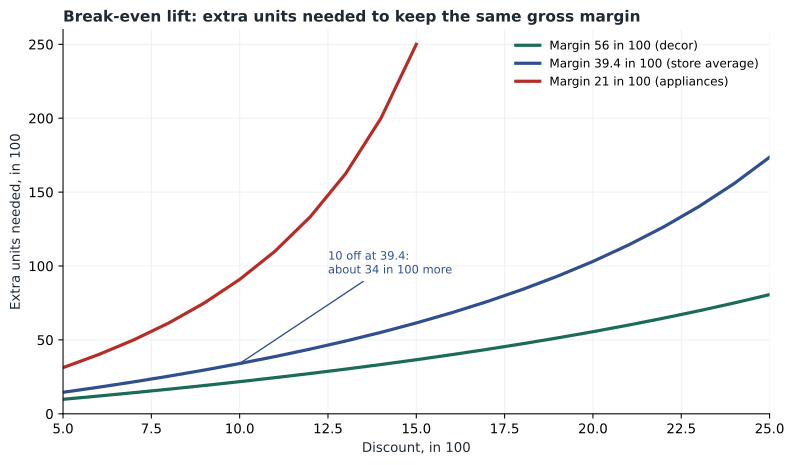
A price reduction cuts the margin on every unit, so it must sell more units to earn the same total margin. The required increase depends on two numbers: the item's gross margin rate at its regular price and the size of the reduction, both as shares of the regular price. The break-even lift is the increase in units needed so that total gross margin stays the same:
where m is the gross margin rate at the regular price and d is the discount, both written as decimals. The formula shows something every store manager should know by heart: the lower the margin, the bigger the lift a discount needs. A discount that is close to the margin needs an enormous lift, and a discount larger than the margin loses money on every unit however many sell.
Worked problem
Break-even lift for a décor weekend
Décor at Juniper & Pine earns a gross margin of about 56 in 100. Tessa proposed 15 in 100 off all throws and cushions for a weekend. By how much would unit sales need to rise to earn the same gross margin? How would the answer change for an appliance with a 21 in 100 margin and a 10 in 100 discount?
Show solution
- For décor, with m = 0.56 and d = 0.15:
- \[\frac{0.56}{0.56 - 0.15} - 1 = \frac{0.56}{0.41} - 1 \approx 0.366\]
- For an appliance, with m = 0.21 and d = 0.10:
- \[\frac{0.21}{0.21 - 0.10} - 1 = \frac{0.21}{0.11} - 1 \approx 0.909\]
Answer: The décor weekend must sell about 37 in 100 more units just to earn the same margin as a normal weekend. The appliance discount must almost double unit sales, a rise of about 91 in 100, which rarely happens. This is why Bev avoided straight discounts on appliances and preferred bundles and free delivery, which customers value highly but cost the store less than the margin they replace.
The hidden costs of promotions
The break-even lift is only the start. Four other effects decide whether a promotion really pays.
Subsidized purchases. Many customers who buy during a sale would have bought at the regular price. Every one of them is given the discount for nothing. Pull-forward. For big, infrequent purchases, a sale often moves purchases that would have happened in the next few weeks into the sale weekend, leaving the following weeks weaker. Cannibalization. A discount on one item can take sales from similar items at full price, such as a reduced sofa drawing buyers away from a full-price one beside it. Reference price damage. If a store runs sales too often, customers learn to wait for them and come to see the sale price as the real price. Mattress and furniture retailers that seem to be permanently on sale have trained their customers to never pay the regular price.
There are benefits beyond the promoted item too. A sale weekend brings more people into the store, and some of them buy other things at full price, the halo effect. A promotion can win a first purchase from a household that becomes a regular customer. And clearing slow stock frees space and cash for products that sell. A full evaluation counts all of these, not just the units of the promoted item.
Worked problem
Did the Labor Day sectional sale pay?
The gray sectional costs the store about 1,440 dollars and normally sells for 2,999 dollars, a margin of about 1,559 dollars. At the sale price of 2,549 dollars the margin was about 1,109 dollars. The store sold 14 during the sale weekend, against an average of 5 a weekend before it, and 3 in each of the next two weekends instead of the usual 5. Ignoring halo sales, did the sale earn more margin than a normal weekend would have?
Show solution
- Margin during the sale weekend:
- \[14 \times 1{,}109 = 15{,}526\]
- Margin on a normal weekend:
- \[5 \times 1{,}559 = 7{,}795\]
- Margin lost to pull-forward in the next two weekends (4 fewer sales at the regular margin):
- \[(5 - 3) \times 2 \times 1{,}559 = 6{,}236\]
- Net gain from the sale:
- \[15{,}526 - 7{,}795 - 6{,}236 = 1{,}495\]
Answer: The sale earned about 1,495 dollars more margin on this sectional than three normal weekends would have, far less than the 14 units suggested. Most of the apparent gain was sales borrowed from the following weeks. Any extra sales of tables, rugs and lamps to sale-weekend shoppers would add to the gain, which is why Bev asked Tessa to check what else those 14 customers bought.
Planning the holiday promotions
With the Labor Day lesson fresh, the group planned the holiday season. The store's main event would be Black Friday weekend, starting Friday, November 27, 2026. As SLS-150 described, the advertised doorbuster would be four queen mattresses reduced from 899 dollars to 499 dollars, with the advertisement stating clearly that only four units were available. Instead of storewide discounts, the plan used targeted offers: 15 in 100 off décor and bedding, where the margin could absorb it; a free set of pillows with mattresses over 1,200 dollars; and free standard delivery on furniture over 2,000 dollars. Appliances would carry only the normal package price for four or more appliances.
Worked problem
What does a gift with purchase cost compared with a discount?
A set of two pillows costs the store 38 dollars and sells for 89 dollars. Bev compared giving the pillows free with a 1,400-dollar mattress against taking 5 in 100 off the mattress instead. Which costs the store less, and how might customers see the two offers?
Show solution
- Cost of the gift to the store:
- \[38 \text{ dollars}\]
- Cost of a 5 in 100 discount on the mattress:
- \[1{,}400 \times 0.05 = 70\]
Answer: The pillows cost the store 38 dollars, while the discount would cost 70 dollars. Customers often value the gift at its retail price, 89 dollars, so it can feel more generous while costing about half as much. The gift also keeps the mattress's regular price intact, protecting the reference price for future customers.
Advertising sale prices honestly
Promotions are one of the most heavily regulated parts of retail marketing, because a misleading sale claim can cost customers real money. The core rule in both countries is the same: a comparison with a "regular" or "was" price must be true.
The FTC's Guides Against Deceptive Pricing say that a "was" or "regular" price comparison is fair only if the former price is one at which the article was openly and actively offered, in good faith, for a reasonably substantial period in the recent regular course of business. A price set briefly just to make a later sale look good is deceptive. The FTC's Guides Against Bait Advertising prohibit advertising an offer the seller does not intend to sell, including refusing to show the advertised item or discouraging its purchase to switch the customer to something more expensive. South Dakota's deceptive trade practices law, chapter 37-24, also prohibits knowingly false or misleading representations in connection with a sale, and the state attorney general enforces it. Juniper & Pine keeps a simple record for every promoted item: the regular price and the dates and units sold at it over the previous six months. Before any "was" price appears on a ticket, flyer or web page, Tessa checks the record. For the Black Friday mattress, the record showed it had sold at 899 dollars in 9 of the previous 12 months.
Promotions and the loyalty program
Loyalty programs give stores a promotional tool that plain discounts lack: offers can be aimed at members rather than everyone. A bonus-points week, an early-access sale or a member-only gift reaches customers who are already engaged, and the store learns who responded. It also creates a risk: if members receive constant offers, the program becomes a discount club, and the store has simply moved its sale prices behind a sign-up form. Tessa proposed a limit for Home Club's first year: no more than four member promotions, each with a clear purpose and a measured result.
Reviewing a promotion afterward
Every promotion at Juniper & Pine now ends with a short review, written within two weeks while the details are fresh. It records the units sold against the plan, the margin earned against the break-even lift, any sign of pull-forward in the following weeks, stock left over and what customers and staff said. The Labor Day review, for example, noted that several sectional buyers said they had planned to buy in October anyway. That comment, more than any figure, persuaded Bev to plan the Black Friday doorbuster for only four units. A file of honest reviews is how a store stops repeating promotions that look busy and earn little.
Common mistakes
MistakeA promotion that sells many units was a success.
InsteadCount the margin given away, the subsidized and pulled-forward sales, and any halo; the units alone prove little.
MistakeA 10 in 100 discount needs about 10 in 100 more sales.
InsteadThe required lift depends on the margin; at a 21 in 100 margin, a 10 in 100 discount needs almost twice the units.
MistakeAny price the store once charged can be shown as the "was" price.
InsteadThe former price must meet the legal tests for genuine, substantial selling or offering at that price.
MistakeAdvertise a doorbuster and deal with shortages when they happen.
InsteadState limited quantities in the advertisement, or have reasonable stock, to avoid a bait-and-switch claim.
MistakeFrequent sales keep customers coming back.
InsteadConstant promotions teach customers to wait for sales and damage the regular price.
Summary and key terms
- Promotions give customers a reason to buy now and should each have a stated purpose: traffic, purchase size, clearance or rewarding customers.
- The break-even lift for a price reduction is m divided by (m minus d), minus 1; low-margin items need much larger lifts.
- Hidden costs include subsidized purchases, pull-forward, cannibalization and damage to reference prices; halo sales are a hidden benefit.
- Gifts with purchase and free delivery can feel generous while costing less than a discount.
- Former-price claims must reflect genuine prices offered for a substantial period; bait advertising is deceptive under FTC guides and South Dakota law.
- Member promotions can target engaged customers but should be limited so the program does not become a discount club.
- Promotion
- A temporary offer that gives customers a reason to buy now.
- Break-even lift
- The increase in units a price reduction must produce to keep total gross margin unchanged.
- Pull-forward
- Purchases moved earlier into a promotion, leaving later periods weaker.
- Halo effect
- Extra full-price sales of other items made to customers drawn in by a promotion.
- Ordinary selling price
- The genuine regular price used as the basis for a savings claim.
- Doorbuster
- An item offered in limited numbers at a very low price to draw traffic.
Practice problems
Work each problem on paper first, then reveal the answer to check.
An item has a 50 in 100 margin. What break-even lift does a 10 in 100 discount need?
Show answer
0.50 divided by 0.40 is 1.25, so 25 in 100 more units.
A sale sold 20 units at 300 dollars margin each, against 12 units at 400 dollars normally. Ignoring pull-forward, did it earn more margin?
Show answer
Yes: 20 times 300 is 6,000 dollars, against 12 times 400, which is 4,800 dollars.
Why can a gift with purchase cost less than a discount of similar appeal?
Show answer
The store pays the gift's cost, while customers often value it at its retail price.
What must a store check before showing a "was" price?
Show answer
That the former price was genuinely charged or offered for a substantial period, as the law in its jurisdiction requires.
Lesson quiz · 5 questions
Score 60% or more to complete this lesson.
Create a free account to save your progress, take quizzes and earn a certificate.