
SLS-257 · Lesson 5 of 12 · 23 min
Local and community marketing
▶ Video coming soon A video version of this lesson is on the way.
On Friday, October 16, 2026, Tessa started the meeting with a question for Aiden: "When someone in Sioux Falls types 'furniture store near me' into their phone, what do they see first?" Aiden tried it. The national chain's store came up first, with 1,200 reviews and a photo gallery. Juniper & Pine came second, with a photo of the building taken in winter, opening hours that were wrong for Sundays and a phone number that rang the old fax line. "That," said Tessa, "is our front window for half the city, and we have been ignoring it."
This lesson is about local marketing: reaching the households within driving distance of the store, where almost all of a furniture store's customers live. It covers the store's listings in local search and maps, traditional local media such as flyers and radio, partnerships with other local businesses, and sponsorships and community involvement. For a single independent store, local marketing is where it can most clearly beat a national competitor: it knows the community, and the community can know it.
The trade area
A store's trade area is the geographic area its customers come from. For Juniper & Pine, Tessa mapped the addresses of the households that bought in 2025. About 55 in 100 of them lived within a 10-minute drive of the store, about 30 in 100 within 10 to 20 minutes, and about 10 in 100 within 20 to 30 minutes. The remaining 5 in 100 came from farther away, mostly smaller towns more than an hour's drive away that had no furniture store of their own. The map showed clear gaps: two newer suburbs, within 15 minutes, where the store had far fewer customers than the number of households would suggest.
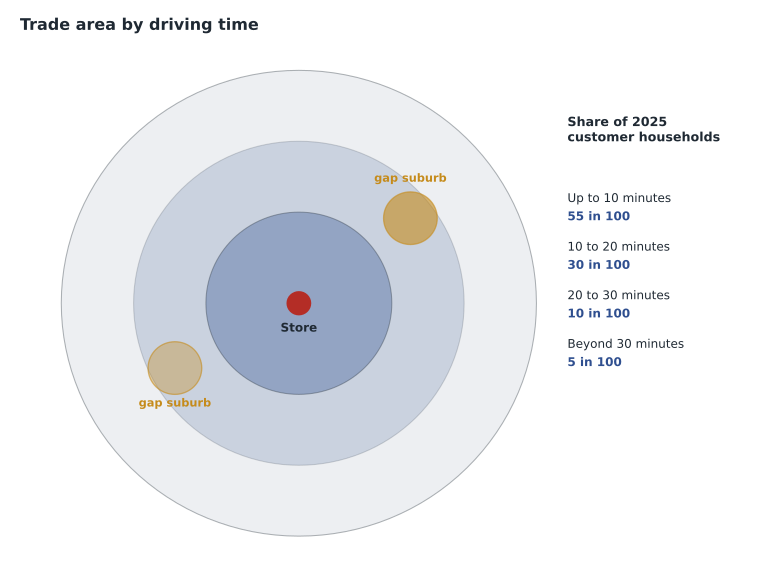
The trade area guides almost every local marketing choice: which neighborhoods receive flyers, where to sponsor a team, which community groups to partner with and where a radio station's audience overlaps the store's customers. It also guides the honest question of whether a channel can reach the store's customers at all. A city-wide radio campaign reaches the whole region, including many people who will never drive to the store; a flyer delivered to the two gap suburbs reaches exactly the households Tessa wanted.
Local search and maps
Most shoppers now find a local store through search and map apps on their phones. The business profile that appears in those results, with its photos, hours, reviews, address and phone number, is often the first thing a new customer sees. Keeping it accurate costs almost nothing and is one of the most valuable things a local store can do. Tessa's checklist for the store's profiles on the major search and map services was short: correct name, address and phone number, identical everywhere; correct hours, including holidays and the Sunday hours that had been wrong; current photos of the outside, the entrance, the parking and each department; a short description; the main product categories; and a link to the website.
The same name, address and phone number should appear in the same form on every directory and listing site, a practice sometimes called NAP consistency, because search services use these details to judge whether listings refer to the same business. Tessa found five versions of the store's name across different sites, including one that still used the name of the furniture store that had been in the building before Juniper & Pine. Correcting them took an afternoon.
The business profile also shows how customers use it. In September 2026, the store's main profile was viewed about 18,200 times, and those views produced about 640 requests for driving directions and about 410 phone calls. After the corrections and new photos, Tessa planned to compare the October and November figures with September's, allowing for the holiday season.
Flyers, radio and other local media
Traditional local media still matter in home furnishings, where many customers are older homeowners and purchases are planned. The main options for Juniper & Pine were printed flyers, digital flyers in shopping apps, local radio and community newspapers.
| Medium | Reach and targeting | Typical use |
|---|---|---|
| Every Door Direct Mail flyers through the US Postal Service | Every household on chosen delivery routes; good for targeting neighborhoods | Sale events; reaching gap suburbs |
| Digital flyers in shopping apps | App users who follow the store or browse its category; low cost | Weekly or event offers |
| Local radio | Wide regional reach, little targeting | Big events such as Black Friday; building awareness |
| Community newspapers and newsletters | Small, loyal local readership | Events, community involvement, older readers |
| Signs and the store's own windows | Everyone who passes | Events and seasonal messages |
Worked problem
Is a flyer drop worth it?
Tessa priced a flyer for the two gap suburbs and two neighborhoods nearby, about 12,000 households in all. Printing would cost about 0.11 dollars a flyer and delivery about 0.20 dollars a flyer. The flyer would carry a 25-dollar certificate on purchases over 200 dollars, and she assumed the average purchase by a household using it would be about 420 dollars, at the store's 39.4 in 100 gross margin. What would the drop cost, and how many households would need to make an extra purchase to cover the printing and delivery?
Show solution
- Cost per flyer and total cost:
- \[0.11 + 0.20 = 0.31 \quad 12{,}000 \times 0.31 = 3{,}720\]
- Gross margin from one extra purchase, before the certificate:
- \[420 \times 0.394 = 165.48\]
- Margin after the 25-dollar certificate:
- \[165.48 - 25 = 140.48\]
- Extra purchases needed to cover the drop:
- \[3{,}720 \div 140.48 \approx 26.5\]
Answer: The drop would cost 3,720 dollars and would need about 27 extra purchases, about 2 households in every 1,000 that received it, to pay for itself. The certificates counted after the drop would overstate its effect, because some households that used them would have shopped anyway, so Tessa planned to compare the four flyer neighborhoods with similar neighborhoods that did not receive it. The rates used here were illustrative estimates; real printing and postal rates change and depend on volume.
Radio is harder to measure. A local station offered a package of 40 thirty-second spots over two weeks before Black Friday for about 4,800 dollars. Its audience covered the whole region, and there was no direct way to count the customers it brought. Bev decided to use radio only for the Black Friday weekend, where a big, short burst of awareness made sense, and to ask every Black Friday customer how they had heard about the sale.
Partnerships with local businesses
Some of the best local marketing comes through other businesses that serve the same households at the moments they need furniture. A household that has just bought a house, renovated a kitchen or moved into a seniors' residence needs furnishings soon. Juniper & Pine had three partnership ideas on the table.
Real estate agents who sell homes in the trade area could give their buyers a Juniper & Pine welcome card: a 50-dollar certificate for new homeowners, valid for three months on purchases over 500 dollars. The store would pay the agents nothing; the card would simply be a gift the agent could give a client. Kitchen and bathroom renovators could recommend the store for appliances, with the store offering to coordinate appliance delivery with the renovation schedule. And property managers of new apartment buildings could include a store flyer in move-in packages.
Worked problem
Measuring the new-homeowner card
In a three-month trial from June to August 2026, six real estate agents gave out 40 welcome cards. Eleven were used, with an average purchase of 1,850 dollars. The certificates cost the store 50 dollars each when used. At a 39.4 in 100 gross margin, what did the trial contribute, assuming the purchases would not otherwise have happened?
Show solution
- Sales from card users:
- \[11 \times 1{,}850 = 20{,}350\]
- Gross margin on those sales:
- \[20{,}350 \times 0.394 \approx 8{,}018\]
- Cost of the certificates used:
- \[11 \times 50 = 550\]
- Contribution:
- \[8{,}018 - 550 = 7{,}468\]
Answer: The trial contributed about 7,500 dollars, and 11 of the 40 cards were used, a strong rate for a printed offer. The assumption that none of the purchases would have happened anyway is generous: some new homeowners would have found the store on their own. Even if half of the purchases had been certain anyway, the cards would still have paid for themselves many times over, so Bev approved extending the program to more agents in 2027.
Partnerships need care. Paying a third party for referrals can create obligations and, in some industries, legal problems, and customers trust a recommendation less if they suspect it was bought. Juniper & Pine's rule was that partners were never paid per referral; the store offered something useful to the partner's customers and nothing to the partner beyond goodwill. Any customer information exchanged through a partnership needed the customer's consent, which in practice meant the store did not receive lists from partners at all. Customers came to the store with their card, and the store recorded the card when they bought.
Sponsorship and community involvement
Local stores are asked constantly to sponsor teams, school events and charity fundraisers. Sponsorship can build goodwill and familiarity, but it is easy to scatter money on requests that reach few customers. Bev used three questions for every request: Does it reach households in our trade area who are likely to buy home furnishings? Does it fit who we are? Can we do something more useful than put our name on a sign?
The last question led to the store's most effective community work. Juniper & Pine already removed customers' old furniture when it delivered new pieces, as part of its delivery service. Much of that furniture was still usable. In 2025 the store began passing usable pieces to a local charity that furnishes homes for families leaving shelters, about 180 pieces in the year. The program cost little beyond the crew's time and some storage, and it gave customers a good reason to choose the store's delivery and removal service. It also gave the store a true story to tell, which mattered more than any logo on a banner. Bev also kept one traditional sponsorship: a youth hockey team in the neighborhood around the store, whose families had been customers for years.
Community work must be honest. A store that claims to donate every old sofa when most go to the landfill is making a misleading claim, and environmental and charitable claims are scrutinized closely in both countries. Tessa's posts about the program reported real numbers from the charity's receipts: pieces collected, pieces placed in homes and the rest recycled where possible.
Measuring local marketing
Local marketing is harder to measure than email, because the store rarely knows exactly who saw a flyer or heard a radio spot. Tessa used three practical methods. Where possible, each channel carried something traceable: a code on the flyer, a separate card for each realtor partner, a short web address in the radio spot. Second, she compared postal areas: sales to households in the flyer's delivery routes against similar routes that did not receive it. Third, the counter staff asked new customers how they had heard about the store and recorded the answer, knowing that memory is unreliable and that people tend to name the last thing they noticed.
Worked problem
Did the flyer reach new households?
In the four weeks after the fall flyer, the store recorded 74 first purchases from households on the flyer's delivery routes, compared with 52 in the same four weeks of 2025. In comparable areas that received no flyer, first purchases rose from 40 to 44. Estimate how many extra first purchases the flyer produced.
Show solution
- Growth in the comparison areas:
- \[44 \div 40 = 1.10\]
- Expected first purchases on the flyer routes without the flyer:
- \[52 \times 1.10 = 57.2\]
- Extra first purchases:
- \[74 - 57.2 \approx 17\]
Answer: The flyer appears to have produced about 17 extra first purchases. That is below the 27 needed to break even on first purchases alone, but new households also come back, which is the point of the loyalty work in the rest of the course. Lesson 11 returns to these comparisons.
Common mistakes
MistakeLocal listings look after themselves.
InsteadBusiness profiles and directories need correct names, addresses, phone numbers, hours and photos, checked regularly.
MistakeRadio and flyers reach everyone, so they are always worthwhile.
InsteadReach only matters if it covers the trade area's likely buyers; targeting and a way to measure response matter more.
MistakeCount every certificate redeemed as a new sale.
InsteadSome users would have shopped anyway; compare with areas or groups that did not receive the offer.
MistakePay partners for each customer they send.
InsteadOffer value to the partner's customers instead; paid referrals reduce trust and can create legal obligations.
MistakeSay yes to every sponsorship request to support the community.
InsteadChoose involvement that reaches the trade area, fits the store and does something useful.
Summary and key terms
- Local marketing reaches the households within driving distance, where almost all of a furniture store's customers live.
- The trade area, mapped from customer addresses, guides where to advertise, sponsor and partner, and reveals gaps.
- Accurate, consistent business profiles and listings are a store's front window in local search and maps.
- Flyers can target neighborhoods; radio builds broad awareness; each needs a sensible way to estimate response.
- Partnerships with real estate agents, renovators and property managers reach households at moments of need.
- Sponsorship and community work should reach the trade area, fit the store, do something useful and be described honestly.
- Local marketing
- Marketing aimed at the households within the store's trade area.
- Trade area
- The geographic area that a store's customers come from.
- Business profile
- A store's listing in search and map services, with its details, photos and reviews.
- NAP consistency
- Using the same business name, address and phone number on every listing.
- Partnership marketing
- Working with other businesses that serve the same customers at related moments.
Practice problems
Work each problem on paper first, then reveal the answer to check.
A flyer drop to 8,000 households costs 0.30 dollars a flyer. Each extra purchase brings 150 dollars of margin. How many extra purchases cover the cost?
Show answer
8,000 times 0.30 is 2,400 dollars; 2,400 divided by 150 is 16 purchases.
Why is NAP consistency important?
Show answer
Search services use identical names, addresses and phone numbers to recognize listings as the same business, and customers need correct details.
Give one way to measure a flyer's effect more accurately than counting certificates.
Show answer
Compare purchases in the flyer neighborhoods with similar neighborhoods that did not receive it.
What three questions did Bev ask about sponsorship requests?
Show answer
Does it reach likely buyers in the trade area, does it fit the store, and can the store do something more useful than display its name?
Lesson quiz · 5 questions
Score 60% or more to complete this lesson.
Create a free account to save your progress, take quizzes and earn a certificate.