
SLS-222 · Lesson 5 of 12 · 22 min
Total cost of ownership
▶ Video coming soon A video version of this lesson is on the way.
On November 4, Priya Nandakumar, the operations manager at Westgate & Rowe, forwarded Maya a quote from an online office-furniture seller. The firm was moving to a new floor in the spring and needed 24 task chairs among other things. The online seller wanted 289 dollars a chair. Ridgeline's quote for the chairs, separate from its 14,800-dollar quote for desks and meeting tables, was 649 dollars a chair. Priya's email had one line: "Can you explain the difference?"
Maya brought the email to the value desk that afternoon. Rob read it and smiled. "She's asking the right question," he said. "Our job is to answer it with her costs, not our brochure. That means total cost of ownership."
What total cost of ownership means
Total cost of ownership (TCO) is the full cost of acquiring, using and disposing of something over the period the customer will own or use it, not just its purchase price. The idea was popularized for information technology by the research firm Gartner in the late 1980s, but it applies to almost any business purchase: vehicles, equipment, furniture, software, buildings. The purchase price is often the smallest part.
TCO is useful to sellers whose products cost more up front but less over time. It is just as useful to buyers, who are often judged on the purchase price their department pays while the costs of a cheap choice land later, in someone else's budget. A good TCO comparison shows everyone the same complete picture.
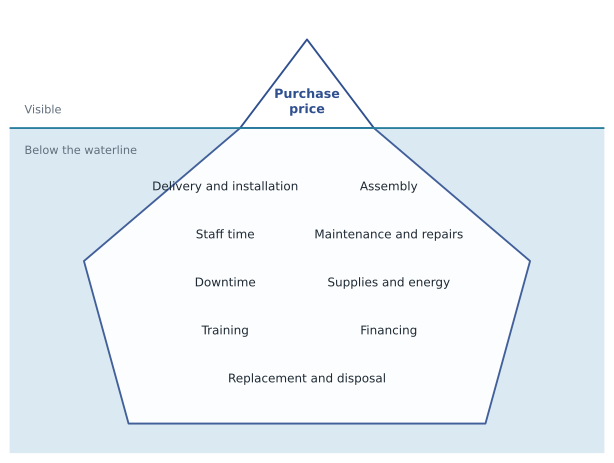
The parts of TCO
Most TCO comparisons gather costs into a few groups. Not every group applies to every product, and a comparison should include only costs that differ between the options; a cost that is the same either way does not change the decision.
| Cost group | What it includes | Chair example |
|---|---|---|
| Acquisition | Purchase price, taxes, delivery, installation, setup | Price, shipping, assembly |
| Operating | Energy, consumables, licenses, subscriptions, staff time to run it | Little for a chair |
| Maintenance and repair | Service contracts, parts, repairs, warranty gaps | Broken casters, gas cylinders, arms |
| Downtime and productivity | Lost work when it fails or is slow | Staff discomfort, sick days (hard to measure) |
| Replacement and disposal | How often it must be replaced; removal and disposal costs | Replacing worn chairs; hauling old ones away |
| Financing | Interest or lease costs | Usually none for chairs |
Westgate & Rowe's chairs
Maya asked Priya three questions before building the comparison. How long did the firm expect to stay in the new office? (At least ten years, under the new lease.) Who would assemble flat-packed chairs? (Probably the office staff, on a Saturday.) What had happened to the firm's last chairs? (They had been bought online seven years ago; most had broken casters or failed height adjustment, and several had already been thrown out.) Maya then built the comparison over ten years, using conservative figures she could explain.
| Per chair, over 10 years | Online chair | Ridgeline chair |
|---|---|---|
| Price | 289 dollars | 649 dollars |
| Delivery and assembly | Curbside delivery; staff assemble in about 25 minutes | Delivered, assembled and placed |
| Expected life in office use | About 5 years | 10 years or more |
| Warranty | 1 year | 12 years, parts and labor |
| Purchases over 10 years | 2 | 1 |
| Repairs outside warranty | About 12 dollars a year | None expected |
| Disposal of worn chairs | About 15 dollars per chair, once | None within 10 years |
Worked problem
Ten-year TCO of 24 task chairs
Using the assumptions in the table, with staff time for assembly valued at 40 dollars an hour, calculate the ten-year cost per chair and for 24 chairs for each option.
Show solution
- Online chair purchases: 2 × 289 = 578 dollars.
- \[\text{Assembly: } 2 \times \frac{25}{60} \times 40 \approx 33.33\]
- Repairs: 12 × 10 = 120 dollars. Disposal: 15 dollars.
- Online total per chair: 578 + 33.33 + 120 + 15 = 746.33 dollars.
- Ridgeline total per chair: 649 dollars, with delivery and assembly included and repairs under warranty.
- \[24 \times 746.33 = 17{,}912 \qquad 24 \times 649 = 15{,}576\]
- Difference: 17,912 − 15,576 = 2,336 dollars over ten years.
Answer: Over ten years the online chairs cost about 17,900 dollars and the Ridgeline chairs about 15,600, a difference of about 2,300 dollars in Ridgeline's favor, even though Ridgeline's chairs cost more than twice as much to buy.
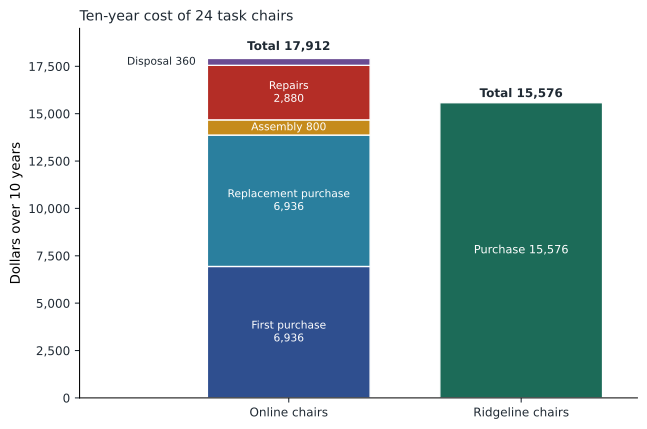
Maya was careful about what she did not include. She did not put a value on comfort, back pain or sick days, although Ridgeline's chair manufacturer had marketing figures on all three. Those effects are real but hard to measure for one firm, and Priya would discount them. The comparison worked without them, and Maya mentioned them in one sentence as possible further benefits. She also noted that if Westgate & Rowe moved again in five years, the online chairs would look better: over five years, before any replacement, the online option cost only 289 + 33.33 + 60 = 382.33 dollars a chair, well under Ridgeline's 649. TCO depends on the period, and the honest answer was that Ridgeline's chairs made sense because the firm planned to stay.
Lease or buy
A second TCO question comes up whenever the customer could buy equipment outright or lease it. Keystone's finance director, Marlene Toews, had told Maya that she preferred not to make large payments between January and April, and Ridgeline's leasing partner offered a five-year lease on the training-center equipment. Maya needed to compare the two in terms Marlene would recognize.
Worked problem
Comparing a five-year lease with a cash purchase
The training-center equipment costs 48,000 dollars to buy. The leasing partner offers a 60-month lease at an interest rate of 7.5 in 100 a year, with a buyout of 1 dollar at the end. Keystone's own discount rate is 8 in 100 a year. Ignoring taxes for now, what is the monthly payment, the total paid, and the present value of the payments at Keystone's rate?
Show solution
- The monthly lease rate is 0.075 ÷ 12 = 0.00625, over 60 months.
- \[\text{Payment} = 48{,}000 \times \frac{0.00625}{1 - 1.00625^{-60}} \approx 961.82\]
- Total paid over 60 months: 961.82 × 60 ≈ 57,709 dollars.
- Present value at Keystone's rate of 0.08 ÷ 12 a month:
- \[\text{PV} = 961.82 \times \frac{1 - (1 + 0.08/12)^{-60}}{0.08/12} \approx 47{,}436\]
Answer: The lease costs about 962 dollars a month, about 57,700 dollars in total. Discounted at Keystone's own rate, the payments are worth about 47,400 dollars today, slightly less than the 48,000-dollar cash price. In present-value terms the two options are close; the lease's real advantage is that it avoids a large payment in Keystone's tightest months.
The result is typical. When the lease rate is close to the customer's own cost of money, leasing and buying cost about the same in present-value terms, and the decision turns on other things: cash timing, who owns the equipment at the end, flexibility to upgrade, the customer's borrowing capacity and how each option is treated for tax and accounting. A seller should present both options fairly and let the customer's finance team choose.
Taxes and accounting
In Sioux Falls, sales tax of 6.2 in 100 (South Dakota's 4.2 plus the city's 2) applies to the purchase price, about 2,976 dollars on this purchase, and South Dakota generally taxes lease payments as well, so a lease spreads the tax over the term. For federal income tax, a purchased asset is normally depreciated over several years, but businesses can often deduct the cost much faster: the One Big Beautiful Bill Act of July 2025 raised the Section 179 expensing limit to 2.5 million dollars, phasing out above 4 million dollars of purchases, with both figures adjusted for inflation from 2026, and restored 100 in 100 bonus depreciation for qualifying property placed in service after January 19, 2025. Payments on a true lease are usually deducted as an expense instead. For accounting, US GAAP (ASC 842) now puts most leases longer than twelve months on the lessee's balance sheet. These rules change and depend on the customer's situation, so a seller should describe the options and leave the tax advice to the customer's accountant.
Maya's approach was to give Marlene the facts in a short table, the cash price, the lease payment, the sales tax under each option and the total paid, and to say plainly that the tax and accounting treatment was a question for Keystone's accountant. Marlene replied that she would take both options to the January board meeting.
Using TCO honestly
TCO comparisons are easy to bias. A seller can choose a period that flatters its product, assume the competitor's product fails early, or include costs that do not really differ. Buyers know this, and many procurement teams build their own TCO models. The safest approach is to use the customer's own figures and periods wherever possible, show every assumption, include the cases where the cheaper option wins, and invite the buyer to change any number.
TCO for software and services
TCO matters just as much for software, where the purchase price is often a small part of the cost. Keystone's IT contractor, Northgate IT, had asked whether Keystone should buy a competing room-booking product that was sold with a perpetual license instead of a subscription. The competitor charged 900 dollars per room once, plus annual maintenance of 20 in 100 of the license price from the second year. RoomFlow charged 45 dollars per room per month with hosting, updates and support included. On license fees alone, the competitor looked cheaper.
Worked problem
Five-year license cost per room: subscription or perpetual license
Compare the five-year license cost per room of RoomFlow at 45 dollars a month with a perpetual license at 900 dollars plus maintenance of 20 in 100 a year in years 2 to 5.
Show solution
- RoomFlow: 45 × 60 months = 2,700 dollars.
- Perpetual license: 900 + (0.20 × 900 × 4 years) = 900 + 720 = 1,620 dollars.
Answer: On license fees, the perpetual license costs 1,080 dollars less per room over five years.
Maya did not stop there, and neither did Northgate IT. The perpetual product had to run on a server at Keystone, which Northgate would install, patch and back up, and upgrades to new major versions were charged separately. Northgate estimated its own time at about four hours a quarter for the booking server, at its contract rate of 95 dollars an hour, and the server itself at about 1,800 dollars, replaced after five years. For six rooms over five years, that added roughly 1,800 + (4 × 4 × 5 × 95) = 9,400 dollars, or about 1,567 dollars per room, more than wiping out the license saving.
| Five years, six rooms | RoomFlow subscription | Perpetual license |
|---|---|---|
| License and maintenance | 16,200 dollars | 9,720 dollars |
| Server hardware | None (hosted) | About 1,800 dollars |
| IT contractor time for the server | None | About 7,600 dollars |
| Approximate total | About 16,200 dollars | About 19,120 dollars |
Maya presented the comparison as Northgate's numbers, not hers, and noted that if Keystone already ran a suitable server and had in-house IT staff with spare time, the result could reverse. That honesty mattered: Northgate's owner had to approve any software Keystone installed, and he recommended RoomFlow to Dale because the comparison included the costs he would carry himself.
The same pattern appears across services. A cheaper service contract with slower response, a lower hourly rate with more hours, or a low monthly fee with high overage charges can each cost more in total. The questions are always the same: what else will the customer pay, over what period, and who in the customer's organization will pay it?
Common mistakes
MistakeTCO is the purchase price plus tax.
InsteadTCO includes acquisition, operating, maintenance, downtime, replacement, disposal and financing costs over the period of use.
MistakeThe longest possible period always gives the fairest comparison.
InsteadUse the period the customer will actually own or use the item; results can reverse over a shorter period.
MistakeLeasing is always more expensive than buying because you pay interest.
InsteadDiscounted at the customer's own rate, a lease can cost about the same; the choice depends on cash timing, ownership and flexibility.
MistakeSellers should advise customers on tax treatment.
InsteadDescribe the options and leave tax and accounting advice to the customer's accountant.
Summary and key terms
- Total cost of ownership is the full cost of acquiring, using and disposing of something over the period of use.
- It groups costs into acquisition, operating, maintenance, downtime, replacement and disposal, and financing, and includes only costs that differ between options.
- A product that costs more to buy can cost less to own, as Westgate & Rowe's chairs showed over ten years, but the result depends on the period.
- Comparing a lease with a purchase means discounting the lease payments at the customer's rate; the two are often close, and the decision turns on cash timing, ownership, flexibility, tax and accounting.
- Sales taxes, capital cost or depreciation rules and lease accounting differ by country and should be confirmed by the customer's accountant.
- Honest TCO uses the customer's figures and shows when the cheaper option wins.
- Total cost of ownership (TCO)
- The full cost of acquiring, using and disposing of something over the period of use.
- Acquisition cost
- Price, taxes, delivery, installation and setup.
- Lease
- An agreement to use an asset for a period in return for regular payments.
- Present value of lease payments
- The lease payments discounted to today at the customer's own rate.
- Section 179 expensing
- A US federal tax rule allowing businesses to deduct the cost of qualifying equipment in the year it is placed in service, up to a limit.
- Bonus depreciation
- A US federal rule allowing an extra first-year deduction for qualifying property, separate from Section 179.
Practice problems
Work each problem on paper first, then reveal the answer to check.
A printer costs 1,200 dollars and uses 300 dollars of toner a year; another costs 1,800 dollars and uses 150 dollars a year. Which is cheaper over four years?
Show answer
First: 1,200 + 1,200 = 2,400 dollars. Second: 1,800 + 600 = 2,400 dollars. They are equal over four years; the second is cheaper over any longer period.
Why should costs that are the same for both options be left out of a TCO comparison?
Show answer
They do not change the difference between the options, so they add work without changing the decision.
A lease and a purchase have almost the same present value. What might decide between them?
Show answer
Cash timing, ownership at the end, flexibility to upgrade, borrowing capacity and tax and accounting treatment.
Lesson quiz · 5 questions
Score 60% or more to complete this lesson.
Create a free account to save your progress, take quizzes and earn a certificate.