
SLS-222 · Lesson 1 of 12 · 19 min
What business acumen means for sellers
▶ Video coming soon A video version of this lesson is on the way.
On Tuesday, September 22, 2026, at four in the afternoon, Rob Kowalski, Ridgeline's vice-president of sales, opened the first of what he called his "value desk" sessions. The idea was simple. Once a week until the end of the fiscal year on November 30, any account executive could bring a live deal to a small meeting room and work through the money side of it with Rob and with Grace Liu, the sales operations analyst. Maya Chen came to the first one with a printed quote for Keystone Grain Equipment and a question she had been asked on a call that morning: "What does this do for our bottom line?"
She had answered with the features. Dale Petrie, Keystone's operations director, had listened politely and then said he would have to run it past finance. Rob read the quote, put it down and asked Maya three questions. How does Keystone make money? What does Keystone's finance director worry about at this time of year? And how many dollars of Keystone's sales would it take to pay for this quote? Maya could answer the first only roughly and the other two not at all.
"That is what this course is about," Rob said. "Not accounting. Just enough business sense to have the conversation the buyer's finance people are going to have about you after you leave."
What business acumen is
Business acumen is the ability to understand how an organization makes money, what its leaders are trying to achieve, and how a decision affects its revenue, costs, cash and risk. For a seller, it means being able to look at your own offer through the customer's eyes and express its value in the customer's financial terms. It does not mean being an accountant. It means knowing enough to ask good questions, understand the answers and avoid saying things that make a finance director stop listening.
Selling research has long separated sellers who describe products from sellers who help customers make business decisions. Neil Rackham's work on large sales in the 1980s found that in major sales, questions about the implications of a problem and the payoff of solving it mattered far more than descriptions of features. More recent surveys by research firms such as Gartner have reported that business buyers spend only a small part of their buying time with sales representatives and want those conversations to add something they cannot find on a website. Such surveys describe what buyers say rather than proving what makes sellers win, but they point the same way: the seller who can talk about the customer's business is more useful than the one who can only talk about the product.
Maya's background made the gap easy to see. On the appliance floor at Juniper & Pine she had sold to households, where the buyer was usually the person who would use the product and pay for it. At Ridgeline, the person who wants a product, the person who signs and the person who pays are often different people, and the one who pays thinks in numbers.
How a business makes money
Every business, from a two-person accounting practice to a manufacturer, turns money into more money through a chain. It sells products or services and earns revenue. It pays the direct costs of what it sold, the cost of goods sold or cost of sales, and what is left is gross profit. It then pays the costs of running the business, such as salaries, rent, marketing and administration, which are its operating expenses. What remains is operating income (often called operating profit). After interest and income taxes comes net income, the profit that belongs to the owners.
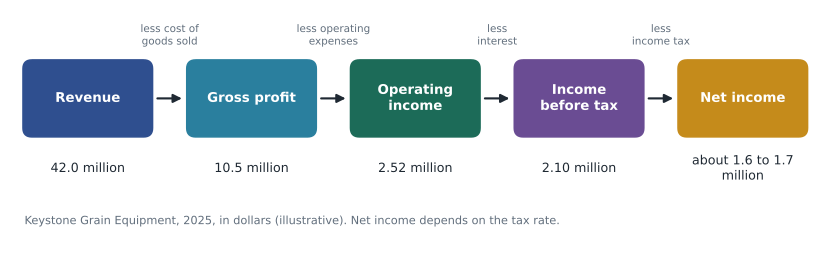
Each step of the chain gives a seller a place to show value. A product that lets the customer sell more raises revenue. One that lowers material or production costs raises gross profit. One that saves staff time or rent lowers operating expenses. One that reduces risk protects all of it. Rob's habit was to ask, for every claim in a proposal, "Which line on their income statement does this move?" If nobody could say, the claim was probably too vague.
| Where value lands | What it looks like at Ridgeline's customers | Example |
|---|---|---|
| Revenue | The customer sells more or keeps customers longer | Keystone wins dealer business after better training sessions |
| Cost of goods sold | Direct costs of the customer's products fall | A manufacturer prints fewer wasted production drawings |
| Operating expenses | Staff time, rent, travel or service costs fall | Eastgate Physiotherapy stops losing staff time to printer jams |
| Cash and working capital | The customer pays later, spreads costs or frees cash | A lease instead of a cash purchase during a busy season |
| Risk | Fewer outages, breaches, fines or failed projects | Fewer double-booked rooms in front of important visitors |
Three questions Rob asks about every customer
Rob's first question, how the customer makes money, sounds obvious, but sellers often skip it. Keystone builds grain-handling equipment such as augers, conveyors and dryers, and sells it through about seventy independent farm-equipment dealers. Its revenue depends on dealers ordering, and dealers order when farmers are confident about the coming season. That made dealer relationships, and the training Keystone gives dealers' staff, central to its business. A room-booking and video system for its training center is not an office expense to Keystone's president; it is part of how the company keeps dealers selling its products.
The second question, what the finance director worries about at this time of year, depends on the customer's cycle. Keystone's shipments are heavily seasonal. Most of its equipment ships between April and September, so it builds inventory over the winter and spring, pays its suppliers before dealers pay it, and borrows on its operating line of credit to bridge the gap. In the fall its cash position is at its strongest; in March it is at its weakest. A quote that asks for a large payment in March lands at the worst possible moment. Maya had not known any of this.
The third question, how many dollars of sales it takes to pay for a purchase, is one of the simplest and most persuasive calculations a seller can make. A business does not pay for a purchase out of revenue; it pays out of profit. If a company keeps 6 cents of operating profit from every dollar of sales, then every dollar it spends that does not earn its way back has to be covered by about 17 dollars of new sales.
Worked problem
How much of Keystone's sales would pay for the training center?
Keystone's operating margin in 2025 was 6 in 100: operating income of 2.52 million dollars on revenue of 42.0 million. Maya's proposal for the dealer training center is 48,000 dollars. If the purchase produced no savings or extra sales at all, how much additional revenue would Keystone need at its normal operating margin to cover the cost?
Show solution
- \[\text{Operating margin} = \frac{2{,}520{,}000}{42{,}000{,}000} = 0.06\]
- \[\text{Revenue needed} = \frac{48{,}000}{0.06} = 800{,}000\]
- Keystone would need about 800,000 dollars of extra sales to earn the 48,000 dollars of operating profit that pays for the room.
Answer: About 800,000 dollars of new sales. This is why a finance director treats every purchase as an investment that must pay its own way, and why Maya's proposal has to show savings or gains, not just features.
Rob used the calculation for a second purpose too: as a reminder of what a discount costs Ridgeline. The same arithmetic applies in reverse. If Ridgeline gives away 1,000 dollars in a discount, it has to sell many thousands of dollars more to earn that profit back. Lesson 7 returns to this.
Who cares about which numbers
Different people inside a customer look at a purchase through different numbers. Business acumen includes knowing which numbers matter to whom, so that each conversation uses the right ones. A finance director may never ask about screen sizes, and an operations manager may never ask about depreciation.
| Role at the customer | Numbers they watch | Questions they ask a seller |
|---|---|---|
| Owner or president | Growth, profit, cash, strategic risk | Does this help us win and keep customers? What happens if we do nothing? |
| Finance director or controller | Cash flow, budgets, return on investment, payback, financing, tax treatment | What does it cost in total, when do we pay, and when do we get it back? |
| Operations director | Throughput, downtime, staff hours, service levels | Will this run reliably, and how much time does it save my team? |
| HR manager | Retention, training hours, safety, absenteeism | Will staff use it, and does it help us keep people? |
| IT manager or contractor | Security, support load, compatibility, licenses | Will this create work or risk for us? |
| Procurement or purchasing | Price, terms, compliance with policy, supplier risk | Is this competitive, and did we follow our rules? |
At Keystone, Dale Petrie cared about the operations columns: fewer double-booked rooms, smoother dealer visits and less time spent apologizing. Linda Sorensen in HR cared about training hours and the experience of new staff. Keystone's finance director, Marlene Toews, cared about cash and payback, and she had a reason to be careful with Ridgeline. Earlier in the fall she had disputed a contracted price increase on Keystone's printers, and Ridgeline had agreed to spread it over three months. Maya would need a different conversation with each of them.
Public bodies and non-profits
Not every customer is trying to make a profit. School divisions, cities, hospitals and charities have budgets rather than profits, but the same thinking applies. They want to deliver more service for the same money, stay within their approved budget, and avoid surprises. Public bodies also have fiscal years that drive when they can buy. A South Dakota school district such as Prairie Valley runs its fiscal year from July 1 to June 30 and adopts its budget at a public hearing before the year starts. A seller who proposes a purchase with no budget line in the current year is asking for something the buyer may not be able to give, however good the value.
For these customers, the useful question is not "how much profit?" but "how much budget does this free up, and for what?" When Ridgeline's managed print proposal to Prairie Valley showed a saving against the division's current spending of about 78,000 dollars a year, the business manager's interest was in what that money could pay for instead: classroom supplies, a reading program, or simply a balanced budget.
Building your own acumen
Rob's advice to Maya was practical. Business acumen grows from habits, not from a single course. He suggested five.
- Read what your customers publish. Public companies publish annual reports; public bodies publish budgets and minutes; private companies publish less, but their websites, job postings and news coverage say a lot about their priorities.
- Learn three numbers for every key account: its revenue, its main cost pressures and its busiest season.
- Ask finance questions early in discovery. "How will this decision be evaluated?" and "Who else will look at the numbers?" are fair questions in any first meeting.
- Translate every claim into money and time. If you say "saves time", say how many hours, whose hours and what they are worth.
- Check your arithmetic before the customer does. A finance director who finds one wrong number will doubt the rest.
Maya left the first session with a list of homework: find out what Keystone's busiest months were, ask Dale who besides him would review the training-center proposal, and redo her quote so that it showed what Keystone would get back for its 48,000 dollars, not just what it would get. She also asked Grace to send her the simple business-case template the team used, which lesson 10 works through in detail.
Acumen and honesty
Business acumen can be misused. A seller who learns the language of finance can also learn to dress up weak numbers so they look strong. Rob was blunt about this. "The point of speaking their language is so they can check us," he said. "If our numbers are honest, a good finance director will make our case for us inside the company. If they are inflated, the same person will kill the deal and remember us." Ridgeline's sales code, introduced in November 2026, required that any savings figure in a proposal be traceable to a source, either the customer's own data or a stated, reasonable assumption. SLS-150 covers the law on misleading claims; this course assumes that every number a seller presents is one the seller believes.
Common mistakes
MistakeBusiness acumen means knowing accounting rules in detail.
InsteadIt means understanding how the customer makes money and how your offer affects revenue, costs, cash and risk.
MistakeEvery person at the customer cares about the same numbers.
InsteadOwners, finance, operations, HR, IT and procurement each watch different measures.
MistakeA purchase is paid for out of the customer's revenue.
InsteadIt is paid for out of profit; at a 6 in 100 operating margin, each dollar of cost needs about 17 dollars of sales to cover it.
MistakePublic bodies do not care about value because they do not make a profit.
InsteadThey care about delivering service within budget, and about when budget is available in their fiscal year.
Summary and key terms
- Business acumen is the ability to understand how an organization makes money and how a decision affects its revenue, costs, cash and risk.
- The profit chain runs from revenue through gross profit and operating income to net income, and each step is a place to show value.
- Dividing a cost by the customer's operating margin shows how much revenue would be needed to pay for it.
- Different roles at a customer watch different numbers, so each conversation should use the right ones.
- Public bodies think in budgets and fiscal years rather than profit.
- Acumen grows from habits such as reading what customers publish and translating every claim into money and time.
- Honest numbers are the point: they let the customer's finance people check the seller's case.
- Business acumen
- Understanding how an organization makes money and how decisions affect its revenue, costs, cash and risk.
- Revenue
- Money earned from selling products or services, before any costs.
- Cost of goods sold
- The direct costs of the products or services a business sold; also called cost of sales.
- Gross profit
- Revenue minus cost of goods sold.
- Operating expenses
- The costs of running a business, such as salaries, rent and administration, not counted in cost of goods sold.
- Operating income
- Gross profit minus operating expenses; also called operating profit.
- Operating margin
- Operating income divided by revenue.
- Fiscal year
- The twelve-month period an organization uses for its budget and financial statements.
Practice problems
Work each problem on paper first, then reveal the answer to check.
A customer has an operating margin of 8 in 100. How much extra revenue would it need to cover a 12,000-dollar purchase that produced no benefit?
Show answer
12,000 ÷ 0.08 = 150,000 dollars.
Which line of an income statement does "saves 20 hours of office staff time a month" affect?
Show answer
Operating expenses, because office salaries are an operating cost.
Why might a quote that requires a large payment in March be a problem for Keystone?
Show answer
Keystone's cash is at its lowest in early spring because it builds inventory before its April to September shipping season.
Lesson quiz · 5 questions
Score 60% or more to complete this lesson.
Create a free account to save your progress, take quizzes and earn a certificate.