
SLS-222 · Lesson 10 of 12 · 20 min
Building a value case
▶ Video coming soon A video version of this lesson is on the way.
By November 10, Maya had most of the pieces of the Keystone training-center case: the benefits from lesson 4, the comparison with the integrator from lesson 8, the lease option from lesson 5 and the executive brief from lesson 9. At the last regular value desk session of the fiscal year, Grace asked her to put them together into a single document that Marlene Toews could hand to Keystone's board, and that would still make sense to someone who had never met Maya.
"A value case isn't a longer proposal," Grace said. "It's the customer's own argument for spending the money, written down so it can be checked. If we've done it right, Marlene could change any number in it and see what happens."
What a value case is
A value case, often called a business case, is a structured document that sets out why a customer should make a particular decision: the problem, the options, the costs, the expected benefits, the assumptions behind them, the risks, and how the results will be measured. In business-to-business selling it is usually built with the customer rather than for it. Its purpose is to help the customer decide, and to help the people inside the customer who support the decision win the internal argument.
A value case differs from a proposal in emphasis. A proposal says what the seller will do and for how much. A value case says what the customer will get, why it is worth the money and how the customer will know. Many large proposals contain a value case; small ones may need only a few lines of one.
The steps
Ridgeline's value-case template followed eight steps, which Grace had adapted from the approach many business-to-business companies use.
| Step | Question it answers | Keystone training center |
|---|---|---|
| 1. Define the problem | What is wrong now, in the customer's words? | Dealer training in rented hotel rooms costs about 27,800 dollars a year and is growing |
| 2. Set the baseline | What does the problem cost today, measured? | 2025: 16 hotel days at 1,100 dollars; 12 trainer trips at 850 dollars |
| 3. List the options | What could the customer do? | Keep using hotels; integrator's rooms; Ridgeline's rooms (four or six) |
| 4. Identify value drivers | Where does each option change costs or results? | Hotel days, trips, coordinator time, service response |
| 5. Quantify with assumptions | How big is each effect, on what basis? | Each benefit with a named source or stated assumption |
| 6. Test the sensitivity | What if the assumptions are wrong? | Low, expected and high cases; break-even |
| 7. Name the risks | What could stop the value appearing? | Installation delays; low use of video training |
| 8. Plan the measurement | How will we know it worked? | Track hotel invoices and trips in 2027 against 2025 |
The baseline
Everything in a value case is measured against the baseline: what the customer's situation costs or produces today, without the change. A weak baseline makes every later figure doubtful. The strongest baselines come from the customer's own records for a complete recent period; the weakest come from industry averages. Maya's baseline came from Keystone's 2025 hotel invoices and travel claims, which Linda and Marlene had supplied. She noted one limitation: 2025 had been an ordinary year, and if Keystone added dealers in 2027 as Raymond expected, the baseline would understate future costs.
The assumptions register
Every value case depends on assumptions, and the honest ones show them. Grace insisted on a short assumptions register: a table listing each assumption, its value, its source and how confident the team was. It made the case easy to check and easy to change.
| Assumption | Value | Source | Confidence |
|---|---|---|---|
| Hotel training days avoided per year | 16 | Keystone 2025 training calendar (Linda Sorensen) | High |
| Hotel cost per day, room and audiovisual | 1,100 dollars | Keystone 2025 hotel invoices | High |
| Trainer trips replaced by video per year | 12 | Linda's review of 2025 trips | Medium |
| Cost per trip, travel and accommodation | 850 dollars | Keystone 2025 travel claims (Marlene Toews) | High |
| RoomFlow subscription | 6 rooms × 45 dollars a month | Ridgeline price list | High |
| Equipment life | 5 years | Manufacturer and Ridgeline service records | Medium |
| Discount rate | 8 in 100 | Keystone hurdle rate (Marlene) | High |
The register also listed what the case deliberately left out: trainers' travel time, any extra dealer sales from better training, the use of the rooms for other meetings, and the coordinator time from lesson 8. Leaving them out made the case conservative; listing them showed the board there was more value that had not been counted.
Sensitivity: low, expected and high
No assumption is certain. A sensitivity analysis shows how the result changes when the assumptions change. The simplest form, which most finance directors expect, is three cases: low, expected and high. The low case asks what happens if things go worse than planned; if the decision still makes sense in the low case, it is a robust decision.
Worked problem
Three cases for the training center
Calculate the annual net benefit, the payback period in months and the three-year ROI for three cases: low (12 hotel days, 8 trips), expected (16 days, 12 trips) and high (20 days, 16 trips). Use 1,100 dollars per hotel day, 850 dollars per trip, 3,240 dollars a year for RoomFlow and an investment of 48,000 dollars.
Show solution
- Low: benefits 12 × 1,100 + 8 × 850 = 13,200 + 6,800 = 20,000 dollars; net 20,000 − 3,240 = 16,760 dollars.
- Expected: benefits 17,600 + 10,200 = 27,800 dollars; net 24,560 dollars.
- High: benefits 22,000 + 13,600 = 35,600 dollars; net 32,360 dollars.
- \[\text{Payback (months)} = \frac{48{,}000}{\text{net}} \times 12: \quad 34.4,\ 23.5,\ 17.8\]
- \[\text{3-year ROI} = \frac{3 \times \text{net} - 48{,}000}{48{,}000}: \quad 0.05,\ 0.535,\ 1.02\]
Answer: Payback ranges from about 34 months in the low case to about 18 in the high case, with 23.5 expected. The three-year ROI ranges from about 5 to about 102 in 100. In the low case, payback slightly misses Keystone's three-year target.
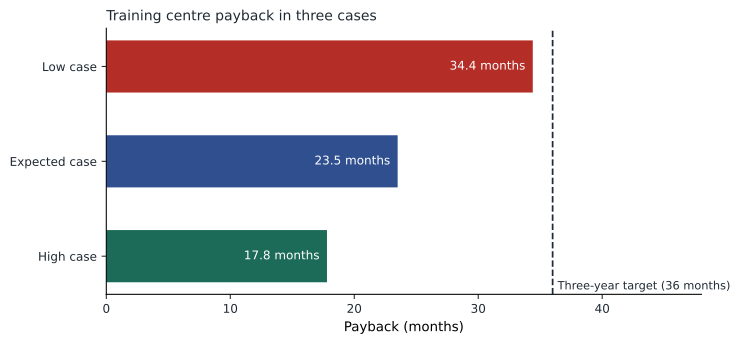
Maya noticed that in the low case the payback was 34.4 months, inside 36 months but only just, and that the three-year ROI was barely positive. She did not hide it. Grace suggested a further question that boards often find more useful than any single case: how bad would things have to be for the project to fail the customer's test?
Break-even
A break-even analysis works backwards from the customer's test to the minimum benefit needed to pass it. It turns an argument about uncertain forecasts into a simpler question: is the customer confident of at least this much?
Worked problem
How many hotel days must the training center replace?
Keystone wants payback within three years. With an investment of 48,000 dollars and RoomFlow at 3,240 dollars a year, what annual benefit is needed? If the 12 trainer trips at 850 dollars are achieved, how many hotel days must be replaced? If no trips are replaced, how many hotel days are needed?
Show solution
- \[\text{Net benefit needed} = \frac{48{,}000}{3} = 16{,}000 \text{ a year}\]
- Gross benefit needed: 16,000 + 3,240 = 19,240 dollars a year.
- \[\text{With 12 trips: } \frac{19{,}240 - 10{,}200}{1{,}100} \approx 8.2 \text{ hotel days}\]
- \[\text{With no trips: } \frac{19{,}240}{1{,}100} \approx 17.5 \text{ hotel days}\]
Answer: With the expected trips, Keystone needs to replace only about 8 of its 16 hotel days to pay back within three years. Without any trips, it would need about 17 or 18 days, slightly more than in 2025. The case depends much more on the hotel days than on the trips.
The break-even result gave Marlene a sentence she could use with the board: "Even if we only bring half our hotel training days in-house, the rooms pay for themselves in three years." That was stronger than any of the three cases on its own.
Building it with the customer
Grace's last point was about ownership. A value case that a seller builds alone and presents to the customer is easy to dismiss as a sales document. One that the customer helped build, with its own data and its own assumptions, is the customer's document. Maya had asked Linda and Marlene for every figure, shown them the draft register on November 6 and accepted two of Marlene's changes: a shorter equipment life of five years instead of seven, and leaving the coordinator's time out of the main case. Both made the result smaller. Both made it more credible.
After the decision
A value case is also a promise. Step 8, measurement, says how the customer will know whether the value appeared. For Keystone, Maya proposed comparing 2027 hotel invoices and trainer trips with the 2025 baseline at a review in early 2028, if the board approved the project. Account managers call this value realization: checking, after the sale, that the promised value arrived, which SLS-220 described as part of key account management. A seller who proposes the measurement up front shows confidence in the case and creates a reason to come back.
A value case for a small deal
Not every deal needs eight steps and a board document. For Eastgate Physiotherapy's managed print proposal, worth 14,400 dollars over three years, the value case fit in a short table inside the proposal, and the owners could read it in a minute. The same principles applied: a measured baseline, stated assumptions, the hard and soft value shown separately, and a simple test.
| Three years | Keep current lease | Ridgeline managed print | Basis |
|---|---|---|---|
| Lease, service and toner | 22,500 dollars | 14,400 dollars | Current invoices; Ridgeline's 400 dollars a month |
| Staff time lost to jams | 14,400 dollars | About 2,400 dollars | Carla Bennett's two-week jam tally at 40 dollars an hour |
| Total | 36,900 dollars | 16,800 dollars | |
| Hard savings | 8,100 dollars | Invoices only | |
| Hard and soft savings | 20,100 dollars | Including staff time |
The table answered the owners' test, "Will this cost us less?", on hard savings alone, which made the decision easy. Maya's covering note added one sentence about the sensitivity: even if jams continued at half the old rate, the hard savings were unchanged, because they came from the invoices. For a decision of this size, that was enough.
The general rule is that the value case should match the size and risk of the decision. A finance director will be suspicious of a twelve-page analysis for a small purchase, and equally suspicious of a single sentence for a large one. A useful test is to ask the customer, early on, "What would you need to see to approve this?" and build exactly that.
How value cases go wrong
Grace kept a list of the problems she found most often when reviewing account executives' value cases. Most of them made the numbers larger and the case weaker.
| Problem | Why it hurts | Fix |
|---|---|---|
| Counting the same benefit twice | Inflates the total; a careful reader finds it | Trace each dollar of benefit to one source |
| Counting benefits the alternative would also deliver | Overstates the difference between options | Count only differences against the realistic alternative |
| Treating soft value as cash | The customer does not see the money | Show hard and soft value separately |
| Using the seller's marketing figures | The customer cannot check them | Use the customer's own data or accepted assumptions |
| Choosing a flattering time period | Looks like manipulation | Use the customer's normal period and equipment life |
| Forgetting running costs | Payback looks shorter than it is | Include subscriptions, service and staff time to run it |
| No measurement plan | The promise cannot be checked later | Say what will be measured, when, and against which baseline |
Maya checked her Keystone case against the list on the evening of November 10 and found one problem. When she combined the pieces into one document, a line in her comparison table had described the hotel savings as an advantage of Ridgeline over the integrator, although both offers would deliver them, exactly the mistake lesson 8 had avoided. She moved the hotel savings to a line shared by both options, and the comparison lost a little size and gained a lot of credibility.
Common mistakes
MistakeA value case is a longer version of the proposal.
InsteadIt is the customer's argument for the decision, with options, assumptions, risks and how results will be measured.
MistakeIndustry averages make a good baseline.
InsteadThe customer's own records for a recent period are far more credible.
MistakeShowing a low case weakens the argument.
InsteadA decision that still makes sense in the low case is robust, and showing it builds trust.
MistakeThe seller should build the value case alone to keep control of the numbers.
InsteadBuild it with the customer, using its data; a customer-owned case is harder to dismiss.
Summary and key terms
- A value case sets out why a customer should make a decision: the problem, baseline, options, value drivers, quantified benefits and costs, assumptions, risks and measurement.
- The baseline should come from the customer's own records.
- An assumptions register lists each assumption with its source and confidence, and what has been left out.
- Sensitivity analysis, usually low, expected and high cases, shows how robust the decision is.
- Break-even analysis works back from the customer's test to the minimum benefit needed, which is often more persuasive than any single forecast.
- A value case built with the customer belongs to the customer.
- Planning how results will be measured after the sale turns the case into a promise and supports value realization.
- Value case
- A structured document setting out why a customer should make a decision, with costs, benefits, assumptions, risks and measurement; also called a business case.
- Baseline
- The measured cost or performance of the customer's current situation.
- Value driver
- A factor through which an option changes the customer's costs or results.
- Assumptions register
- A table of the assumptions behind a value case, with values, sources and confidence.
- Sensitivity analysis
- Testing how a result changes when assumptions change.
- Break-even analysis
- Finding the minimum benefit needed to meet the customer's test.
- Value realization
- Checking after the sale that the promised value was delivered.
Practice problems
Work each problem on paper first, then reveal the answer to check.
An investment of 30,000 dollars has running costs of 2,000 dollars a year. What annual gross benefit is needed for a two-year payback?
Show answer
Net needed 15,000; gross 15,000 + 2,000 = 17,000 dollars a year.
Why did Maya accept Marlene's changes that made the result smaller?
Show answer
They made the case more credible and made it Keystone's case rather than Ridgeline's.
What four things did the assumptions register list as left out?
Show answer
Trainers' travel time, extra dealer sales, other use of the rooms and the coordinator's time.
Lesson quiz · 5 questions
Score 60% or more to complete this lesson.
Create a free account to save your progress, take quizzes and earn a certificate.