
SLS-213 · Lesson 4 of 12 · 20 min
Preparing to negotiate
▶ Video coming soon A video version of this lesson is on the way.
Prairie Valley's request for proposals arrived on Monday, September 14, 2026. It asked for a five-year managed print service for 14 schools and the division office, with proposals due on Friday, October 9. The document said the division would shortlist up to three suppliers and might invite them to submit a best and final offer. Darnell read it and said to Maya, "The negotiation starts today, not when they call us in. Most of what we get will be decided by how well we prepare."
Research on negotiation supports him. Studies of professional negotiators, going back to Neil Rackham and John Carlisle's observations of skilled labor and contract negotiators in the 1970s, found that skilled negotiators spent no more total time preparing than average ones, but used it differently: they considered more options, looked for more common ground and set ranges rather than single fixed points. This lesson describes a preparation process that works for both a five-year public contract and a Saturday appliance sale, though the second takes five minutes rather than five days.
What preparation covers
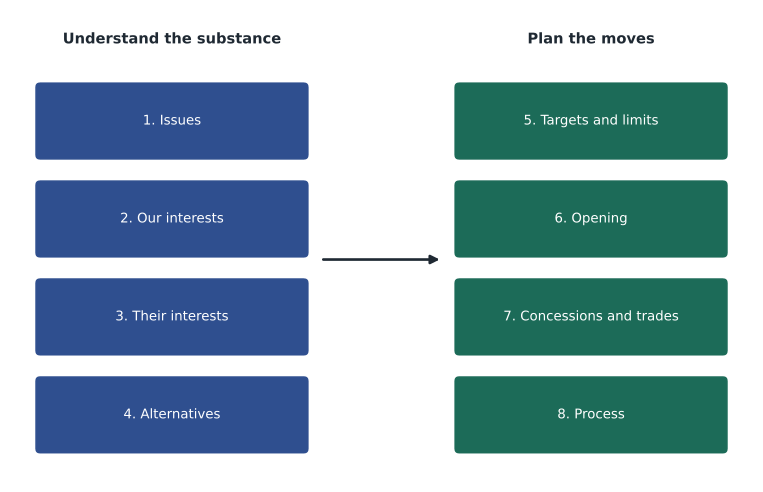
Preparation answers a set of questions before the negotiation begins. Darnell gave his team a one-page planning sheet with eight headings.
| Heading | Question to answer |
|---|---|
| 1. Issues | What will be negotiated, and which issues matter most to each side? |
| 2. Our interests | Why do we want each outcome? What do we really need? |
| 3. Their interests | What does the customer need, and why? Who else influences them? |
| 4. Alternatives | What will each side do if there is no agreement? |
| 5. Targets and limits | What outcome are we aiming for, and what is our walk-away point? |
| 6. Opening | What will we propose first, and how will we justify it? |
| 7. Concessions and trades | What can we give, what will we ask for in return, and in what order? |
| 8. Process | Who attends, who speaks, what is the agenda, and what authority do we have? |
Listing the issues
The first step is to list everything that could be negotiated, not just price. In the Prairie Valley bid, Maya and Darnell listed eleven issues: price per black page, price per color page, monthly device fees, contract length, renewal options, service response times, toner delivery, device placement, training, reporting and the cost of devices added or removed during the term. Listing them all matters because, as lesson 1 explained, each extra issue is a chance to trade.
For each issue, the planning sheet asks how important it is to each side. Ridgeline's sellers use a simple rating of high, medium or low. The most valuable trades come from issues that matter a lot to one side and little to the other.
| Issue | Importance to Ridgeline | Likely importance to Prairie Valley |
|---|---|---|
| Price per page | High | High |
| Contract length | High (longer is better) | Medium (wants an exit if service is poor) |
| Service response time | Medium | High (classes depend on working printers) |
| Training for school staff | Low cost to provide | Medium |
| Usage reporting by school | Low cost (already in the software) | High (the business office wants it) |
| Toner delivery to each school | Medium | Medium |
| Device change charges | Medium | Low |
The table already suggests trades. School-by-school usage reporting costs Ridgeline almost nothing, because its print management software produces it automatically, but the division's business office wants it badly. Ridgeline could offer it generously in exchange for something it values more, such as a longer contract.
Understanding interests on both sides
Interests are the reasons behind what each side asks for. Lesson 5 explores them in depth. In preparation, the key is to write down what you know and what you need to find out. Maya knew from her earlier meetings that the facilities manager wanted fewer printer models to support, that the business office wanted to cut costs by at least 10 in 100 compared with the current contract, and that principals cared about printers working on the first day of term. She did not know how much weight the procurement officer would put on price compared with service, so she listed that as a question to ask at the clarification meeting.
It is just as important to be clear about your own interests. Ridgeline wanted the Prairie Valley contract for its revenue, but also because winning one school division would make it easier to sell to the three neighboring divisions. That interest made a longer contract and a good reference more valuable to Ridgeline than a few extra dollars per month.
Targets and walk-away points
Every negotiator needs two numbers for each important issue: a target, the realistic outcome they are aiming for, and a walk-away point, also called a reservation point or resistance point, which is the least favorable deal they will accept. Below the walk-away point, no deal is better than this deal.
Setting a walk-away point in advance is one of the most important things a negotiator can do. Without one, a seller under pressure tends to keep conceding, because each small step seems reasonable on its own. With one, the seller knows exactly when to stop.
Worked problem
Setting a walk-away price
Ridgeline's proposal to Prairie Valley is worth 70,800 dollars a year. The cost of delivering it, including devices, service, toner and software, is estimated at 49,560 dollars a year. Ridgeline's usual target gross margin is 30 in 100. For multi-year public-sector contracts, Rob Kowalski has set a minimum of 22 in 100. What is Ridgeline's walk-away price, and what margin does the proposal price give?
Show solution
- Margin at the proposal price: (70,800 − 49,560) ÷ 70,800 = 21,240 ÷ 70,800 = 0.30, or 30 in 100.
- At the minimum margin, price × (1 − 0.22) = cost, so price = cost ÷ 0.78.
- \[P_{\text{walk}} = \frac{49\,560}{0.78} \approx 63\,538\]
- Round up to a figure the team can remember: 63,540 dollars a year.
- Room between proposal and walk-away: 70,800 − 63,540 = 7,260 dollars a year.
Answer: The proposal price gives the target margin of 30 in 100. Ridgeline's walk-away price is about 63,540 dollars a year; below that, the contract would earn less than the 22 in 100 minimum. That leaves about 7,260 dollars a year of room for concessions.
A walk-away point should rest on real numbers and real alternatives, not on hope or pride. It can change if circumstances change, for example if costs fall or the value of a reference customer turns out to be higher than expected. But it should not change in the middle of a negotiation simply because the other side pushes hard. If it needs to change, the team should step out, discuss it, and agree a new figure deliberately.
Authority
Before any negotiation, a seller must know what they are allowed to agree. Ridgeline's discount bands, from lesson 1, set that out for price. Other terms have their own limits: Maya could agree service response times that matched Ridgeline's standard service levels, but anything faster needed approval from the service manager, because it would change staffing.
Knowing your authority protects you in two ways. It stops you agreeing something your company cannot deliver. And it gives you a legitimate reason to pause: "That's beyond what I can approve on my own; let me take it to my manager" buys time to think without sounding evasive. Lesson 7 discusses how buyers use the same tactic.
Planning concessions
A concession is anything one side gives up or improves in the other's favor. Lesson 6 covers concession patterns in detail. During preparation, the task is to list possible concessions, estimate what each costs your company and what it is worth to the customer, and decide what you will ask for in return. A concession that costs little and is worth a lot to the customer is a strong trading chip; it should not be given away for nothing.
| Possible concession | Cost to Ridgeline per year | Value to Prairie Valley | Ask in return |
|---|---|---|---|
| School-by-school usage reports | About 0 (automatic) | High | A five-year term rather than three |
| Two training sessions per school per year | About 2,100 dollars | Medium | Agreement to a single toner ordering process |
| Four-hour service response instead of next day | About 3,000 dollars | High | Reference visits for other divisions |
| Page price 0.0005 dollars lower | About 720 dollars | Medium | A volume commitment or longer term |
| Free removal of old devices | About 1,800 dollars once | Medium | Signing by a set date |
Planning the process
The last part of preparation is practical. Who will attend? Who will speak on price, and who on service? What is the agenda? How will the team signal to each other if they need a break? Ridgeline sent three people to the Prairie Valley clarification meeting: Maya as the lead, Darnell to handle price questions, and Ridgeline's service manager to answer technical questions. They agreed that only Darnell would respond to any request for a lower price, and that anyone could ask for a five-minute break.
Preparing for a retail negotiation
In retail, preparation is quicker but follows the same logic, and much of it happens before the customer walks in. Juniper & Pine's associates know their authority (price matching on identical in-stock items from local competitors, package pricing on four or more major appliances, waiving the haul-away fee, and adjusting delivery fees by up to 50 dollars) and know what needs a manager. Before a big sale, Carl does a quick mental version of the planning sheet.
Worked problem
Carl's five-minute plan for the Morales kitchen
Elaine and Victor Morales are coming back on Saturday, October 17, to decide on a four-appliance kitchen package. What would a quick plan cover?
Show solution
- Issues: total price, delivery dates, installation, haul-away, protection plans, financing.
- Their interests (from the first visit): a matching look; the range and dishwasher cannot arrive until after the countertops go in on November 6; a budget of about 6,000 dollars; worry about another long delivery wait after a bad experience elsewhere.
- Store interests: the package sale and protection plans; avoiding two separate delivery trips where possible.
- Target: the 5,646-dollar package with two protection plans. Limit: price-match any identical in-stock local advertised price; anything further needs Bev.
- Trades: staged delivery (fridge now, range and dishwasher on November 9) at no extra charge, which costs the store one extra truck stop, in exchange for completing the sale today.
Answer: Carl went into the conversation knowing what the Moraleses cared about, what he could offer, what it cost the store and what he would ask in return. The quick plan took him less time than making a coffee.
Common preparation failures
The most common failure is not preparing at all, especially for negotiations that seem routine. The second is preparing only for price. The third is preparing only your own side: knowing exactly what you want but having no idea what the customer needs, which leaves you unable to propose trades. The fourth is setting a walk-away point and then abandoning it under pressure.
After the Prairie Valley proposal went in, Darnell kept the planning sheet on the team's shared drive and updated it after every contact with the division. By the time the shortlist was announced on October 21, the sheet had been revised four times. Lesson 7 follows what happened next.
Preparing for the other side's preparation
Good preparation also anticipates how the other side is preparing. A professional buyer will usually have their own target and walk-away, a list of concessions they want, and a view of the seller's alternatives. Asking "What would I do in their place?" helps a seller predict the opening, the likely requests and the arguments the buyer will use. Before the Prairie Valley clarification meeting, Darnell asked Maya to write the procurement officer's planning sheet as she imagined it. Maya guessed that page price would be the first issue raised and that the officer would ask Ridgeline to match a lower bid. Both guesses turned out to be right, and the team had answers ready.
Common mistakes
MistakePreparing only for price.
InsteadList every issue that could be negotiated and rate its importance to each side.
MistakeHaving no walk-away point.
InsteadSet a walk-away point based on real costs and alternatives before the negotiation starts.
MistakeChanging the walk-away point under pressure.
InsteadIf it must change, step out and agree a new figure deliberately with your team.
MistakeGiving away low-cost, high-value concessions for nothing.
InsteadPlan what you will ask for in return for each concession.
MistakeNot knowing your authority.
InsteadKnow exactly what you can agree, and use the limit as a legitimate reason to pause.
Summary and key terms
- Preparation decides much of a negotiation's outcome.
- A planning sheet covers issues, both sides' interests, alternatives, targets and limits, the opening, concessions and trades, and the process.
- Listing every issue, not just price, and rating its importance to each side reveals trades.
- Each important issue needs a target and a walk-away point; below the walk-away point, no deal is better.
- A walk-away price can be calculated from cost and a minimum margin: price = cost ÷ (1 − minimum margin).
- Sellers must know their authority, which protects them and gives a legitimate reason to pause.
- Planned concessions list the cost to the seller, the value to the customer and what to ask in return.
- Process planning covers attendees, roles, agenda and signals.
- Retail preparation is quicker but follows the same logic.
- Target
- The realistic outcome a negotiator is aiming for on an issue.
- Walk-away point
- The least favorable deal a negotiator will accept; also called the reservation or resistance point.
- Authority
- The limits on what a negotiator is allowed to agree without approval.
- Concession
- Something given up or improved in the other side's favor.
- Planning sheet
- A structured summary of issues, interests, alternatives, targets, opening, trades and process.
Practice problems
Work each problem on paper first, then reveal the answer to check.
A deal costs 30,000 dollars a year to deliver and the minimum margin is 25 in 100. What is the walk-away price?
Show answer
30,000 ÷ 0.75 = 40,000 dollars a year.
Why is school-by-school reporting a strong trading chip for Ridgeline?
Show answer
It costs Ridgeline almost nothing to provide but is highly valued by the division's business office.
Name two common preparation failures.
Show answer
Any two of: not preparing, preparing only for price, preparing only your own side, abandoning the walk-away point under pressure.
Lesson quiz · 5 questions
Score 60% or more to complete this lesson.
Create a free account to save your progress, take quizzes and earn a certificate.