
SLS-213 · Lesson 12 of 12 · 22 min
Role-play lab: a negotiation
▶ Video coming soon A video version of this lesson is on the way.
The last workshop session was on Thursday, November 12, 2026, two days after Prairie Valley announced its decision. Darnell had promised a role-play lab, and he had written two cases: one for Ridgeline's B2B sellers, and one he had borrowed from Bev Halvorsen for the Juniper & Pine associates, who joined the session for the afternoon because the two businesses had agreed to share training. Each participant would prepare for 20 minutes, negotiate for 15, and then be debriefed against a scorecard. Maya went first in the morning; Aiden went first in the afternoon.
This lesson walks through both role-plays, with the preparation, annotated excerpts from each negotiation, the scorecard and the debrief. It brings together every lesson in the course. Readers should use the case briefs to try the negotiations themselves before reading how Maya and Aiden handled them.
The scorecard
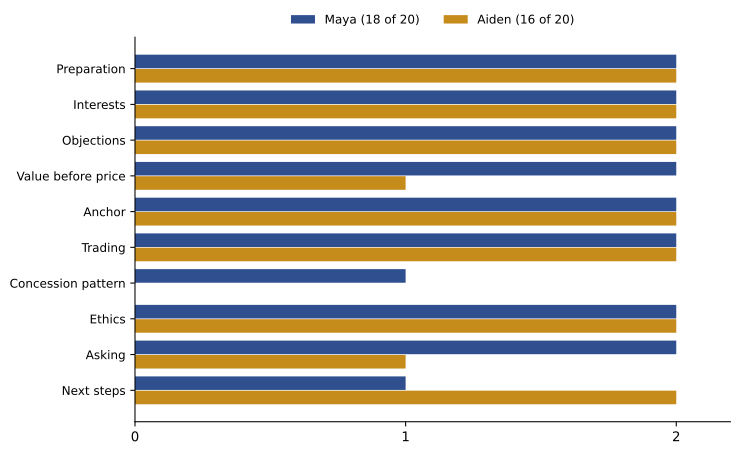
Both role-plays were scored on the same ten criteria, each worth 0, 1 or 2 points: 0 for not done, 1 for partly done, 2 for done well. The criteria come straight from the course.
| Criterion | What a 2 looks like | Lesson |
|---|---|---|
| 1. Preparation | Clear issues list, target, walk-away and planned trades | 4 |
| 2. Interests | Asked why before responding to positions | 5 |
| 3. Objection handling | Listened, acknowledged, clarified, responded, confirmed | 3 |
| 4. Value before price | Linked the price to the customer's needs before discussing discounts | 2, 8 |
| 5. Anchor and justify | Opened credibly and explained the opening | 6 |
| 6. Trading concessions | Every concession linked to something in return | 6 |
| 7. Concession pattern | Few concessions, each smaller than the last | 6 |
| 8. Ethics and honesty | No false claims, pressure or manipulation | 1, 10 |
| 9. Asking for commitment | Clear, specific and comfortable request | 9 |
| 10. Confirming and next steps | Summarized the agreement and the path to signature | 11 |
Case 1: Westgate & Rowe
Maya's case reused a fictional buyer from SLS-120: Priya Nandakumar, office administrator at Westgate & Rowe, a 22-person accounting firm moving to a new office when its lease ends in March. Darnell played Priya. The case brief gave Maya the following.
| Item | Detail |
|---|---|
| Proposal | Furniture for two meeting rooms (14,800 dollars), RoomFlow for 4 rooms (109 dollars a month, annual term), managed print with 2 devices (260 dollars a month, five-year term) |
| Ridgeline margins | Furniture about 40 in 100; RoomFlow about 70 in 100; managed print about 30 in 100 |
| Maya's authority | Up to 5 in 100 off any item; up to 10 in 100 with Darnell's approval |
| What Maya knows | Priya's boss wants three quotes; the move is in mid-March; the firm's busy season runs February to April |
| What Maya does not know | What the other quotes say; what Priya's budget is |
Darnell's private brief for Priya, which Maya did not see, said that the firm's budget for the meeting rooms was 14,000 dollars, that one competitor had quoted 13,400 dollars for similar furniture but could not deliver until April, and that Priya's real worry was having working meeting rooms on the first day in the new office, because clients would visit during tax season.
Maya's preparation
Maya filled in the planning sheet from lesson 4 in 18 minutes. Her issues list had seven items: furniture price, delivery date, installation, RoomFlow term, RoomFlow setup, print term and payment terms. Her target was the full proposal with no more than 3 in 100 off the furniture. Her walk-away on furniture was 10 in 100 off, the most Darnell could approve.
Worked problem
Maya's walk-away on the furniture
The furniture is priced at 14,800 dollars with a gross margin of about 40 in 100. At Maya's walk-away of 10 in 100 off, what would the furniture sell for, and what margin would remain?
Show solution
- Cost of the furniture: 14,800 × 0.60 = 8,880 dollars.
- Price at 10 in 100 off: 14,800 × 0.90 = 13,320 dollars.
- Gross profit: 13,320 − 8,880 = 4,440 dollars.
- Margin: 4,440 ÷ 13,320 = about 0.333, or about 33 in 100.
Answer: At the walk-away, the furniture would sell for 13,320 dollars and keep a margin of about 33 in 100. Maya planned to stay well above it.
Her planned trades were: guaranteed delivery and installation in the week of March 8, before the move, in exchange for signing by December 18; a free RoomFlow setup session for staff in exchange for a three-year RoomFlow term instead of annual; and, only if needed, a small furniture discount in exchange for both.
Excerpts from the negotiation
| Speaker | What was said | Coach's note |
|---|---|---|
| Priya | "Honestly, your furniture is the most expensive of the three quotes. Can you match 13,400?" | Competitive pressure with a specific figure (lesson 7) |
| Maya | "Thanks for telling me. Can I ask what's included in that quote, and when they could deliver?" | Acknowledged and clarified rather than conceding (lesson 3) |
| Priya | "Similar tables and chairs. They said April." | The hidden issue appears: timing |
| Maya | "Your move is mid-March, and clients will be visiting during tax season. How important is it that the rooms are ready on day one?" | Asked about the interest, not the position (lesson 5) |
| Priya | "Very. My boss would be furious if clients met in an empty room." | The real interest is confirmed |
| Maya | "Then here's what I can do. If you can sign by December 18, I'll guarantee delivery and installation the week of March 8, so the rooms are ready before you move in." | If-then trade on something cheap for Ridgeline and valuable to Priya (lesson 6) |
| Priya | "That helps. But I still have to explain the price difference to my boss." | Value is accepted; price is still an issue |
| Maya | "I understand. If we also move RoomFlow to a three-year term, I can include a staff setup session and take 3 in 100 off the furniture. That brings it to 14,356 dollars." | Second trade, smaller and linked to term (lessons 6 and 8) |
| Priya | "Could you do 5?" | A further request |
| Maya | "I'd rather not move further on price, but I can put the delivery guarantee in writing with a credit if we miss it. Would that help with your boss?" | Held price; offered a low-cost reassurance instead |
| Priya | "It would. Okay." | Agreement |
| Maya | "Great. So that's furniture at 14,356 with installation the week of March 8, guaranteed; RoomFlow for 4 rooms on a three-year term with a setup session; and print as proposed. I'll send the order form today for signature by December 18. Is that right?" | Summarized and confirmed next steps (lessons 9 and 11) |
Worked problem
What did Maya give, and what did she get?
Maya agreed 3 in 100 off the furniture and a free setup session (about 250 dollars of staff time) in exchange for signing by December 18 and a three-year RoomFlow term instead of annual. RoomFlow for 4 rooms is 109 dollars a month. Compare the furniture discount with the extra RoomFlow revenue that the three-year term secures beyond the first year.
Show solution
- Furniture discount: 14,800 × 0.03 = 444 dollars.
- Total given: 444 + 250 = 694 dollars.
- RoomFlow revenue per year: 109 × 12 = 1,308 dollars.
- Revenue secured for years 2 and 3: 1,308 × 2 = 2,616 dollars, at a margin of about 70 in 100, which is about 1,831 dollars of gross profit.
Answer: Maya gave about 694 dollars and secured about 2,616 dollars of RoomFlow revenue for years two and three, worth about 1,831 dollars in gross profit. She also met the customer's real interest, rooms ready before the move, which mattered more to Priya than the price.
Maya's debrief
Darnell scored Maya 18 out of 20. She earned full marks on preparation, interests, objection handling, value before price, anchoring, trading, ethics and asking for commitment. She lost a point on concession pattern because her second concession bundled two things at once, a discount and a setup session, which made it look larger than she intended; a cleaner sequence would have offered the setup session first and held the discount in reserve. She lost another point on next steps because she did not confirm who at Westgate & Rowe would sign, which, as lesson 11 showed, can delay a deal. Maya noted both in her development plan.
Case 2: the bedroom set
Aiden's case came from Bev's file of real situations, with the names changed. Bev played a customer, Mrs. Lindqvist, furnishing a guest bedroom.
| Item | Detail |
|---|---|
| Items | Queen bed 1,899 dollars, dresser 1,299 dollars, two nightstands at 499 dollars each |
| Store policy | Set price on four or more matching pieces: 3,799 dollars; price match on identical in-stock models at local competitors' current advertised prices; delivery 129 dollars, adjustable by up to 50 dollars |
| Furniture margin | About 45 in 100 |
| Customer's request | A competitor advertises the same bed for 1,749 dollars; she wants 15 in 100 off the whole set |
Worked problem
Checking the numbers before negotiating
What is the separate price of the four pieces, what discount does the set price represent, and what would 15 in 100 off the separate price be?
Show solution
- Separate price: 1,899 + 1,299 + 499 + 499 = 4,196 dollars.
- Set price discount: 4,196 − 3,799 = 397 dollars; 397 ÷ 4,196 = about 0.095, or about 9.5 in 100.
- Fifteen in 100 off the separate price: 4,196 × 0.85 = 3,566.60 dollars.
- Gap between the customer's request and the set price: 3,799 − 3,566.60 = 232.40 dollars.
Answer: The set price already gives about 9.5 in 100 off. The customer's request would cost a further 232.40 dollars, which is beyond Aiden's authority.
| Speaker | What was said | Coach's note |
|---|---|---|
| Mrs. Lindqvist | "Hartwell Furniture has this bed for 1,749. I want 15 in 100 off the lot, or I'll buy the bed there." | Position plus a stated BATNA |
| Aiden | "Thanks for showing me. Let me check it's the same model so I can match it properly." | Verified before conceding (lesson 8) |
| Aiden | "Their ad is for the Brookline II, which has a different headboard and no storage drawers. Ours is the Brookline with drawers, so it isn't an identical model." | Honest explanation; not a match under policy |
| Mrs. Lindqvist | "Well, it looks the same to me." | Product objection |
| Aiden | "They are close. The drawers are the main difference. Would you use the storage in a guest room?" | Clarified the value of the difference |
| Mrs. Lindqvist | "I suppose. My mother stays for weeks at a time." | Interest revealed: the guest stays a long time |
| Aiden | "Then the drawers will help. If you take all four pieces, the set price is 3,799, which is already about 9.5 in 100 off. I can also take 50 dollars off delivery if a Tuesday or Wednesday works." | Set price plus a traded delivery adjustment |
| Mrs. Lindqvist | "I was hoping for more." | Pressure |
| Aiden | "Let me see what I can do." | Coach's note: signals there is more (lesson 6) |
| Aiden | "I've checked, and that's the best I can do. Shall I write it up for Tuesday the 24th?" | Asked for commitment, but after signaling there was more |
Aiden's debrief
Bev scored Aiden 16 out of 20. His strongest moments were checking the model number, explaining the difference honestly and asking whether the storage mattered, which uncovered the customer's real interest. She took a point off value before price, because he mentioned the set price before fully exploring what the customer needed. She gave no points for concession pattern, because "let me see what I can do" signaled more room and then produced nothing, which Bev said would leave a real customer feeling misled. And she took a point off asking for commitment, because the close came straight after that disappointment. "You did the hard parts well," Bev told him. "Next time, don't promise to look for more unless there is more. Tell her kindly that the set price is the best price, and go back to the drawers and the delivery date."
What the lab showed
Darnell closed the session with three observations. First, in both role-plays, the turning point came when the seller asked about interests rather than arguing about price. Priya's real concern was timing; Mrs. Lindqvist's was storage for a long-staying guest. Second, both sellers held their price better than they would have in September, and both did so by offering something else of value rather than refusing flatly. Third, both lost points on small process details: the order of concessions, the signal that more was coming, confirming who would sign. "Those are the things that separate a good negotiator from a very good one," he said. "And they only get fixed with practice."
Maya's real deals ended the fall in good shape. Keystone had signed on October 30 with installation booked for the week of January 11. Lakeview Veterinary Hospital had signed on November 10. Prairie Valley's contract was with the lawyers, on track for signature by November 24. Aiden, meanwhile, had sold his first full kitchen package on his own the previous weekend, after reading the Morales file and asking Carl one question: "What did they actually need?"
Common mistakes
MistakeSkipping preparation because it is only a role-play.
InsteadPrepare as you would for a real negotiation; the habit is the point.
MistakeBundling two concessions into one step.
InsteadOffer concessions one at a time, the cheapest and most valued first.
MistakeSaying "let me see what I can do" when there is nothing more.
InsteadSay kindly that this is the best price, and return to value.
MistakeForgetting to confirm who will sign.
InsteadConfirm the decision-maker and signature process when summarizing the agreement.
MistakeTreating feedback as criticism.
InsteadUse the scorecard to choose one or two specific things to practice.
Summary and key terms
- The role-play lab combined the course's skills in two cases.
- A ten-criterion scorecard covered preparation, interests, objection handling, value before price, anchoring, trading, concession pattern, ethics, asking for commitment and confirming next steps.
- In the B2B case, Maya uncovered the buyer's real interest in having rooms ready before a move, traded a delivery guarantee for an early signature and a three-year term, gave about 694 dollars to secure about 2,616 dollars of future revenue, and scored 18 of 20.
- In the retail case, Aiden verified that a competitor's bed was a different model, uncovered the customer's need for storage, offered the set price and a traded delivery discount, and scored 16 of 20, losing points mainly for signaling more room than he had.
- In both cases the turning point was asking about interests rather than arguing about price, and the remaining gaps were small process details that improve with practice.
- Role-play
- A practice negotiation in which participants play seller and buyer using prepared case briefs.
- Case brief
- The information given to a role-play participant, sometimes including private details the other side does not see.
- Scorecard
- A list of criteria used to assess and give feedback on a performance.
- Debrief
- A review after a role-play of what went well and what to improve.
Practice problems
Work each problem on paper first, then reveal the answer to check.
Four pieces cost 900, 650, 300 and 300 dollars. The set price is 1,950. What discount is that, in 100?
Show answer
Separate total 2,150; 2,150 − 1,950 = 200; 200 ÷ 2,150 = about 9.3 in 100.
A three-year subscription is 95 dollars a month. How much revenue do years two and three add?
Show answer
95 × 12 × 2 = 2,280 dollars.
Why did Aiden lose points for "let me see what I can do"?
Show answer
It signaled more room and then produced nothing, which would leave a real customer feeling misled.
Lesson quiz · 5 questions
Score 60% or more to complete this lesson.
Create a free account to save your progress, take quizzes and earn a certificate.