
SLS-213 · Lesson 1 of 12 · 21 min
What negotiation means in sales
▶ Video coming soon A video version of this lesson is on the way.
On a Thursday afternoon in mid-September 2026, Darnell Brooks gathered Ridgeline's newer sellers in the small boardroom for the first session of what he called the negotiation workshop. Maya Chen had been at Ridgeline for just over two weeks. She had already learned that customers rarely said yes to the first price, and she had already given away a free delivery she probably did not need to give. Darnell opened with a question: "Who here has negotiated something this week?" Two hands went up. Then he asked who had agreed a meeting time, moved a deadline, asked for a better parking spot, or talked a customer out of a cheaper model. Every hand went up. "Then you all negotiate," he said. "The only question is whether you do it on purpose."
Across town, at Juniper & Pine Home, Aiden Laroque was learning the same lesson on the sales floor. A couple shopping for a kitchen full of appliances had shown him a competitor's quote on their phone and asked what he could do. Aiden's instinct was to find the lowest price the system would let him enter. Carl Jensen, who had sold appliances at the store for nine years, took him aside afterward. "Price is one thing they asked about," Carl said. "It is not the only thing they care about. Find out the rest before you start giving money away."
This course follows both of them through the fall of 2026, as Maya works through a large public-sector print contract and a technology deal with a manufacturer, and Aiden learns to handle price-match requests and bundle negotiations in a busy appliance and furniture department. It is shared by the Professional Sales and the Retail Sales and Store Management programs, because negotiation and closing happen in both worlds, with different stakes, speeds and rules.
A working definition
Negotiation is a process in which two or more parties who need something from each other try to reach an agreement on terms that neither could impose alone. Each side has some power, some interests and some alternatives. If one side could simply dictate the outcome, there would be nothing to negotiate; if neither side needed the other, there would be no reason to try.
In sales, negotiation usually happens near the end of the sales process, after the seller has understood the customer's needs and proposed a solution, but it can appear anywhere. A prospect may negotiate the length of a first meeting, the scope of a free trial or who will attend a demonstration. Most of what people call negotiation in sales is about the terms of a deal: price, quantity, delivery dates, payment terms, contract length, warranties, service levels, installation, training and what happens if something goes wrong.
Negotiation is not the same as persuasion, though the two overlap. Persuasion is trying to change what someone believes or wants. Negotiation is working out terms when both sides already want an agreement but not on exactly the same terms. A seller who is still persuading the customer that the product is worth buying is not ready to negotiate. One of the most common sales mistakes, which this course returns to often, is negotiating price before the customer has agreed that the solution is right.
Two kinds of negotiation
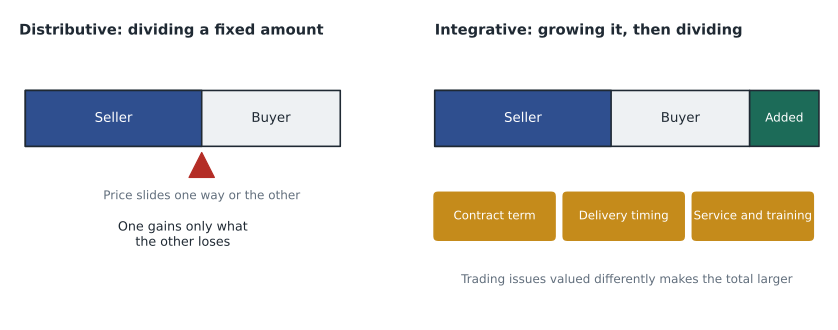
Negotiation researchers have long distinguished two broad kinds of bargaining. Howard Raiffa's classic *The Art and Science of Negotiation* (1982) and the work of Richard Walton and Robert McKersie before it described the difference between dividing value and creating it.
| Distributive negotiation | Integrative negotiation | |
|---|---|---|
| Basic idea | Dividing a fixed amount of value | Increasing the total value, then dividing it |
| Typical issue | A single issue, usually price | Several issues at once: price, terms, timing, service |
| How each side gains | One side's gain is the other's loss | Both can gain by trading things valued differently |
| Common name | Win-lose, zero-sum or claiming value | Win-win, positive-sum or creating value |
| Retail example | Haggling over the price of one floor-model sofa | Adding delivery timing, a matching chair and a protection plan to a sofa purchase |
| B2B example | Procurement demanding a lower page price | Trading a longer contract for a lower page price and quarterly reviews |
Real sales negotiations nearly always contain both. Even in a friendly integrative deal, someone eventually has to decide the price, and every dollar off the price is a dollar off the seller's revenue. Even in a hard distributive haggle, there are often other issues hiding underneath: when the customer needs delivery, how they want to pay, what worries them about the purchase. Skilled negotiators look for those issues, because each one is a chance to trade something cheap to give for something valuable to get.
Why negotiation matters to sellers
Negotiation decides how much of the value a sale creates goes to the seller's company and how much goes to the customer. That sounds abstract, but its effect on profit is very direct. Consider Ridgeline's managed print service, where the company earns a gross margin of about 30 in 100 on revenue. A discount does not come out of revenue in the same proportion as it comes out of profit.
Worked problem
What a small discount does to gross profit
Maya has a managed print proposal worth 40,000 dollars a year with a gross margin of 30 in 100. A customer asks for 5 in 100 off. How much revenue, and how much gross profit, does the discount cost?
Show solution
- Gross profit before the discount: 40,000 × 0.30 = 12,000 dollars.
- Revenue after a 5 in 100 discount: 40,000 × 0.95 = 38,000 dollars, a loss of 2,000 dollars of revenue.
- The cost of delivering the service does not change: 40,000 − 12,000 = 28,000 dollars.
- Gross profit after the discount: 38,000 − 28,000 = 10,000 dollars.
- The 2,000-dollar discount comes entirely out of gross profit: 2,000 ÷ 12,000 = about 0.167.
Answer: The discount costs 5 in 100 of revenue but about 17 in 100 of gross profit (2,000 of 12,000 dollars). A small concession on price is a large concession on profit.
This is why sales managers watch discounting so closely, and why lesson 8 is devoted to it. It is also why good negotiators would usually rather give something that costs the company little, such as a faster delivery date or an extra training session, than give money.
Negotiation also shapes the relationship that follows. A deal pushed through with pressure and tricks may close, but a customer who feels cheated will be harder to serve, quicker to complain and less likely to renew. A customer who feels the deal was fair, even if they did not get everything they asked for, is the beginning of a long account. In business-to-business selling, where much of the value comes from renewals and expansion, that matters more than any single price.
Negotiation in B2B and in retail
The same principles apply in both of this course's settings, but the practice looks different.
| B2B (Ridgeline) | Retail (Juniper & Pine) | |
|---|---|---|
| Who negotiates for the buyer | Often several people: a user, a manager, a finance or procurement officer | Usually the shopper, sometimes a partner or family member |
| How long it takes | Days to months, over several meetings | Minutes, usually in one visit |
| What is negotiable | Price, term, service levels, payment terms, legal terms, scope | Price within limits, delivery, bundles, protection plans, financing |
| Seller's authority | Account executive within a discount band; manager or VP above it | Associate within store policy; manager for exceptions |
| Written outcome | Proposal, contract or purchase order | Sales order and receipt, sometimes a financing agreement |
| Rules that apply | Contract law, procurement policies, competition law | Consumer protection law, store pricing policies, competition law |
In retail, many prices are not negotiable at all: a store with fixed prices and a clear price-match policy is not going to haggle over a lamp. But negotiation still happens around the edges. Juniper & Pine allows associates to match a local competitor's advertised price on an identical in-stock item, to offer a package price on four or more major appliances, and to adjust delivery and installation fees within limits. Above those limits, the associate asks Bev Halvorsen, the store manager, or the department lead. Knowing exactly where the limits are, and why they exist, is the first skill a retail negotiator needs.
In B2B, nearly everything is negotiable in principle, which makes discipline more important. Ridgeline account executives can approve discounts up to 5 in 100 on equipment and services on their own, up to 10 in 100 with Darnell's approval, and anything beyond that only with Rob Kowalski, the vice-president of sales. Every discount above the account executive's band must be recorded in the CRM with a reason. Those rules are not there to stop sellers closing deals; they are there to make sure discounts are given deliberately and in exchange for something.
Mindsets that help and mindsets that hurt
Many new salespeople approach negotiation with one of two unhelpful mindsets. The first is fear: the belief that the customer holds all the power and that any resistance means the deal is about to be lost. Sellers in this state give concessions before they are asked, accept the first counter-offer and apologize for their own prices. The second is combat: the belief that negotiation is a contest to be won, in which the other side is an opponent and anything that gains an advantage is fair. Sellers in this state make aggressive demands, hide information and damage relationships.
A more useful mindset sits between the two. It treats the customer as a partner in solving a problem, while accepting that partners can have different interests, and it treats the seller's own company's interests as legitimate. Roger Fisher, William Ury and Bruce Patton, in *Getting to Yes* (first published in 1981, with later editions in 1991 and 2011), called this principled negotiation: being soft on the people and hard on the problem. Their four core recommendations are worth learning now, because they come up throughout this course.
| Principle | What it means | In a sales negotiation |
|---|---|---|
| Separate the people from the problem | Keep relationships and emotions apart from the substance | Stay friendly with a tough procurement officer while holding firm on price |
| Focus on interests, not positions | Look behind what people demand to why they want it | Ask why the customer wants a shorter contract before arguing about length |
| Invent options for mutual gain | Generate several possible agreements before choosing | Offer two or three packages that trade price against term or service |
| Insist on objective criteria | Use fair standards rather than willpower | Point to published price lists, market rates or the customer's own cost data |
Lesson 5 adds the most famous idea from the same book, the BATNA, or best alternative to a negotiated agreement. For now, it is enough to know that a negotiator's real power comes less from tactics than from having a good alternative if this deal does not happen.
Ethics and honesty
Negotiation has a reputation for dishonesty, and some popular negotiation advice encourages bluffing. The line between acceptable and unacceptable behavior is worth drawing early. It is normal and acceptable not to reveal everything: a seller does not have to tell a customer the lowest price they are allowed to accept, and a buyer does not have to reveal their budget. It is not acceptable to lie about facts that matter to the other side's decision: inventing a competing offer, claiming a price increase is coming when it is not, or promising features that do not exist.
Those lies are not only unethical. In many cases they are illegal. Misleading representations about prices and products can breach the FTC Act and South Dakota's deceptive trade practices law, and a contract won by misrepresentation can be set aside by a court. SLS-150, Sales Law and Ethics, covers those rules in depth. This course will point to them where they touch negotiation and closing, especially in lessons 10 and 11.
Darnell's rule for his team was simple: "Say nothing in a negotiation that you would be embarrassed to see in an email to the customer's boss." That rule allows firmness, silence and keeping some information private. It rules out bluffing about facts and pressure tactics that depend on the customer not understanding what is happening.
The shape of this course
The course moves through a negotiation roughly in the order it unfolds. Lessons 2 and 3 deal with objections: the concerns and doubts that customers raise, which are often the first sign that a negotiation has begun. SLS-101 introduced objections briefly; this course goes much deeper. Lessons 4 to 6 cover preparation: setting goals and limits, understanding interests and alternatives, and planning offers and concessions. Lessons 7 and 8 cover two situations that shape many B2B deals, negotiating with procurement departments and deciding when and how to discount. Lessons 9 to 11 cover closing: asking for commitment, judging which closing techniques help and which hurt, and turning an agreement into a signed contract. Lesson 12 is a role-play lab in which Maya and Aiden each run a full negotiation.
Throughout, the course follows a few running cases. At Ridgeline, Maya is part of a team bidding for a five-year managed print contract with Prairie Valley School District, which issued a formal request for proposals in September 2026, and she is negotiating a meeting-room technology deal with Dale Petrie at Keystone Grain Equipment. At Juniper & Pine, Aiden is working with Elaine and Victor Morales, who are renovating their kitchen and want a full set of appliances, and he is learning how Carl and Bev handle price-match requests and furniture package deals.
Common mistakes
MistakeThinking negotiation happens only when the customer asks for a discount.
InsteadRecognize that terms, timing, scope and meetings are all negotiated, and plan for them.
MistakeTreating every negotiation as a single issue: price.
InsteadLook for other issues that can be traded, such as term, delivery, service and payment.
MistakeGiving concessions out of fear before the customer asks.
InsteadWait until you know what the customer values, and trade concessions rather than give them.
MistakeTreating the customer as an opponent.
InsteadBe soft on the people and hard on the problem: stay respectful while protecting your company's interests.
MistakeBluffing about facts, such as inventing competing offers or price increases.
InsteadKeep some information private if you need to, but never misrepresent facts that matter to the customer's decision.
Summary and key terms
- Negotiation is a process in which parties who need something from each other try to agree on terms neither could impose alone.
- In sales it covers price, quantity, timing, payment, contract length, service and legal terms, and it often begins with objections.
- Distributive negotiation divides a fixed amount of value; integrative negotiation adds issues and trades so both sides gain; real deals contain both.
- Discounts hurt profit much more than revenue: 5 in 100 off revenue at a 30 in 100 margin costs about 17 in 100 of gross profit.
- B2B negotiations involve more people, more issues and more time than retail ones, which usually happen in one visit within store policy limits.
- Principled negotiation, from Getting to Yes, means separating people from the problem, focusing on interests, inventing options for mutual gain and using objective criteria.
- It is acceptable to keep information private but not to misrepresent facts.
- Negotiation
- A process in which parties who need something from each other try to agree on terms neither could impose alone.
- Distributive negotiation
- Bargaining over how to divide a fixed amount of value, usually on a single issue such as price.
- Integrative negotiation
- Bargaining that creates more total value by trading several issues the parties value differently.
- Principled negotiation
- The approach in Getting to Yes: soft on the people, hard on the problem, focused on interests and fair criteria.
- Discount band
- The range of discount a seller may approve without a manager's sign-off.
- Concession
- Something one side gives up or improves in the other side's favor during a negotiation.
Practice problems
Work each problem on paper first, then reveal the answer to check.
A deal is worth 20,000 dollars a year at a gross margin of 25 in 100. What gross profit does a 5 in 100 discount remove?
Show answer
20,000 × 0.05 = 1,000 dollars, which is 1,000 ÷ 5,000 = 20 in 100 of the 5,000-dollar gross profit.
Give one distributive and one integrative issue in a retail sofa sale.
Show answer
Distributive: the price of the sofa. Integrative: delivery timing, a matching chair or a protection plan that the customer values more than they cost the store.
Which of these is acceptable in negotiation: not revealing your lowest price, or claiming a competitor offered a lower price when none did?
Show answer
Not revealing your lowest price is acceptable; inventing a competing offer is a misrepresentation and is not.
Lesson quiz · 5 questions
Score 60% or more to complete this lesson.
Create a free account to save your progress, take quizzes and earn a certificate.