
SLS-120 · Lesson 5 of 12 · 19 min
Nonverbal communication
▶ Video coming soon A video version of this lesson is on the way.
Aiden was showing a young couple a sectional sofa when Bev, watching from across the showroom, noticed something he had missed. Every time Aiden mentioned the price of the extra chaise section, the woman glanced at her partner and folded her arms, and the partner stopped asking questions. Aiden, reading the room as interest, kept talking about the chaise. After they left without buying, Bev asked him what he thought had happened. He said they were probably just shopping around. 'Maybe,' Bev said. 'Or maybe the chaise put them over budget and you kept selling it. Next time something changes in their faces, stop and ask.'
Nonverbal communication is everything people communicate without words: facial expressions, eye contact, gestures, posture, touch, use of space, appearance and the voice itself, including tone, pace, volume and pauses. This lesson covers the main nonverbal channels, what sellers can and cannot learn from them, and how to manage their own nonverbal signals. It also corrects some popular myths that circulate in sales training.
A myth to set aside first
Many sales and presentation courses claim that only 7 in 100 parts of communication come from words, 38 from tone of voice and 55 from body language. The figures come from two small experiments published in 1967 by the psychologist Albert Mehrabian and colleagues. Participants heard single words spoken in different tones, or saw photographs of faces, and judged whether the speaker liked or disliked them. The studies were about how people resolve a conflict between words and tone when judging feelings, using single words, not about communication in general. Mehrabian himself has said that the figures do not apply to ordinary conversation. If they did, a seller could understand a customer speaking a language the seller does not know simply by watching them.
The useful lesson in Mehrabian's work is narrower and still important: when words and nonverbal signals conflict, especially about feelings, people tend to trust the nonverbal signals. A buyer who says 'that price is fine' in a flat voice while looking away will be heard as unsure. A seller who says 'I'd be happy to help' while glancing at the clock will be heard as impatient.
The main nonverbal channels
| Channel | What it includes | What sellers can reasonably notice |
|---|---|---|
| Face | Smiles, frowns, raised eyebrows, expressions of surprise or concern | A change in expression when a topic comes up |
| Eyes | Eye contact, looking away, glances at other people | A glance at a partner or colleague before answering |
| Gestures | Hand movements, nods, pointing, touching products | Handling a product, or pulling back from it |
| Posture | Leaning in or back, open or closed stance, orientation of feet and shoulders | Leaning in when interested, turning toward the exit when finished |
| Voice | Tone, pace, volume, pitch, pauses, sighs | Hesitation, a flatter tone, a sudden speed-up |
| Space | Distance between people, seating, standing position | Stepping back when the seller comes too close |
| Appearance | Dress, grooming, objects carried | Little, beyond the setting; avoid judging budget by clothes |
| Time | Punctuality, how long people wait, checking the time | Repeated glances at a watch or phone |
Reading signals: clusters, changes and context
Popular books often list body language signals with fixed meanings: crossed arms mean defensiveness, touching the nose means lying, looking up and to the left means remembering. Research does not support fixed meanings like these. Crossed arms can mean defensiveness, but they can also mean the person is cold, comfortable or simply used to standing that way. A single signal means very little on its own.
Sellers get more from three habits. First, look for clusters: several signals pointing the same way, such as folded arms, a glance at a partner, a shorter answer and a step back, together suggest discomfort far more reliably than any one of them. Second, look for changes: what matters most is a shift from the person's own baseline, such as a customer who was asking lively questions and suddenly goes quiet. Third, consider context: the room temperature, the person's culture, whether they are tired or rushed, and what was just said.
Most important of all, treat nonverbal signals as questions, not answers. When Bev saw the couple's reaction to the chaise price, she did not conclude that they could not afford it. She concluded that something had changed and that Aiden should check. A gentle, open question does that without embarrassing anyone: 'I've been talking a lot about the chaise. How are you both feeling about the layout so far?' or 'Would it help to see what the sofa looks like without the chaise?'
Worked problem
Reading a cluster
During a meeting at Northfield Family Clinic, the office manager, Janet Morrow, had been leaning forward and asking detailed questions about how scanned documents reach patient files. When Maya moved on to the three-year managed print contract, Janet sat back, crossed her arms, stopped taking notes and began giving shorter answers. What should Maya conclude, and what should she do?
Show solution
- Count the signals: sitting back, crossed arms, no more notes, shorter answers. Four signals point the same way.
- Note the change: Janet's baseline in this meeting was leaning in and asking questions, so this is a shift.
- Note the context: the shift came right after Maya raised the contract length.
- Treat it as a question: something about the contract may be a concern, but Maya does not know what.
- Ask openly and without pressure: "I notice we've moved from the scanning to the contract. What questions do you have about the three-year term?"
Answer: Janet explained that the clinic had been locked into a five-year lease with its previous supplier and had paid to get out of it. Maya learned that contract flexibility mattered more to the clinic than price, which changed her proposal.
Can sellers tell when a buyer is lying?
Sales training sometimes promises that sellers can learn to detect deception from body language. The evidence says otherwise. A large 2006 review by Charles Bond and Bella DePaulo, combining hundreds of studies, found that people judging whether others were lying or telling the truth were right about 54 times in 100, barely better than chance. Trained professionals, including police officers, did little better. Popular cues such as avoiding eye contact or fidgeting are not reliable signs of lying; many honest people avoid eye contact when nervous, and many practiced liars hold it.
For sellers, the practical conclusion is to stop trying to catch buyers out and to focus instead on understanding them. If a buyer's words and signals seem to conflict, the most likely explanations are uncertainty, discomfort or a concern they have not yet voiced, not deception. The response is the same in every case: ask.
Managing your own nonverbal signals
Sellers also send signals, and buyers read them. Several habits help.
Open, attentive posture. Face the buyer, keep your hands visible and relaxed, and lean slightly in when listening. Avoid standing between a retail customer and the exit, which can feel like blocking.
Natural eye contact. In most North American business settings, steady but not fixed eye contact signals attention and confidence. Looking away from time to time is normal. Staring is uncomfortable.
A voice that matches the message. Slow down and lower the pitch slightly when discussing something important, such as price or terms. Rushing through price signals discomfort with it.
Hands off the phone. Glancing at a phone or watch, even briefly, signals that something else matters more.
Smiling that is real. Genuine smiles involve the muscles around the eyes as well as the mouth. Forced smiles are easy to spot and can come across as insincere, so it is better to look interested than to hold a smile.
Space and distance
The anthropologist Edward T. Hall, in his 1966 book The Hidden Dimension, described four zones of personal space that people in North America tend to use. The distances are approximate and vary with culture, setting and the relationship, but they are a useful guide for sellers, especially on a sales floor.
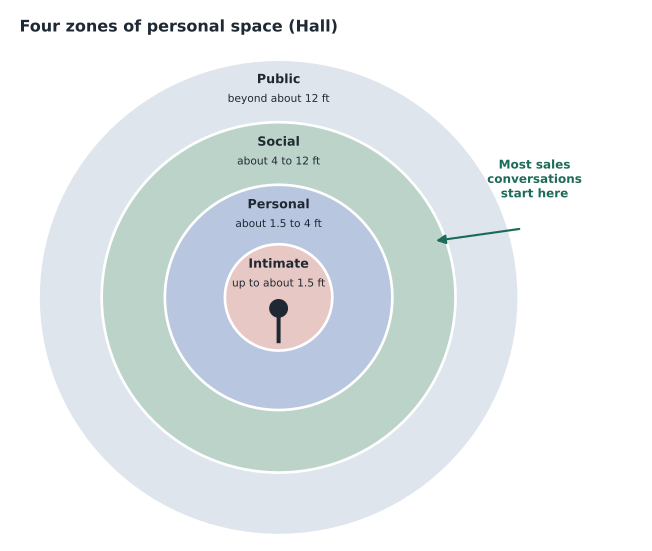
Most first conversations with a customer start in Hall's social zone, roughly 4 to 12 feet apart, and move into the personal zone, about 1.5 to 4 feet, only as the conversation warms up. Bev teaches Aiden to approach customers at an angle rather than head on, to stop at a comfortable distance, and to let the customer close the gap. If a customer steps back, he steps back too.
Seating matters in business meetings for the same reason. Sitting directly across a table from a buyer can feel adversarial, while sitting at a corner of the table or side by side while looking at a document together feels collaborative. When Maya reviews a proposal with a buyer, she tries to sit beside them and look at the same page.
Culture and individual differences
Nonverbal norms vary across cultures and between individuals. The amount of eye contact that feels respectful, the comfortable distance between people, whether touch such as a handshake is welcome and how much emotion is shown in the face all differ. In Canada and the United States, sellers meet buyers from many backgrounds, and they should not assume that one set of norms applies to everyone. They should also avoid the opposite mistake of stereotyping buyers by culture. The practical approach is to notice what the individual in front of you does, follow their lead, and ask if unsure.
Individual differences matter too. Some people, including some autistic people and some people with certain disabilities or medical conditions, may use eye contact, facial expression or gesture differently from what a seller expects. A customer who does not make eye contact is not necessarily uninterested or dishonest. This is another reason to treat nonverbal signals as prompts for questions rather than as conclusions.
Bev's summary for Aiden after the sectional sofa is short: 'Watch for changes, check with a question, and never decide what someone can afford from what they're wearing.' The couple came back two weeks later and bought the sofa without the chaise. They asked for Aiden.
The voice as a nonverbal channel
Researchers call the nonverbal features of speech paralanguage: pitch, pace, volume, rhythm, pauses and sounds such as sighs or laughs. Paralanguage carries a great deal of meaning in sales conversations, and it becomes the main channel on the phone, as lesson 7 explains. A few patterns are worth listening for, always as prompts for questions rather than as proof. A buyer who speeds up and raises their voice may be excited or frustrated. A buyer who slows down and goes quiet may be thinking hard or losing interest. A buyer who answers a direct question after an unusually long pause may be uncertain, or may be weighing how much to share.
Sellers should also notice their own paralanguage. Many people speak faster and at a higher pitch when nervous, which can make them sound less confident. Others trail off at the end of sentences or turn statements into questions with a rising tone, which can make a clear point sound uncertain. Recording a practice conversation and listening back, with permission from anyone else on the recording, is the quickest way to hear these habits. Maya was surprised to hear that she said "right?" at the end of almost every explanation. Once she noticed, she replaced it with a pause and an open question, which sounded more confident and gave the buyer room to respond.
Nonverbal communication also includes how sellers handle products and spaces. A seller who handles a sample carefully, wipes fingerprints off a display or straightens a cushion after a customer sits on it signals respect for the product and for the next customer. A seller who drops a brochure on the table or leans on a display signals the opposite, even without a word.
Common mistakes
MistakeOnly 7 in 100 parts of communication come from words.
InsteadMehrabian's figures came from experiments with single words about feelings and do not apply to ordinary conversation.
MistakeCrossed arms always mean the buyer is defensive.
InsteadSingle signals have no fixed meaning; look for clusters and changes, and consider context.
MistakeTrained sellers can tell when a buyer is lying.
InsteadPeople detect lies only slightly better than chance; ask about concerns instead of trying to catch the buyer out.
MistakeStanding close to a customer shows enthusiasm.
InsteadStart at a social distance, approach at an angle and let the customer close the gap.
MistakeA customer who avoids eye contact is uninterested.
InsteadNorms vary with culture and individual; treat signals as prompts for questions.
Summary and key terms
- Nonverbal communication includes face, eyes, gestures, posture, voice, space, appearance and time.
- Mehrabian's 7, 38 and 55 figures are widely misused; his real finding is that people trust tone and face when they conflict with words about feelings.
- Single signals have no fixed meaning; clusters, changes from a baseline and context matter.
- People detect lies only slightly better than chance, so sellers should ask about concerns rather than try to spot deception.
- Sellers should manage their own posture, eye contact, voice, phone habits and use of space.
- Nonverbal norms vary by culture and individual, so follow the buyer's lead and ask when unsure.
- Nonverbal communication
- Everything communicated without words, including the voice's tone, pace and pauses.
- Cluster
- Several nonverbal signals that point in the same direction.
- Baseline
- A person's usual way of behaving, against which changes are noticed.
- Personal space zones
- Hall's intimate, personal, social and public distances.
Practice problems
Work each problem on paper first, then reveal the answer to check.
What did the Mehrabian experiments actually study?
Show answer
How people judged liking from single words spoken in different tones and from facial photographs, when words and tone conflicted.
What three habits help sellers read nonverbal signals?
Show answer
Look for clusters, look for changes from the baseline and consider context.
About how accurate were people at telling lies from truth in the Bond and DePaulo review?
Show answer
About 54 times in 100, barely better than chance.
What should Aiden do if a customer steps back during a conversation?
Show answer
Step back too and give the customer more space.
Lesson quiz · 5 questions
Score 60% or more to complete this lesson.
Create a free account to save your progress, take quizzes and earn a certificate.