
SLS-120 · Lesson 10 of 12 · 22 min
Storytelling in sales
▶ Video coming soon A video version of this lesson is on the way.
Linda Sorensen at Keystone Grain Equipment had read the RoomFlow brochure, watched the demonstration and listened to Maya describe the features. She was still not sure. Then Maya told her about the facilities coordinator at a credit union in another city who had been just as worried about staff resistance. The coordinator had started with two rooms, asked the three most skeptical managers to test the system for a week, and fixed the two things they complained about before rolling it out. Six months later, those three managers were the ones explaining the system to new staff. Linda asked for the coordinator's name so she could call her. 'That story did more than the whole demo,' Darnell said afterwards. 'Because it was about her worry, not our software.'
Stories are one of the oldest ways people share knowledge and make sense of experience. In sales, a good story can make an abstract benefit concrete, help a buyer picture themselves solving a problem, show that the seller understands the buyer's situation and make a conversation memorable. This lesson covers why stories work, the kinds of stories sellers use, how to structure them, and the line between illustrating honestly and misleading.
Why stories work
Psychologists Melanie Green and Timothy Brock, in a series of studies published in 2000, described a process they called narrative transportation: when people are absorbed in a story, they tend to think less critically about it, feel more connected to its characters, and are more likely to accept the beliefs the story carries. Later reviews have found that the more transported people are, the more a story tends to shift their attitudes and intentions, although the size of the effect varies a great deal between studies.
Stories also help memory. People generally remember information better when it is connected in a meaningful sequence, with causes and consequences, than when it is presented as a list of separate facts. A buyer who hears that 'the system reduces double bookings' may forget it by the afternoon. A buyer who hears about the credit union coordinator and her three skeptical managers is likely to remember it, and to retell it to colleagues.
These same features are why stories carry responsibility. A story that lowers a buyer's critical guard should be true, relevant and fair. The power of storytelling is a reason to use it carefully, not to use it to slip past a buyer's judgment.
Kinds of sales stories
| Kind | What it does | Example |
|---|---|---|
| Customer story | Shows how someone like the buyer solved a similar problem | The credit union coordinator and the skeptical managers |
| Problem story | Helps the buyer see a risk or cost they had not considered | A clinic that lost a day of scanning when an unsupported printer failed |
| Company or origin story | Explains why the seller's company does what it does | Why Juniper & Pine started offering virtual consultations for rural customers |
| Personal story | Builds trust by showing who the seller is | Maya on why she moved from retail to business sales |
| Vision story | Helps the buyer picture life after the change | A Monday morning at Keystone with every room booked correctly |
Customer stories are the most useful in most sales conversations because they are evidence as well as illustration. They show that the product has worked for someone in a similar position. Their strength depends on how similar the situation is. A story about a large hospital is less persuasive to a three-doctor clinic than a story about another small clinic.
The structure of a sales story
Most effective sales stories share a simple structure. Darnell teaches four parts, a version of the situation, complication and resolution pattern long used in business writing and consulting.
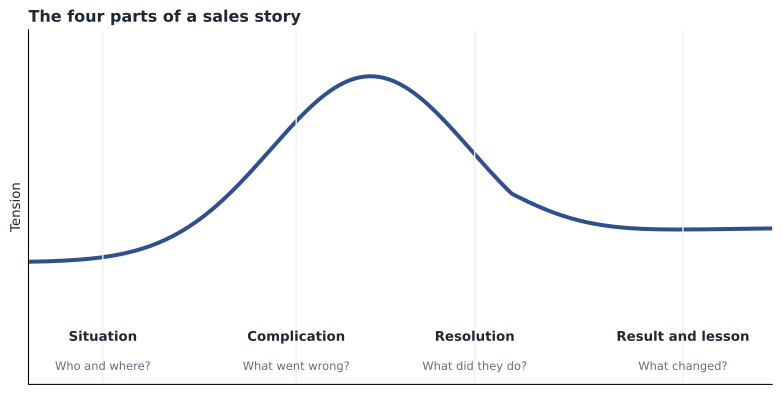
| Part | Question it answers | Credit union story |
|---|---|---|
| Situation | Who, where and what was normal? | A facilities coordinator at a credit union with eight meeting rooms |
| Complication | What went wrong or what was at risk? | She expected managers to resist a new booking system |
| Resolution | What did they do, and what was the turning point? | She started with two rooms and asked the three most skeptical managers to test it first |
| Result and lesson | What changed, and why does it matter to this buyer? | Six months later those managers were teaching others; starting small with critics can work at Keystone too |
The fourth part is what makes a story a sales story rather than an anecdote. It connects the story back to the buyer: 'That's why I thought of her when you mentioned the managers.' Without that link, the buyer is left to work out why the seller told the story, and may decide it was just a pitch.
Worked problem
Building a customer story
Aiden wants a story to help customers who are unsure about buying a mattress without trying it for a long time in the store. Juniper & Pine offers a 90-night comfort exchange. In September, a customer named Mr. Dhillon bought a firm mattress, found after three weeks that it was too firm for his shoulder, exchanged it for a medium one and later sent the store a thank-you note. Build a four-part story Aiden could tell, and check it is fair.
Show solution
- Situation: "A customer last month was in the same spot. He'd tried a few in the store and picked a firm one because his old mattress sagged."
- Complication: "After about three weeks, his shoulder was sore every morning. He was worried he'd made an expensive mistake."
- Resolution: "He brought it to us under the 90-night comfort exchange and switched to a medium. We picked up the first one when we delivered the new one."
- Result and lesson: "He sent us a note saying he finally sleeps through the night. That's why I don't worry too much if you're not 100 percent sure today. You have time to find out at home."
- Fairness check: the story is true, names no private details, and Aiden should also mention the exchange fee and any conditions, because leaving them out would make the story misleading.
Answer: The story turns the exchange policy into something the customer can picture. Aiden does not use the customer's name, and he always adds the exchange conditions so the story does not promise more than the policy does.
Telling stories well
Keep it short. Most sales stories should take one to two minutes. Long stories lose the buyer and start to feel like a performance.
Make it specific. Specific details, such as eight meeting rooms or three skeptical managers, make a story believable. Vague stories, such as 'one of our customers saw great results', sound invented.
Make it relevant. Choose stories that match the buyer's situation and concern, which is only possible after listening. A story told before discovery is a guess.
Make the customer the hero. In good customer stories, the person who solved the problem is the customer, with the product and seller playing a supporting role. Buyers identify with the customer, not with the vendor.
Use the buyer's words. Linking the story to something the buyer said, such as 'you mentioned the managers', shows that the story was chosen for them.
Invite the buyer in. End with a question: 'Does that sound like your situation, or is it different?' This turns the story back into a conversation.
Honest storytelling
Because stories are persuasive, they must be truthful. Several rules follow.
Do not invent customers or results. A made-up story presented as true is deception, and if a buyer asks to speak to the customer, it collapses. Hypothetical examples are fine when they are clearly labeled: 'Imagine a Monday morning when...'
Do not stretch results. If a customer reduced double bookings from five a month to one, say that, not that they 'eliminated' them. In both countries, claims about results can be treated as representations about the product, and exaggerated ones may breach consumer protection or competition law. SLS-150 Sales Law and Ethics covers what counts as a misleading representation.
Do not cherry-pick unfairly. Telling only the story of the one customer whose project went perfectly, when most took twice as long, gives a false picture. If results vary, say so.
Protect privacy. Use customer names and details only with permission. Many companies have formal reference programs in which customers agree to share their stories and take calls from prospects. Without permission, describe the customer generally, such as 'a credit union in another city', and leave out identifying details.
Avoid turning other people's misfortune into fear selling. Problem stories about failures and losses can be honest and useful, but they should not exaggerate risks to frighten the buyer into a decision.
Finding and keeping stories
Good sellers collect stories deliberately. After a successful installation, Darnell asks account executives to write a short note in the CRM in the four-part structure, including what the customer said in their own words and whether the customer has agreed to be a reference. Ridgeline's marketing team turns the strongest of these into short case studies with the customer's approval. On the retail side, Bev keeps a binder of thank-you notes and reviews, with permission to share, that associates can read to find stories for common worries such as delivery, assembly and exchanges.
Sellers also need a few stories of their own. A short, true personal story about why the seller does the work, or about a mistake they learned from, can build trust when the moment is right. Maya's story about learning to listen from a retired couple buying a dishwasher, from lesson 1, is one she now tells new customers who are nervous about a big change. It works because it is true, short and about listening rather than about her.
Stories in two settings
Business and retail stories differ mainly in length and evidence. In business selling, stories often need to stand up to scrutiny: a buyer may ask for the customer's name, call them, or ask for numbers. Maya keeps short, approved case studies in the CRM and checks before each meeting which ones fit the buyer's industry and size. In retail, stories are usually shorter and more personal, and they often address a specific worry in the moment: delivery, assembly, durability, exchanges. Aiden's mattress story takes about forty seconds.
In both settings, the same check applies before telling a story: is it true, is it relevant to what this buyer just told me, and would the customer in the story be comfortable hearing how I told it? If the answer to any of these is no, a plain explanation is better than a story.
Stories also travel. A good customer story told to one person at a buying organization is often retold to others, which is part of its value. That is another reason to keep stories accurate: a story that gets exaggerated as it is retold can create expectations the product cannot meet. Sellers can help by following up in writing with the key facts of the story, such as the number of rooms, the timeline and the result, so that the retold version stays close to the truth.
Worked problem
Choosing between two stories
Maya has two customer stories about RoomFlow. In the first, a 300-person insurance company cut meeting room no-shows by half in three months. In the second, a 40-person manufacturer with a shared lunchroom and two boardrooms stopped double bookings within a month and found that staff used the lunchroom for meetings less often. Which should she tell Keystone Grain Equipment, a 60-person manufacturer, and why?
Show solution
- Compare size: Keystone has 60 staff, much closer to the 40-person manufacturer than to the 300-person insurer.
- Compare industry: both Keystone and the second customer are manufacturers with shared plant spaces.
- Compare problem: Keystone's concern is double bookings with visiting dealers, which matches the second story.
- Check the facts: Maya confirms the second customer has agreed to be a reference.
Answer: The second story fits on size, industry and problem, so it is more likely to feel relevant. Maya saves the insurance company story for larger office-based buyers.
Common mistakes
MistakeAny story makes a pitch more persuasive.
InsteadStories persuade when they are true, relevant to the buyer's concern and short.
MistakeVague stories protect customer privacy.
InsteadUse specific details that make the story believable, and remove only identifying details unless the customer has agreed to be named.
MistakeIn a customer story, the seller and product are the heroes.
InsteadMake the customer the hero, with the product and seller in support.
MistakeA good story can round results up a little.
InsteadState results accurately; exaggerated results can be misleading representations.
MistakeStories should be told early to grab attention.
InsteadChoose stories after listening, so they match the buyer's situation.
Summary and key terms
- Stories make benefits concrete, help memory and build understanding; narrative transportation can reduce critical thinking, which is why stories must be honest.
- Sellers use customer, problem, company, personal and vision stories; customer stories are usually the most useful.
- A sales story has a situation, a complication, a resolution, and a result and lesson that link back to the buyer.
- Tell stories that are short, specific, relevant and about the customer, and end with a question.
- Never invent customers or results, stretch outcomes, cherry-pick unfairly or share private details without permission.
- Collect stories deliberately, with the customer's own words and permission to share.
- Narrative transportation
- Being absorbed in a story, which tends to reduce critical thinking and increase acceptance of its message.
- Customer story
- A true account of how a customer like the buyer solved a similar problem.
- Reference program
- An arrangement in which customers agree to share their story or take calls from prospects.
- Situation, complication, resolution
- A classic structure for stories and business messages.
Practice problems
Work each problem on paper first, then reveal the answer to check.
Name the four parts of a sales story.
Show answer
Situation, complication, resolution, and result and lesson.
Why did Maya's credit union story work better than the demonstration for Linda?
Show answer
It addressed Linda's specific worry about staff resistance, through someone in a similar position.
What must Aiden add when telling the mattress exchange story?
Show answer
The exchange fee and any conditions, so the story does not promise more than the policy.
How should a seller describe a customer who has not agreed to be named?
Show answer
Generally, without identifying details, such as "a credit union in another city".
Lesson quiz · 5 questions
Score 60% or more to complete this lesson.
Create a free account to save your progress, take quizzes and earn a certificate.