
SLS-120 · Lesson 3 of 12 · 21 min
Open, closed and probing questions
▶ Video coming soon A video version of this lesson is on the way.
Aiden's first week on the floor at Juniper & Pine produced a pattern Bev recognized at once. A customer would stop at a refrigerator and Aiden would walk over and ask, 'Can I help you?' The customer would say, 'Just looking, thanks,' and that would be the end of it. When a customer did engage, Aiden would ask a quick string of questions: 'Do you want stainless? French door? Do you need an ice maker?' The customer would answer yes or no, Aiden would show a model, and more often than not the customer would say they needed to think about it. On Saturday afternoon Bev took him aside. 'Every question you asked could be answered in one word,' she said. 'So that's what you got. One word. You never found out why they were looking at a fridge.'
Questions are the seller's main tool for learning about the buyer, and the kind of question asked largely decides the kind of answer received. This lesson covers the basic types of questions, when each is useful, how to probe for more detail without interrogating, and the questions to avoid. It stays at the level of individual questions. Planning a full discovery conversation in business sales, and structured questioning models such as SPIN, are the subject of SLS-211 Consultative Selling and Discovery.
Closed questions
A closed question can be answered with a single word, a short fact or a choice from a few options: yes or no, a number, a date, a color. 'Is the fridge for this home?' 'How many people live in the house?' 'Do you need it delivered before the 20th?' Closed questions are not bad questions. They are efficient for confirming facts, checking understanding, narrowing choices and getting commitment. Their weakness is that they only collect information the seller already thought to ask about. A string of closed questions also feels like a form being filled in, and it puts the seller in control of the conversation in a way many buyers find uncomfortable.
Open questions
An open question invites the buyer to answer in their own words and at their own length. Open questions often begin with what, how, why, tell me or describe. 'What has you thinking about a new fridge?' 'How does your family use the kitchen?' 'Tell me about how meeting rooms get booked today.' Open questions let the buyer lead the conversation toward what matters to them, and they surface information the seller would not have known to ask about. They also signal interest in the buyer as a person rather than as a sale.
Open questions need care. Very broad questions such as 'Tell me about your business' can feel lazy or overwhelming, especially to a busy professional buyer who expects the seller to have done some homework. The best open questions are focused on a specific area: 'Tell me about how printing works at the front desk during a busy morning.' And questions beginning with why can sound accusing: 'Why did you buy that brand last time?' may come across as a challenge. A softer form works better: 'What led you to that brand last time?'
| Closed questions | Open questions | |
|---|---|---|
| Typical start | Is, are, do, does, can, will, how many, which | What, how, tell me, describe, walk me through |
| Best for | Confirming facts, narrowing choices, getting commitment | Exploring needs, feelings, priorities and context |
| Who leads | The seller | The buyer |
| Risk if overused | Feels like an interrogation; misses what matters | Feels vague; the conversation drifts |
| Example at Ridgeline | "Do you lease the current printers?" | "How does a document get from the front desk into a patient's file today?" |
| Example at Juniper & Pine | "Is this for the main living room?" | "How do you use that room on a typical evening?" |
The question funnel
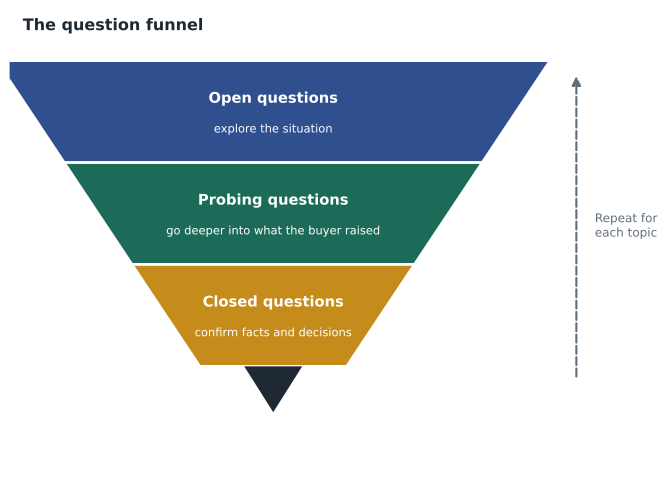
A useful pattern for many sales conversations is the question funnel. The seller starts wide, with open questions that let the buyer describe the situation, then narrows with probing questions that explore what the buyer has raised, and finally uses closed questions to confirm facts and decisions. The funnel can be repeated for each topic in a conversation.
Worked problem
A funnel on the sales floor
Bev asks Aiden to plan the questions he could use with a customer looking at refrigerators, using the funnel.
Show solution
- Open: "What has you thinking about a new fridge?" The customer says the old one is making a noise and they are renovating the kitchen next spring anyway.
- Probe: "You mentioned the renovation. How do you picture the kitchen when it's done?" The customer describes a counter-depth look and says the current fridge sticks out past the cabinets.
- Probe: "When you say it sticks out, how far?" The customer is not sure but thinks about 6 inches.
- Closed: "Would you like the new one to sit flush with the cabinets?" Yes. "Do you have the width of the opening?" No, but they can measure it tonight.
- Next step: Aiden suggests they measure the opening and come back, or send the measurement, so he can show only models that fit.
Answer: Starting open uncovered two facts Aiden would never have asked about: the renovation and the wish for a counter-depth look. The closed questions then pinned down what he needed to show the right models.
In that example, the closed questions at the bottom of the funnel were the same kind of questions Aiden had been asking all week. The difference was their timing. Asked first, they produced one-word answers. Asked after the customer had described the renovation, they were natural follow-ups that showed Aiden had been listening.
Probing questions
A probe is a follow-up question that goes deeper into something the buyer has just said. Probes are where much of the useful information in a sales conversation comes from, because buyers usually start with a surface version of their concern. Common kinds of probe include:
| Kind | Purpose | Example |
|---|---|---|
| Elaborating | Ask for more on a point | "Tell me more about that." |
| Clarifying | Pin down a vague word | "When you say slow, what happens?" |
| Example | Ask for a specific case | "Can you walk me through the last time it happened?" |
| Impact | Explore the effect of a problem | "What does that mean for the front desk on a busy morning?" |
| Priority | Find out what matters most | "Of the things you mentioned, which would make the biggest difference?" |
| Echo | Repeat a key word as a question | "Embarrassing?" |
The echo probe deserves a word. Repeating a single important word with a questioning tone, and then pausing, is one of the simplest and most effective probes. When the Keystone facilities manager told Maya on her follow-up call that the double bookings had been 'a bit of a mess with the dealers', she said, 'A mess?' and waited. He then explained that one dealer had joked publicly that Keystone could not run a meeting, let alone a supply chain, and that the plant manager had not found it funny.
Probes should follow the buyer's lead, not the seller's agenda. A good probe uses the buyer's own words and goes where the buyer seems to want to go. A probe that steers every answer back toward a product feature is a pitch disguised as a question, and buyers notice.
Questions to avoid
Some questions do more harm than good.
Leading questions suggest the answer the seller wants: 'You'd agree that reliability is the most important thing, wouldn't you?' They feel manipulative and produce agreement that means little. If reliability matters, an open question will reveal it: 'What matters most to you in a new printer?'
Multiple questions packed into one leave the buyer unsure what to answer, and they usually answer only the last part. 'How many people use the room, and how are bookings made, and is anyone in charge of it?' is three questions. Ask one, listen, then ask the next.
Questions the seller could have answered with simple research waste the buyer's time and suggest a lack of preparation, particularly in business selling. A seller who asks a school division how many schools it has, when the answer is on its website, starts at a disadvantage.
Loaded or presumptive questions assume a decision the buyer has not made: 'When we deliver your new sofa, will Thursday or Saturday be better?' This is sometimes taught as a closing technique. Used before the buyer has shown real interest, it is pushy, and SLS-213 Negotiation and Closing discusses why such techniques carry risk.
Questions that pry too far too soon can also backfire. Asking a retail customer about their budget before showing any products, or asking a business buyer about their political standing inside the company in the first five minutes, can feel intrusive. These are legitimate questions, but they need a reason and a little trust first. A simple explanation helps: 'So I can show you the right range, do you have a price you'd like to stay around?'
How many questions?
There is no correct number of questions for a sales conversation. Conversation analytics firms that analyze recorded business sales calls have reported that successful discovery calls tend to include a moderate number of questions spread through the conversation, and that calls with very few questions or with a rapid string of them both tend to do worse. Like the talk-ratio figures in lesson 1, these findings come from vendors' own data and should be treated as a rough guide. The underlying advice is sound: ask enough to understand, space your questions so the buyer has time to answer fully, and make sure the conversation feels like a conversation rather than a questionnaire.
Darnell suggests a test after each call: count the questions that produced an answer longer than one sentence. On Maya's first Northfield Family Clinic call, eleven of her fourteen questions were closed, and only two produced a full answer. On a call a month later, she asked twelve questions, seven of them open, and eight produced a full answer.
Worked problem
Working out a question mix
On a recorded call, Maya asked 15 questions: 6 open, 3 probing follow-ups and 6 closed. What fraction of her questions were open or probing, and how does it compare with her first clinic call, where 3 of 14 were open or probing?
Show solution
- Open and probing questions on the new call: 6 + 3 = 9.
- \[9 \div 15 = 0.6\]
- On the first call: 3 open or probing questions out of 14.
- \[3 \div 14 \approx 0.21\]
- The share rose from about 21 in 100 to 60 in 100.
Answer: About three in five of Maya's questions were now open or probing, compared with about one in five on her first call.
Asking questions in two settings
Business buyers usually expect questions. A scheduled discovery call exists so that the seller can learn about the buyer's situation, and a buyer who has agreed to the call has agreed, in principle, to answer. The risk is asking questions that feel generic, or that make the buyer do the seller's homework. Preparation lets the seller start with informed questions: 'I saw that Northfield added two physicians this year. How has that changed the front desk?'
Retail customers often do not expect questions and may be wary of them. Many shoppers have learned to deflect salespeople. Bev's advice to Aiden is to replace 'Can I help you?', which invites 'No, thanks', with a friendly greeting and a light open question tied to what the customer is looking at: 'That one's popular with families. What's got you shopping for a sofa?' If the customer still prefers to browse, he lets them, and stays available. Questions work best on the floor when they are obviously about helping the customer find the right thing, not about qualifying them as a prospect.
Common mistakes
MistakeClosed questions are bad questions.
InsteadClosed questions are useful for confirming facts and decisions; they work best after open questions have explored the situation.
MistakeAny open question is a good question.
InsteadThe best open questions are focused on a specific area and show the seller has done some preparation.
MistakeProbes should steer the buyer toward the product.
InsteadProbes should follow the buyer's lead, using the buyer's own words.
MistakeAsking several questions at once saves time.
InsteadAsk one question at a time and listen to the full answer.
Mistake"Can I help you?" is the best retail opening.
InsteadIt invites "Just looking". A friendly greeting with a light open question about what the customer is looking at works better.
Summary and key terms
- The kind of question asked largely decides the kind of answer received.
- Closed questions confirm facts and decisions; open questions let the buyer describe their situation in their own words.
- The question funnel moves from open to probing to closed, and can be repeated for each topic.
- Probes go deeper into what the buyer has said, using elaborating, clarifying, example, impact, priority and echo questions.
- Avoid leading, multiple, unprepared, presumptive and prematurely prying questions.
- Counting the questions that produce full answers is a practical way to check your questioning.
- Closed question
- A question that can be answered with a word, a fact or a choice.
- Open question
- A question that invites an answer in the buyer's own words.
- Probe
- A follow-up question that goes deeper into something the buyer has said.
- Question funnel
- A sequence that moves from open questions to probes to closed questions.
- Leading question
- A question that suggests the answer the asker wants.
Practice problems
Work each problem on paper first, then reveal the answer to check.
Turn "Do you need a bigger printer?" into an open question.
Show answer
For example: "How is the current printer handling the volume at the front desk?"
What is an echo probe? Give an example.
Show answer
Repeating a key word as a question and pausing, such as "A mess?"
What is wrong with "You'd agree that quality matters most, wouldn't you?"
Show answer
It is a leading question that suggests the answer and produces agreement that means little.
A seller asks 20 questions; 8 are open and 4 are probes. What fraction are open or probing?
Show answer
12 divided by 20 is 0.6, or 60 in 100.
Lesson quiz · 5 questions
Score 60% or more to complete this lesson.
Create a free account to save your progress, take quizzes and earn a certificate.