
SLS-101 · Lesson 11 of 12 · 20 min
How salespeople are paid and measured
▶ Video coming soon A video version of this lesson is on the way.
Maya's offer letter from Ridgeline was a page longer than any she had received in retail. It set out a base salary of 52,000 dollars, an annual quota of 600,000 dollars of new first-year revenue, a commission of 5 percent on revenue up to quota and 8 percent above it, a guaranteed draw for her first three months, and a quarterly bonus for RoomFlow subscriptions. She read it three times and then asked Grace Liu, the sales operations analyst, to walk her through it. "Everyone should do that," Grace said. "The plan tells you what the company wants you to do. If you don't understand it, you'll work hard on the wrong things."
This lesson explains the common ways salespeople are paid and the measures used to judge their performance, in both B2B and retail. Understanding them matters for choosing jobs, for planning your own effort, and later, for managers who design plans. Course SLS-230, Sales Management and Leadership, returns to plan design.
Ways of paying salespeople
Sales pay plans balance two goals. The company wants pay to rise and fall with results, so that sellers are motivated and costs track revenue. Sellers want enough security to pay rent in a slow month. Plans sit somewhere along a range between the two.
| Plan | How it works | Suits | Watch for |
|---|---|---|---|
| Straight salary | Fixed pay regardless of sales | Roles where teamwork, service or long cycles make individual credit hard to measure | Little direct reward for extra effort |
| Salary plus commission | A base salary plus a share of sales or margin | Most B2B and many retail commission roles | The balance between base and variable pay |
| Straight commission | Pay is entirely a share of sales | Experienced sellers in real estate, some retail and independent agents | Income swings; minimum wage rules for employees still apply |
| Draw against commission | An advance paid each period and later deducted from commissions earned | New sellers and seasonal businesses | Whether unearned draws must be repaid |
| Bonus | A payment for reaching a target or goal | Rewarding specific results, such as new accounts or team targets | Clear rules for how targets are measured |
| Spiff | A short-term incentive for selling a particular product | Launches, clearing stock, protection plans | Can push sellers toward products the customer does not need |
A draw deserves a closer look because new sellers often misunderstand it. With a recoverable draw, the advance is like a loan against future commissions: if commissions earned in the period are smaller than the draw, the shortfall carries forward and is deducted later. With a non-recoverable draw, the advance is a guaranteed minimum that does not have to be paid back. Maya's three-month draw is non-recoverable, which gives her time to build a pipeline without falling into debt to her employer.
Commission plans must also respect employment law. Under the federal Fair Labor Standards Act, most employees, including many paid partly or wholly by commission, must receive at least the minimum wage for hours worked, and states such as South Dakota set their own minimum wage rules. Under specific conditions in federal law, outside salespeople are exempt from both the minimum wage and overtime requirements, and some commissioned employees of retail and service businesses are exempt from overtime. Deductions from pay are also limited, which is one more reason to read the plan carefully.
Commission on revenue or on margin
Commission can be calculated on revenue (the selling price) or on gross margin (the selling price minus the cost of goods). The choice changes behavior. A seller paid on revenue loses little by discounting: cutting a 10,000-dollar sale to 9,000 dollars costs them a tenth of their commission. A seller paid on margin feels the discount more sharply, because the whole discount comes out of the margin. Juniper & Pine pays furniture commission on margin for this reason, and Carl defends price harder than anyone in the store.
Questions to ask about a pay plan
Grace gives every new Ridgeline seller a list of questions to ask about their plan, and they apply to almost any sales job. What exactly counts as a sale for commission purposes: a signed contract, a delivered order or a paid invoice? When is commission paid, and what happens if a customer cancels or does not pay? Is commission calculated on revenue or margin? Is the draw recoverable? How is the quota set, and can it change during the year? How are deals shared when two people work on them? What happens to commission on deals in progress if the seller leaves? Answers to these questions should be in writing, and a seller who is unsure should ask before relying on an expected payment.
Territories and fairness
In B2B sales, a seller's results depend heavily on their territory, the set of customers or geographic area they are responsible for. A territory full of large organizations with contracts expiring this year offers far more opportunity than one full of small offices that renewed last year. Managers try to make territories fair, balancing the potential in each so that quotas can be set reasonably. Darnell gave Maya a territory of schools, clinics and small offices in the south half of the city, with a quota set lower than the experienced account executives' because it had fewer large accounts and she was new. Plans and territories change from year to year as the business changes, which is another reason to understand how they work.
The ethics of incentives
Incentives are powerful, and they can push sellers toward behavior that harms customers. Plans that pay heavily for one product can lead to selling it to people who do not need it. Targets that are impossible to reach honestly can lead to misreporting or pressure tactics. Large spiffs on protection plans have, in several industries, led regulators and courts to look closely at how such products were sold. Well-designed plans reduce these risks by paying for results that are good for customers, such as renewals and satisfaction, and by checking how sales were made, for example through returns, cancellations and complaints.
Individual sellers still have a choice. Carl earns more protection plan commission than anyone in the store, but he offers the plan once, explains it honestly and accepts a no. His attachment rate is high because customers trust his recommendations, not because he pushes. Over a career, that approach almost always pays better than pressure, because it produces repeat customers and referrals rather than complaints.
Measuring retail associates fairly
Retail measures need context to be fair. An associate who works mostly weekday mornings will have lower sales per hour than one who works Saturday afternoons, because the customers are different. One who covers the mattress department will have a higher average transaction value than one in décor. Good managers compare associates working similar shifts and departments, look at trends over several weeks rather than single days, and pay attention to the measures associates control most directly, such as conversion and units per transaction, rather than only total sales.
Stores that share commission within a department, or pay team bonuses based on the store's total, encourage associates to help each other rather than compete for customers. Juniper & Pine pays individual commission in large furniture and appliances, where sales are long and personal, but a team bonus in décor and small items, where customers often move between several associates during one visit. Each choice matches the way customers in that department actually buy.
Worked problem
A discount under two commission plans
A sale is priced at 10,000 dollars with a cost of goods of 6,000 dollars. Plan R pays 5 percent of revenue; Plan M pays 12.5 percent of gross margin. How much does each plan pay at full price, and how much at a 1,000-dollar discount?
Show solution
- At full price, revenue is 10,000 dollars and margin is 4,000 dollars.
- \[R: 0.05 \times 10{,}000 = 500 \qquad M: 0.125 \times 4{,}000 = 500\]
- With the discount, revenue is 9,000 dollars and margin is 3,000 dollars.
- \[R: 0.05 \times 9{,}000 = 450 \qquad M: 0.125 \times 3{,}000 = 375\]
- The drop in commission under each plan:
- \[R: 500 - 450 = 50 \qquad M: 500 - 375 = 125\]
Answer: Both plans pay 500 dollars at full price. The discount costs the seller 50 dollars under the revenue plan but 125 dollars under the margin plan, which matches the company's loss more closely: the discount removed a quarter of the margin, and the margin-based commission also falls by a quarter.
Quotas and attainment
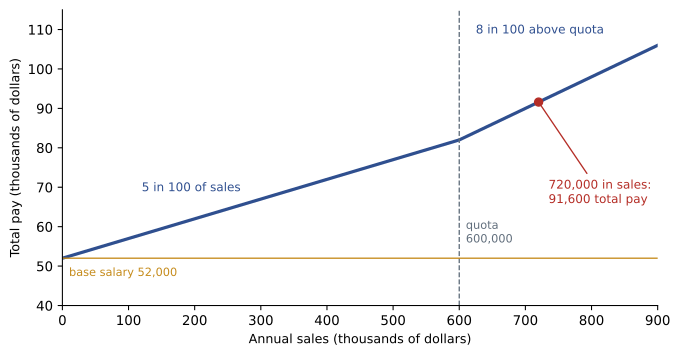
A quota is the sales target a seller is expected to reach in a period, usually a year divided into quarters. Attainment is actual sales divided by quota. Plans often include an accelerator, a higher commission rate on sales above quota, to reward exceptional results, and sometimes a decelerator or threshold below which commission is lower or not paid.
Worked problem
Maya's first full year
Suppose that in her first full year Maya sells 720,000 dollars of first-year revenue against her 600,000-dollar quota. Her plan pays 5 percent up to quota and 8 percent above it, plus her 52,000-dollar base salary. What is her attainment and her total pay?
Show solution
- Attainment is sales divided by quota.
- \[720{,}000 \div 600{,}000 = 1.20\]
- So she reaches 1.2 times quota, or 120 percent attainment.
- Commission on revenue up to quota:
- \[0.05 \times 600{,}000 = 30{,}000 \text{ dollars}\]
- Commission on revenue above quota, at the accelerated rate:
- \[0.08 \times (720{,}000 - 600{,}000) = 0.08 \times 120{,}000 = 9{,}600 \text{ dollars}\]
- Total pay:
- \[52{,}000 + 30{,}000 + 9{,}600 = 91{,}600 \text{ dollars}\]
Answer: Maya would reach 120 percent of quota and earn 91,600 dollars: 52,000 base and 39,600 commission. Without the accelerator, all 720,000 dollars at 5 percent would have paid 36,000 dollars of commission, so the accelerator adds 3,600 dollars.
How sales performance is measured
Pay plans reward a few results, but managers watch many more measures to understand how a seller is doing and where to coach. Measures fall into three groups. Activity measures count what the seller does: calls, emails, meetings, demonstrations. Pipeline measures describe the deals in progress: how many, how large, at which stages, and how fast they move. Outcome measures count results: revenue, margin, win rate, retention. Activity is easiest to control and outcomes are what matter, so good managers look at all three together. A seller with plenty of activity and few outcomes may need help with skills; one with strong outcomes from little activity may be relying on luck or a few large customers.
Retail stores use their own measures, often reported for each associate and each shift.
| Retail measure | How it is calculated | What it shows |
|---|---|---|
| Sales per hour | Sales divided by hours worked | Overall productivity on the floor |
| Average transaction value (ATV) | Sales divided by number of transactions | Size of each sale, including add-ons |
| Units per transaction (UPT) | Items sold divided by transactions | Success with add-ons and complete solutions |
| Conversion rate | Transactions divided by shoppers or groups served | Ability to turn browsers into buyers |
| Attachment rate | Sales with a protection plan or accessory divided by eligible sales | Add-on selling, which must stay honest |
Measures shape behavior, sometimes badly. A store that rewards protection plan attachment heavily may find associates pressuring customers into plans they do not need, which leads to complaints, cancellations and, in some cases, regulatory trouble. A B2B team measured only on calls made may produce many short, useless calls. Good measures are balanced: they reward results and also the way results are achieved, including customer satisfaction and retention.
Common mistakes
MistakeReading only the base salary in a sales offer.
InsteadWork out total pay at realistic sales levels, and understand quotas, rates, accelerators and draws.
MistakeAssuming a draw is free money.
InsteadA recoverable draw must be earned back from commissions; ask which kind it is.
MistakeDiscounting freely because commission is on revenue.
InsteadDiscounts cut the company's margin far more than your commission; defend price and offer value.
MistakeChasing one measure at the customer's expense.
InsteadBalanced measures include satisfaction and retention; pushing add-ons customers do not need backfires.
Summary and key terms
- Sales pay ranges from straight salary to straight commission, with salary plus commission most common; draws, bonuses and spiffs add to the mix.
- A recoverable draw is an advance against future commissions; a non-recoverable draw is a guaranteed minimum.
- Employment law still applies to commission pay, including minimum wage and limits on deductions.
- Commission on margin ties the seller's pay to the company's profit more closely than commission on revenue.
- A quota is a sales target, attainment is sales divided by quota, and an accelerator raises the rate above quota.
- Performance is measured through activity, pipeline and outcome measures; retail uses sales per hour, average transaction value, units per transaction, conversion and attachment rates.
- Measures shape behavior, so they must be balanced.
- Commission
- Pay calculated as a share of revenue or margin.
- Draw
- An advance against commissions, either recoverable or non-recoverable.
- Spiff
- A short-term incentive for selling a particular product.
- Quota
- The sales target for a period.
- Attainment
- Actual sales divided by quota.
- Accelerator
- A higher commission rate paid on sales above quota.
- Average transaction value
- Total sales divided by the number of transactions.
Practice problems
Work each problem on paper first, then reveal the answer to check.
A seller's quota is 400,000 dollars and they sell 340,000 dollars. What is their attainment?
Show answer
340,000 ÷ 400,000 = 0.85, or 85 percent.
An associate sells 6,300 dollars in 35 transactions and 63 items. What are the ATV and UPT?
Show answer
ATV = 6,300 ÷ 35 = 180 dollars; UPT = 63 ÷ 35 = 1.8.
Why might a store pay commission on margin rather than revenue?
Show answer
Because a discount then reduces the seller's commission in the same proportion as the store's margin, encouraging sellers to defend price.
Lesson quiz · 5 questions
Score 60% or more to complete this lesson.
Create a free account to save your progress, take quizzes and earn a certificate.