
SLS-101 · Lesson 10 of 12 · 18 min
Following up and keeping customers
▶ Video coming soon A video version of this lesson is on the way.
Carl Jensen keeps a battered binder behind the appliance counter at Juniper & Pine. It holds a page for every customer he has sold to in nine years: names, what they bought, the delivery date, children's and pets' names if the customer mentioned them, and notes such as "wants to replace the dryer when the kids move out." Two weeks after every delivery he phones to ask how the product is working. Each spring he sends a short note to customers whose appliances are nearing the end of their warranty. About half of his sales each year come from people in the binder or people they sent to him.
Aiden was surprised by that figure. Bev was not. "Most associates think the sale ends at the till," she said. "Carl thinks it starts there." This lesson covers what happens after a customer says yes: delivering on the promise, checking satisfaction, keeping in touch, and earning repeat business and referrals. It also covers following up with prospects who did not buy, because many of tomorrow's customers are people who said "not yet" today.
Why keeping customers matters
Winning a new customer takes time and money: marketing to reach them, sales time to understand and persuade them, and often a discount to win their first order. Keeping an existing customer usually costs much less, and loyal customers tend to buy more over time, cost less to serve because they already know the product and the process, and recommend the business to others. For these reasons most businesses earn a large share of their profit from repeat customers.
The idea is captured in customer lifetime value, the total gross margin a business can expect from a customer over the whole relationship. A simple estimate multiplies the margin a customer generates each year by the number of years they are expected to stay.
Keeping track: the CRM and the client book
Follow-up only works if it is organized. B2B sellers usually rely on a CRM to record every customer's purchases, contacts, renewal dates and promised actions, and to remind them when a follow-up is due. Grace set up Ridgeline's CRM so that every won deal automatically creates tasks: a thank-you within a day, an installation check, a two-week check-in, a quarterly review and a renewal reminder a year before the contract ends. Maya's job is to complete each task with something useful rather than tick it off.
Retail sellers often keep a client book, which may be a paper binder like Carl's, a notes app or the store's customer database. A good client book records what each customer bought, when it was delivered, what else they mentioned wanting, the best way to contact them and whether they agreed to be contacted. It also records small personal details the customer chose to share, such as a new baby or a renovation, used carefully and respectfully. The goal is to remember customers as people, not to track them.
Privacy rules apply to all of this. Customer information should be collected for a clear purpose, kept accurate, stored securely and used only in ways the customer would reasonably expect. Personal notes that would embarrass the seller if the customer read them should not be written down at all.
Account reviews in B2B
For business customers, the most valuable follow-up is often a regular account review: a short meeting, typically quarterly or twice a year, in which the seller and customer look at how the product or service is performing, what has changed in the customer's organization and what is coming next. For Northfield, a review might show print volumes, service calls, response times and how many room bookings RoomFlow handled, and then ask about the expansion next door. Reviews keep the relationship focused on value, surface problems early, and often reveal the next opportunity long before a competitor hears of it.
Measuring whether customers stay
Businesses track retention with a few simple measures. The retention rate is the share of customers at the start of a period who are still customers at the end of it; its opposite is the churn rate. Ridgeline tracks the share of contracts that renew, and Juniper & Pine tracks the share of customers who buy again within two years. These figures tell managers whether follow-up is working. A seller whose customers rarely come back is losing value even if their new sales look healthy, because every lost customer must be replaced by a new one, at a much higher cost.
Referral programs and introductions
Some businesses formalize referrals with a program that rewards customers for introducing new ones, such as a gift card for each referred customer who buys. A program can work well if it is simple, the reward is clearly explained, and the referred customer is treated as well as any other. In B2B, rewards are often inappropriate or prohibited: many organizations do not allow employees to accept gifts from suppliers, and public bodies such as school divisions usually have strict rules. In those settings the best referral is simply a satisfied customer willing to take a call from a prospect. Maya asks permission before giving any customer's name as a reference, and she limits how often she asks each one, so that references remain willing.
Introductions work best when the seller makes them easy. Rather than asking a customer to "let me know if you think of anyone," Maya asks a specific question: "Do you know an office manager at another clinic who might be dealing with the same printer problems?" Specific questions trigger specific names. She then offers to send the customer a two-line note they can forward, which saves them effort and means the introduction arrives in their own words.
Every referred prospect deserves especially careful handling. The prospect arrives with some trust borrowed from the person who referred them, and a poor experience damages two relationships at once. Sellers should thank the referring customer, whether or not a sale results, and let them know how things turned out.
Worked problem
What a managed print customer is worth
Northfield Family Clinic signs a managed print contract at 395 dollars a month. Ridgeline's gross margin on managed print is about 35 percent of revenue. Ridgeline's records show that clinics it serves well renew for a second five-year term about 70 in 100 times. Estimate the lifetime gross margin over the first term and the expected value of the second term, ignoring price changes.
Show solution
- Annual revenue and margin.
- \[395 \times 12 = 4{,}740 \text{ dollars a year}\]
- \[0.35 \times 4{,}740 = 1{,}659 \text{ dollars of margin a year}\]
- Margin over the first five-year term.
- \[1{,}659 \times 5 = 8{,}295 \text{ dollars}\]
- Expected margin from a second term, weighted by the chance of renewal.
- \[0.70 \times 8{,}295 = 5{,}806.50 \text{ dollars}\]
- Total expected lifetime margin.
- \[8{,}295 + 5{,}806.50 = 14{,}101.50 \text{ dollars}\]
Answer: The contract is worth about 8,295 dollars of margin over its first term and about 14,100 dollars over its expected lifetime, before counting any furniture, RoomFlow subscription or referrals. Renewal depends on service, so follow-up that keeps the clinic satisfied is protecting about 5,800 dollars of expected margin.
That figure changes how Maya thinks about follow-up. A thirty-minute check-in call each quarter costs very little against the value it protects.
Following up after the sale
The first follow-up begins before the product arrives. Customers are often most anxious just after they commit, a feeling sometimes called buyer's remorse or post-purchase dissonance: did I choose well, did I spend too much, will they deliver? A short message thanking the customer and confirming the next steps, such as delivery date, installation plan and who to call with questions, reassures them that the decision was sound.
| When | Retail example (Juniper & Pine) | B2B example (Ridgeline) |
|---|---|---|
| Right after the sale | Thank-you and confirmation of delivery window | Thank-you, signed agreement, implementation timeline and contacts |
| At delivery or installation | Delivery team checks the sofa in place; associate calls if there was a problem | Installation on the agreed date; Maya attends or calls the same day |
| A week or two later | Call or message: is it working, any questions? | Check-in: are staff using secure release, any service issues? |
| Regularly afterwards | Seasonal notes, care tips, warranty reminders | Quarterly service review; usage report; renewal planning a year ahead |
| At natural moments | New product lines relevant to past purchases | Expansion, new staff, new budget year |
Good follow-up is useful to the customer. A message that only says "just checking in" wastes their time. A message that shares a care tip for the new leather sofa, a reminder that the washer's first-year warranty is ending, or a report showing the clinic's printers had no downtime last quarter gives them a reason to read it.
When something goes wrong
Problems after the sale, such as a dented fridge, a late installation or a printer that fails in its first week, feel like threats, but they are also opportunities. Customers whose problems are fixed quickly and generously often become more loyal than customers who never had a problem, because they have seen how the business behaves under pressure. The response should be fast, personal and accountable: acknowledge the problem, take ownership even if another department caused it, fix it, and follow up to confirm. Course SLS-130, Customer Service and Customer Experience, covers service recovery in detail.
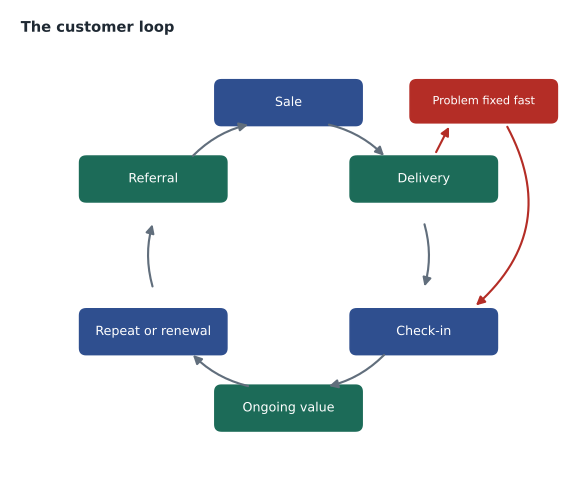
Referrals and reviews
Satisfied customers are the most credible advertising a business can have, but most will not recommend a seller unless asked. The best time to ask is when the customer has just experienced the value: the week after a smooth delivery, or after a quarterly review that showed good results. The request should be simple and specific: "If you know another clinic dealing with printer headaches, I'd be grateful for an introduction." In retail, Bev asks associates to invite happy customers to leave an online review, without offering anything in return.
Reviews and referrals are covered by law. The Federal Trade Commission's rule on fake reviews and testimonials, in force since October 2024, prohibits businesses from buying or creating fake reviews and from offering incentives for reviews that must be positive, and the FTC's endorsement guides require material connections to be disclosed. Juniper & Pine's rule is simple: ask genuine customers for honest reviews, never write them or pay for them, and never pressure anyone to change a negative one. Many businesses also offer referral rewards to customers who send new business; any such program should be described clearly so nobody is misled.
Following up with prospects who did not buy
Not every prospect buys the first time. Some had no budget, some chose a competitor, some had other priorities. Many will be back in the market later, and the seller who stayed in touch politely is the one they call. The key is to follow up with purpose and permission. Ask, when a prospect says no, whether and when it would be welcome to check back ("Would it be all right if I called when your budget is set in the spring?"), record the answer in the CRM, and call then with something useful.
Follow-up by email and text must respect the law. The CAN-SPAM Act sets rules for commercial email, including honest subject lines, identifying the sender and honoring opt-outs, and the Telephone Consumer Protection Act restricts calls and texts, especially automated ones, without consent. Course SLS-150, Sales Law and Ethics, covers the details. For now, the practical rule is to note in the CRM how and when each person agreed to be contacted.
Common mistakes
MistakeTreating the sale as the end of the relationship.
InsteadPlan follow-up from confirmation through delivery, check-ins and renewal; repeat customers and referrals carry most of the profit.
MistakeSending "just checking in" messages.
InsteadEvery follow-up should give the customer something useful: information, a reminder, a report or help.
MistakeHiding from post-sale problems or blaming another department.
InsteadRespond quickly, take ownership, fix it and confirm; good recovery builds loyalty.
MistakeAsking for or rewarding only positive reviews.
InsteadAsk genuine customers for honest reviews, never pay for positive ones, and follow the rules on endorsements.
Summary and key terms
- Keeping customers usually costs less than winning new ones, and loyal customers buy more, cost less to serve and refer others.
- Customer lifetime value estimates the margin a customer brings over the whole relationship.
- Follow-up starts at confirmation, to ease buyer's remorse, and continues through delivery, an early check-in, regular useful contact and natural moments such as renewals.
- Problems fixed quickly and accountably can strengthen loyalty.
- Ask satisfied customers for referrals and honest reviews at the moment they have experienced value, and follow the law on reviews and endorsements.
- Follow up with prospects who did not buy, with permission and purpose, and record how each person agreed to be contacted.
- Customer lifetime value
- The total gross margin a business expects from a customer over the whole relationship.
- Buyer's remorse
- Anxiety after a purchase about whether the decision was right.
- Referral
- A recommendation from an existing customer that leads to a new prospect.
- Renewal
- A customer choosing to continue a contract or subscription when it ends.
- Retention
- Keeping existing customers over time.
Practice problems
Work each problem on paper first, then reveal the answer to check.
A customer generates 600 dollars of gross margin a year and is expected to stay 7 years. Estimate their lifetime value.
Show answer
600 × 7 = 4,200 dollars.
Write a follow-up message for a customer whose sofa was delivered last week that gives them something useful.
Show answer
For example: "Hi Sam, I hope the sofa is settling in well. A tip for the first month: plump the seat cushions every few days while the filling settles. If anything isn't right, call me directly at..."
When is the best time to ask for a referral?
Show answer
Soon after the customer has experienced the value, such as after a smooth delivery or a good quarterly review.
Lesson quiz · 5 questions
Score 60% or more to complete this lesson.
Create a free account to save your progress, take quizzes and earn a certificate.